
Founders vs. Investors- A Pendulum Swing in Calling the Shots

The conventional wisdom in the world of Silicon Valley start-ups has been that the founders call the shots and that the investors are cheerleaders — and sometimes enablers — of the entrepreneurs they backed.

“But on Tuesday, when investors pressured Travis Kalanick to step down as the chief executive of Uber, the start-up universe was abruptly reminded that investors can flex their muscles and that founders are not untouchable.”

Ms. Benner noted that, “The balance of power at young tech companies has long been a delicate issue. Silicon Valley’s start-up ecosystem relies on founders’ and investors’ getting along — the entrepreneurs come up with the ideas and need the financiers’ money while the financiers need the founders to help them strike it rich. Over time, who holds the upper hand has shifted back and forth.

“In recent years, the pendulum has swung decidedly in the direction of entrepreneurs. As with most things in the Valley, the reason is money. In 2016, $333.5 billion was directed into the venture capital industry, compared with $213.7 billion in 2006, according to data from the National Venture Capital Association and Pitchbook.

“That has allowed entrepreneurs to have their choice of investors. And they have been able to demand provisions that benefited them financially and cemented their control.”

The Times article added that, “Over the past few quarters, venture firms have gained a bit more of an advantage in negotiations as worries have increased that private valuations are too high and as the frenzy for start-ups has ebbed.

“‘There’s no question that founder power peaked in 2015 and we’ve been two years into normalizing,’ said Paul Martino, a partner at the venture firm Bullpen Capital. ‘We’re not in an investor-friendly environment, but we’ve certainly moved closer to the center.'”

Posted in Start-up Company Law | Comments closed

New Certification for Bee-Friendly Farms

A news release earlier this week from USDA’s Natural Resources Conservation Service (NRCS) indicated that, “A new certification program enables agricultural producers to let consumers know they are farming in ways that benefit bees. Funded by a grant from the U.S. Department of Agriculture (USDA), the Xerces Society for Invertebrate Conservation partnered with Oregon Tilth to develop and launch the Bee Better Certified program.

“‘Bee Better Certified is working with conservation-minded farmers to meet a growing interest from consumers to know how their food choices impact bees,’ said Xerces Executive Director Scott Hoffman Black. ‘Many species of bees have suffered declines over the years, but by creating habitat and reducing pesticide use, Bee Better is generating meaningful change on working farms, helping to preserve crop pollinators and the valuable services they provide to farmers.'”

The USDA item noted that, “After piloting the program with 13 farmers over the past few months, Xerces  and Oregon Tilth are now opening it to farmers nationwide. The program focuses on integrating flower-rich habitat on farms in order to provide food and nesting sites for native bees, honey bees and other pollinators. It also helps farmers reduce or eliminate use of pesticides known to cause harm to bees.

“Oregon Tilth assesses and certifies farms based on the amount and quality of habitat created as well as the incorporation of pest management strategies aimed at protecting crop pollinators.”

This week’s update added that, “The project received a $350,000 Conservation Innovation Grant in 2016 from USDA’s Natural Resources Conservation Service (NRCS) which Xerces matched to develop and test the first-of-its-kind program. The Conservation Innovation Grant program aims to drive public-private innovation to support next-generation conservation efforts.”

Posted in Agriculture Law | Comments closed

Startup Wave Has Hit Mexico Hard

Marcus Dantus indicated yesterday at The Financial Times Online that, “If you walk through the streets of Mexico City’s hipster neighbourhoods of Condesa or Roma, you are almost certain to bump into an aspiring entrepreneur. The entrepreneurial wave has hit Mexico hard and seems to be gaining momentum rapidly. A new generation of millennials and post-millennials, led by a group of entrepreneurs in their late 30s to early 50s, is starting to believe you can change the world by creating new and better solutions to everyday problems.

“The phenomenon is manifesting everywhere, not just in Mexico City and not just in Mexico. Cities in Latin America, Asia, Africa and Europe that would not typically be considered innovation hubs are witnessing an entrepreneurial fever at all levels of society, government, industry and academia.

“But Mexico is particularly ripe for this change. The country is macroeconomically stable and enjoys a good relationship with most nations in the world. It is second highest among 140 countries in the Happy Planet Index, a measure of human wellbeing and environmental impact devised by the UK think-tank New Economics Foundation. This, coupled with its hospitality, world-renowned food and natural beauty, makes Mexico an attractive destination for tourists and immigrants from around the globe. In the past couple of years, for the first time in its modern history, the country reversed its emigration wave, with more Mexicans leaving the US to return to their home country than arriving.”

The FT item explained that, “Different layers of government are injecting federal, state and local dollars into entrepreneurship and technology development via grants, loans and even direct investment into start-ups and venture capital funds, all of which are helping to spark a new culture.”

Mr. Dantus added that, “And money is beginning to pour in. Not only are many international incubators, accelerators and funds investing in Mexico, the number of Mexican seed and venture capital funds has increased rapidly from three in 2008 to 14 in 2012 and more than 60 by last year.”

Posted in Start-up Company Law | Comments closed

Tyson Adds Welfare Checks in Poultry Production Process

The Associated Press reported today that, “The nation’s largest meat producer says it has installed video cameras in key areas of all its poultry processing operations and will seek a new way to slaughter birds.

“Tyson Foods says it views itself as a steward for millions of birds and that it isn’t reacting to the bad publicity that comes when undercover videos show abuses in agriculture. In recent years, animal rights groups have shown some workers with a number of companies treating animals roughly before they are slaughtered.

“Tyson says a third party will review videos remotely, concentrating on areas where workers handle live animals. Tyson has also hired nearly five dozen ‘animal well-being’ specialists to circulate among its growers.”

The AP article noted that, “The company also says it will explore killing birds with carbon dioxide gas rather than through traditional means.”

Posted in Agriculture Law | Comments closed

Ranchers Sue USDA, Seek Return of Country-of-Origin Labeling

Associated Press writer Nicholas K. Geranios reported yesterday that, “Ranchers on Monday sued the U.S. Department of Agriculture, seeking to force meat to again be labeled if it’s produced in other countries and imported to the United States.

“The lawsuit, filed in federal court in Spokane, seeks to overturn a March 2016 decision by the Department of Agriculture to revoke regulations requiring imported meat products to be labeled with their country of origin. That change allowed imported meat to be sold as U.S. products, the lawsuit said.”

The AP article indicated that, “Between 2009 and 2016, the USDA required country-of-origin labeling on meat.

“The lawsuit said the change violated the nation’s Meat Inspection Act, which required that slaughtered meat from other countries be clearly marked.

“The Department of Agriculture on Monday declined to comment on a matter that is in litigation.”

Mr. Geranios added that, “The lawsuit asks the court to vacate USDA’s current regulations, which allow corporations that import beef and pork and other products into the United States to label that meat ‘Product of USA.'”

Posted in Agriculture Law | Comments closed

Ag Venture Company TechAccel LLC, Expands to St. Louis

TechAccel LLC, a Kansas City-based venture and technology development organization, is expanding to the St. Louis area, where it has leased space at the Donald Danforth Plant Science Center in Creve Coeur.

“Terms of the lease agreement were not disclosed.

“The company, founded in 2014, invests in early-stage ag tech companies. Among startups with St. Louis ties that it has funded are Benson Hill Biosystems and Agrivida Inc.”

The article noted that, “TechAccel and the Danforth Center collaborated previously when the ag venture group provided $250,000 in grants to Danforth Center to demonstrate proof-of-concept or commercial feasibility studies with principal investigators affiliated with the Danforth Center.

“In St. Louis, TechAccel is looking to make equity investments in small companies as well as help extend companies’ technology to additional markets. TechAccel will use the Danforth Center to do research.”

Posted in Agriculture Law, Start-up Company Law | Comments closed

Competition for Wealthy Taxpayers Impacting State Estate Taxes

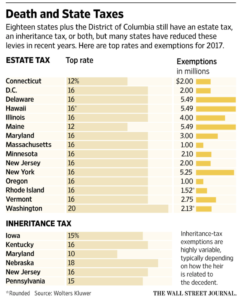
Laura Saunders indicated last week at The Wall Street Journal Online that, “Want proof taxes can actually go down? In the past three years, nine states have eliminated or lowered their estate taxes, mostly by raising exemptions.

“And more reductions are coming. Minnesota lawmakers recently raised the state’s estate-tax exemption to $2.1 million retroactive to January, and the exemption will rise to $2.4 million next year. Maryland will raise its $3 million exemption to $4 million next year. New Jersey’s exemption, which used to rank last at $675,000 a person, rose to $2 million a person this year.

“Next year, New Jersey is scheduled to eliminate its estate tax altogether, joining about a half-dozen others that have ended their estate taxes over the past decade.”

Graphic from The Wall Street Journal (“Why More States Are Killing Estate Taxes.”)

The Journal item noted that, “While most recent changes have been to state estate taxes, some states with inheritance taxes are feeling pressure as well. Six states have these levies, which are payable by the person who inherits assets rather than the estate of the person who died. States can have either one of the taxes, or both.”

Posted in Agriculture Law | Comments closed

USDA: $20 Million for Jobs for Young People, Veterans

A news release today from USDA indicated that, “USDA and partners committed $20 million in 21st Century Conservation Service Corps partnership agreements to provide 4,000 work opportunities for youth, young adults and veterans up to 35 years old, a move that will help the U.S. Forest Service accomplish mission-critical infrastructure and landscape restoration projects on the ground. The U.S. Forest Service is one of seventeen USDA Agencies.

“The funding represents investments by USDA of $13 million and $7 million from partner organizations. Contributions by the Forest Service and partners are expected to reach $40 million by the end of 2017 and provide 11,000 work opportunities. Some funds are already placed with 21st Century Conservation Service Corps partnership agreements; other funds will continue to be obligated throughout the summer.”

The update noted that, “The work accomplished by participants will include hundreds of miles of trail maintenance and improvements, watershed protection, removal of vegetation as part of wildfire prevention, improvements to recreation facilities, and other essential work on lands managed by the Forest Service.”

“Involving veterans in these opportunities helps them learn new skills while continuing to serve their nation and local communities. In FY2016, 910 veterans were engaged on Forest Service volunteerism and service projects, of which 170 participated in 21st Century Conservation Corps projects. In FY2017, the agency expects to hire 186 veterans,” today’s update said.

Posted in Agriculture Law | Comments closed

Technology Brings Shift in How U.S. Crops Move– Trading Giants Cut Out

Bloomberg writers Shruti Singh, Jeff Wilson, and Mario Parker reported yesterday that, “It wasn’t that long ago that U.S. farmers like Brian Marshall had few choices about where and when to sell their crops, which meant taking whatever price was offered at the local grain elevator during harvest season.

“Today, the Missouri grower stores his own corn and soybeans, sells them whenever he wants and arranges deliveries directly to processors or exporters. That could spell trouble for global agricultural companies including Archer-Daniels-Midland Co., Bunge Ltd., Cargill Inc.and Louis Dreyfus Co. that  generate billions of dollars providing those kinds of services to farmers.

“‘People are doing a lot more things in house,’ said Marshall, 40, a third-generation farmer who works with his father on more than 4,000 acres near Kansas City. ‘You cut out a middleman or two.'”

The Bloomberg article noted that, “American growers are taking advantage of technologies that weren’t around two decades ago to squeeze more profit from crops, especially after record harvests left global surpluses and plunging agricultural income. Up-to-the-second price and weather data accessible by smartphone make it easier to sell every bushel, while email and social networks give farmers more information to make decisions. They’ve also expanded storage capacity by 20 percent since 2003, government data show, reducing their reliance upon local elevators.

“At the same time, buyers like ethanol maker Green Plains Inc. are bypassing the big merchants to make direct purchases from farmers. With grain and oilseed crops valued at about $108 billion last year, the stakes are high for companies that have made their living for generations with vast networks of trucks, grain elevators and barges.”

Yesterday’s article added that, “Marshall stopped paying big grain handlers to store, dry and haul crops for his family farm over the last several years, but he’s also starting to ween his business off their marketing services. Last year, he asked a global grain trader to sell 15 percent of his soybean crop before it was planted. It went for around $8.50 a bushel in March 2016. After the harvest in October, Marshall stored some of his soybeans and recently sold them for $10.14.

“While there’s still market risk no matter who holds the crop, Marshall says during the past year he did just as well as or better than the professionals without having to pay them a commission.”

Posted in Agriculture Law | Comments closed

Kickstarter for Cows: “Crowd Cow” Startup Expands its Reach

Rachel Nania reported yesterday at WTOP Radio Online (Washington, D.C.) that, “Last week, the Seattle-based startup Crowd Cow expanded its reach to the D.C. area.

“The company sells cuts of sustainable meat from small farms across the U.S., one cow at a time, using a crowdfunding model. In fact, co-founder Joe Heitzeberg likens the business to ‘Kickstarter for cows.'”

The article explained that, “Here’s how it works: Consumers log on to the Crowd Cow website and find a featured cow. One day it may be a rare breed of grass-fed, grass-finished cattle from family farmers in upstate New York; the next it could be American-raised wagyu beef from a small farm in Washington.

“Interested parties select their desired cuts — everything from hanger steaks, to shanks, to round roasts and even soup bones are available for sale — and once most of the cow is claimed, the credit cards are charged and the meat ships.

“Then, a new cow gets featured, and a new selection of cuts are made available for sale.”

Ms. Nania indicated that, “The cost of the meat on Crowd Cow is similar to what one might expect to pay in a specialty foods store or butcher shop. Recent sales for premium ground beef from a grass-fed, grass-finished Murray Grey cow, for example, rang in around $16 for 2 pounds; a 6.5-pound share of brisket sold for $65.

“Heitzeberg says the Crowd Cow model not only helps the conscious consumer, but it also benefits small, sustainable farmers.”

Posted in Agriculture Law, Start-up Company Law | Comments closed