
Minnesota Introduces a First-Of-Its-Kind Law to Assist Young Farmers

Tom Meersman reported recently at the Minneapolis Star-Tribune Online that, “Matthew Fitzgerald was at the wheel of a tractor last week near Hutchinson, Minn., flames from a customized cultivator trailing him as the last step in his efforts to rid the grass and weeds from the rows of organic corn plants.

“The unusual cultivation is one of several techniques that are growing in favor as millennials and others push farms away from herbicides toward organic production. Fitzgerald, 25, describes it as a ‘giant grill for weeds,’ and he and other young farmers are changing the industry, from embracing new methods to sharing information through social networks.

“Their numbers are still small — only 4 percent of principal farm operators in the state are under the age of 35 and the average age is 56, according to federal census numbers. But Fitzgerald is part of a movement of young farmers to increase their ranks. The National Young Farmers Coalition considers a recent law passed in Minnesota to be a major win for its cause.”
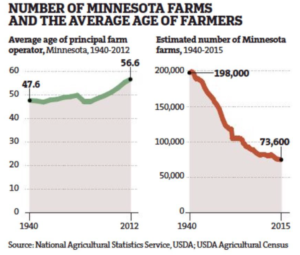
Graph from, “First-of-its-kind law aims to help young farmers find their footing in Minnesota,” by Tom Meersman (Minneapolis Star-Tribune, July 1, 2017).

The article explained that, “The law, a first of its kind in the U.S., aims to give beginning farmers a leg up — or at least a fighting chance — to get access to farmland by providing tax credits to the landowners who sell or rent land or farm equipment to them.

“‘The No. 1 barrier for beginning farmers is access to land,’ Fitzgerald said. ‘There’s lots of good workshops and resources and programs that can help people who are interested in farming, but ultimately when it comes down to it, you need to get on some soil to be a farmer.’

“Over the next 20 years, 573 million acres of farmland across the country will change management, according to the coalition.”

Mr. Meersman added that, “Details of how to implement the Minnesota law are still being worked out by state departments of agriculture and revenue, but an early estimate predicted that it could help 370 farmers annually — half renters, half buyers — once it takes effect in 2018.

“The law offers landowners a 5 percent state income tax credit if they sell land or machinery to new or beginning farmers, 10 percent if they rent land or equipment and 15 percent if they set up a crop share agreement. To be eligible for the program, the beginning farmer needs to have farmed for 10 years or fewer and must take an approved farm management course. Landowners could not qualify for tax credits if they sell or rent to their own family members.

“Iowa and Nebraska offer similar tax credit programs for land rental, but Minnesota will be the first state to also allow the credits on land sales.”

Posted in Agriculture Law | Comments closed

USDA Authorizes Additional CRP Flexibilities Due to Drought Conditions

A news release yesterday from USDA indicated that, “On June 23 Secretary of Agriculture Sonny Perdue authorized emergency grazing of Conservation Reserve Program (CRP) acres during the primary nesting season in North Dakota, South Dakota, and Montana in the counties meeting D2 or greater, as indicated by the US Drought Monitor. Since that time the drought has continued to deepen and the forecast is for hot, dry weather in the upcoming week in the northern plains. As such, the Secretary is authorizing emergency grazing of CRP for any county in which any part of its border lies within 150 miles of a county approved for emergency grazing of CRP.

“In addition, for any county in which any part of its border lies within 150 miles of any county approved for emergency grazing of CRP, USDA will allow CRP contract holders who hay their acreage according to their mid-management conservation plan to donate their hay to livestock producers. CRP contract holders still have the ability to sell their hay with a 25-percent reduction in their annual rental payment as they’ve been fully authorized to do in the past.

“Emergency haying is not authorized at this time. The Secretary will continue to monitor conditions and will consider expanding emergency authority if conditions worsen.”

Yesterday’s release added that, “A map displaying counties approved for CRP emergency grazing and the donation of hay under mid-contract management authority, will be available at:

https://www.fsa.usda.gov/programs-and-services/conservation-programs/conservation-reserve-program/emergency-haying-and-grazing/index

“To take advantage of the emergency grazing provisions, producers should contact their local USDA Service Center. To find your local USDA Service Center visit http://offices.usda.gov

Posted in Agriculture Law | Comments closed

USDA Authorizes Emergency Grazing in Drought Areas

A news release last week from USDA indicated that, “Secretary of Agriculture Sonny Perdue today authorized emergency grazing on Conservation Reserve Program (CRP) lands in Montana, North Dakota and South Dakota.  All or parts of these states are experiencing severe or extreme drought conditions – indicated as categories D2 and D3 on the U.S. Drought Monitor.

“‘Due to reduced availability of forage, ranchers in the hardest hit locations have already been culling their herds,’ said Perdue. ‘Without alternative forage options like grazing CRP lands, livestock producers are faced with the economically devastating potential of herd liquidation.’

“CRP is a voluntary program administered by USDA’s Farm Service Agency (FSA) available to agricultural producers to help them safeguard environmentally sensitive land and, when needed, provide emergency relief to livestock producers suffering the impacts of certain natural disasters.”

The release added that, “‘If the drought continues and pasture recovery becomes less likely, feed supplies will decline, the quality and quantity of hay is reduced and stock water becomes scarce – considerable stressors for both the livestock and our producers,’ said Perdue. ‘If opening up grazing lands reduces even some of these stressors for these ranchers, then it’s the right thing for us to do.'”

Posted in Agriculture Law | Comments closed

New Insurance Plan for Triticale Available

A news release last week from USDA’s Risk Management Agency indicated that, “The [USDA’s] Risk Management Agency (RMA) today announced a new insurance plan option for the crop triticale. Triticale is a cross between wheat and rye and can be covered through this new plan.

“The triticale plan derived from the Federal Crop Insurance Act’s 508(h) process, which allows private parties to develop insurance products that are: (1) in the best interests of producers, (2) follow sound insurance principles and (3) are actuarially appropriate.

“‘This plan for triticale demonstrates the kind of expertise, involvement, and commitment those in the private sector have for understanding what types of risk management insurance products farmers need. By raising this need up to the Federal Crop Insurance Corporation, together we are making a stronger farm safety net,’ said RMA Acting Administrator Heather Manzano.”

The news update added that, “Insurance for triticale is now available in select counties in California, Idaho, Kansas, Oklahoma, Oregon, Texas, and Washington and will be effective for the 2018 crop year. The plan provides coverage for damage resulting from naturally occurring events. It is similar to other individual yield-based insurance plans and uses a producer’s Actual Production History to establish the insurance guarantee.”

Posted in Agriculture Law | Comments closed

“Pink Slime” Lawsuit Settled

Reuters writer Timothy Mclaughlin reported today that, “Beef Products Inc has settled a closely watched defamation lawsuit against American Broadcasting Co and its reporter Jim Avila, the meat processor said on Wednesday.

“BPI had claimed ABC, a unit of Walt Disney Co and Avila defamed the company by calling its ground-beef product ‘pink slime‘ and making errors and omissions in a 2012 report.

“The terms of the settlement were not disclosed.”

The article explained that, “The trial began earlier this month in the tiny town of Elk Point, South Dakota, and had been expected to last eight weeks.

“BPI had claimed up to $1.9 billion in damages, which could have been tripled to $5.7 billion under South Dakota’s Agricultural Food Products Disparagement Act.

“During its reports, ABC used the term ‘pink slime‘ more than 350 times across six different media platforms including TV and online, Dan Webb, an attorney for BPI, said during opening statements on June 5.”

Today’s article also noted that, “In the aftermath of ABC’s broadcasts, BPI closed three of its four processing plants and said its revenue dropped 80 percent to $130 million.”

Posted in Agriculture Law | Comments closed

Viptera Corn Lawsuit- Farmers Awarded $217.7M in Compensatory Damages

DTN writer Todd Neeley reported on Friday that, “A Kansas jury has awarded farmers $217.7 million in compensatory damages in the first of several class-action lawsuits filed against Syngenta over the shipment of Viptera corn to China.

“The jury in the U.S. District Court for the District of Kansas in Kansas City took less than a day to render a verdict.

“A spokesperson for Syngenta told DTN that punitive damages were not awarded in the case. Instead, damages were awarded on actual losses as determined by the jury.”

The DTN article pointed out that, “Donald L. Swanson, an attorney with Koley Jessen in Omaha who follows the Syngenta cases, told DTN the Kansas case is the first of what may be a ‘half-dozen’ cases.

“‘The idea is to try a number of cases like this and get a jury verdict in each,’ Swanson said. ‘The jury verdicts will then inform the parties on how the overall case should settle. That’s what happened, for example, in the prior rice cases. A positive jury verdict in the first Bellwether trial is, obviously, a very good thing for the plaintiffs. Syngenta will appeal this ruling.’

“Swanson said the appeal process could take a couple of years to complete.”

Posted in Agriculture Law | Comments closed

Dicamba Damage- Complaints Snowballing

Some thought this year would be different.

“Last year, when illegal usage of the drift-prone herbicide dicamba was blamed for widespread crop damage across southeastern Missouri and other states — and is even suspected of triggering deadly feuds between farmers — many expressed hope that the problem would diminish in future growing seasons, with proper forms of the herbicide gaining approval for use on crops engineered to tolerate the spray.

“But that may have been wishful thinking, if the recent explosion of 242 cases of alleged dicamba misuse in Arkansas is any indication. Amid the snowballing number of complaints in the state, the Arkansas State Plant Board proposed an emergency ban of the chemical for in-crop use Friday.”

Mr. Gray noted that, “Leading the way with 81 complaints is Mississippi County, Ark., which borders Missouri’s Bootheel, where most of the region’s cases were concentrated last year. Those in the Bootheel, meanwhile, are waiting to see if a similar crisis unfolds once again. The area’s growing season lags a bit behind that in Arkansas, and it wasn’t until late last June that local dicamba complaints began to surface.

“But Kevin Bradley, a University of Missouri plant sciences professor who investigated much of last year’s damage, says he’s been fielding complaints of crop injury over the past couple of weeks, while the Missouri Department of Agriculture has received 60 reports of misuse so far, statewide. Last year, more than 120 cases of suspected drift were reported to Missouri officials.

“Bradley says continued damage from the herbicide this year would be a predictable consequence of so many farmers converting to dicamba-tolerant soybeans and cotton — many of whom did so to avoid the damage suffered last year.”

The Post-Dispatch article indicated that, “The volatile chemical is sensitive to vaporizing and drifting into nearby fields where nonresistant crop varieties are vulnerable to injury. Last year, much of the damage was believed to have been caused by renegade farmers who illegally sprayed older, highly volatile versions of the chemical on Monsanto’s dicamba-tolerant soybean and cotton, which the company released prior to regulatory approval of the corresponding herbicide.

“Though growers were warned not to apply ‘off-label’ or unauthorized forms of dicamba, many appeared to do so to combat weeds that have developed resistance to other herbicides like glyphosate, the active ingredient in Roundup.

“This year, newly approved dicamba products from Monsanto and BASF aimed to offer farmers less-volatile alternatives to use with resistant seed varieties. But even those could be triggering at least some of the complaints.”

Posted in Agriculture Law | Comments closed

Dicamba Ban in Arkansas

DTN writer Pam Smith reported on Friday that, “The Arkansas State Plant Board (ASPB) has voted to pass a proposed emergency rule to ban the use of in-crop dicamba, with an exemption for pastureland. The board also ruled to expedite the rule increasing civil penalties for dicamba misuse.

“Earlier this year, the board had agreed to increase misuse fines up to $25,000, but those were not originally supposed to kick in until August.

“These are just the first steps in the process of establishing an emergency rule, noted Adriane Barnes, Arkansas Agriculture Department director of communications. The next step includes a review of the proposed rule by the governor before being submitted to the Executive Subcommittee of the Arkansas Legislative Council for approval.”

The DTN article explained that, “The pending ban and legislation applies only to the state of Arkansas and would be a 120-day halt to spraying. Still, the dicamba drama is being followed closely by farmers, spray applicators and seed salesmen throughout the soybean and cotton belts. Farmers have clamored for new technologies to help fight tough-to-control weeds that have increasingly become resistant to herbicides.

“Dicamba drift complaints in 2015 and 2016 were often blamed on the fact farmers were able to plant dicamba-tolerant varieties, but had no low-volatility herbicide component available.”

Ms. Smith added that, “Dicamba drift issues are also being recorded in Mississippi, Tennessee and Missouri. University of Illinois weed specialist Aaron Hager said he’s has seen the puckering and cupping of leaves characteristic to dicamba injury showing up in Illinois this week. ‘Our spray season is about two weeks behind most of the Southern states,’ he said.

“How much injury the symptoms represent is difficult to tell since yield loss is typically connected to the dose the plant receives and the growth stage it is. Soybeans nearing the reproductive stages are typically most vulnerable.”

Posted in Agriculture Law | Comments closed

Media Startups Look to Unpaid Student Writers

Austen Hufford reported this week at The Wall Street Journal Online that, “As head editor for the local chapter of an online food-culture publication, Brogan Dearinger spent most mornings last fall coming up with story ideas, editing submissions and checking the performance of articles.

“But there was no money in it—at least not for her.

“Ms. Dearinger, then a senior at Indiana University Bloomington, was among about 8,000 unpaid college students working for local chapters of Spoon University Inc., a for-profit media company.”

The Journal item explained that, “Spoon is among a group of for-profit media startups—including Her Campus Media LLC, focused on college women, and millennial-centric Odyssey Media Group Inc.—that have popped up across college markets in recent years.”

Mr. Hufford noted that, “Originally founded by undergraduates, these sites rely on students to produce localized content for free, in exchange for training and experience. Groups provide a community environment for students, with weekly meetings and social events similar to campus clubs, but members have article quotas—typically one a week—and work to increase the page views and engagement that help their for-profit parent companies succeed.

“The companies, which don’t disclose financial information, have attracted millions of dollars in funding for their ability to cheaply generate large amounts of content and traffic. Spoon, until recently backed by venture capital, was purchased in May for an undisclosed amount by Scripps Networks Interactive Inc., the owner of HGTV and part owner of Cooking Channel and Food Network.

“As more traditional media companies move to ramp up digital revenue and cover costs as print advertising declines, these student-based sites have a lower-cost model to produce articles and make revenue from advertising and sponsored posts. The startups run franchise-like microsites, with local chapters led, written and edited by students and overseen by a small group of paid employees. Spoon has 200 chapters, Her Campus has 340 and Odyssey has 1,200.”

The Journal item added that, “Ms. Dearinger, who juggled her work at Spoon with a restaurant job and journalism classes, says the unpaid experience was more relevant than the student newspaper for becoming a professional food writer.”

Posted in Start-up Company Law | Comments closed

Some Malt Barley Farmers in New York Eligible for Federal Crop Insurance

The Associated Press reported today that, “Malt barley farmers in 44 upstate New York counties are now eligible for crop insurance from the federal government.

“Malt barley is a necessary ingredient in beer and spirits, and the lack of crop insurance had hindered expansion of the craft brewing industry in New York.”

The AP article explained that, “The state now has approximately 2,000 acres of malt barley. Because of New York’s Farm Brewing Law, it is estimated malt barley production will have to grow fifteen-fold in the next decade to meet the needs of New York brewers and distillers.”

Posted in Agriculture Law | Comments closed