
Venture Capital Investment in Agricultural Production up 24 Percent in 2017

A recent editorial in the Omaha World-Herald stated that, “American agriculture is no stranger to technological change. Just compare the Midlands’ planting and cultivation methods in various eras from pioneer times through the 20th century to now. The advancements and refinements have been remarkable.

“In the 21st century, thanks to advanced technology and producers’ embrace of it, the pace of change is picking up even more. During 2017, venture capital investment in agricultural production totaled $4.2 billion, up 24 percent from the year before. Areas receiving particular investor attention included software management, big data analytics and automated equipment.

“John Deere, the well-known manufacturer of green-and-yellow farm equipment, spent $305 million last year to buy Blue River Technology, a tech firm that, by its own description, uses ‘computer vision, robotics and machine learning to help smart machines detect, identify and make management decisions about every single plant in the field.’ Precision spraying of herbicides is a particular focus for the company.”

The editorial pointed out that, “Nebraska is home to several homegrown firms exploring new opportunities in high-tech agriculture. Here are three examples:

» iNet Solutions Group is an Omaha-based developer of agriculture-related desktop and website applications and mobile app development. Its clients include some of the country’s largest agricultural cooperatives and trading firms.

» GrainBridge Corp., also in Omaha, provides agricultural risk management software used widely throughout the ag sector.

» Quantified Ag, in Lincoln, has created a biometric ear tag that helps feedlot operators keep closer watch over animals.”

The World-Herald item added, “Change is ongoing for modern agriculture. As always, successful producers will need to stay up to date and, as needed, innovative to meet the challenges.”

Posted in Agriculture Law | Comments closed

Organic Consumers Association Files Suit Against Ben & Jerry’s

A PRNewswire update from last week stated that, “The Organic Consumers Association (OCA) today filed suit against Vermont-based Ben & Jerry’s Homemade, Inc., for deceptive labeling, marketing and sale of Unilever’s Ben & Jerry’s Ice Cream products. The suit was filed in D.C. Superior Court under the D.C. Consumer Protection Procedures Act.

“‘Unilever reportedly spent more than $9 billion on advertising in 2017 alone,’ said OCA International Director, Ronnie Cummins. ‘A significant portion of that was spent to create the false perception that Ben & Jerry’s is committed to a clean environment and high animal welfare standards. Unilever knows those values foster brand loyalty and also allow the company to charge a premium.

“‘Ben & Jerry’s decades-old practice of sourcing dairy ingredients from conventional dairy operations has led to a water pollution crisis in Vermont. There is nothing socially or environmentally responsible about that.'”

Last week’s update noted that, “Regeneration Vermont, OCA’s campaign partner in the Ben & Jerry’s media campaign, has issued reports on the health, environmental, labor and animal welfare threats from industrial dairies that supply Ben & Jerry’s.”

Posted in Agriculture Law | Comments closed

Techstars Farm to Fork Accelerator Program Begins For Nine Startups

Kristen Leigh Painter reported yesterday at the Minneapolis Star Tribune Online that, “Work begins immediately for nine startup companies selected for the Farm to Fork Accelerator Program in St. Paul, Techstars announced Monday.

“The participating startups, which come to Minnesota from Brazil, India and Canada and various U.S. states, will spend the next three months in Techstar’s incubator.

“Techstars, a Boulder, Colo.-based business development organization, designed its Farm to Fork program specifically for food and agriculture entrepreneurs. This is the first of three participant cohorts in the three-year program created in partnership with St. Paul-based Ecolab and Minnetonka-based Cargill.”

Ms. Painter noted that, “The participating companies cut a wide swath in this space — from Austin, Texas-based Big Wheelbarrow, which seeks to leverage artificial intelligence to connect buyers with local food growers, to Canada-based EIO Diagnostics, which uses imaging technology for early detection of illness in dairy cows.

“While in Minnesota, the creators of these small companies will have access to more than a hundred mentors, including executives from Cargill and Ecolab.

“‘We really looked for teams that could move quickly and execute quickly, because the company might end up doing something totally different in four months from what they are doing today,’ said Brett Brohl, managing director for the Farm to Fork Accelerator.”

The Star Tribune article added that, “Techstars aims to jump-start good ideas, while the sponsoring corporations hope to identify and invest in emerging technologies that could help their interests. Farm to Fork is one of 15 new Techstars accelerators, part of 41 Techstars accelerator programs globally. One in Minneapolis is focused on retail in partnerships with Target Corp.”

Posted in Agriculture Law, Start-up Company Law | Comments closed

Startup That Produces Beef From Cattle Cells Receives $8.8 Million in Funding

Jacob Bunge reported today at The Wall Street Journal Online that, “German drugmaker Merck KGaA and a top European meat processor are backing a startup producing beef from cattle cells, ramping up a race to transform the global meat industry with cell-culture technology.

“The $8.8 million investment in Netherlands-based Mosa Meat by Merck’s venture investing unit and Basel, Switzerland-based Bell Food Group fuels a continuing effort to fulfill growing global demand for meat via a process that developers say requires a fraction of the resources used in traditional livestock and poultry production.

“Cell-culture meat makers have yet to begin selling any of their products. But the emerging technology has drawn investments from major U.S. meat processors like Cargill Inc. and  Tyson Foods Inc. It also is raising complaints among cattle ranchers and hog farmers, some of whom regard it as a lab-developed imitation of traditional hamburgers and pork.”

The article noted that, “Mosa is led by Mark Post, a Maastricht University physiologist who unveiled the world’s first lab-grown burger in 2013, and Peter Verstrate, a food technician at the university. Mr. Post’s prototype burger cost $330,000 to develop, but the project encouraged Mr. Post to form Mosa, which previously received funding from Google Inc. co-founder Sergey Brin.

“‘We’ve done a lot of work in scaling up the cell culture… to something that can be used on an industrial scale,’ said Mr. Post.”

Mr. Bunge added that, “Some promoters of the technology see it replacing significant portions of the existing meat industry over time. Meat companies have billed it as an additional way to provide beef, pork or chicken to an expanding and more affluent world population that is expected to strain the existing agricultural system.”

Posted in Agriculture Law, Start-up Company Law | Comments closed

Iowa Farmers Helping Monarch Butterflies Survive

Des Moines Register writer Donnelle Eller reported yesterday that, “Growing up in eastern Iowa, Rob Stout spent his summers pulling milkweed from his family’s soybean fields.

“Now he’s planting it, along with coneflowers, black-eyed Susans and other plants and flowers that support monarch butterflies, an insect that environmentalists say is nearing extinction.

“‘My father probably would be spinning in his grave,’ Stout said, knowing his son mows around milkweed, avoids spraying the plants and lets them go to seed.”

Ms. Eller noted that, “Stout and others hope the state’s plan to create up to 830,000 acres of habitat for the monarchs’ 3,000-mile migration swings through the state will be enough to rebuild the pollinators’ numbers.”

The Register article explained that, “Environmental groups have petitioned the federal government to place the iconic black and orange butterfly on the federal endangered species list.

“That could mean added regulations and restrictions for farmers, developers, landowners and others.”

Yesterday’s article added, “The state’s two-decade-long effort is part of a 16-state regional plan to develop up to 7 million acres of habitat for the monarch’s migration east of the Rockies.

“Iowa hopes to plant 188 million new stems of milkweed, part of the 1.6 billion stems needed in the Midwest.”

Posted in Agriculture Law | Comments closed

Home Ownership: Wall Street Investors Betting That Well-to-Do Families Increasingly Willing to Rent

Wall Street Journal writers Ryan Dezember and Laura Kusisto reported this week that, “Wall Street is betting that more well-off Americans will want to be renters.

“Financiers who loaded up on homes after the housing bust for pennies on the dollar are buying yet more—despite home prices in many markets being at all-time highs.

“Their wager: High prices, higher mortgage rates and skimpy inventory are making homeownership harder. Well-to-do families who might have bought a single-family home in another era are willing to rent a house now, especially if it means access to a good school system.”

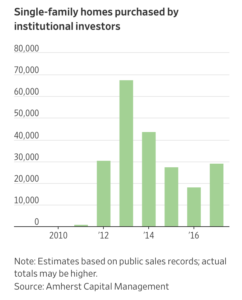
The Journal article noted that, “The number of homes purchased by major investors in 2017 was at least 29,000, up 60% from the previous year, estimates Amherst Capital Management LLC, a real-estate investment firm with an affiliated business that made nearly 5,000 of those purchases.”

“House Money: Wall Street Is Raising More Cash Than Ever for Its Rental-Home Gambit,” by Ryan Dezember and Laura Kusisto. The Wall Street Journal (July 9, 2018).

Dezember and Kusisto explained that, “This year, investors have raised billions of dollars from bond buyers, pension funds and even wealthy Chinese individuals to purchase more homes. They have been particularly aggressive buyers in places like Atlanta, Phoenix, and other metro areas with good schools and faster-growing economies.”

This week’s article added, “Cash to acquire and renovate homes has become so abundant lately that some rental investors can’t spend it fast enough. Without enough homes to buy, some investors are now building their own in popular residential markets like Miami and Nashville, Tenn.—upending a traditional pattern of Americans buying starter homes and moving up.”

Posted in Real Estate Law | Comments closed

Ruling is Significant Win for Advancing Roundup Lawsuits

Bloomberg writer Joel Rosenblatt reported yesterday that, “Monsanto Co. lost a court ruling that permits key witnesses to testify in a lawsuit claiming the company’s Roundup weed killer caused cancer for farmers and other users.

“It’s a significant victory for the cancer victims, who need expert testimony to advance more than 300 suits in San Francisco federal court seeking to hold Monsanto liable for failing to warn consumers about the risk of using the weed killer. A jury trial hasn’t been scheduled, but the decision puts pressure on Monsanto to settle the cases.

“‘Moving forward, we will continue to defend these lawsuits with robust evidence that proves there is absolutely no connection between glyphosate and cancer,’ Monsanto Vice President Scott Partridge said in an e-mailed statement. ‘We have sympathy for anyone suffering from cancer, but the science clearly shows that glyphosate was not the cause.'”

Mr Rosenblatt noted that, “U.S. District Judge Vince Chhabria is evaluating the toxicity of the world’s most popular herbicide, the subject of a heated debate among scientists and regulators worldwide for more than 30 years. Witnesses cut from the lineup may have profoundly shaped the outcome of the lawsuits collected before the judge.

“Despite misgivings about testimony he called ‘shaky,’ Chhabria will let at least three key witnesses testify. The judge concluded a reasonable jury could find that glyphosate, the main ingredient in Roundup, can cause non-Hodgkin’s lymphoma at exposure levels people realistically may have experienced.

“‘So long as an opinion is premised on reliable scientific principles, it should not be excluded by the trial judge; instead the weaknesses in an unpersuasive expert opinion can be exposed at trial, through cross-examination or testimony by opposing experts,’ Chhabria wrote in his opinion.”

Posted in Agriculture Law | Comments closed

Roundup Weed Killer Trial Underway, Cancer Claim

The Associated Press reported yesterday that, “Lawyers for a school groundskeeper dying of cancer asked a San Francisco jury on Monday to find that agribusiness giant Monsanto’s widely used weed killer Roundup likely caused his disease.

“Dewayne Johnson’s lawsuit is the first case to go to trial among hundreds of lawsuits saying Roundup caused non-Hodgkin’s lymphoma.

“Johnson sprayed Roundup and a similar product, Ranger Pro, at his job as a pest control manager at a San Francisco Bay Area school district, according to his attorneys.”

The AP article stated that, “He sprayed large quantities from a 50-gallon tank attached to a truck, his attorney, Brent Wisner, told jurors during his opening statement. When the wind was gusty, it would cover his face, Wisner said. When a hose broke once, it soaked his entire body.”

However, yesterday’s article pointed out that, “George Lombardi, an attorney for Monsanto, said non-Hodgkin’s lymphoma takes years to develop, so Johnson’s cancer started well before he began working at the school district.

“Many government regulators have rejected a link between the active ingredient in Roundup — glyphosate — and cancer. Monsanto has vehemently denied such a connection, saying hundreds of studies have established that glyphosate is safe.”

The AP article added that, “The outcome of Johnson’s case will not affect the hundreds of other lawsuits in state and federal courts, but it may serve as an indicator of how the others might go.”

Posted in Agriculture Law | Comments closed

Senate Farm Bill Includes Measure to Curtail Organic Fraud

Hope Kirwan reported earlier this month at Wisconsin Public Radio Online that, “Organic industry leaders in Wisconsin are applauding a recently approved version of the Farm Bill for cracking down on fraud.

“The U.S. Senate passed their version of the legislation on Thursday, June 28.

“Based on legislation introduced by Wisconsin Senator Tammy Baldwin, the bill would require the U.S. Department of Agriculture to update tracking of imported organic agricultural products. Those shipments would be required to have an electronic import certificate, which would be consolidated into an annual report on the total number of organic imports accepted into the U.S.”

The update explained that, “Over the last year, reports of fraud and an internal audit have highlighted the USDA’s failure to enforce organic standards on imports.

“John Mesko, executive director of the Midwest Organic and Sustainable Education Service, said the department’s current practices were developed when organic was a small, U.S.-based movement.

“‘Now we have a much more global organic industry,’ Mesko said. ‘We have lots of people around the world trying to participate in that industry and reap some of the benefits of it. And frankly, we’re behind on our ability to keep up with the technology.'”

Posted in Agriculture Law | Comments closed

Indoor Farming Startup Lands Amazon Veteran

Bloomberg writer Olivia Zaleski reported last week that, “Bowery Farming Inc., an agriculture startup that’s less than two years old, got a big boost last month when it poached Brian Donato, a veteran of Amazon’s automation efforts.

“Donato will oversee Bowery’s indoor farm in Kearny, New Jersey, a forgotten industrial enclave once famous for building warships. There, Bowery grows leafy greens in a computerized labyrinth of sensor-rich trays that monitor and react to humidity, light and carbon dioxide. Human farmers work alongside the crates, which automatically adjust inputs, like light and temperature. The system, which resembles a giant game of three-dimensional Tetris, is designed to grow lettuce and herbs with limited water and no pesticides.

“During his seven years at Amazon, Donato managed Amazon fulfillment centers, the massive distribution hubs where humans and robots pick, pack and assemble hundreds of thousands of orders, each day, for delivery. He most recently ran Amazon Home Services, which provides cleaners, carpenters and more to harried homeowners. Before that he directed operations for the Amazon Fresh and Pantry food delivery services. Bowery’s heavily automated process reminds Donato of the fulfillment systems he implemented at Amazon, where he was part of the team that integrated robots into the human workforce. ‘We had to teach people to care for the automation and to work with it,’ he says.”

The Bloomberg article added that, “Bowery’s indoor farm is controlled by proprietary software called BoweryOS. It uses a web of cameras and sensors to automatically tinker with inputs, like air flow, that help plants flourish. Bowery says one square foot of its indoor farm is 100 times more productive, and less wasteful, than an equivalent plot of arable land. Rival indoor farms make similar claims.

“Besides running the existing farm, Donato will help Bowery Farming set up automated facilities on the outskirts of cities. This summer, he’ll launch Bowery’s second grow house; it’s not far from the current operation in Kearny and 30 times the size of the original farm. A representative for Bowery declined to provide the square footage and yield of its current operation.”

Posted in Agriculture Law, Start-up Company Law | Comments closed