USDA Opens Election Period for Seed Cotton Program

An update on Monday from USDA’s Farm Service Agency (FSA) stated that, “[USDA] today announced that seed cotton producers, who want to participate in the Agriculture Risk Coverage (ARC) and Price Loss Coverage (PLC) programs for the 2018 crop year, may now submit applications. The signup period begins today and ends on Dec. 7, 2018.

“In accordance with changes to ARC and PLC made by the Bipartisan Budget Act of 2018, farm owners with generic base acres and recent planting history of covered commodities have a one-time opportunity to allocate all of the generic base acres on their farm.

“‘ARC and PLC are a vital part of the safety net that ensures American agriculture remains competitive and producers are able to manage risk,’ said USDA Farm Service Agency Administrator Richard Fordyce. ‘USDA encourages any cotton producer to look into these important safety net programs.'”

The FSA release noted that, “Farms with generic base acres that were planted or approved as a prevented planted commodity during the 2009 through 2016 crop years, are eligible to allocate generic base acres. This includes upland cotton.”

“Visit www.fsa.usda.gov or the local FSA office for information about FSA and the 2014 Farm Bill programs and programs impacted by the Bipartisan Budget Act of 2018.”

Posted in Agriculture Law | Comments closed

Homeownership Rate Climbs, But Remains Historically Low

Wall Street Journal writer Josh Mitchell reported late last week that, “The U.S. homeownership rate continues to climb, with more Americans benefiting from the sharp rise in home values in recent years.

“The downside: Homeownership remains historically low. It has risen tepidly this year despite strong economic growth.

“The share of homes in which at least one occupant is the owner rose to 64.3% in the second quarter, up a tenth of a percentage point from the first quarter, the Commerce Department said Thursday in a report. The rate has climbed 0.6 percentage point over the past year.”

“Homeownership Keeps Climbing,” by Josh Mitchell. The Wall Street Journal (July 26, 2018).

The Journal article indicated that, “But the rate remains far below the peak of 69.2% in late 2004, and a full percentage point below the 50-year average.

“There are also new clouds hovering over the housing market, meaning that further gains in homeownership may be tough to achieve. Sales of previously owned homes fell 2.2% in June, National Association of Realtors data show.

“And sales of newly built homes, while up over the past year, fell in June from the prior month, Commerce Department data show.”

Mr. Mitchell added that, “The average rate on a 30-year mortgage has risen more than half a percentage point since early January to 4.54%, according to Freddie Mac. Existing-home prices climbed 5.2% over the past year to an all-time record in June, NAR figures show.”

Posted in Real Estate Law | Comments closed

USDA Update: “EU Court Extends GMO Directive to New Plant Breeding Techniques”

A report on Friday from USDA’s Foreign Agricultural Service (“EU Court Extends GMO Directive to New Plant Breeding Techniques,” by Jennifer Lappin) stated that, “On July 25, 2018, the Court of Justice of the European Union issued its judgment that organisms created through many newer genome editing techniques are to be regulated as genetically modified organisms (GMOs) in the EU. This decision subjects such organisms, and food and feed products containing these organisms, to expensive and lengthy approval processes as well as traceability, labelling, and monitoring obligations. In addition to affecting global agricultural trade, this judgment has significant consequences for EU innovation.”

The USDA update noted that, “Surprising many, the Court issued a judgment for ‘Case C-528/16 Confederation Paysanne and Others‘ taking a very restrictive view of how the EU’s main GMO legislation from 2001, ‘Directive 2001/18/EC,’ applies to organisms created by new plant breeding techniques such as CRISPR/Cas or Talen. Many scientists, breeders, and agri-food industry stakeholders had anticipated that the Court would categorize organisms derived from these newer mutagenic techniques as GMOs, but exempt them from the regulatory obligations in the Directive.

“Instead, the Court found that organisms produced with newer mutagenesis methods are subject to the regulatory obligations of the EU’s GMO Directive. As such, they will be subject to risk assessment and review requirements as they are applied to the cultivation and imports of transgenic varieties (incorporating foreign genes into the organism). For context, products approved for importation in 2017 under the GMO Directive took an average of six years to complete—five years for the risk assessment by the European Food Safety Authority and a year to garner Commission approval through the risk management process. Cultivation approvals, as well as new applications, for transgenic varietals have languished.”

Friday’s report stated that, “Under the EU’s GMO Directive 2001/18/EC, the EU focuses on the process of genetic alternation to determine what agricultural products are regulated. However, the EU’s GMO Directive exempts certain genetic modification techniques— notably for this case, ‘the mutagenesis exemption.’ In plant breeding, mutagenesis is a long-established technique that uses chemical, radiation, or other physical stimuli to induce mutations. Plant breeders then evaluate whether the genetic alternations have yielded beneficial properties. If so, these plants are selected for use in breeding programs. With the Directive’se xemption, plants developed through these common breeding techniques can enter the EU marketplace without additional GMO-related regulation. The EU’s GMO Directive does not have a legislative definition for mutagenesis. Although most new genome editing methods use mutagenesis in a more targeted manner than older techniques, the Court found that newer techniques are not covered by the ‘mutagenesis exemption.'”

The USDA update added, “The Commission has yet to react to the judgment. Follow on actions will likely have to wait until after the elections, as the European Commission and Parliament’s terms are coming to a close. The Commission’s election recess starts in October 2018, and the European Parliament’s recess usually starts by March with elections following in May of 2019.”

More information on the ruling is available here.

And Secretary of Agriculture Sonny Perdue responded to the ruling on Friday, noting in part that, “Government policies should encourage scientific innovation without creating unnecessary barriers or unjustifiably stigmatizing new technologies. Unfortunately, this week’s ECJ ruling is a setback in this regard in that it narrowly considers newer genome editing methods to be within the scope of the European Union’s regressive and outdated regulations governing genetically modified organisms.”

Posted in Agriculture Law | Comments closed

Chinese Venture Capital Funding into American Technologies Continues at Record Pace

Wall Street Journal writers Kate O’Keeffe and Eliot Brown reported earlier this month that, “Tighter national security reviews have curbed Chinese deal-making in the U.S., but a new study shows China is pouring money into cutting-edge American technologies at a record pace this year through loosely regulated venture capital investments.

“Chinese foreign-direct investment into the U.S., made through deals such as acquisitions, fell into negative territory during the first five months of the year, according to data that takes asset sales into account from the Rhodium Group, a New York consulting firm.

“Yet the figures belie China’s sustained interest in U.S. technology, which it is continuing to target through relatively unrestricted investments in startups in Silicon Valley and elsewhere, Rhodium said in a new report reviewed by The Wall Street Journal.”
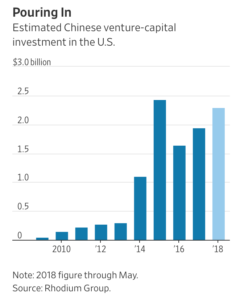
“China Targets U.S. Tech Startups in Investment Loophole,” by Kate O’Keeffe and Eliot Brown. The Wall Street Journal (July 16, 2018).

The Journal writers noted that, “The report’s findings could give fresh momentum to national security hawks who have singled out Chinese investment as posing disproportionate risks to the U.S. because the entities may be directed and subsidized by the government of China, an economic and military rival.

“Over the period from January to May 2018, Chinese venture capital investment in the U.S. had already reached nearly $2.4 billion, which was its previous full-year record set in 2015, according to Rhodium’s analysis.

“From 2000 through May 2018, Rhodium found more than 1,300 funding rounds of U.S. startups with at least one Chinese-controlled investor, representing an estimated $11 billion in Chinese investment. Around three-quarters of those transactions have occurred since 2014, the report by Thilo Hanemann, Adam Lysenko and Daniel Rosen, says.”

The Journal article explained that, “Venture capital is defined by investments targeting startups with big potential that require large amounts of money in early days. It typically involves groups of investors that each take small stakes and gradually put in more money as the company grows.

“Chinese investors targeting startups have historically focused their investments in the information and communications technology sectors as well as the health, pharmaceuticals and biotechnology sectors, Rhodium found. They are also targeting technologies such as 3-D printing, robotics and artificial intelligence, and recently have plowed money into companies such as Grail, a Silicon Valley cancer detection startup, the report said.

“The new data on venture investing, which is notoriously hard to track given complex legal structures and limited disclosure requirements, comes amid an array of potential actions by the U.S. government to further regulate foreign tech investing.”

Posted in Start-up Company Law | Comments closed

New Home Sales Fall in June, But Above Last Year

A news release from the Census Bureau on Wednesday stated that, “Sales of new single-family houses in June 2018 were at a seasonally adjusted annual rate of 631,000, according to estimates released jointly today by the U.S. Census Bureau and the Department of Housing and Urban Development. This is 5.3 percent below the revised May rate of 666,000, but is 2.4 percent above the June 2017 estimate of 616,000.”

Monthly New Residential Sales, June 2018. Release Number: CB18-111 (July 25, 2018).

The release added that, “The median sales price of new houses sold in June 2018 was $302,100. The average sales price was $363,300.”

Posted in Real Estate Law | Comments closed

Texas Congressman: State Tax Policy Driving Startups to the Lone Star State

Jade Scipioni reported recently at Fox Business Online that, “Entrepreneurs are ditching Silicon Valley and heading south to Texas instead to launch their startups, according to a congressman from the Lone Star State.

“Rep. Roger Williams, R-Texas, told FOX Business’ Maria Bartiromo [July 19th] that the Texas is seeing an influx of new companies recently.

“Among the reasons for the influx is an absence of personal income and corporate income taxes.”

The Fox Business update noted that, “‘We’re seeing a lot of job growth and a lot of startup companies and it’s being fueled in many cases by energy but also by the opportunity of no personal income tax. [It’s] a very business friendly state and it wants businesses to come and start up,’ Williams said.

“Texas has long been known as a popular business-friendly state. Austin, in particular, has been known as a mecca for startups because of the city’s ability to attract a lot of foreign students to colleges like the University of Texas at Austin. According to the 2016 Kauffman Growth Entrepreneurship Index, Austin grew its startups faster than every city except Washington, D.C., by more than 80% growth.”

Posted in Start-up Company Law | Comments closed

Home Sales Slumped in the Second Quarter

Laura Kusisto and Sharon Nunn reported on the front page of today’s Wall Street Journal that, “Home sales slumped in the second quarter despite what was likely the strongest period for U.S. growth in years, the latest sign that the economic expansion faces headwinds.

“Existing-home sales slipped 0.6% in June from the previous month to a seasonally adjusted annual rate of 5.38 million, the National Association of Realtors said Monday. Compared with a year earlier, sales in June declined 2.2%.

“Home sales have now declined on an annual basis in five of the first six months this year, a worrying trend since housing is considered a crucial indicator of overall economic health, economists say.”

The Journal article stated that, “By a number of measures, the economy looks to be accelerating after a long stretch of subpar growth. Economists are forecasting U.S. growth to exceed 4% for the second quarter when numbers are released on Friday. Jobless claims are falling, and corporate profit growth continues to looks strong.

“But weakness in the housing market could muddy the picture. Housing contributes about 15% to 18% of gross domestic product. Existing-home sales help drive other sectors of the economy. Consumer confidence and home-improvement spending, construction and mortgage lending tend to suffer when home sales slump.”

Today’s article added that, “Mortgage-application volume decreased 2.5% in the week ending July 13, compared with a week earlier, including a 5% decline in purchase applications, according to an index put out by the Mortgage Bankers Association last week.

“New home construction, which is the major driver of housing-related employment, has also struggled lately. Housing starts declined 12.3% in June from the prior month, according to the Commerce Department. That was the largest monthly percentage drop in about a year and a half, driven by construction declines in all regions of the U.S. for almost all types of housing.

“Realtors say some buyers have grown weary of the run-up in prices, especially after mortgage rates increased. Brook Hogan, a real-estate agent in Portland, Ore., said she has seen signs that consumers are growing more cautious, especially at the higher end of the market. ‘It’s definitely slowing. Buyer confidence is a big deal,’ she said.”

Posted in Real Estate Law | Comments closed

European Court of Justice to Rule on Gene-Edited Crops

Reuters writer Ben Hirschler reported on Friday that, “Gene editing in agriculture takes center stage next Wednesday when Europe’s highest court rules in a case that could determine the fate of the technology that is already making waves in the field of medicine.

“The European Union has long restricted the use of genetically modified organisms (GMOs) widely adopted around the world, but there is legal uncertainty as to whether modern gene editing of crops should fall under the same strict GMO rules.

“The European Court of Justice (ECJ) will rule whether the use of genetic mutation, or mutagenesis, which is now exempt from GMO rules, should differentiate between techniques that have been used for decades and the new gene-editing technology.”

Friday’s article pointed out that, “The biotech industry argues that much of gene editing is effectively little different to the mutagenesis that occurs naturally or is induced by radiation – a standard plant breeding method since the 1950s.

“But environmentalists, anti-GM groups and farmers concerned about the potential environmental and health impacts of all genetically engineered products fear that allowing gene editing would usher in a new era of ‘GMO 2.0’ via the backdoor.”

“The case before the ECJ was brought by a group of French agricultural associations that want the existing EU exemption for plant varieties obtained via mutagenesis to be restricted to long-standing conventional techniques,” the Reuters article said.

Posted in Agriculture Law | Comments closed

Startup Helps With Home Subscription Sales of Household Products

Wall Street Journal writers Rob Copeland and Sharon Terlep reported earlier this month that, “Colgate-Palmolive Co. is turning to an online startup to help it sell products like toothpaste through a home-subscription service, the latest experiment by a big household-products maker to cut out traditional retailers as sales shift online.

“Colgate, which has been selling its namesake product since 1873, is close to a deal to acquire a minority stake in Hubble, people familiar with the matter say. The two-year-old New York company currently sells contact lenses in brightly colored boxes online.

“As part of the deal, Hubble would develop new online subscription avenues for some of Colgate’s products, the people said. The first one, focused on oral care including teeth whitening, is expected to start as soon as this year, while others in areas like pet food remain under consideration, the people said.”

The Journal writers noted that, “The better-late-than-never move brings Colgate, maker of products from Tom’s toothpaste to SoftSoap, into an arena vexing the biggest makers of household goods.

“Subscription-service startups have yet to deliver profits for the most part, but have succeeded in wooing shoppers en masse from industry stalwarts, forcing them to respond. In toothpaste alone, there are several upstarts like Quip and Goby selling monthly subscriptions for toothbrushes or paste.

“Defections to razor subscription services Dollar Shave Club and Harry’s forced Procter & Gamble Co.’s Gillette to slash prices and shift focus toward new products. P&G executives are now exploring a range of alternatives to the traditional retailer model.”

The article added that, “Online sellers like Hubble eschew traditional advertising, instead pouring money into social-media marketing to sign up customers for recurring subscriptions. The model has become an alluring workaround for manufacturers struggling in the age of e-commerce, cutting out retailers.

“Under pressure from Amazon.com Inc., big retailers like Walmart Inc.have been pressuring consumer-product companies to lower prices and speed up delivery of products. Despite these tensions, the vast majority of household products are still sold through traditional brick-and-mortar stores.”

Posted in Start-up Company Law | Comments closed

Dicamba Beyond the Soybean Fields

DTN writer Emily Unglesbee reported today that, “Images of cupped soybean fields have come to symbolize the dicamba injury crisis underway in farm country in the U.S. But what happens when chemicals like dicamba move beyond the soybean fields of commercial farmers onto the property of rural homeowners, business owners and organic and specialty crop farmers?

“In South Dakota, a vegetable farm that was destroyed by dicamba in a matter of weeks last year was hit again this June by another cocktail of herbicides, including dicamba.

“An elderly Illinois homeowner has watched her carefully landscaped yard wither for two years in a row from dicamba injury.”

The DTN article noted that, “A resort owner in Tennessee is fighting to save his gardens, plants, trees and a nearby historic state park after the second consecutive year of dicamba damage.

“Over the course of two months, DTN conducted dozens of interviews on non-soybean dicamba injury and found that injured property owners like these face an uphill battle to justice.

“State departments of forestry, natural resources and agriculture pass responsibility for non-soybean dicamba injury back and forth between each other, like a hot potato. State regulators are struggling to keep up with the pace of complaints, leading to long delays and unresolved investigations. Even state investigations that find a pesticide applicator at fault can only fine the applicator — not compensate the victim. Laboratories are still learning how to test for dicamba residue effectively, and at what levels. Unless an applicator was flagrantly off label, insurance companies maintain that they are not responsible when dicamba volatilizes and moves off-target. The companies who manufacture the new dicamba herbicides insist that volatility is rare and dicamba injury unusual.”

Today’s article added that, “At the end of the day, most of the property owners interviewed face serious financial losses that they will never recover. Some wonder if they will ever be able to grow vegetables or trees in their patch of countryside again if dicamba-tolerant soybean acres and their accompanying dicamba use continues to swell.”

Posted in Agriculture Law | Comments closed
