“House Flipping” is Back

Kirsten Grind and Peter Rudegeair reported in Thursday’s Wall Street Journal that, “House flipping, a potent symbol of the real-estate market’s excess in the run-up to the financial crisis, is once again becoming hot, fueled by a combination of skyrocketing home prices, venture-backed startups and Wall Street cash.

“After nearly being felled by real-estate forays almost a decade ago, a number of banks are now arranging financing vehicles for house flippers, who aim to make a profit by buying and selling homes in a matter of months. The sector is small—participants say roughly several hundred million dollars in financing deals have been made in recent months—but is expected to keep growing.”
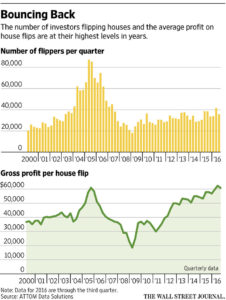
Graph From The Wall Street Journal.

Graph From The Wall Street Journal.

The Journal writers explained that, “The number of investors who flipped a house in the first nine months of 2016 reached the highest level since 2007. About a third of the deals in the third quarter were financed with debt, a percentage not seen in eight years.

“Trying to win business, big banks in the past few weeks have flown executives to Southern California—where much of the house-flipping activity is occurring—to organize funding deals, say people familiar with the meetings.

“Investors are making an average profit of about $61,000 on each flip, up from about $19,000 at the bottom of the market in 2009, according to housing-research firm ATTOM Data Solutions, which is the parent company of real-estate website RealtyTrac. The calculation measures the difference between the housing value when an investor purchases the home and when it is sold.”

Yesterday’s article added that, “The boom is being accelerated by online lenders such as San Francisco-based LendingHome Corp. and Asset Avenue Inc. in Los Angeles, as well as crowdfunding websites such as Groundfloor Finance Inc., that allow individual investors to fund fix-and-flip loans. LendingHome, backed by venture-capital investors, says it has extended more than $1 billion in loans in the 2½ years since its launch.”

“Loans to house flippers are short term—usually around seven months—and come with interest rates ranging between 7% and 12%. Because real-estate investors are typically higher risk, they put more cash down—sometimes as much as 65%. By comparison, a 30-year home mortgage has an interest rate around 4%, and borrowers typically don’t put more than 25% down,” the Journal article said.

Posted in Real Estate Law, Start-up Company Law | Comments closed

Rural Business Survival Rates

A recent article (“Survival Rates of Rural Businesses: What the Evidence Tells Us“) at Choices Online magazine, by Steven Deller and Tessa Conroy, stated that, “Promoting business start-ups and small business activity can stimulate competition and an entrepreneurial spirit within rural communities, which in turn, enhances efficiency, innovation and productivity growth. To succeed, smaller businesses need to be able to adapt to changing environments with flexible production technologies and business strategies. New and small businesses are often a source of experimentation and innovation. By pushing the frontier, they play a vital role in the innovative processes that drive economic growth and development. The importance of business start-ups and a network of smaller businesses to the viability of the local economy has become increasingly recognized by policy makers, as well as rural development researchers and community leaders.  Several recent studies have found that start-ups are critical to both gross and net job growth.”

Deller and Conroy noted that, “Not all start-ups or small businesses are innovative—meaning those that bring a new product, process, or service to market. Many start-ups and small businesses are classified as common or reactionary.”  The authors explained that, “While community leaders would prefer to foster innovative and high-growth businesses that become a major source of local employment, in rural areas most tend to be characteristically common. Although not necessarily considered as innovative, common and reactionary small businesses can be important to rural communities.”

The Choices article pointed out that, “In rural areas, a small business closure is often quite visible and widely known across the community. Because it is often viewed as a failure, it can create an environment within the community where potential entrepreneurs become risk averse. The local disapproval of failure can discourage risk-taking related to both start-ups and expansion decisions, leading to a stagnant and even declining local economy.”

The authors stated that, “Regardless of designation as either a rural or urban county, between 1990 and 2007, businesses in the typical county had a five-year survival rate of 69% (Figure 1).”

Figure 1. New Business Five-Year Survival Rates. (Source: Calculations based on the National Establishment Time Series (Choices Online Magazine)).

Figure 1. New Business Five-Year Survival Rates. (Source: Calculations based on the National
Establishment Time Series (Choices Online magazine)).

After a closer look at the data, the authors stated that, “In fact, the analysis reveals a survival gradient along the rural-urban spectrum. At the extremes, new businesses in remote small rural areas have a five-year survival rate of 72% which is statistically significantly greater than the largest urban areas where the rate is 67%.”

Deller and Conroy pointed out that, “In urban markets, business owners might be willing to take on riskier business ideas because, if it fails, they can easily try another venture or return to the labor market as a wage-earner. Further, in rural communities where business owners are known figures in the community one’s social standing may be at risk if the business is a failure, particularly if bankruptcy is an outcome.”

The Choices article added that, “In the end, the promotion of entrepreneurial activity at all levels is vital for a dynamic and vibrant local economy whether it be a large urban city or a remote rural village. Communities that foster, nurture and support business at the point of start-ups and those all-important first five years of operation through networking, educational, technical and mentoring services will prove to foster stronger local economies and communities.”

Posted in Agriculture Law, Start-up Company Law | Comments closed

Lower Commodity Prices Driving Rental Rates Down

A recent news update from University of Missouri Extension indicated that, “Renters and property owners are negotiating new farmland leases in response to lower farm commodity prices, says University of Missouri Extension agriculture business specialist Joe Koenen.

“Communication helps landlords and tenants find a middle ground for new leases, Koenen says. Landlords in tune with lower farm prices recognize that tenants will request rent adjustments. ‘I know of renters who are negotiating leases. Several are being successful,’ he says. ‘Overall, so far it seems relatively smooth.'”

The Missouri Extension item noted that, “Some owners, however, resist the change. Landowners who invested in land with expectations of a set return seem most reluctant to renegotiate new terms, Koenen says.

“Open communication between landlord and tenant throughout the term of the lease—not just when down markets hit—is key.

“‘Communicate every year, not just when prices go down,’ Koenen says. Talk to landlords about income and expenses and how that affects your bottom line.”

The update added that, “Tenants who are good stewards of rental property should remind landowners of this. Loyalty and tradition still matter in rural areas, Koenen says.”

Posted in Agriculture Law | Comments closed

USDA Farm Loan Program Refunded Through April

Associated Press writer Roxana Hegeman reported yesterday that, “U.S. farmers drained all available government agricultural loan money this past fiscal year to get through one of the worst agricultural downturns in recent years, but no one who qualifies for a farm loan will be denied in the next four months due to an unusual provision passed this month by Congress.

“The budget patch gives the Agriculture Department’s Farm Service Agency authority to meet the spike in loan demand by using future funding, according to U.S. Sen. Jerry Moran, a Kansas Republican who chairs an agricultural appropriations panel. There is no limit to how much the USDA can lend through April 28 — a victory for farm groups who pressed Washington for the fix to avert a looming loan crisis.

“Already, corn and wheat prices have pushed farmers to the limit, and beef prices are hurting ranchers. They turned to lenders, leading the FSA to fall short $137 million short of needed direct and guaranteed loan funds in the fiscal year ending Sept. 30.”

Ms. Hegeman indicated that, “Operating loans for 2016 are coming due at a time of widespread downturn. Farmers in Georgia, the Carolinas and Alabama have gotten a double whammy of drought and flooding. Midwest states are reeling from a glut in global grain markets that has slashed crop prices, and cotton growers in Georgia and Texas also are suffering due to low prices. Consumer demand for milk is down. Cattle prices are falling.

“Not as many people are able to pay off their 2016 operating loans, and the next 60 to 90 days will be telling, said Steve Apodaca, vice president for the Washington, D.C.-based The American Bankers Association’s Center for Agricultural and Rural Banking.

“Most borrowers will be able to sustain themselves another year, and bankers will be able to help restructure their loans and add federal guarantees to commercial loans, Apodaca said. He is not expecting a repeat of the farm crisis of the 1980s, when land values tanked and interest rates were high.”

Yesterday’s AP article added that, “This year’s bountiful yields and low interest rates on loans helped many growers. But many commercial lenders are now demanding farmers whose operations are under stress to get government guarantees that any money lent for next year’s crops will be repaid.

“‘When a farmer goes under, it affects that rural community,’ Apodaca said. ‘He is no longer buying seed, he is no longer buying equipment. His family is no longer going to the local Main Street and buying goods and services.'”

Posted in Agriculture Law | Comments closed

U.S. Supreme Court Could Hear USDA Wetlands Determination Appeal

DTN writer Todd Neeley reported yesterday that, “The U.S. Supreme Court on Jan. 6 may decide whether it will hear a legal challenge to USDA’s wetlands determination system filed by a South Dakota farmer last fall.

“Miner County, South Dakota, farmer Arlen Foster petitioned the high court to consider whether a USDA procedure to determine wetlands on his 0.8 acre of land in the Prairie Pothole region is ‘arbitrary and capricious.’

“Last week, Foster’s petition was distributed for review by the court at its Jan. 6 conference. Every year, the court holds multiple conferences to look at filed petitions. Typically, the court doesn’t discuss every petition during those conferences. Those cases not discussed are considered to be denied.”

Mr. Neeley noted that, “Foster, who is represented by the Pacific Legal Foundation, told DTN in September that winter dumps piles of snow nearly every year along a tree belt near a 0.8-acre tract of land on his farm in the southeastern part of the state. Spring melt drains onto his field, often making it impossible to farm.

“As a result, the 0.8 acre tract was declared a wetland based on a USDA process Foster asked the court to review. That process uses so-called reference sites when a tract of land being reviewed has been farmed, making it difficult to determine the presence of wetlands.

“This month, USDA and attorneys for Foster filed briefs with the court on whether it should hear the case.”

The DTN article explained that, “In the brief filed with the Supreme Court, USDA said it followed procedure in selecting the reference site when examining Foster’s land…[T]he Natural Resources Conservation Service, or NRCS, has faced a backlog of requests for wetlands determinations. As a result, many landowners have been left waiting for years.

“In Foster’s situation, he said NRCS instead used a comparison site to make a determination. This deprives him of his rights, he contends in his appeal. Such comparisons are allowed by NRCS procedures.”

More background on the case can be found here.

Posted in Agriculture Law | Comments closed

Tea Trailblazer Teforia Hopes to Mimic Success of Keurig

Tracey Lien reported in today’s Los Angeles Times that, “Monica Shih has a pasta maker, an air fryer, a deep fryer, an ice-cream machine and a popcorn maker in her kitchen. But her most expensive culinary gadget by far is her Teforia tea infuser, which retails for $1,499. She considers it an ‘investment.’

“‘I’m a huge tea drinker,’ said the 42-year-old stay-at-home mom from Seattle. ‘I felt like it was something I would use every day.'”

The article also noted that, “Jordan Peimer, 57, an arts administrator from San Diego, decided a Teforia was worth the cost considering how serious he is about tea.

“‘I like the idea of being able to get the most out of the actual tea itself,’ Peimer said.”

Ms. Lien explained that, “It’s not crazy, Shih and Peimer insist: Look at how much people spend on coffee.

“That’s the case that Teforia is trying to make for its pricey machine. The Mountain View, Calif., start-up, founded by former Xbox, Amazon and Nokia industrial designer Allen Han, has 18 employees. Backed with $17 million in venture capital funding, Teforia hopes to be a trailblazer in the tea world, doing for tea what Keurig and Nespresso did for coffee.”

Today’s article indicated that, “‘When Keurig was [bought by a private equity firm this year], it was privatized at a value of $15 billion,’ said Jay Eum, managing director of venture capital firm Translink, which led Teforia’s $12-million Series A funding round. ‘Tea is a more consumed beverage than coffee is, so we’re excited to find a company and product that could be the Keurig of the tea market.'”

However, Ms. Lien pointed out that, “There’s an elephant in the room, though. As any Starbucks barista will tell you, people are fussy about coffee. And if the proliferation of high-end coffee shops such as Blue Bottle is anything to go by, people can be outright snobs about it.

“But tea? At $3 for 100 teabags, most tea-drinking Americans seem content with dunking a bag into boiling water and calling it a day.”

The article noted that, “Teforia is selling its own tea, available in Keurig-style capsules, but owners of the machine also can use their own loose-leaf teas. The device connects to a mobile app in which users can tell the Teforia what kind of tea they’re using and what flavors they’d like to enhance.

“The Teforia is Wi-Fi enabled and downloads lab-tested tea recipes, allowing it to modulate the flavor, aroma, caffeine and anti-oxidant levels of each cup by changing steep time, water temperature and aeration. Water passes though the vacuum-sealed infuser, which is made of hand-blown borosilicate glass, sloshing the tea leaves around before releasing the brew into a bulbous carafe.

“Teforia executives and investors espouse the therapeutic qualities of watching the machine prepare tea. [Alessandra Ghini, Teforia’s chief marketing officer] calls it a ‘tea theater.'”

The Los Angele Times article also stated that, “Teforia’s investors see opportunity in the $40-billion global tea market, especially in Asia, where tea culture is huge. The growing middle class in emerging markets could be a way in for the tea infuser.”

Posted in Start-up Company Law | Comments closed

American Craft Brewery Eyes German Market

Los Angeles Times writer Shan Li reported last week that, “In June, Stone [Brewery] opened a brewery in Berlin, becoming one of the first American craft breweries to operate in Germany. Its arrival could prove a test not just for Stone but for a cohort of innovative American brewers that fueled the rise of the U.S. craft brewing scene but have not yet developed large global customer bases.

“The move comes as craft breweries are facing slowing growth in the U.S. After years of rapid expansion, established craft brewers are bumping up against thick competition from an explosion of small breweries they inspired and behemoth brands that have refreshed their offerings to compete. Some independent brewers have sold off to beverage conglomerates or are taking a page from their book by setting their sights on global markets.

“‘2015 seemed to be the first year that growth may be reaching a plateau,’ said Nick Petrillo, senior analyst at IBISWorld. ‘Craft beer isn’t stalling, but it’s going to reach a point of maturity in the sense its growth isn’t going to be as massive.'”

The LA Times article noted that, “Stone’s move to Europe is part of a big bet on its future as a global beer player. In addition to the brewery, the beer maker also opened up a restaurant and beer garden there in September.

“[Dominic Engels, Stone’s chief executive] said staking a claim in Berlin is part of Stone’s long-term plans to ‘shape’ the overseas market. The 10th-largest U.S. craft brewery wanted to get a foothold early in Europe, which is chock full of regional influences and countries in different stages of appreciating craft beer.

“‘It’s something we need to start now so it can be of substance later,’ he said. ‘There is no such thing as a homogeneous European approach that makes sense. It’s going to have to be done market by market.'”

The article added that, “Last year only about 132,000 gallons of beer from the U.S. were imported to Europe, [Rodger Wegner, managing director of the Assn. of Export Brewers of Northern, Western and Southwestern Germany] said, out of 172 million gallons imported in total. In 2015, imports accounted for about 6.8% of total domestic consumption, according to the German Brewers’ Federation. By comparison, imports to America made up nearly 16% of total domestic consumption last year, according to the Brewers Assn.

“Imports into Germany — which mostly come from other European countries such as Belgium — have dropped in recent years. Overall sale of German beers, along with domestic consumption, have steadily slipped as well.”

Posted in Start-up Company Law | Comments closed

Purchases of New Home Sales Rise at Rapid Pace in November

Bloomberg writer Michelle Jamrisko reported today that, “Purchases of new U.S. homes increased in November to the second-fastest pace in almost nine years as the beginning of a spike in mortgage rates persuaded buyers to quickly sign contracts.

“Sales rose 5.2 percent to a four-month high of a 592,000 annualized pace, Commerce Department data showed Friday. The median forecast in a Bloomberg survey was for a 2.1 percent gain to 575,000. The advance included the largest gain in the Midwest market since October 2012 and the fastest pace of demand in the West in almost nine years.

“Home sales are closing in on the strongest year in a decade, supported by a robust labor market and, until recently, the lowest mortgage rates since the 1970s. Progress has been gradual, however, with residential construction contributing little to economic growth as higher prices and stricter lending standards turn more Americans into renters.”

Graph From Bloomberg News.

Graph From Bloomberg News.

Today’s article added that, “The median sales price of a new house decreased 3.7 percent from November 2015 to $305,400, Friday’s report showed.”

Posted in Real Estate Law | Comments closed

Home Mortgage Rates on the Rise

Kathy Orton reported in today’s Washington Post that, “House hunters might need to start adjusting their expectations as the days of ultra-low mortgage rates could finally be winding down.

“With homeownership hovering around a 50-year low, the American dream of owning a home seems like an unattainable goal to some, as prices are rising, supply is dwindling and mortgage rates have climbed to heights not seen in more than two years.

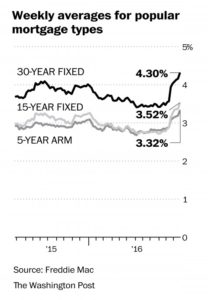
“According to the latest data released Thursday by Freddie Mac, the 30-year, fixed-rate average jumped to 4.3 percent with an average 0.5 point. (Points are fees paid to a lender equal to 1 percent of the loan amount.) It was 4.16 percent a week ago and 3.96 percent a year ago.”


Graph From The Washington Post.

Graph From The Washington Post.

Today’s article noted that, “A homebuyer who held off purchasing a $500,000 home in July when rates sank to 3.41 percent now will pay $255 more a month on a 30-year loan.”

The Post article added that, “The combination of higher rates and higher prices may present obstacles for potential homebuyers, as U.S. economic growth has been steady but slow. The housing market is very dependent on the jobs market. People are reluctant to make large purchases such as buying a home unless they have a steady income. Although unemployment is down, wage growth has been stubbornly lackluster. Average hourly earnings declined by 3 cents to $25.89 last month, offsetting the large gains in October.

“The rise in the 30-year fixed rate is also tempting borrowers to consider adjustable-rate mortgages again.”

Posted in Real Estate Law | Comments closed

House Ag Committee Chairman Remarks on Timeliness of 2018 Farm Bill

Meghan Grebner reported yesterday at Brownfield Online that, “The Chairman of the House Agriculture committee says he is confident that the House and Senate Ag Committees will be able to get a Farm Bill passed before the current bill expires.”

Rep. Mike Conaway (R, Tex.) was quoted in the Brownfield update as saying, “Certainly no – no need for the normal drama that you have of extensions and expirations and all the things you go with that. There’s no reason to do that. So, I’m hopeful that (Senate Ag Chairman) Pat Roberts and I can get this on President Trump’s desk in time – you know, before the current (farm) bill expires.”

Yesterday’s update added that, “The debate on the 2018 Farm Bill is likely to take a different tone from the 2014 Farm Bill since this Farm Bill will be written in a down farm economy.”

A “down” farm economy makes a timely conclusion to the 2018 Farm Bill all the more important for Illinois farmers.

Posted in Agriculture Law | Comments closed