Non-Tech Companies Get More Aggressive in Acquiring Start-Ups

New York Times writer Leslie Picker reported earlier this month that, “For years, mergers and acquisitions in technology were fairly straightforward: Every investment bank kept a list of a dozen or so companies like Google and IBM that had a track record of acquisitions and cash to deploy. When the time and price were right, bankers would seek to match the tech giants with a start-up, and a deal would be hatched.

“Now the technology deal-making club has had its doors blown wide open.

“All kinds of companies, including century-old industrial stalwarts like General Motors and General Electric, are among the corporate giants acquiring tech start-ups of late.”

The article indicated that, “This trend, of course, reflects how new technology is radically changing many traditional businesses. Developments like connected homes and driverless cars are upending old models. Many companies have come to the realization that building technology in-house was a painstaking process that often meant getting leapfrogged by start-ups.

“So companies not usually thought of as being in the tech sector have become more aggressive, making more than $125 billion worth of acquisitions in 2016, the most ever. Five years ago, that figure was $20 billion.”

Ms. Picker pointed out that, “Last year, the number of technology companies sold to non-tech companies surpassed those acquired by tech companies for the first time since the internet era began, according to data compiled by Bloomberg. Excluding private equity buyers, 682 tech companies were purchased by a company in an industry other than technology, while 655 were acquired by tech companies, Bloomberg’s data showed.”

The Times article added that, “Investment bankers expect this trend to continue this year as well. They have been fielding many calls from companies outside the tech sector wondering what shareholders might think about a potential tech acquisition.

“Non-tech chief executives have been found mingling at technology conferences, trying to spot their next potential target. And the assortment of so-called unicorns, or private companies valued at $1 billion or more, may be more inclined to sell this year after very few went public or sold in 2016.”

Posted in Start-up Company Law | Comments closed

Texas Rancher Files Federal Action Regarding Endangered Species Rules

Tawnell D. Hobbs reported in today’s Wall Street Journal that, “A tiny spider-like creature that lives in caves on his property is causing a giant headache for Texas rancher John Yearwood.

“The Bone Cave harvestman, a blind arachnid found in Central Texas, has been on the U.S. endangered species list since 1988.

“But Mr. Yearwood wants the harvestman—which resembles a spider but technically is more of a cousin sometimes called a daddy longlegs—removed from protected status. He said its discovery on his land hinders the use of at least 35 acres north of Austin that has been in his family since 1871.”

From the January 6 edition of The Wall Street Journal.

From the January 6 edition of the Wall Street Journal.

Today’s article noted that, “‘It’s the government telling me that I, at my own expense, have to have a preserve for everyone in America,’ Mr. Yearwood said. ‘I pay taxes on the land every year. And there’s no way I can sell it—nobody will buy it.’

“Federal law prohibits modifications or degradation of habitats of endangered species that could impact their breeding, feeding or sheltering, except under federal permit. Those permits are mostly available for conservation and scientific purposes. Harming or harassing the species, physically or through noise or light is also prohibited.”

Today’s article added that, “[Mr. Yearwood] and other property owners have filed a lawsuit against the U.S. Fish and Wildlife Service, which oversees endangered species rules, to delist the harvestman, saying it isn’t endangered and is unnecessarily restricting use of their property. Mr. Yearwood’s suit also contends that the federal government is exceeding its authority by regulating ‘noneconomic activity.’

“Last month, the state of Texas threw support behind Mr. Yearwood in a friend-of-court brief filed in U.S. District Court in the Western District of Texas, calling the situation a ‘clear overreach in the use of federal power.’

“The rancher’s dilemma is a peculiar example of broader tensions in the West over federal oversight of land. In this case, the conflict confronts federal rules for privately owned land.”

Posted in Agriculture Law | Comments closed

Senators Like What They Hear from EPA Nominee on RFS

Front page of the business section in today's Des Moines Register.

Front page of the business section in today’s Des Moines Register.

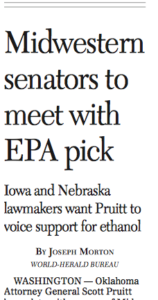
An update yesterday at BartellPowell noted that some Midwestern senators had sought a meeting with President-elect Trump’s choice to head the Environmental Protection Agency, Oklahoma Attorney General Scott Pruitt.

The Senators were “seeking promises [that Pruitt] won’t gut federal policies that promote renewable fuels such as corn-based ethanol.”

Joseph Morton reported in today’s Omaha World-Herald that, “Nebraska and Iowa Republican senators seemed satisfied as they emerged Thursday from a meeting with President-elect Donald Trump’s nominee for the Environmental Protection Agency.

“Sen. Chuck Grassley, R-Iowa, arranged the sit-down to discuss the importance of renewable fuels with Oklahoma Attorney General Scott Pruitt, who has been critical of policies such as the Renewable Fuel Standard [RFS] in the past.

“Grassley and other senators indicated they liked what they heard.”

Mr. Morton noted that, “‘It was a very positive meeting,’ Grassley told reporters as he stood next to Pruitt. ‘As far as I know, every senator was very satisfied with the answers we got.'”

“‘I think the whole room is supportive,’ Sen. Deb Fischer, R-Neb., said. ‘He’s just open and honest.'”

Meanwhile, Donnelle Eller reported on the front page of the business section in today’s Des Moines Register that, “Midwest Republican senators got reassurances from EPA chief nominee Scott Pruitt that he will ‘follow the law’ that requires ethanol and biodiesel to be blended into the nation’s fuel supply, Sens. Joni Ernst and Chuck Grassley said.”

“‘He has no intention to undermine the RFS,’ Ernst said, adding that Pruitt ‘went a step further,’ criticizing the current EPA administration for missing deadlines that set RFS fuel blending requirements.”

Posted in Agriculture Law | Comments closed

Investing in Farmland

Writing last month at U.S. News Online, Dawn Reiss indicated that, “Every year farmland is lost to urbanization. According to American Farmland Trust, a nonprofit that works to save farmland from development, the U.S. loses 40 acres of farmland every hour, with 37 percent of America’s developed land having been converted in the last three decades. In 2015, a little more than 2 million farms were left in the U.S. according to the USDA.

“For those who own it, it’s called ‘gold with a coupon’ since farmland pays rental income to investors who are collecting from farmers while generating capital appreciation that can be used to hedge against inflation.”

Ms. Reiss noted that, “Unlike real estate, which is tied to a local economy, some investors are using farmland to diversify their portfolios because returns tend to be immune to stock or bond fluctuations.

“‘It does have a fairly high cash yield compared to other asset classes with similar risks,’ says Greyson Colvin, managing partner and founder of Colvin & Co., an agriculture-focused investment manager in New York. ‘For institutional investors, this is a great alternative to treasury and corporate bonds.’

“But farmland is difficult to access. It’s privately owned in patchwork pieces across the U.S., much of which is sold at local auctions.

“‘There’s no way to access the best tracts unless you’ve got real expertise,’ [Eric O’Brien, co-founder and managing director at Fall Line Capital in San Mateo, California, a private equity firm specializing in acquiring and developing U.S. farmland] says. ‘We pass on 90 percent of the deals we see for physical or economic reasons. It’s a difficult asset to get your arms around.'”

The U.S. News article added that, “Anyone who invests in farmland should recognize that this is a long-term investment. Experts say many farmland investors fall into two categories – those who want to sell after a decade or so and those who look at this an intergenerational investment that can be inherited…[I]t’s important to understand the difference between annual row crops like corn, soybeans and wheat, and permanent crops such as almonds, peaches and grapes – anything grown in a vineyard or orchard.

“‘They have completely different investment risk and return characteristics,’ [Hunt Stookey, director of research and investment strategy for Ceres Partners, headquartered in South Bend, Indiana] says, citing the larger consistent global demand for row crops that contrasts the popularity boom-and-bust cycles many permanent crops face.”

Ms. Reiss also stated that, “Farming should be measured over cycles of 5 to 10 years and not over one crop. Colvin says his grandfather told him in a five-year period there will be one disaster crop, three adequate crops and one bumper crop that would sustain a farmer for that period.”

Posted in Agriculture Law | Comments closed

Senators Concerned about Biofuels Policy Under Trump

Joseph Morton reported on the front page of today’s Omaha World-Herald that, “Oklahoma Attorney General Scott Pruitt has a date with a group of Midwestern senators seeking promises he won’t gut federal policies that promote renewable fuels such as corn-based ethanol.

“Pruitt’s ability to assure those farm-state lawmakers during the meeting, scheduled for this afternoon, could determine whether he’s confirmed as President-elect Donald Trump’s pick to head the Environmental Protection Agency.”

Clip from the front page of today's Omaha World-Herald.

Clip from the front page of today’s Omaha World-Herald.

Mr. Morton explained that, “Pruitt has criticized the agency for what he considers regulatory overreach — a position that thrills regulation-weary farmers and the Republican senators who represent them.

“But Pruitt also has criticized the agency’s Renewable Fuel Standard, echoing complaints from the oil industry that such a policy is simply unworkable. The RFS, which by law requires certain amounts of renewable fuels be blended into the gasoline supply, has been key to the explosive growth of the ethanol industry, particularly in Iowa and Nebraska — the No. 1 and No. 2 ethanol-producing states.”

Today’s OWH article added that, “[Deb Fischer (R., Neb.)] met with Pruitt separately on Wednesday. She said he assured her that he believes in following the law, which calls for the RFS to continue. She said she has heard some concerns from Nebraskans about Pruitt’s nomination.

“‘I’m hopeful that we’ll be able to put their concerns at ease in the nomination process,’ Fischer said.”

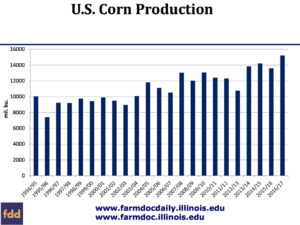
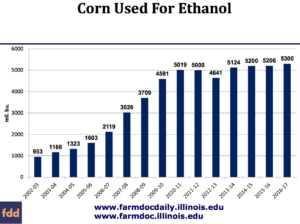
Since the drought of 2012, U.S. corn production has been robust, and corn used for ethanol has become an important demand variable in the corn balance sheet.


cornprod

U.S. corn production has been robust since the drought of 2012.

corn

Although stable for the past few years, corn used for ethanol is still an important component of demand and use.

Beyond corn, the Renewable Fuel Standard also has implications related to advanced biofuels and the biomass-based diesel volume requirement, which could have broader impacts on the soybean complex.

Posted in Agriculture Law | Comments closed

Hog Supplies, and Prices, May Increase in 2017

Purdue University agricultural economist Chris Hurt indicated yesterday at the farmdoc daily blog (“Weekly Outlook: More Pork in 2017 With Higher Hog Prices?“) that, “The latest Hogs and Pigs report released on December 23 indicated that pork supplies in 2017 will be larger than pre-report expectations.”

Dr. Hurt explained that, “Hog prices were extremely depressed in the final quarter of 2016 when live prices averaged about $37 per hundredweight. That was the lowest quarterly price since 2003. The lowest prices were in mid-November, touching the extremely low $30s. Recovery came quickly with prices rising to the lower $40s by the end of the year. For all of 2016 live hog prices averaged about $46.

“What will hog prices be in 2017? With three percent higher production one might expect annual prices to be lower, but there are additional items to consider. First, retail prices did drop in 2016, but there is opportunity for those prices to come down more. Lower retail prices will stimulate the quantity of pork that consumers purchase. Secondly, USDA expects exports to expand by five percent which will move more of the increased production to foreign customers. Finally, with the addition of new processing capacity, the farm-to-wholesale margins are expected to drop. Lower margins at the processing stage may contribute to stronger bids to hog producers.

“Live hog prices are expected to be about $48 in 2017, $2 higher than in 2016. By quarter prices are expected to average $45 in the first quarter, the very-low $50s in the second and the third quarters, and then $43 in the final quarter of 2017. A range of $2 higher or lower would be reasonable for price projections.”

Yesterday’s farmdoc update added that, “Pork exports to China will bear watching in 2017. Last year, exports to China nearly doubled growing to near 16 percent of total exports. Also of deep interest to the pork industry in 2017 will be the position of the new administration on trade issues and how that might impact agriculture. Mexico became the number one destination for U.S. pork in 2015 and 2016 so that trade relations with Mexico will need to be watched carefully for potential impacts on the hog market.”

Posted in Agriculture Law | Comments closed

Enterprising Suppliers- Eating Fresh, Local Throughout the Year

Sarah Baker Hansen reported in today’s Omaha World-Herald that, “For Mary Dishman, eating fresh, local produce doesn’t end with the last of the summer tomatoes and sweet corn.

“Dishman, 52, cooks dried beans and mushrooms into warming dishes for her Papillion family. She experiments with winter squash and greens. She pops local popcorn, scrambles local eggs and cuts local cheeses.

“She gets all of those ingredients, and many other locally made products, through her wintertime community supported agriculture box, a service that locally owned Tomato Tomato started for its customers about three years ago.”

Front page of the "Living" section in today's Omaha World-Herald.

Front page of the “Living” section in today’s Omaha World-Herald.

The OWH article noted that, “Many Omahans are finding ways to eat local foods through the fall and winter, whether it be through a CSA box or shopping at places like Tomato Tomato or Lone Tree Foods, both organizations that are actively working with farmers to help make the local wintertime produce selection more robust.

“Erin Schoenberg is the sales manager at Lone Tree, and she said as more consumers get interested in eating local throughout the year, it creates new opportunities for small farmers to produce food year-round. Many local farmers are already doing it.”

Ms. Hansen explained that, “Schoenberg said many farmers who work with Lone Tree use greenhouses or high tunnels, which are non-heated greenhouses, or harvest crops earlier in the season and store them in coolers to be sold later.”

Today’s article added that, “Schoenberg said the offerings in winter are different, but still fairly diverse. Greens are a big seasonal product, she said, and Lone Tree provides spinach mix, cabbage, microgreens and kale to local grocery stores, including Hy-Vee.

“Regular and sweet potatoes carry through the winter, she said, as do beets and carrots. Dairy, grain and honey, she said, never go out of season.”

Posted in Agriculture Law, Start-up Company Law | Comments closed

Investors Poured Less Money into Startups in 2016

Michael J. de la Merced reported in Friday’s New York Times that, “Investors who once poured money into the nation’s start-ups with abandon began to tighten their belts this year.

“The amount of money that flowed into start-ups in the United States fell in 2016 for the first time in four years as the number of deals struck tumbled to their lowest levels since 2011.”

The article noted that, “But the technology world has high hopes that 2017 will prove to be brighter, as the parent company of Snapchat and other highfliers prepare to go public and venture capitalists amass huge new war chests.

“About $67.8 billion was invested in start-ups in 2016, according to data from PitchBook, down 15 percent from last year. And just 7,841 deals were struck, down 25 percent from the period a year ago.

“Much of 2016 proved to be a less ebullient time for the once red-hot start-up market.”

Friday’s article added that, “Of course, heavyweight start-ups had little trouble raising money. Uber alone raised $3.5 billion from the Kingdom of Saudi Arabia, putting its cash hoard from outside investors at more than $11 billion. Lyft, Palantir and Snap Inc., the parent of Snapchat, all raised enormous sums as well, as did big non-American start-ups like the Chinese ride-hailing service Didi Chuxing.

“And some start-ups sold out to bigger companies for multibillion-dollar valuations. Jet.com, an e-commerce company that began selling goods only within the last two years, sold itself to Walmart for $3.3 billion.

“Investors are betting 2017 will be better. Renaissance Capital pointed out that the average total return of I.P.O.s in 2016 reached 23 percent, a sharp reversal from the negative 2.1 percent return of 2015 offerings and surpassing the 21 percent return of two years ago.”

Posted in Start-up Company Law | Comments closed

A Look at Inflation Adjusted Home Prices

Steven Russolillo reported in Tuesday’s Wall Street Journal that, “By one measure, the housing market’s lost decade is finally a thing of the past. In real terms, it is far from over.

“U.S. home values in September topped their previous peak from a decade ago, according to the S&P/Case-Shiller 20-City Home Price Index. New data expected Tuesday should show more of the same in October. Prices have grown at about a 5% annual clip for much of the past two years.

“On paper, home-price increases may have come full circle following the worst housing bust since the Great Depression. But these nominal price gains don’t take into account the consumer price increases that inflate home values over time. In real terms, the index still is about 16% below the 2006 high. A number of factors could make further price appreciation and possibly even a new inflation-adjusted high that much tougher to come by in the new year.”

The Journal article added that, “The market is flashing warning signs. The homeownership rate still hovers near a five-decade low and it is tough for less-affluent buyers to obtain mortgages. Meanwhile, mortgage rates have risen substantially since Donald Trump’s election victory, which will affect affordability.

“Even without that, historical trends suggest that housing prices aren’t likely to keep rising at their current pace. For instance, since prices bottomed in 2012, they have risen in real terms at more than 5% a year, according to data courtesy of Yale economist Robert Shiller. That is great news for current homeowners but bad for anyone looking to buy, particularly first-time buyers. The appreciation far exceeds income growth over that time frame.”

Posted in Real Estate Law | Comments closed

USDA Makes it Easier to Transfer Certain Land to the Next Generation

A news release yesterday from the U.S. Department of Agriculture’s Farm Service Agency (FSA) indicated that, “Agriculture Deputy Under Secretary Lanon Baccam today announced that beginning Jan. 9, 2017, [USDA] will offer an early termination opportunity for certain Conservation Reserve Program (CRP) contracts, making it easier to transfer property to the next generation of farmers and ranchers, including family members. The land that is eligible for the early termination is among the least environmentally sensitive land enrolled in CRP.

“This change to the CRP program is just one of many that USDA has implemented based on recommendations from the Land Tenure Advisory Subcommittee formed by Agriculture Secretary Tom Vilsack in 2015. The subcommittee was asked to identify ways the department could use or modify its programs, regulations, and practices to address the challenges of beginning farmers and ranchers in their access to land, capital and technical assistance.

‘”The average age of principal farm operators is 58,’ said Baccam. ‘So, land tenure, succession and estate planning, and access to land is an increasingly important issue for the future of agriculture and a priority for USDA. Access to land remains the biggest barrier for beginning farmers and ranchers. This announcement is part of our efforts to address some of the challenges with transitioning land to beginning farmers.'”

Yesterday’s update noted that, “Normally if a landowner terminates a CRP contract early, they are required to repay all previous payments plus interest. The new policy waives this repayment if the land is transferred to a beginning farmer or rancher through a sale or lease with an option to buy. With CRP enrollment close to the Congressionally-mandated cap of 24 million acres, the early termination will also allow USDA to enroll other land with higher conservation value elsewhere.”

“Acres terminated early from CRP under these land tenure provisions will be eligible for priority enrollment consideration into the CRP Grasslands, if eligible; or the Conservation Stewardship Program or Environmental Quality Incentives Program, as determined by the Natural Resources Conservation Service,” the news release said.

Posted in Agriculture Law | Comments closed