
USDA Provides New Cost Share Opportunities for Organic Producers

A news release from the United States Department of Agriculture indicated yesterday that, “[USDA] today announced that starting March 20, 2017, organic producers and handlers will be able to visit over 2,100 USDA Farm Service Agency (FSA) offices around the country to apply for federal reimbursement to assist with the cost of receiving and maintaining organic or transitional certification.

“‘USDA is committed to helping the organic sector grow and thrive through a wide variety of programs, and part of that commitment is making it easy for stakeholders to access our services. That’s why, starting March 20, producers will be able to visit their local FSA offices to access organic certification cost-share reimbursements for up to 75 percent of the cost of organic certification,’ said FSA Administrator Val Dolcini. ‘This will provide a more uniform, streamlined process nationwide; and it will give organic producers a chance to learn about other valuable USDA resources, like farm loans and conservation assistance that can help them succeed.’

“USDA is making these changes to encourage increased participation in the National Organic Certification Cost Share Program (NOCCSP) and the Agricultural Management Assistance Organic Certification Cost Share Program, and at the same time provide more opportunities for organic producers to access a full range of USDA programs, such as disaster protection and loans for farms, facilities and marketing. Producers can also access information on nonfederal agricultural resources, and get referrals to local experts, including organic agriculture, through USDA’s Bridges to Opportunity service at the local FSA office.”

Yesterday’s update added that, “Eligible producers include any certified producers or handlers who have paid organic or transitional certification fees to a USDA-accredited certifying agent. Application fees, inspection costs, fees related to equivalency agreement/ arrangement requirements, travel/per diem for inspectors, user fees, sales assessments and postage are all eligible for a cost share reimbursement from USDA.

“Once certified, producers and handlers are eligible to receive reimbursement for up to 75 percent of certification costs each year up to a maximum of $750 per certification scope—crops, livestock, wild crops and handling.

“To learn more about organic certification cost share, please visit www.fsa.usda.gov/organic or contact a local FSA office by visiting http://offices.usda.gov.”

Posted in Agriculture Law | Comments closed

USDA Releases Results of First Local Food Marketing Practices Survey

A news release yesterday from the United States Department of Agriculture indicated that, “More than 167,000 U.S. farms locally produced and sold food through direct marketing practices, resulting in $8.7 billion in revenue in 2015, according to the results from the first Local Food Marketing Practices Survey released today by the U.S. Department of Agriculture’s National Agricultural Statistics Service (NASS). The report results cover both fresh and value-added foods, such as meat and cheese.

“Farms selling food directly to institutions and intermediates, such as wholesalers who locally branded the product or food hubs, brought in the most revenue at $3.4 billion. The next category, at $3 billion in sales, was from approximately 115,000 operations with direct-to-consumer sales, such as on-farm stores and farmers markets. Sales directly to retailers were $2.3 billion from over 23,000 operations nationwide.

“The top five states by value of total direct food sales were:

California, $2,869 million
Michigan, $459 million
New York, $441 million
Pennsylvania, $439 million
Wisconsin, $431 million”

The USDA release added that, “The survey also concluded that more than 80 percent of all direct market food sales occurred within 100 miles of the farm, and that most farms selling to consumers were less than 20 miles from their largest grossing marketplace.

“Approximately 300,000 people were involved in making decisions for the farms that sold directly in 2015. Of these, 62 percent were men and 38 percent were women – a higher proportion of women than among all farms, according to data from the 2012 Census of Agriculture.”

Posted in Agriculture Law | Comments closed

New Retirement Account Option for Farm Households

An update yesterday at the U.S. Department of Agriculture’s blog stated that, “Compared to the general population, farmers and ranchers have a distinctive combination of assets, income sources, and saving habits, with large percentages of their financial portfolios intertwined in the business equity, all which must be carefully considered when planning for intergenerational transfers, and while generating and maintaining retirement income.

“As for actual savings accounts, while 60 percent of all households nationwide participate in some type of a retirement account, just 40 percent of eligible farm households do. In fact, only 7 percent of farmers and ranchers contribute to the types of Individual Retirement Accounts (IRA) that can provide helpful tax advantages, with just 3 percent of the general population having an IRA.

“That’s why the U.S. Department of the Treasury recently launched a new tool, known as myRA, for anyone interested in a simple, safe, understandable, and affordable method to start saving for retirement.”

The USDA update noted that, “The myRA is not intended to replace existing employer-sponsored retirement plans, such as a 401(k) plan, because those accounts may offer special incentives like an employer matching payment. But if you don’t have access to a retirement savings plan, or excessive fees and complicated investment options are daunting, or perhaps you would like the younger members of your family to have better retirement awareness, then the U.S. Treasury’s myRA savings account might be an option for you.”

For more information about myRA accounts, see this U.S. Department of the Treasury webpage.

Posted in Agriculture Law | Comments closed

Federal Reserve Bank of Minneapolis Ag Credit Survey- Land Values, Cash Rents Decline

Last week, the Federal Reserve Bank of Minneapolis indicated in an Agricultural Credit Condition Survey that, “Land values retreated further across district states, and interest rates on loans barely changed from the previous quarter. The outlook for the fourth quarter is similar, with lenders in the district overwhelmingly expecting farm incomes to decrease further.”

The Fed report stated that, “‘Things do not look good right now,’ a Wisconsin ag banker commented, grimly summarizing the state of the sector. A strong majority of district lenders surveyed (85 percent) reported that farm incomes decreased in the third quarter of 2016 from a year earlier, while none said that incomes increased.”

“Unlike other recent periods where low output prices primarily took their toll on crop producers, the pain is now being shared more broadly, with livestock prices falling recently as well. This trend was reflected in Montana, where 100 percent of respondents indicated that incomes fell,” the Fed report said.

Last week’s update added that, “The rate of repayment on agricultural loans fell, reflecting tighter budgets for farm households, while renewals slightly increased…[and]…Falling incomes also drove increases in demand for loans by farm households in the third quarter.”

With respect to land values and cash rents, the Fed report pointed out that, “The average value for nonirrigated cropland in the district fell by more than 3 percent from a year earlier, according to survey respondents. Irrigated land values fell 1 percent, while ranch- and pastureland values fell 5 percent, perhaps reflecting the more recent downturn in livestock prices. The district average cash rent for nonirrigated land dropped by more than the decrease in value, down almost 5 percent from a year ago. Rents for irrigated land decreased about 6 percent, while ranchland rents fell by 10 percent.”

Posted in Agriculture Law | Comments closed

Farmers See Increased Hops Revenue, Craft Beer Sales a Variable

On Monday, Financial Times writer Emiko Terazono reported that, “US hop farmers have celebrated record revenues from their crops in 2016 as they planted more acres despite signs that the craft beer boom, which has boosted demand for the key brewing ingredient, may be peaking.

“The value for the year’s hop crop soared 44 per cent this year from 2015, totalling just short of $500m, according to the US Department of Agriculture. ‘Higher hop acreage and production’ and the continued trend to shift hop production to more expensive varieties favoured by craft beer makers were behind the jump, said the USDA in its latest report on hop output.

“Craft brewers use four-to-ten times more hops than the amount used in the average lager produced by multinational brewers, and the surge in popularity for microbrews, which are high in flavour and aroma, has pushed up demand and prices for certain speciality hops. Nevertheless, as farmers push to plant more hops, US consumption of craft beer may be slowing.”

The FT article noted that, “In certain US cities, especially those on the west coast, craft beer consumption has reached almost 50 per cent of the market, said Michael McDougall at Société Générale in New York. ‘It appears that craft beer could be reaching a saturation point,’ he said.”

Ms. Terazono added that, “Hop experts are urging caution about further expansion of production. US sales of craft beer, which rose 18 per cent in 2013 and 2014, have fallen 8 per cent in the first six months of this year, according to the Brewers’ Association. “

Posted in Agriculture Law | Comments closed

Single-Family Home Construction Remains at Recessionary Levels

p

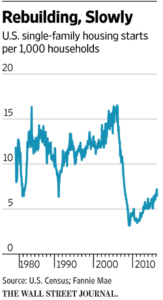
Graph from The Wall Street Journal.

Chris Kirkham reported in Saturday’s Wall Street Journal that, “U.S. unemployment is hovering near the lowest level in a decade, jobless claims have reached a 43-year low and home prices have surged to records. But in this eighth year of economic expansion, the number of single-family homes under construction remains at recessionary levels.

“Housing starts dropped 18.7% in November to a seasonally adjusted annual rate of 1.090 million, the Commerce Department said Friday. Permits, an indication of how much construction is in the pipeline, were down a milder 4.7% to 1.201 million.”

The Journal article explained that, “Adjusting for population growth, single-family construction is barely back to the prior troughs of recessions in 1981 and 1991, according to research from mortgage giant Fannie Mae. Even October’s monthly readings, which showed single-family starts at the highest level in nine years, were more than 15% below long-run averages.

“Sparse construction of new houses remains one of the enduring legacies of the housing bust and is one of the biggest impediments to achieving a more balanced recovery, economists said.”

Mr. Kirkham added that, “The industry’s inner workings broke down during the housing crash of the last decade and haven’t fully recovered. Builders have faced difficulties finding skilled construction labor, while financing has been difficult for smaller builders and land developers. What’s more, younger buyers remain on the sidelines, prompting builders to focus on a smaller group of upmarket buyers.”

Posted in Real Estate Law | Comments closed

Craft Beverages (“Alcohol Cluster”) Growing, Articles Show

Gregory S. Schneider reported last week at The Washington Post Online that, “Ten years ago, there was only a single cidery in [Virginia], and it had just opened. Denkers’s will be the 19th.

“Or 18th — state officials disagree on the exact number. The industry is just now getting big enough to track. The state’s Department of Alcoholic Beverage Control didn’t collect production and tax data on cidermakers until July.”

The article noted that, “The rise was predictable. There seems to be a winery at every highway exit, and craft beer breweries are popping up like coffee shops. Cider was ripe for a resurgence. But Virginia is catching up to a national cider-drinking trend that may have eased in the past year or two.

“Retail sales of hard cider (at stores, not restaurants) grew by about 11 percent in 2015, a fraction of the 71 percent growth the year before, according to Nielsen. Draft magazine, which covers the beer and cider industry, reported over the summer that cider sales slowed toward the end of last year.”

Mr. Schneider added that, “Virginia Gov. Terry McAuliffe (D) is a big booster of cider, as well as craft beer and wine. His office regularly cranks out news releases announcing jobs that involve fermentation. Brewpubs and wineries are among his favorite spots to hang out.

“‘Sometimes I get some grief from people’ for the announcements, McAuliffe said. ‘But this whole space drives our agriculture business and at the same time helps boom our tourism.’ He can spout the precise numbers off the top of his head: ‘Last year we sold 416,750 cases of cider, and that was up 52 percent from the year before.'”

Eric Mortenson reported in the latest edition of The Capital Press that, “The largest Pacific Northwest hard cider makers report average annual sales of nearly $1.9 million and attract more than 22,000 taproom visitors a year, according to a 2016 industry survey. An online poll of Northwest Cider Association producers showed the newest member of what Oregon economic analysts call the ‘alcohol cluster‘ is following the path worn by the region’s successful wine, beer and spirits makers.

“Cider makers in Oregon, Washington, Idaho, Montana and British Columbia took part in the poll, with 60 percent reporting they began business in the past five years.”

The article pointed out that, “The cost of ‘heirloom’ apple juice used to make cider, for example, ranged from $5 to $7 a gallon, while the previous year’s survey revealed a cost range of $2.50 to $10 per gallon.”

And the Associated Press reported this week that, “The number of farm distilleries in New York state has nearly doubled in two years.

“Democratic Gov. Andrew Cuomo’s administration said Tuesday that the state is now home to 107 farm distilleries, which create liquor using primarily New York state agricultural products.

“Cuomo says the rapid increase in the number of businesses shows that state efforts to help the burgeoning craft beverage industry are paying off.”

Posted in Agriculture Law, Start-up Company Law | Comments closed

Startup Works to Improve Shelf Life of Produce

Stephanie Strom reported in Wednesday’s New York Times that, “What if a Florida tomato could be left on the vine long enough to turn red and fully develop its flavor — and still be ripe and juicy when it arrived at a grocery store in New York days later?

“That is precisely the promise of a start-up here in Southern California, Apeel Sciences, that aims to make obsolete the gas, wax and other tricks growers use to keep fruits and vegetables fresh over time.

“Using leaves, stems, banana peels and other fresh plant materials left behind after fruits and vegetables are picked or processed, Apeel has developed a method for creating imperceptible, edible barriers that the company says can extend the life of produce like green beans and berries by as much as five times. Apeel can even deliver a day-of-the-week bunch of bananas, each ripening on a different day.”

The article noted that, “An Apeel product already has been used to stretch the shelf life of cassava in Africa.

“‘It takes 30 days to get blueberries grown in Chile to market in the United States, which means they have to be picked before they’re ripe and shipped under heavy refrigeration,’ said James Rogers, the founder and chief executive of Apeel. ‘We can change that.'”

Ms. Strom explained that, “If the product performs as advertised, it could bring sweeping changes to the produce industry and grocery aisles. It could reduce food waste and the use of pesticides and increase the varieties of fruits and vegetables available.”

Wednesday’s article added that, “But the company’s product is still largely untested at a commercial level, and it faces several potential hurdles beyond effectiveness. Consumers may be wary of a new coating on fresh food, for example, and growers may decide it adds too much cost.

“‘The socioeconomic factors are as important as these technologies themselves,’ said Christopher B. Watkins, a professor at the College of Agriculture and Life Sciences at Cornell University.

“Americans have greater access than ever to a wide variety of fruits and vegetables year-round. That abundance can come at the expense of taste, as plants are chosen for their ability to withstand time and transportation, not necessarily for their flavor. And yet an enormous amount of what’s produced still rots before it can be shipped.”

Posted in Agriculture Law, Start-up Company Law | Comments closed

“Flash Drought” Negatively Impacted Farmers in the Southeast

Cameron McWhirter and Jim Carlton reported yesterday at The Wall Street Journal Online that, “Droughts sparked deadly wildfires, killed tens of millions of trees and damaged crops and livestock in large regions of the U.S. in 2016.

“Major regional droughts hit the U.S. this year in the Southeast, California and New England—and all developed differently. But changes in the earth’s climate mean regional droughts and other ‘extreme events are going to be more common than in the past,’ said Brian Fuchs, climatologist at the Nation Drought Mitigation Center at the University of Nebraska—Lincoln.

“The Southeast saw a ‘flash drought’ this fall that hurt cattle ranchers and production of hay, peanuts and other crops. After a hot and dry summer, the early fall saw no rain in much of the region. ‘The summer didn’t end,’ Mr. Fuchs said. ‘It expanded itself into November.'”

The Journal writers explained that, “California is heading into a sixth year of drought, although conditions have eased in the northern third of the state following abundant rain and snow last winter and above-average precipitation this fall. The California drought has hit the state’s big agriculture sector the hardest, forcing farmers to fallow vast acreages and lay off workers. Exacerbating that situation, farmers have complained, has been federal pumping restrictions put in place a few years ago to protect endangered fish.

“Overall, farmers in 2016 idled about 79,000 acres, costing 4,700 jobs and total economic costs of $603 million, according to estimates by the Center for Watershed Sciences at the University of California, Davis. That was a big improvement from 2015, when the center calculated that 540,000 acres were idled at a cost of 21,000 jobs and $2.7 billion in economic impacts.”

Yesterday’s article added that, “Last year at this time, 97% of the Golden State was in some degree of drought compared with 73% in 2016, according to estimates by the University of Nebraska’s National Drought Mitigation Center. The rain and snow that has fallen heaviest in Northern California have helped refill reservoirs depleted by drought, prompting state officials earlier this year to lift a mandatory 25% cut in urban water use imposed for the first time statewide in 2015. Folsom Lake near Sacramento, for example, now sits at 61% of its capacity compared with just 14% at this time a year ago—-rising more than 18 feet since just Dec. 1.”

Posted in Agriculture Law | Comments closed

New Rules From USDA Aim to Protect Livestock Producers

Kelsey Gee reported yesterday at The Wall Street Journal Online that, “The U.S. Department of Agriculture set new rules to protect farmers from anticompetitive business practices, ending a six-year battle between livestock and poultry producers and meatpacking companies that buy their products.

“Under one rule issued Wednesday, farmers can ask the USDA to intervene when they believe meatpackers have underpaid or treated them unfairly. Previously, farmers had to prove a meatpacker’s tactics hurt the entire market. Two more rules the USDA proposed would protect farmers from retaliation for speaking out against deceptive terms or inadequate pay and would define such unfair practices more clearly.

“Farm groups have tussled over the regulations since Congress proposed them as part of the 2008 Farm Bill, in part because they pit farmers against big meat companies. The USDA first proposed a similar set of rules in 2010, but progress was stymied after lawmakers blocked funding.”

Ms. Gee explained that, “The rules affect nearly one million chicken, cattle and hog producers in the U.S. as well as food giants like Tyson Foods Inc., Sanderson Farms Inc. and JBS SA that buy their livestock. Many farmers have direct contracts with a processor that could now be deemed discriminatory, some industry groups fear.”

The Journal article added that, “The rules are subject to a 60-day comment period, by which time a new agriculture secretary could be in place under President-elect Donald Trump.

“The National Pork Producers Council said it would ‘work with the Trump administration and the new Congress’ to repeal the rules.

“Many farmers said they hope the Trump administration will stand with smaller farmers and keep the new rules.”

Also yesterday, the House Agriculture Committee issued a news release on this development, which noted that, “Today, the U.S. Department of Agriculture (USDA) announced the release of three controversial Grain Inspection, Packers and Stockyards Administration (GIPSA) rules—one interim final rule and two proposed rules that will be open for a 60-day public comment period.

“The release follows a November 15th letter from Leader McCarthy and House Committee Chairmen cautioning the current Administration ‘against finalizing pending rules or regulations in the Administration’s last days’ and warning of Congress’ intent to scrutinize and overturn such actions if necessary.

“USDA’s actions also run counter to Chairman K. Michael Conaway’s (R-TX) suggestion to Secretary Vilsack in an October 20th letter that all three rules be withdrawn.”

In the release, Chairman Conaway indicated that, “I’m disappointed that the generally productive and non-partisan relationship I’ve developed with USDA over the past two years has culminated in a last minute effort to push through a partisan trio of rules—even despite assurances that they would be tabled for more thorough and appropriate consideration by the incoming Administration. It is particularly troubling given Congressional disapproval with the overreach of these costly rules dating back to their original proposal in 2010.”

Posted in Agriculture Law | Comments closed