Extension Webinar: How to Grow a Horticulture Business

A Purdue University news release this week indicated that, “Purdue Extension will host a webinar covering the keys to success for small-scale horticulture businesses.
The webinar is free and will be presented March 29, 11 a.m. to noon. Registration is required.

“The featured speaker will be Jack Klemeyer, a veteran business coach, consultant, and founder of Grow Your Business Coaching. Klemeyer presents programs nationwide and has been named one of the Top 50 Business Connectors in Indianapolis.

“Participants will learn sales strategies that build revenue.”

The release added that, “The webinar is open to everyone. To register go to https://purdue.qualtrics.com/jfe/form/SV_bIXhXsqnMOlIH6R.

Posted in Agriculture Law, Start-up Company Law | Comments closed

Cover Crops Not Being Used By Many Farmers

Donnelle Eller reported in Wednesday’s Des Moines Register that, “Cover crops, a weapon to prevent soil, nitrogen and phosphorus from leaving farm fields, grew on 2.6 percent of Iowa’s nearly 23 million acres of corn and soybeans last spring, a report released Wednesday says.

“By comparison, Indiana farmers had cover crops on 7.1 percent of their 11 million corn and soybean acres, and Illinois growers on 2.3 percent of nearly 21 million acres, says the Environmental Working Group and Practical Farmers of Iowa in their report looking at the three states.

“Iowa had 591,880 acres of cover crops; Indiana, 794,724; and Illinois, 488,626, based on satellite data looking at cover-crop growth between the fall of 2015 and spring 2016.”

Graph From The Des Moines Register.

The Register article added that, “The report said at its current pace, it could take the state at least three decades to reach a cover crop goal of 12.6 million acres.

“The cover-crop acres are part of one scenario outlined in the Iowa’s Nutrient Reduction Strategy to cut by 45 percent the nitrogen and phosphorus that leaves the state and contributes to the dead zone in the Gulf of Mexico.”

Posted in Agriculture Law | Comments closed

Company’s Challenge: Create Consumer Interest in Organic Cotton, Similar to Organic Food

John Ewoldt reported this week at the Minneapolis Star Tribune Online that, “Organic cotton textiles register no more than a footnote in the world’s cotton production, but Vishal Naithani wants to change that.

“His company, Sustained Organic Living in Edina, selects certified organic cotton grown in India with non-GMO seeds. The products are made using only fair trade labor on the farms and in the factories.

“The challenge for Naithani and his company, which is also known as Sol Organics, is to be able to create the level of interest among consumers for organic apparel that has been generated for organic food. For now, his chief weapon is price: He aims to price his products significantly lower than his online competitors and on par with high-quality bedding that is not fair trade organic.”

The article explained that, “Part of the reason Naithani acts as a maverick is that organic cotton hasn’t grabbed the consumer’s attention like organic milk, produce and poultry.

“‘Shoppers aren’t ingesting organic cotton as they do organic foods, so they may not see the benefit,’ said Mary Brett Whitfield, senior vice president at Kantar Retail, a retail consulting business. ‘We haven’t trained shoppers to think about how cotton is grown or how it fits in the environmental food chain.'”

Mr. Ewoldt added that, “Naithani and others in the business believe that, in time, more consumers will search out organic sheets, towels and clothing. Only 5 percent of consumers purchase organic clothing, slightly higher among millennials, according to Kantar Retail.

“The average price paid for a queen sheet set in the U.S. is $80, but organic cotton sets (300 thread count sateen) start at $240 at BollandBranch.com and $258 at Coyuchi.com.

“At the wholesale level, organic, fair trade cotton costs only about 15 percent more than conventional cotton, Naithani said. He doubles the cost of the goods for his retail price while competitors triple the cost, he said.”

Posted in Agriculture Law, Start-up Company Law | Comments closed

Long Term Health Care Planning- Part of Farm Business Transition Planning

A recent University of Minnesota Extension update by Gary Hachfeld stated that, “Not planning for long term health care, when doing farm business transition and estate planning, can financially cripple the farm business.

“There are three reasons why many farm families overlook planning for long term health care when doing business transition and estate planning. They do not realize the probability of needing long term care, they do not realize long term care costs have skyrocketed in the last 5 years and there are lots of misconceptions about what people think they can do with their assets to shelter them from long term care costs, said Gary A. Hachfeld, University of Minnesota Extension educator in agricultural business management.

“‘Long term health care costs are potentially more financially devastating to a farm business than any tax issue,’ Hachfeld said. ‘Long term care costs can undo any amount of transition and estate planning if not addressed.'”

The Extension update noted that, “Currently, one in every two Americans over the age of 65 will have some type of stay in a nursing home. One in ten Americans over the age of 65 will have a nursing home stay greater than five years. Of those individuals currently receiving nursing home level care, 40 percent are under the age of 65. Long term care costs, based upon a recent survey by Genworth Financial, shows median costs for home care of $65,000 and a private nursing home room at $97,000.”

Posted in Agriculture Law | Comments closed

Extension Update: A Guide on Planning the Transition to Organic

Richard Little indicated a University of Nebraska Extension update from last week that, “Nebraska farmers considering a transition to organic production will gain a broad overview of the planning needed to be successful in this new NebGuide, Planning the Transition to Organic Crop Production (G2282).


“Organic weed management practices using ridge cultivation.” (Photo from University of Nebraska Extension).

“The NebGuide identifies issues and outlines a path for farmers and their consultants to start the transition to organic certification. It provides Nebraska-specific guidance and on-line resources for:

* preparing to meet organic certification requirements;
assessing farm resources;

* choosing a transition strategy;

* integrating a market-based strategy;

* developing a business plan and record keeping system; and

* developing a farm management approach for weed and soil fertility management, crop rotation, and integration of livestock.

Posted in Agriculture Law | Comments closed

Farmland Taxation

Jennifer Ifft and Todd Kuethe indicated recently at the farmdoc daily blog (“The Ongoing Debate over Farmland Taxation“) that, “All 50 U.S. states provide some form of preferential tax treatment for agricultural land. These tax policies were adopted state-by-state in response to the rapid loss of farmland associated with the rapid expansion of urban land use activities, following World War II. The majority of States tax farmland through a form of use-value assessment. Under use-value assessment, agricultural lands are taxed according to the potential earnings from agricultural production, rather than the full market value of the property. The goal of these programs was to limit farmers’ tax liability based on the belief that, in many areas, farmland market values were predominantly driven by the potential conversion to non-agricultural uses, such as housing or commercial development. The mechanisms used to measure potential earnings from agricultural have come under fire in a number of states, as a result of the recent declines in farm profitability. Farmers in a number of states have argued that the measures of ‘potential’ earnings drastically lag the realized decline in farm profit margins.

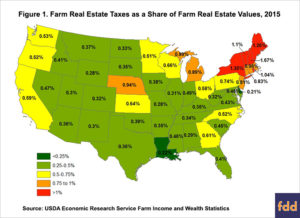
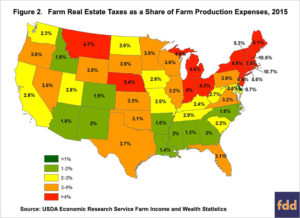
“The two most common concerns expressed by farmers are that (1) the effective tax rate exceeds the underlying value of the property [See Figure 1] and (2) the tax burden accounts for an outsized share of farm production expenses [See Figure 2].”


Figure 1 from, “The Ongoing Debate over Farmland Taxation.” (farmdoc daily, March 10, 2017).

Last week’s update noted that, “Figure 1 indicates a clear regional pattern. Effective tax rates are highest in the Northeast, at well above one percent of the farm real estate value. The lowest effective tax rates are found in Louisiana and Delaware, but the rates are relatively stable across most of the Midwest and Plains states.”


Figure 2 from, “The Ongoing Debate over Farmland Taxation.” (farmdoc daily, March 10, 2017).

And the farmdoc update added that, “The tax burden also indicates a clear regional pattern. Real estate taxes represent a larger share of production expenses in Northeastern States, but farm real estate taxes exceed four percent of total production expenses in a number of other states, including Indiana, Ohio, and Nebraska.”

“While farmland owners in all 50 States are given some form of preferential property tax treatment, a continued decline in farm profit margins will likely result in farmers requesting additional property tax relief,” the farmdoc update said.

Posted in Agriculture Law | Comments closed

Restaurant Deliverer Foodsby Raises $6 million- Breaking Out of Downtown Delivery

Kavita Kumar reported last week at the Minneapolis Star Tribune Online that, “While the restaurant delivery industry has been exploding in recent years, a Minneapolis-based start-up thinks it has cornered an untapped piece of the market: big office buildings in the suburbs.

“‘If you look downtown, it’s a crowded space,’ said Ben Cattoor, CEO of Foodsby. ‘But once you start breaking out of that high-density area, where delivery is a very difficult game, that’s where our model works. … We focus on the outskirts.’

“Investors have bought into the concept. Foodsby recently closed on a $5.9 million round of Series A funding led by Greycroft Partners, Corazon Capital and Rally Ventures.”

The article explained that, “Foodsby already is up and running in seven markets — the Twin Cities, Dallas/Fort Worth, Denver, Atlanta, Kansas City, Mo., Charlotte, N.C., and Des Moines. The company works with more than 4,000 businesses and has more than 700 restaurant partners such as Davanni’s, Subway, Chili’s and Leeann Chin.”

The Star Tribune article indicated that, “Founded in 2012, Foodsby was inspired by the multiple trips [Ben Cattoor, CEO of Foodsby] saw a restaurant delivery person make to his Inver Grove Heights office when he was an accountant at CHS Inc.

“‘I watched the same driver show up five times in 45 minutes,’ he said.

“Figuring there had to be a better way to coordinate such deliveries, he created the Foodsby platform. When office buildings sign up for the service, workers can see what restaurants are scheduled to make deliveries to their office that day and place an order.”

Last week’s article added that, “There’s no minimum order required and tipping is not expected, but there is a $2 delivery fee.

“The advantage for restaurants, Cattoor said, is that they can schedule all of their deliveries at once.”

Posted in Start-up Company Law | Comments closed

New Confined Livestock Operation Brings Controversy- Notices of Intent to Build/Expand Remain Strong in Illinois

Tracy Crane reported yesterday at the News-Gazette (Champaign, Il.) Online that, “Gabe Shepherd has been around hog barns since he was a kid.

“‘I’ve been covered in manure from head to toe,’ the grain and livestock farmer told more than 80 Fithian-area residents who packed the town’s community center recently, concerned about a large hog confinement operation to be built on Shepherd’s land by Parks Livestock, a Vermilion County-based company with facilities in several states and Canada.

“‘Manure is a wonderful fertilizer,’ said Shepherd, who will be using manure from the Parks facility to fertilize his crop land each fall. ‘That is what is in it for us, because manure is such a good fertilizer.'”

The article noted that, “Others in the Fithian area don’t feel the same as Shepherd.

“Rita Trankina, a lifelong Fithian resident, grew up on a farm west of the small town. Her dad tenant-farmed about 800 acres and had some cattle and a dairy cow for their family, she said.

“‘But it’s my opinion that this is a far thing from farming,’ said Trankina, who wasn’t familiar with large hog-finishing facilities but has recently done research that’s left her concerned about a myriad of issues, including air quality, contamination of nearby creeks and the use of antibiotics in the hogs that could be contributing to antibiotic resistance that affects humans.”

The News-Gazette article added that, “[T]he Vermilion County Board has taken a neutral stance on the issue. But the groundswell of opposition closer to Fithian continues to grow.

“The Fithian Village Board passed a resolution in February against construction of the Parks facilities. Less than two weeks ago, the village board in nearby Muncie did the same.

“Still, those actions have no legal bearing on the Illinois Department of Agriculture, which has until March 30 to either issue the permits or ask for more information from Parks.”

More broadly with respect to the state of Illinois, the News-Gazette article explained that, “Since January 2016, the state department of agriculture has received at least 50 notices of intent to build new hog facilities across Illinois, including three in Vermilion County.

“There have been another 40-plus notices of expansion, including two in Ford County, near the town of Cropsey. The Effingham area has been a hotbed of expansion, with at least six notices of intent for new operations or expansions.

“Driving this surge: the growing demand for pork, almost entirely in other countries, but particularly in the Asian market, according to [Art Halstead with Parks Livestock].”

Posted in Agriculture Law | Comments closed

Bee, Pollinator Awareness Raised by Missing Bee on Honey Nut Cheerios

Kristen Painter reported last week in the Minneapolis Star Tribune that, “General Mills has removed the bee mascot from its Honey Nut Cheerios box to increase pollinator awareness.

“The Golden Valley-based food company is asking consumers to help ‘bring the bees back’ by ordering and planting free wildflowers for the pollinators to feast on.

“‘BuzzBee’ is missing from cereal boxes in the United States and Canada.”

Graphic from the Minneapolis Star Tribune.

The article explained that, “The cereal company set up a website for people to order wildflower seeds that will be shipped to homes at no cost. General Mills hopes this will help the firm reach its goal of planting 100 million wildflowers this year while bringing greater awareness of the role that bees play in the food system.

“About 30 percent of all ingredients in the company’s products rely on pollination, and more than two-thirds of world crops that feed people are pollinated by bees, the company said. In the last several years, General Mills has given more than $4 million to Xerces Society to support pollinator and biodiversity projects.”

Ms. Painter added that, “The average Minnesota beekeeper lost nearly 60 percent of bees in 2015-2016, the highest average loss rate of any state, according to the USDA pollinator data.”

Posted in Agriculture Law | Comments closed

Iowa Governor Expresses Assurance on Trump Administration Biofuels Policy

William Petroski reported in on the front page of the business section in Tuesday’s Des Moines Register that, “Gov. Terry Branstad said Monday he is aware of reports of a backroom deal in the Washington, D.C., that would hurt Iowa’s renewable fuels industry, but has been assured President Donald Trump’s administration will support producers of ethanol and biodiesel fuels.

“‘I know the rumors and I can tell you who was involved, and I can tell you they are not true,’ Branstad told reporters Monday. He added that he has talked with his son, Eric Branstad, who works in the Trump administration, and that his son told him that ‘this is not going to happen.'”

The front page of the business section from Tuesday’s Des Moines Register.

The Register article indicated that, “The renewable fuels industry was in an uproar last week after a national advocacy group said a Trump official told the organization the president would sign an executive order shifting the burden for blending ethanol and biodiesel into the nation’s fuel supply from oil refiners to fuel retailers. The move, critics said, would hurt Iowa farmers and consumers by hindering the widespread use of ethanol and biodiesel. The White House subsequently distanced itself from the reports.”

Mr. Petroski added that, “Branstad said he had had a ‘very good meeting’ with Scott Pruitt, the newly confirmed administrator of the Environmental Protection Agency. He said Pruitt indicated that the Trump administration’s EPA will make timely decisions regarding the Renewable Fuel Standard, which requires transportation fuel to contain a minimum volume of renewable fuels.”

Posted in Agriculture Law | Comments closed