Mortgage Rates Jump Ahead of Federal Reserve Meeting

Bloomberg writer Prashant Gopal reported yesterday that, “U.S. mortgage rates rose, sending costs for 30-year home loans to their highest level this year before the Federal Reserve meets to consider an increase in its benchmark interest rate.

“The average rate for a 30-year fixed mortgage was 4.21 percent, up from 4.1 percent last week, Freddie Mac said in a statement Thursday. The average 15-year rate climbed to 3.42 percent from 3.32 percent.”

The Bloomberg article noted that, “The Treasury yields that guide mortgage costs jumped in the past week as a series of speeches by Federal Reserve officials bolstered traders’ expectations that the central bank will almost certainly raise rates at its March 14-15 meeting. Chair Janet Yellen said an increase ‘would likely be appropriate’ if the job market and inflation keep moving toward the Fed’s targets.”

Posted in Real Estate Law | Comments closed

Roadside Mowing in Rural Minnesota– Debate About Property Rights, Plight of Bees

Josephine Marcotty reported this week at the Minneapolis Star Tribune that, “A showdown over roadside mowing in rural Minnesota has unleashed a surprisingly passionate debate at the Legislature about the culture of farming, property rights and the desperate plight of bees and monarch butterflies.

“It’s put wildlife in a fierce — but so far losing — competition with Minnesota farmers for the right to the increasingly valuable grass, flowers and other vegetation that grow along 175,000 acres of state-owned roads across the state.

“A bill headed for a vote on the House floor would prevent the Minnesota Department of Transportation from asking landowners to get a permit before they mow roadside ditches and grassy shoulders — something farmers say they’ve been doing for decades without government intrusion.”

“A farmer returned to his farm on Hwy. 30 after raking ditch hay with his tractor. The state wants farmers to get permits to mow ditches, hoping to preserve the grassy strips along roads for wildlife habitat. But farmers say they rely on harvesting the grass to feed livestock.” (PHOTO and CAPTION from the Minneapolis Star Tribune).

The Star-Tribune article noted that, “As corn, soybeans and other row crops have expanded across the state, Minnesota has lost large expanses of grass and other crops available for livestock forage;” and the article added that, “Now, some farmers say roadside mowing is the only source of hay for their animals.

“The shift also means there is far less wild growth for pheasants, managed honeybees, wild insects and, perhaps most critically of all, monarchs, which can only reproduce on milkweed that is rapidly disappearing.”

This week’s article added that, “In rural Minnesota, landowners adjacent to the roads largely believe they own the land to the centerline and the government has rights to use it, he said. While that’s largely true for county and township roads, it’s not so for the state.”

And the article pointed out that, “[I]n a fragmented landscape, roadsides provide badly needed connections for animals and insects to move from one place to another and for plants to pollinate, said wildlife experts.”

“For now, however, legislation is well on its way in both the House and Senate, and it seems likely that the farmers will retain freedom to mow along state roads,” the Star Tribune article said.

Posted in Agriculture Law | Comments closed

Iowa AgriTech Accelerator Will Host Its First Class This Year

Laurie Bedord reported this week at Successful Farming magazine online that, “The Iowa AgriTech Accelerator, which was launched in 2016 by the Greater Des Moines Partnership and the Cultivation Corridor, will host its first class this year. Focused on ag tech startup companies, the Accelerator is designed to build upon one of the state’s key industries – agriculture – and the entrepreneurial activity that can advance technology in the industry.

“‘Central Iowa’s agriculture industry has a history of innovation,’ says Tej Dhawan, who will serve as the interim director. ‘The Accelerator will advance innovation by connecting many of the leading agriculture businesses and farm groups in our region to startups working with cutting-edge technology.'”

Ms. Bedord noted that, “In addition, the Partnership and Cultivation Corridor announced that Grinnell Mutual, Kent Corporation, and Sukup Manufacturing have signed on as investing companies to The Accelerator. They join DuPont Pioneer, Farmers Mutual Hail Insurance Company, John Deere, and Peoples Company. Each company has committed $100,000 to support The Accelerator for the first year.”

The update added that, “Investing companies will also provide mentoring to companies in The Accelerator. Additionally, the Iowa Corn Growers Association, the Iowa Soybean Association, and the Iowa Pork Producers Association will provide farmer mentors to the Accelerator. Iowa State University will provide technical and business expertise.

“The application process will be open from April 3 through May 12, 2017. Interested startup companies should contact Dhawan at tej.dhawan@agiowa.com.”

Posted in Agriculture Law, Start-up Company Law | Comments closed

Proposed Border Tax Could Hamper U.S. Ag Exports

Associated Press writer Katarina Velazquez reported late last week that, “Weld County, Colorado, is more than 700 miles from the closest Mexican border, but a proposed import tariff on the United States’ southern neighbor leaves local agriculture commodities in a state of uncertainty.

“At the end of January, President Donald Trump suggested a 20 percent tariff on all imports from Mexico to pay for his long-promised wall between the bordering countries.

“The move could spark a trade war that would harm Weld producers if Mexico executed a retaliatory tax or implemented trade barriers. Local producers could lose the income they get from exporting goods to Mexico. The tax also could raise prices on products for consumers in both countries or limit the products they could purchase.”

The AP article noted that, “Tom Lipetzky, trade spokesman for the Colorado Department of Agriculture, said if the tariff was implemented, the U.S. could expect Mexico to retaliate by imposing similar tariffs on U.S. products being exported to Mexico.

“Mexico is the second-highest export market for Colorado producers, according to the U.S. Department of Commerce, and losing that income would gouge producers already hurting from low commodities prices in the states.”

Ms. Velazquez pointed out that, “A Mexican senator, Armando Rios Piter, said in mid-February he wants to introduce a bill that would halt the country from buying U.S. corn, and shift those purchases to Brazil and Argentina. [Mark Sponsler, CEO of Colorado Corn] said that isn’t something he views as an imminent threat, but it’s something to address and keep in mind since it could hurt all U.S. corn farmers financially.

“‘Trade with Mexico is important in agriculture, and we, as in agricultural producers, benefit from trade with the country, and these are things that make us really look at that,’ he said. ‘The U.S. can’t lose any trading partner without it affecting our agriculture in Colorado.'”

Posted in Agriculture Law | Comments closed

Dairy Producers Call for Clarification on Meaning of “Milk”

Associated Press writer Candice Choi reported on Friday that, “Is ‘fake milk’ spoiling the dairy industry’s image?

“Dairy producers are calling for a crackdown on the almond, soy and rice ‘milks’ they say are masquerading as the real thing and cloud the meaning of milk. A group that advocates for plant-based products, the Good Food Institute, countered this week by asking the Food and Drug Administration to say terms such as ‘milk’ and ‘sausage’ can be used as long as they’re modified to make clear what’s in them.”

The AP article noted that, “The U.S. actually spells out the required characteristics for a range of products such as French dressing, canned peas and raisin bread. It’s these federal standards of identity that often trigger the food fights.

“Though soy milk and almond milk have become commonplace terms, milk’s standard of identity says it is obtained by the ‘complete milking of one or more healthy cows.’ That’s a point the dairy industry is now emphasizing, with the support of lawmakers who last month introduced legislation calling for the FDA to enforce the guidelines.

“‘Mammals produce milk, plants don’t,’ said Jim Mulhern, president of the National Milk Producers Federation.”

The AP article added that, “The Plant Based Foods Association, which represents companies like Tofurky and milk alternatives, says standards of identity were created to prevent companies from passing off cheaper ingredients on customers. But the group says that’s not what soy, almond and rice milk makers are trying to do.

“Those companies are charging more money, and consumers are gravitating toward them, said Michele Simon, the group’s executive director.”

Posted in Agriculture Law | Comments closed

Protection Against Tax ID Theft

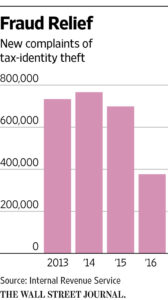
Laura Saunders indicated in Saturday’s Wall Street Journal that, “New cases of tax-identity theft have dropped sharply following coordinated efforts by tax agencies and preparers, but filers need to stay vigilant.

“Tax-ID theft, also called tax-refund fraud, occurs when a criminal uses stolen personal information to file a return in someone else’s name and receive a bogus refund. The thief claims the bogus amount whether or not the actual filer is due a refund.

“Victims are often unaware of the crime until a computer rejects the real return. Correcting the problem is often onerous and can take months.”

The Journal article explained that, “During 2016, the Internal Revenue Service received 376,000 new reports of tax-ID theft involving federal returns, less than half the total of 766,000 during the peak year of 2014. The agency also estimates that it rejected almost $6.6 billion in fraudulent refund claims in 2016, compared with $8.7 billion in 2015, indicating that thieves were less active. About 150 million individual returns are filed annually.”

Graph From The Wall Street Journal.

Some of the tips to protect against tax-ID theft contained in the Journal article included:

“-Push your preparer. Respected stand-alone accounting firms are a rich target now, experts say. Clients of these firms often pay taxes in April but don’t file returns for up to six more months after getting an extension—so the information is valuable to thieves in the meantime. Ask about the firm’s cybersecurity.

–Minimize tax refunds. The average refund now tops $3,000, and ID theft victims have to wait months for theirs. If you adjust withholding to get a lower refund or even small bill for tax due, there will be less pain if you’re a victim.

–Don’t be lazy with passwords. Make them strong and don’t use the same one for different portals, especially if you do your taxes online.”

Posted in General Interest | Comments closed

Still Waiting For a Secretary of Agriculture

Tamar Hallerman reported on the front page of Saturday’s Atlanta Journal-Constitution that, “Sonny Perdue wasn’t mentioned by name when President Donald Trump took to Twitter on Friday to lambaste Senate Democrats for slow-walking consideration of his two remaining Cabinet picks, but Georgia’s former two-term governor was clearly high on the chief executive’s mind.

“It’s been more than six weeks since Trump tapped the Republican to be his secretary of agriculture, and the Senate has yet to schedule a confirmation hearing for Perdue, much less a floor vote.

“What was not made clear in Trump’s tweet is that the delay has little to do with Congress at this point.”

The ACJ article explained that, “Perdue’s paperwork has yet to technically arrive in the Senate, which means lawmakers have been unable to officially vet Perdue. The holdup appears to be with the FBI, which is conducting a comprehensive background check that’s customary for all Cabinet nominees, according to two Republican senators and a handful of aides in the Senate and administration.

“Still unclear is what is causing the slowness or whether any red flags have been raised.

“Two transition officials and one White House aide not authorized to speak on the record insisted that nothing is wrong and that the delay has to do with Perdue being the last Cabinet nominee announced by the Trump administration, which put him at the back of the line as the feds screened other high-level picks.”

Ms. Hallerman added that, “The delay has led to frustration and some uneasiness on the part of Perdue’s allies, farm state lawmakers and Republican U.S. Rep. Pat Roberts of Kansas, the chairman of the Senate Agriculture Committee, who has underscored the need to quickly install a new agriculture head.

“‘As soon as we get the paperwork we’ll move,’ Roberts said Thursday. ‘We can pass him out of committee, we can pass him on the floor.’

“Two administration aides said they are optimistic that all the paperwork can be delivered to the Senate within the next week.”

Posted in Agriculture Law | Comments closed

IRS Could Face Budget Cuts

New York Times writer Alan Rappeport reported last week that, “President Trump has a rocky history with the Internal Revenue Service, which he has complained audits him with unfair ferocity. Now he wants to significantly cut the tax agency’s funding at a time when it has already been bleeding staff and struggling to keep up with a flood of returns ahead of Tax Day.

“The plans, revealed this week in documents associated with the White House budget outline, put Mr. Trump at odds with his Treasury secretary, Steven Mnuchin, who has argued that the I.R.S. needs more money and a larger staff.

“Another round of cuts, tax experts say, could put one of the few federal departments that pay for themselves on life support.”

The Times article noted that, “The White House budget office has proposed a 14.1 percent cut to the I.R.S. for the fiscal year that begins in October, reducing the agency’s budget to $9.65 billion; six years ago, it stood at $12.1 billion ($13.6 billion when adjusted for inflation).

“If approved, the cuts would happen when the number of audits is down and customer service complaints are up as a result of the drop in funding.”

Mr. Rappeport pointed out that, “Promising to modernize a Treasury unit that many conservatives have threatened to abolish, Mr. Mnuchin said he was certain that Mr. Trump understood the concept of ‘we add people, we make money.’ Investing in the I.R.S., Mr. Mnuchin suggested, was a smart move because the agency’s work ultimately paid for itself through the revenue that it brought in.

“The White House, it seems, has other ideas.

“The potential reduction in I.R.S. funding is the latest example of potential division within the Trump administration’s economic team, which has wrestled with how to cut taxes, invest in the military and lower the debt at the same time.”

The Times article added that, “Handicapping the agency with additional budget cuts will make matters worse, experts say, emboldening scofflaws to take their chances against an increasingly toothless tax collector. And as funding continues to fall, honest taxpayers are suffering from a lack of attention.”

Posted in General Interest | Comments closed

Washington State Booming Wine Industry Enjoys Record Grape Production

Associated Press writer Nicholas K. Geranios reported on Wednesday that, “Washington state’s booming wine industry produced a record harvest of wine grapes in 2016 after cooler weather lengthened the growing season, officials said Wednesday.

“Last year’s harvest in Washington, the second-largest producer of premium wines in the U.S., tallied 270,000 tons, beating the state’s previous record of 227,000 tons in 2014, according to the Washington State Wine Commission, which represents licensed wineries and wine grape growers.

“As recently as 2012, the state produced just 188,000 tons of grapes.”

The AP article explained that, “California is by far the nation’s largest wine producer. A preliminary report for 2016 showed that farmers there grew 4 million tons of grapes, up 8.5 percent from the year before but short of a record. California’s final report on the grape crush is due March 10.

“In Washington, the 2016 haul was up 22 percent from 2015. Red varieties outpaced white, totaling 58 percent of the harvest. Cabernet Sauvignon was the top variety.”

Mr. Geranios added that, “The state has more than 900 wineries, with most of the grapes grown east of the Cascade Range that runs through the middle of the state.”

Posted in Agriculture Law | Comments closed

St. Louis AgTech Hub Urged to Focus on Community Development

Steph Kukuljan reported last week at the St. Louis Business Journal Online that, “39 North, St. Louis’ agtech innovation hub, should focus on community development and diversity in order to truly succeed, Danforth Center Chief Operating Officer Sam Fiorello said [Feb. 21st] at Venture Cafe’s latest program.

“Fiorello was part of a panel discussion on the future of agtech that featured Monsanto Co. Chief Technology Officer Robb Fraley, BioSTL GlobalSTL Lead Vijay Chauhan and KWS’ Derek Bartlem at the Donald Danforth Plant Science Center in Creve Coeur. It was a standing-room only crowd at the discussion, which was the first event of the inaugural Venture Cafe: 39 North, a monthly networking and discussion program. It was the first of two new local programs put on by Venture Cafe, the nonprofit that hosts gatherings that attract more than 500 people weekly in the Cortex innovation district.”

The update added that, “Fiorello advocated for 39 North to reach out to the community, especially people of color, to broaden the innovation hub’s economic impact. Fraley echoed the community engagement sentiment, relating Monsanto’s struggles of maintaining broad public support for its work after it neglected to educate the community on genetically modified products when they first came to the market.”

Posted in Agriculture Law, Start-up Company Law | Comments closed