Danone, WhiteWave Antitrust Yogurt Issue

Rick Barrett reported in today’s Milwaukee Journal Sentinel that, “A Wisconsin-based group that represents organic farmers says it’s won a U.S. Department of Justice victory against Danone, the France-based maker of Dannon yogurt, regarding competition in the American yogurt market.

“The Cornucopia Institute says it argued that Danone should liquidate its holdings in the Stonyfield Farms organic yogurt brand as a condition of Danone’s proposed $12.5 billion acquisition of WhiteWave Foods.

“The Justice Department agreed and said it would approve the WhiteWave deal if Stonyfield were sold to an independent buyer.”

Mr. Barrett noted that, “The sale will help ensure competitive marketplaces for farmers that sell organic milk and consumers who purchase it nationwide, the Justice Department said in a statement.”

The Journal Sentinel article added that, “Danone is a global food company that had $24.3 billion in sales in fiscal 2015. Stonyfield Farms, a Danone subsidiary, is one of the nation’s largest organic yogurt makers.”

Posted in Agriculture Law | Comments closed

American Bankers Association Presents Testimony at House Agriculture Committee Hearing

An update this week at the American Bankers Association (ABA) Journal Online stated that, “Testifying on behalf of the [ABA] today at a hearing before the House Agriculture Committee’s Commodity Exchanges, Energy and Credit Subcommittee, banker Nate Franzen outlined several changes ABA is seeking in the upcoming Farm Bill. Franzen is president of agri-business at First Dakota National Bank in Yankton, S.D., and past chairman of ABA’s Agricultural and Rural Bankers Committee.

“Highlighting the successes of the previous Farm Bill — in particular, the bill’s improvement of crop insurance, the Conservation Reserve Program and removal of borrower term limits for the Farm Service Agency’s guaranteed loan programs — Franzen noted that the new bill must make ‘substantial changes’ to keep pace with the changing agricultural landscape. Specifically, he advocated for increasing the current loan limit on FSA guaranteed loans, noting that the formula for indexing the programs has not kept up with the rising costs of agriculture. ABA has endorsed legislation introduced by Rep. Mike Bost (R-Ill.) that would increase the cap from $1.4 million to $3.5 million and double the size of direct operating and ownership loans from $300,000 to $600,000.”

Mr. Franzen also noted that, “The agricultural economy has been slowing, with farm sector profitability expected to decline further in 2017 for the fourth consecutive decline. However, farm and ranch incomes for the past five years have been some of the best in history. With the 2014 Farm Bill in place, farmers, ranchers, and their bankers achieved a level of certainty from Washington about future agricultural policy. Interest rates continue to be at or near record lows, and the banking industry has the people, capital and liquidity to help American farmers and ranchers sustain through any turbulence in the agricultural economy.

“Banks continue to be one of the first places that farmers and ranchers turn when looking for agricultural loans. Our agricultural credit portfolio is very diverse – we finance large and small farms, urban farmers, beginning farmers, women farmers and minority farmers. To bankers, agricultural lending is good business and we make credit available to all who can demonstrate they have a sound business plan and the ability to repay.

“In 2015, farm banks – banks with more than 15.5% of their loans made to farmers or ranchers – increased agricultural lending 7.9 percent to meet these rising credit needs of farmers and ranchers, and now provide over $100 billion in total farm loans. Farm banks are an essential resource for small farmers, holding $48 billion in small farm loans, with $11.5 billion in micro- small farm loans (loans with origination values less than $100,000). These farm banks are healthy and well capitalized and stand ready to meet the credit demands of our nation’s farmers large and small.”

Posted in Agriculture Law | Comments closed

Millennial Entrepreneurs- If Ventures Stall, Consider an M.B.A.

Kelsey Gee reported yesterday at The Wall Street Journal Online that, “Millennial entrepreneurs are starting to hear an unlikely piece of advice when their ventures stall: consider an M.B.A.

“Graduate business programs from Columbia University in New York to University of California at Berkeley’s Haas School have spent millions of dollars building innovation centers and creating venture-capital funds in recent years. They are adding new courses and deploying industry veterans to teach, all in an effort to recruit more would-be founders.

“A quarter of prospective M.B.A. students aimed to start a business in 2015, according to the latest Graduate Management Admission Council survey, up from 20% in 2010. Even so, academia has been slow to adapt, with fewer than 10% of graduate business programs offering degrees in entrepreneurship last year, according to the Association to Advance Collegiate Schools of Business.”

The Journal article noted that, “The ballooning resources for student ventures reflect a streak of opportunism among young entrepreneurs in need of funding and university admissions officers, who can proudly plug graduates’ startups on their schools’ websites. Some administrators hope the growing interest among millennials to create companies—rather than pursue traditional post-M.B.A. careers like investment banking—will reinflate a shrinking pool of applicants to U.S. business schools.”

Ms. Gee added that, “Business degrees have become an easier sell for would-be founders as schools now teach how to grow small businesses, in addition to managing large ones, said Steve Blank, an entrepreneur and lecturer at Haas and Columbia’s business school.”

Posted in Start-up Company Law | Comments closed

New York City Sees Farm-to-Table Movement Merge With Condo Boom

Josh Barbanel reported today at The Wall Street Journal Online that, “It was only a matter of time before the farm-to-table movement merged with the Brooklyn condominium boom.

“On a large south-facing terrace on the eighth floor of 550 Vanderbilt Ave., an 18-story brick and concrete building near the Barclays Center in downtown Brooklyn, crews are erecting three large metal boxes and filling them with soil suitable for high-altitude farming.

“Condo owners will be able to sign up for a small plot to grow their own vegetables there, alongside Ian Rothman, a farmer and co-owner of Olmsted, a trendy farm-to-table restaurant a few blocks away.”

The Journal article explained that, “Farm-to-condo is an extension of the flowering urban farming movement that has produced crops on the grounds of public-housing developments and on the sprawling rooftops of commercial buildings in the city.

“Last year a 5,000 square-foot farm opened in a courtyard between two rental buildings at Urby, a development near the waterfront in Stapleton on Staten Island. That farm is tended by a resident farmer, who receives a salary and a free apartment to tend the fields.”

Mr. Barbanel added that, “Condo owners will be able to sign up each season for plots of at least 7 feet by 10 feet in the 1,600 square-foot farm, enough to harvest a significant edible crop, said Ashley Cotton, executive vice president for external affairs at Forest City Ratner Cos. The largest farm bed will be about 39 feet by 21 feet and will be divided by plank walkways.”

Posted in Agriculture Law, Start-up Company Law | Comments closed

In Response to Wildfires, USDA Authorizes Emergency Grazing on Some CRP Land

A news release yesterday from the U.S. Department of Agriculture (USDA) stated that, “[USDA], acting in response to a directive from President Donald J. Trump, today authorized emergency grazing on Conservation Reserve Program (CRP) lands located in Kansas, Oklahoma, and Texas – the three states which were most heavily impacted by ongoing wildfires which began on March 6, 2017. USDA Acting Deputy Secretary Michael L. Young issued a memorandum authorizing the emergency grazing of cattle by ranchers, who are facing the ruination of their herds due to lack of sufficient grazing land. The authorization is pursuant to appropriate restrictions and conservation measures, which can be found in the Acting Deputy Secretary’s memorandum.

“‘Ranchers are facing devastating conditions and economic calamity because of these wildfires and they need some relief, or else they face the total loss of their herds in many cases,’ said Acting Deputy Secretary Young. ‘These measures will allow them to salvage what remains of their cattle and return to the important business of feeding Americans and the rest of the world. I commend and thank President Trump for acting decisively in response to this dire situation.'”

The news item added that, “Ranchers and farmers are only now able to begin to estimate losses, since the fires are still burning in some places and access to the lands to survey the damage has been limited.”

Posted in Agriculture Law | Comments closed

Annual Contributions When Dividing Farm Business Income

Michael Langemeier indicated in an update last week at the farmdoc daily blog (“How Should Farm Business Income be Divided?”) that, “If everyone in the farm business owned a similar amount of business assets, worked the same number of hours, and provided management expertise, the answer to the question in the title would be very straightforward. In this unlikely scenario, business income could be split equally. Unfortunately, asset ownership, hours worked, and management responsibilities vary across managers, operators, and owners of the business. This increases the importance of coming up with a conceptual framework to divide farm business income. This article describes a model that can be used to divide farm business income, and provides an illustration of how this model can be used in practice.”

The update noted that, “Hofstrand (2016) describes two methods that can be used to divide business income between parties in the business in an equitable manner. These two methods are the contributions model and the 50/50 model. With the contributions model, which is the focus of this article, an annual contribution is computed and allocated to each party before splitting net income. Annual contributions are computed using the relative value of each party’s contribution of resources to the farm business.”

Dr. Langemeier explained that, “Resources that need to be included in the contributions model include land, buildings, machinery and equipment, breeding livestock, working capital, and labor and management.”
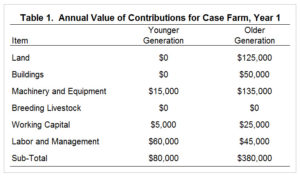
Graph from the farmdoc daily blog, “How Should Farm Business Income be Divided?” (March 31, 2017).

The farmdoc update added that, “Table 1 contains an illustration of how the contributions model can be used to divide business income. This illustration assumes that there are two parties involved, a younger and an older generation. In this illustration, the older generation owns the vast majority of the land, buildings, machinery and equipment, and working capital…[I]t is important to note that the annual contributions reported in table 1 are distributed before net income is split between the parties.”

“The annual value of the contributions will need to be updated every year to account for changes in owned acres, building values, machinery and equipment values, and working capital. When dealing with a younger generation and an older generation, what typically happens is the annual contribution of the younger generation increases over time while the annual contribution of the older generation decreases over time. If assets were purchased together, the ownership shares would need to be divided accordingly. It is also important to note that if assets are disposed of the sales amount needs to be divided using the ownership percentages,” the farmdoc update said.

Posted in Agriculture Law | Comments closed

In U.S. Food Start-Up Scene, Granola is Popular

Kristen Leigh Painter reported in today’s Minneapolis Star Tribune that, “The venture capital arm of General Mills is investing in Purely Elizabeth, a Boulder, Colo.-based maker of granola, oatmeal, muesli and cereal that uses more nutrient-rich ingredients than a typical bowl of grains.

“The $3 million investment from General Mills’ 301 Inc. unit is Purely Elizabeth’s first funding round and General Mills is the sole investor.

“Granola is a popular product in the U.S. food start-up scene, but 301 Inc. believes Purely Elizabeth offers unique ingredients, taste and leadership under chief executive and founder Elizabeth Stein.”

The article noted that, “‘She was early to use chia seed and millet and some of these other novel grains as a part of her formulation, so she’s always been on the leading edge,’ said John Haugen, vice president and general manager of 301 Inc. ‘It’s nutrient-dense, but the reason people keep buying it is because it’s delicious.’

“This is the eighth food start-up that 301 has invested in since General Mills reset the division in fall 2015.”

Ms. Painter added that, “Previously, the purpose of 301 Inc. was to develop cutting-edge product ideas in-house for General Mills. But, the company quickly realized it couldn’t out-compete, on ideas and passion, the swell of food entrepreneurs across the nation.

“It now invests in early-stage food companies to help them grow market share and improve business fundamentals while General Mills gains a potential leg up if the packaged-food giant wanted to acquire the brand down the road.”

Posted in Agriculture Law, Start-up Company Law | Comments closed

Cargill PR Issues Regarding GMOs

Kristen Leigh Painter reported on Saturday at the Minneapolis Star Tribune Online that, “As soon as Cargill announced that an outside group had certified more than a dozen of its ingredients as non-GMO, the agribusiness giant was publicly scourged by some of its closest allies.

“The moment should have been a good one for the world’s largest agriculture business. But a backlash came fast and furious online, pitting familiar factions against one another: those for and those against ­genetically modified foods.

“The situation highlights the tricky balance large food companies are trying to strike among competing interests. For a sprawling company like Cargill, it shows the challenge of appeasing its customers without alienating its suppliers.”

The article pointed out that, “Critics were particular vexed by Cargill’s choice of third-party ­certifier: the Non-GMO Project, which opposes genetic modification in food production. Since Minnetonka-based Cargill is one of the world’s largest producers of genetically modified foods, many of its suppliers, as well as some in the science community, felt betrayed.”

Ms. Painter explained that, “The federal government did pass a law in July requiring all food manufacturers to label products — either with a word, picture or QR code — that contain GMOs. The law provides a definition for bioengineered foods that some groups, including the Food and Drug Administration, have said may be too narrow. This leaves third-party verifiers as the most sought-after standard.”

The Star Tribune article added that, “While Cargill may be accused of supporting an organization that is trying to change its supply chain and activities, the company has never been shy about its support of farmers and GMO technology.

“‘We fully recognize that GMO technology is essential and indispensable to sustainably feed the world’s rapidly expanding population,’ [Randy Giroux, Cargill’s vice president of food safety]­ said in an e-mail. ‘We have thousands of scientists and agronomists working to enable new biotech crops. We are unshaken in our belief in the safety of GMOs and are wholly committed to our GMO ­partners.'”

Posted in Agriculture Law | Comments closed

Community Bankers Optimistic on Regulatory Reprieve

Paul Gores reported on Saturday at the Milwaukee Journal Sentinel Online that, “A group of Wisconsin bankers on a recent lobbying trip to Washington, D.C., returned with heightened optimism that some of the rules now governing community banks — regulations they contend are too costly — will be eased.

“Community banks in Wisconsin and the U.S., defined generally as banks with assets of less than $10 billion, have complained since 2010 that reforms passed by a then-Democrat controlled Congress and aimed at preventing another financial crisis unfairly imposed an expensive compliance burden on them.

“They’ve argued that consumers have been affected in the process, too, as banks have stopped offering some services rather than go through the hassle of dealing with the new rules.”

The article noted that, “Now that President Donald Trump has told the Treasury secretary to review the 2010 Dodd–Frank Wall Street Reform and Consumer Protection Act and its thousands of regulations, community bankers are hopeful some relief could be on the way.”

Mr. Gores added that, “While big banks don’t like the cost of complying with new rules, either, the expense of compliance, form-completion and additional record keeping is more difficult for smaller banks to absorb, [Rose Oswald Poels, who as chief executive of the Wisconsin Bankers Association] said.”

Posted in General Interest | Comments closed

Home Prices on the Rise

Wall Street Journal writer Laura Kusisto reported this week that, “U.S. home prices rose in January at their fastest rate since mid-2014, a trend that bodes well for sellers but could start to eat into demand as buyers get priced out of the market.

“The S&P CoreLogic Case-Shiller Indices, which cover the entire nation, rose 5.9% in the 12 months ended in January, the strongest increase in 31 months, up from a 5.7% year-over-year increase in December.

“The 10-city index gained 5.1% over the year, up from 4.8% the prior month, and the 20-city index gained 5.7%, up from a 5.5% increase.”

The Journal article noted that, “The accelerating gains are being driven by job growth, a large demographic of people entering their 30s and looking to buy homes, and limited supply of homes on the market.

“Economists said it isn’t sustainable for price growth to outpace income growth for long, however. Wages are rising at about 2.5%, much slower than home prices.”

Ms. Kusisto explained that, “Limited supply is a big driver of the price gains. Inventory in December hit its lowest level since 1999, when the National Association of Realtors started tracking the data. The number of homes for sale was down 7.1% in January compared with a year earlier, the Realtors said. It has since ticked up slightly, but inventory in February remained 6.4% below a year earlier.”

Posted in Real Estate Law | Comments closed
