
New Corn, Soybean Apps from Purdue University

A news release last week from Purdue University stated that, “Purdue Extension has introduced two new mobile apps based on the annual Corn and Soybean Field Guide, making it even easier for grain producers, crop advisers and other agribusiness professionals to access timely, research-based crop management information.

“Both the Corn Field Scout and Soybean Field Scout apps include detailed text written by Extension specialists along with photos and interactive tools to help users address common crop management issues.

“‘The apps are designed to be user-friendly and provide the latest available updates from Purdue Extension specialists,’ said Corey Gerber, director of Purdue’s Crop Diagnostic Training and Research Center and member of the app development team. ‘Used along with the Corn and Soybean Field Guide, the apps are a tremendous reference tool to have handy throughout the growing season.'”

Last week’s update added that, “Both apps provide calculators to determine optimal seeding rates and estimate yield loss, as well as recommendations for limestone, nitrogen, phosphorus and potassium application. There are also pages to add field notes.

“Each app costs $5.99. Versions are available for both iOS and Android devices. For the iOS version of the Corn Field Scout, go to the Apple App Store at https://itunes.apple.com/us/app/purdue-extension-corn-field-scout/id1127799599?mt=8. For the Android version, visit Google Play at https://play.google.com/store/apps/details?id=purdue3id.edu.fieldguide.CornScout&hl=en.

“The iOS version of the Soybean Field Scout is available from the Apple App Store at https://itunes.apple.com/us/app/purdue-extension-soybean-field-scout/id1127801827?mt=8 and the Android version is available on Google Play at https://play.google.com/store/apps/details?id=purdue3id.edu.fieldguide.SoybeanScout&hl=en.”
Posted in Agriculture Law | Comments closed

Butter or Margarine? Spawns Lawsuit

New York Times writer Daniel Victor reported earlier this months that, “If you order chicken, you expect chicken.

“If you order a coffee, you expect a coffee.

“But if you order butter, is margarine or a vegetable spread an acceptable substitute?

“It wasn’t to Jan Polanik, who sued 23 Dunkin’ Donuts locations in Massachusetts for serving him ‘margarine or a butter substitute’ instead of butter with his bagels between June 2012 and June 2016. He filed a pair of class-action lawsuits in March against franchise owners who are responsible for multiple stores. He paid 25 cents for butter and was not told a substitute was used, according to the suits.”

The Times article noted that, “Thomas G. Shapiro, a lawyer who represented Mr. Polanik, said it was unclear what each of the restaurants used in lieu of butter, but one of the stores had ‘a large tub that looked a lot like a tub of Country Crock, a very inexpensive spread that is sold in grocery stores.’

“‘The main thrust of the case, really, is to get the stores, and hopefully Dunkin’ Donuts generally, to change that practice and not deceive people,’ he said.”

Mr. Victor added that, “Dunkin’ Donuts said in a statement that it was aware of the lawsuit but did not address any companywide butter policies.

“‘The majority of Dunkin’ Donuts restaurants in Massachusetts carry both individual whipped butter packets and a butter-substitute vegetable spread,’ the company said in a statement.”

The article also pointed out that, “Take Wisconsin. It would be wise for you to not mess with Wisconsin’s butter.


“There, butter-specific laws crack down on would-be margarine hawkers. An unannounced margarine-for-butter swap at a restaurant is expressly forbidden, punishable by a fine of up to $500 and three months in prison for the first offense, and as much as $1,000 and a year in prison for subsequent offenses. Margarine cannot be served to students, patients or inmates in state facilities.”

Posted in Agriculture Law | Comments closed

Agriculture Isn’t Just for Farmers

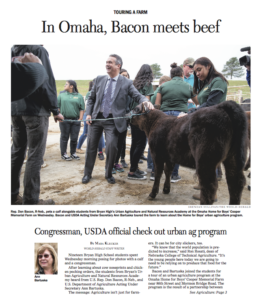
Mara Klecker reported in today’s Omaha World-Herald that, “Nineteen Bryan High School students spent Wednesday morning posing for photos with a calf and a congressman.

“After learning about cow noseprints and chicken pecking orders, the students from Bryan’s Urban Agriculture and Natural Resources Academy heard from U.S. Rep. Don Bacon, R-Neb., and U.S. Department of Agriculture Acting Under Secretary Ann Bartuska.

“The message: Agriculture isn’t just for farmers. It can be for city slickers, too.”

From today’s Omaha World-Herald.

Today’s article noted that, “‘It’s so important to give the public, especially our young people, the chance to see what agriculture looks like,’ Bartuska said. Though the USDA typically is thought of as a department with a rural focus, Bartuska said that notion is changing. Over the past few years, the department has developed an urban agriculture ‘toolkit’ for city dwellers who want to start growing their own food.

“‘I think there’s a growing demand for this now,’ Bartuska said. ‘It started with the local food movement and stimulated this desire for more urban farms.’

“Bacon said as a farm kid living 5 miles away from the nearest town, he wouldn’t have been able to imagine farms within city limits.”

The World-Herald article added that, “‘Fewer and fewer people are in touch with agriculture,’ [Rep. Bacon] said. ‘I think it’s really important to train folks who aren’t living on farms to appreciate agriculture and what it does.'”

Posted in Agriculture Law | Comments closed

Equity Crowdfunding- New Opportunities, But Caution for Everyday Investors

Christopher Mims noted earlier this week at The Wall Street Journal Online that, “When Oculus VR sold to Facebook for $2 billion in 2014, some asked: What if the people who backed the virtual-reality startup two years earlier on the crowdfunding site Kickstarter had received shares instead of T-shirts or VR headsets?

“They might have seen $100 turn into $14,000, says Richard Swart, chief strategy officer of NextGen Crowdfunding.

“Until the past year or two, the Oculus approach to crowdfunding was the only one available to everyday investors who aren’t wealthy. Federal law prohibited Kickstarter and similar platforms from offering shares to backers, so startups doled out merchandise or other perks instead.”

Mr. Mims explained that, “But the Securities and Exchange Commission recently finalized rules based on the 2012 Jumpstart Our Business Startups (JOBS) Act, creating an opportunity for so-called equity crowdfunding, which companies like Mr. Swart’s are eager to promote.”

Nonetheless, the Journal article noted that, “An Oculus-like success story is what the equity crowdfunding industry needs in order to take off, proponents say. However, most of the deals investors are buying into so far suggest such an outcome is unlikely anytime soon.

“Worse, it seems as though many investors will be unlikely to see any return on their investments at all: Some companies appear to be using this funding mechanism as a last resort, having been passed over by professional investors.”

Mr. Mims added that, “It’s clear that the original intention of the JOBS Act—to encourage formation and growth of new businesses in a world in which the stock market is actually shrinking—was a good one. What isn’t yet clear, and won’t be clear for some time, is whether everyday investors will be savvy enough to sort the good deals from the bad.”

Posted in Start-up Company Law | Comments closed

U.S. Senator Chuck Schumer Calls for Expanded Crop Insurance for Barley- Assist Craft Brewers in New York

An Associated Press article from earlier this week reported that, “Sen. Charles Schumer [D., N.Y.] is calling on the U.S. Department of Agriculture to make crop insurance for malt barley available to more New York farmers to help the craft brewing industry in the state.”

The AP article explained that, “New York’s farm and craft breweries need state-grown malt barley to make their beer, but many farmers are unwilling to plant it because it’s prone to losses from severe weather and disease.

“Schumer says more farmers would take the risk if they had access to federal crop insurance like growers do in other states. Right now, the insurance is available in only four New York counties.”

A related news update from Sen. Schumer pointed out that, “Schumer explained that there is currently a need for increased malt barley production throughout New York State as a result of its burgeoning craft brewing industry. Alongside water, yeast and hops, barley is one of the major components of beer and of many spirits produced by distilleries. Malt consists of barley that is germinated and then dried under highly controlled conditions. These conditions help to release the enzymes needed to convert the barley starches into sugars. These sugars are then fed to yeast through the process of fermentation, which ultimately creates the final product, alcohol. Schumer explained that many Central New York farmers are beginning to grow this barley, which they then often provide to malt houses like 1866 Malt House. These malt houses take the barley seed grains and put them through the process of malting; this is so the barley seeds can begin to germinate and thus convert the starches into sugars. This malt barley is then given to brewers and distillers who have the yeast and fermentation conditions needed to make beer and spirits.

“Schumer noted that the craft beer industry has been growing throughout New York State over the past few years and in the Central New York. This growth has increased the need for local ingredients, like hops and malt barley. The hops industry has already taken off, however hops are needed in much smaller quantities than malt barley. For example, to make a typical half-keg worth of beer (15.5 gallons) less than five pounds of hops would be required. Conversely, the amount of malt barley needed ranges from 35-50 pounds. As a result, New York State will need more farmers to grow barley and more malt houses to convert that barley into malt if the suppliers are to keep up with the industry needs.”

Posted in Agriculture Law | Comments closed

Trump Ag Advisor: Administration Won’t Allow EPA Funded Attacks on Farmers

Don Jenkins reported late last month at the Capital Press Online that, “President Trump’s top agricultural adviser says the new administration won’t tolerate federal support for advocacy campaigns like What’s Upstream.

“Ray Starling, special assistant to the president for agriculture, trade and food assistance, outlined the White House’s farm policy priorities in a speech March 21 at the National Press Club in Washington, D.C.

“‘This administration will not allow the EPA to give taxpayer dollars to activist groups who then turn around and put up billboards that attack our farmers and ranchers,’ said Starling, a former general counsel for the North Carolina Department of Agriculture.”

The Capital Press article explained that, “Between 2011 and 2016, the Environmental Protection Agency financially supported What’s Upstream, which was organized by the Swinomish Indian Tribe and several environmental groups. They hoped to influence Washington state lawmakers to vote for stricter limits on farming near waterways.

“The campaign included a website, radio ads and a letter-writing campaign, but billboards in Olympia and Bellingham attracted the attention of federal lawmakers. The EPA withdrew its support soon after Senate Agriculture Committee Chairman Pat Roberts, R-Kan., called the billboards ‘disturbing‘ and ‘malicious.'”

Mr. Jenkins added that, “The tribe, funded by an EPA grant passed through the Northwest Indian Fisheries Commission, had a budget of some $655,000 for the campaign. The EPA’s inspector general has yet to release a congressionally requested audit into how the money was used.”

Posted in Agriculture Law | Comments closed

North Carolina State Lawmakers Address Hog Farm Liability

Associated Press writer Jonathan Drew reported yesterday that, “Legislation to limit farms’ liability in lawsuits over animal waste smells passed the [North Carolina] state House Monday after a significant change that will keep it from applying to current lawsuits against a large hog producer.

“After a lengthy debate, the House narrowly voted to add language to specify the legislation would not apply to any pending cases. The chamber then passed the amended bill as a whole, sending it to the state Senate.

“The legislation would limit penalties that a jury or judge could impose against hog farms or other agricultural operations in lawsuits accusing them of creating a nuisance for neighbors. The farms’ liability would be limited to the lost rental or property value plaintiffs can prove was the result of the nuisance. The liability couldn’t exceed a piece of property’s market value.”

The AP article noted that, “One of the bill’s sponsors, Republican Rep. Jimmy Dixon of Duplin County, argued that the bill was needed to protect the network of contract farmers in North Carolina who raise the hogs for large pork producers.

“Dixon, himself a longtime farmer, argued that many of the allegations that the farms create a nuisance are ‘at best exaggerations and at worst outright lies.'”

Mr. Drew added that, “Dixon represents a territory dotted with livestock operations in the country’s No. 3 hog state by gross income. Hogs were a $21 billion industry nationwide in 2015, with North Carolina operations racking up $2.3 billion of that, according to the U.S. Agriculture Department.”

Recall that Iowa recently passed legislation regarding livestock operations and nuisance lawsuits, background on that state law is available at this BartellPowell update from March 24th.

And an Illinois state lawmaker also introduced legislation recently regarding large livestock operation waste issues.

Posted in Agriculture Law | Comments closed

Start-Up Technology Hubs: Wisconsin–Midwest Gain Recognition

Rebecca Carballo reported on Saturday at the Milwaukee Journal Sentinel Online that, “Wisconsin is gaining some national media recognition in its quest to build a reputation as a hub for start-up technology companies.

“The most recent splash of publicity came when a national report by TechNet and the Progressive Policy Institute announced its list of 25 cities poised to add 1 million tech jobs in the next five years.”

Graph from The Milwaukee Journal Sentinel.

The article noted that, “Madison ranks 16th in the report, which is titled, “The Top 25 ‘Next in Tech’ Cities Fostering Startup Growth.’

“According to the report, start-ups are heading to the Midwest heartland and the South.”

Ms. Carballo added that, “Emerging tech hubs — the so-called ‘Next in Tech’ cities — are setting up shop in cities such as Madison; Provo, Utah; Nashville, Tenn.; New Orleans; Cleveland; Denver; and Charleston, S.C. The lures of a lower-cost of living and talent pools fed by nearby colleges help. But in the case of several cities, such as Detroit (internet of things, connected cars) and Nashville (health care), local industries and existing infrastructure are the real carrots.

“‘I was surprised by cities in the Midwest that made the list,’ says Michael Mandel of PPI, who conducted the study. E-commerce contributed to job creation in Ohio, Tennessee and Kentucky among companies large and small, he said.

“‘Start-up culture began in the garages of Silicon Valley, but has spread nationally,’ says Linda Moore, CEO of TechNet, a bipartisan network of tech executives. ‘The best, most productive way to create jobs is to foster start-ups in those regions.'”

Posted in Start-up Company Law | Comments closed

Wine / Grape Industry Expanding in Indiana- Startups Assisted by the Purdue Wine Grape Team

A news release last week from Purdue University indicated that, “It’s probably not the first thing that comes to mind when Indiana is mentioned, but the Hoosier wine industry is among the fastest growing agriculture industries in the state.

“Indiana wine sales have steadily increased by 15 percent each year to create an industry that produces more than 1 million gallons of wine, and contributes more than $72 million to the state’s economy, according to the Purdue Wine Grape Team, which helps support Indiana’s wineries and vineyards. The state currently has 92 wineries, up from 34 in 2007.

“The team, which consists of the Purdue departments of Food Science, and Horticulture and Landscape Architecture, features Extension specialists in enology (winemaking), viticulture (grape growing), and marketing. These specialists assist commercial and amateur grape growers and winemakers in Indiana and around the world.”

The news release noted that, “This summer, there will be a few new wineries opening across the state, adding to the current 92 that the team supports. The team helps new and start-up wineries and vineyards by providing educational resources and advice.”

Last week’s update added that, “This summer, the Purdue Wine Grape Team will host the 26th annual INDY International Wine Competition on May 24-25 with more than 2,000 entries from 11 countries and 40 U.S. states. This competition is the largest scientifically organized and independent wine competition in the United States and is an excellent way for wine producers worldwide to showcase their skills.”

Posted in Agriculture Law | Comments closed

Use of Drones for Agriculture on the Rise

Cody Nagel reported in today’s Omaha World-Herald that, “Steve Kyes owns roughly 2,800 acres of farmland north of here [Central City, Neb.], mostly corn and soybean fields.

“With the help of his stepson, Andrew Luebbe, and a hired employee, Kyes, 44, and his crew have focused on increasing their profits.

“Inside Kyes’ farm office sits an unmanned aerial vehicle (UAV) — commonly known as a drone — with the potential to make his operation more efficient and, maybe someday, more profitable.”

From the front page of the “Money” section in today’s Omaha World-Herald.

Today’s article noted that, “Across the country, farmers like Kyes are taking to the sky in hopes of improving production and quality on the ground. As always, there’s a cost-benefit equation: The bill for a drone and accessories can fly past $1,500, not counting specialized cameras or other gear.

“As government regulations are put in place and technology advancements continue, the popularity of UAVs on farms in the United States is projected to grow rapidly.

“Farms eventually will account for an 80 percent share of the global commercial drone market, according to a 2013 report by the Association for Unmanned Vehicle Systems International.”

Mr. Nagel added that, “Richard Ferguson, a professor of soil science at the University of Nebraska-Lincoln for 31 years, said drones have tremendous potential as a tool to improve management for farmers.

“‘There are a range of things that growers can accomplish with being able to look at a crop from an aerial perspective,’ Ferguson said, noting the movement toward computer-influenced precision agriculture, which marries computers and other technology with farming techniques on the ground.”

Posted in Agriculture Law | Comments closed