States Sue to Stop Massachusetts Cage Free Egg Law

The Associated Press reported yesterday that, “Massachusetts is being sued by 13 other states that claim a voter-approved law to ban the sale of eggs and other food products from farm animals that are confined in overly restrictive cages is unconstitutional.

“The states, led by Indiana, filed the lawsuit with the U.S. Supreme Court last week. It follows another action filed by more than a dozen states earlier in the month against California, which has a similar law.

“The 2016 ballot question in Massachusetts was backed by more than 77 percent of voters. It requires, among other things, that only cage-free eggs be sold in the state by 2022, regardless of where the eggs were produced.”

The AP article stated that, “In their compliant, the states claim that Massachusetts is attempting to impose its own regulatory standards on farmers in other states, in violation of the commerce clause of the U.S. Constitution.

“The plaintiffs claim farmers ‘will have to increase their production costs by decreasing flock or herd size, investing in new infrastructure, and undertaking contentious zoning approval processes.'”
Posted in Agriculture Law | Comments closed

Tax Reform: Benefits and Concerns for Agriculture

A news release on Friday from  K·Coe Isom indicated that, “The national ag accounting and business advisory firm K·Coe Isom said the House-Senate tax bill released today provides near-term benefits to many ag producers, but rate reductions and estate tax changes beneficial to ag are temporary.

“‘The core of this bill is a 21% flat rate for C corporations,’ said Doug Claussen, Principal and CPA with K·Coe Isom.  ‘Most farm businesses are not structured as C corps and won’t benefit from this rate unless they restructure.  For farms that are structured as C corps, those in the 15% tax bracket would actually see a tax increase from this flat rate.  The majority of farmers, however, are sole proprietors or structured as pass-through entities.  These farmers should see some benefits from the deduction for business and pass-through income, immediate expensing of capital purchases, and to some degree from reductions in individual rates.'”

The release noted that, “The bill also includes a 20% deduction on business and pass-through income and flattens and reduces individual rates — though by a much smaller amount.  Finally, the bill effectively repeals the alternative minimum tax for many farmers and will allow for immediate expensing of most capital purchases.

“In addition to positive changes for agriculture, the tax bill also repeals or limits a number of provisions important for farmers:

  • The bill limits the ability of farmers to carry back losses only two years rather than the current 5 years.
  • The bill limits the ability of larger farmers to deduct business interest expense.
  • The bill repeals the Domestic Production Activities Deduction (DPAD/Sec. 199) deduction used by many farmers and cooperatives.
  • The bill eliminates the use of like-kind exchanges for personal property.”

Fridays update added that, “‘One key concern among agriculture is that the benefits of this bill – lower rates, bonus depreciation for immediate expensing, increased limits for estate taxes – these are all temporary.  The individual rates and estate tax changes expire at the end of 2025 while the bonus depreciation begins phasing out in 2022 and fully expires in 2027.  The loss and limitations on deductions currently used by farmers, however, are permanent,’ said Claussen.  ‘Farmers could see their taxes increase in the future if rate reductions or enhanced expensing provisions are allowed to expire.'”

Posted in Agriculture Law | Comments closed

GOP Set to Pass Tax Reform Measure

Richard Rubin and Siobhan Hughes reported on Friday at The Wall Street Journal Online that, “Republicans stood on the verge of delivering the most significant changes to the U.S. tax code in more than three decades, after a series of last-minute deals appeared to remove the last big obstacles to passage next week.

“The plan would deliver $1.5 trillion in tax cuts over a decade and reorder large chunks of the U.S. economy. The GOP, ending a year in full control of the Congress and White House, is delivering lower tax rates for individuals, business owners and corporations. However, those individual cuts would expire after 2025, the end of some deductions will sting residents of high-tax states and independent analysts say the plan will increase budget deficits.

“On Friday, Republicans picked up the backing of Sens. Marco Rubio (R., Fla.) and Bob Corker (R., Tenn.). Mr. Corker was the only Republican who voted no on the Senate’s first version. The bill needs 50 votes to clear the Senate. With Mr. Corker’s support it could wind up with 52. The House will vote first, on Tuesday, and passage looks likely. The bill seems likely to land on President Donald Trump’s desk soon.”

The Journal article stated that, “For individuals, the top rate would come down, too, from 39.6% to 37%. The other brackets would be 10%, 12%, 22%, 24%, 32% and 35%. An exemption on the 40% estate tax would be doubled to more than $11 million per person, though Republicans fell short of repealing the tax as some wanted.

“The bill would cut taxes for most households, though those reductions wouldn’t be universal or permanent. Many of the individual tax cuts are expected to expire after 2025. Republicans say future Congresses would extend them, making the actual fiscal cost larger than advertised.”

Posted in Agriculture Law | Comments closed

China’s Venture-Capital Firms are Raising Heaps of Money

Li Yuan indicated yesterday at The Wall Street Journal Online that, “David Su was one of China’s first venture capitalists. A month after starting out in 2000, the dot-com bubble burst. For much of the year, he and his partners scraped to raise $33 million to invest in China’s nascent internet industry.

“Despite that initial challenge, Mr. Su proved adept in early-stage investing. His portfolio includes search-engine giant Baidu Inc., ride-sharing giant Didi Chuxing Technology Co. and bike-sharing app Ofo. His Matrix Partners China, which he co-founded in 2008, has nurtured 20 ‘unicorns,’ or startups valued at $1 billion or more.

“Even with all that experience and success, Mr. Su says he feels as anxious now as he did back in 2000, if for a very different reason.”

The Journal article stated that, “While capital back then was hard to come by, now the market is flooded with funding. Mr. Su and other venture capitalists compete with Chinese government-backed funds, mega-investors like SoftBank Group Corp. and tech giants Tencent Holdings Ltd. and Alibaba Group Holding Ltd.

“‘In my 18 years in the industry, the tide of capital is riding extremely high this year,’ Mr. Su told me.

“In the first 11 months of this year, 3,418 new venture-capital and private-equity funds in China raised 1.6 trillion yuan ($241.76 billion), more than double the amount of 2015 and more than 10 times that of 2006, according to consultancy Zero2IPO Group. It estimates about 12,000 investment firms manage 8.5 trillion yuan in capital, an increase from 8,000 firms managing 5 trillion yuan in 2015.”
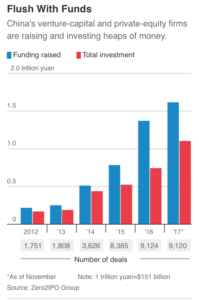
“China’s Wild Bunch: Startup Investors Are Cashed-Up Cowboys,” by Li Yuan. The Wall Street Journal Online (December 14, 2017).

Yesterday’s article noted that, “It results in over-the-top valuations, intense competition for good startup targets and greater uncertainty for funders about whether or when their investments will pay off.

“Mr. Su used to spend weeks and months researching companies and getting to know the founders. With founders now flush with offers, Mr. Su and his colleagues are under pressure to move much faster. In some instances, he says, he was negotiating with a startup in his office in Beijing while rival financiers waited downstairs in the building lobby with contracts in hand.

“A few times, he and his partners had to decide whether to invest in a startup in three hours, he says. There was no time to do due diligence.”

The Journal article added that, “Out of 221 unicorns in the world, 59 are in China, according to CB Insights. While that may lag behind the 127 from the U.S., it’s ahead of the U.K.’s 12 and India’s nine. Many Chinese investors want to invest in Silicon Valley because they think the valuations there are more reasonable.”

Posted in Start-up Company Law | Comments closed

Missouri Issues Fines Related to Dicamba Use in 2016

Reuters writer Tom Polansek reported yesterday that, “Missouri has issued its first fines over the misuse of a farm chemical in 2016 that went on to be linked in different formulations to widespread U.S. crop damage this year, the state said on Thursday.

“Authorities fined eight people a total of $145,125 for improperly spraying the chemical known as dicamba, used to kill weeds, in what Missouri called ‘the first wave of civil penalties issued to applicators,’ according to a statement.”

The Reuters article noted that, “The delay between sprayings last year and the state’s action shows how a long process of investigating many complaints about dicamba use is straining resources in farm states.”

Mr. Polansek added that, “This year, damage related to dicamba herbicides covered 3.6 million acres in 25 states, according to University of Missouri data. Several states have imposed new restrictions on dicamba use for 2018 to avoid a repeat of the damage.”

Posted in Agriculture Law | Comments closed

Minnesota Restrictions on Dicamba

Associated Press writer Steve Karnowski reported this week that, “Minnesota announced restrictions Tuesday on how farmers can use the herbicide dicamba in 2018, responding to complaints by soybean growers across the country that it harmed their crops this year.

“The Minnesota Department of Agriculture set a June 20 cutoff date for applying the herbicide and prohibited applications when the temperature or forecast high for the day is above 85 degrees. The rules are meant to reduce instances of the herbicide drifting and damaging neighboring fields, which has been a problem in soybean- and cotton-growing states nationwide this year.

“‘We will be closely monitoring the herbicide’s performance with these restrictions in 2018,’ Agriculture Commissioner Dave Frederickson said in a statement.”

The AP article stated that, “The Minnesota Department of Agriculture says it received 253 complaints from soybean growers in 49 Minnesota counties, including 55 requests for formal inspections. University of Minnesota researchers estimate that 265,000 acres across the state were affected.

“The Minnesota Soybean Growers Association welcomed the new rules.”

Posted in Agriculture Law | Comments closed

Loss of Deduction Would Effectively Raise Taxes for Members of U.S. Farm Cooperatives

Jacob Bunge reported yesterday at The Wall Street Journal Online that, “Farmers and ranchers are pushing back on an aspect of the proposed U.S. tax overhaul that could eliminate a widely used deduction when much of the U.S. agriculture sector is struggling.

“The tax bills passed by the Senate and the House of Representatives both eliminated a provision in the U.S. tax code that allows members of agricultural cooperatives to reduce their taxable income by deducting some co-op costs.

“In some cases, the deductions can be substantial. For U.S. dairy farmers, who milk an average 210 cows each, the deduction worked out to about $100 per cow, according to Dave Buck, president of the Minnesota Milk Producers Association, who raises dairy cows near Goodhue, Minn.”

The Journal article indicated that, “If that deduction disappears, ‘effectively, it’s going to raise our taxes,’ Mr. Buck said.”

Mr. Bunge explained that, “Now some farmers and co-ops are pinning their hopes on language in the recently passed Senate version that provides farm cooperative members with a 23% deduction on profits that are distributed to members. Yet some cooperative officials say that approach wouldn’t measure up to the current deduction structure.

“Agriculture groups and cooperative members had called on lawmakers to preserve the Domestic Production Activities Deduction, also known as Section 199. Farm groups estimate the deduction amounts to almost $2 billion a year total.

“The Section 199 deduction has been critical for farm cooperatives, organizations owned by groups of farmers and ranchers who market their crops and goods through them. The co-ops sell products and services like fertilizer and pesticides to members and disperse profits back to members according to how much business they do with the co-op.”

Yesterday’s article added that, “Farm groups have warned that eliminating the deduction will siphon money out of rural areas.

“‘We understand the need for changes to the tax code,’ said John Reifsteck, chairman of farm cooperative Growmark Inc., who raises grain in Champaign County, in Illinois. ‘But we really do not think that we as farmers, cooperatives, should pay significantly more taxes on the same earnings we’ve had in the past.'”

Posted in Agriculture Law | Comments closed

Venture Capital Firms are using Algorithms to Find Start-Ups

Maija Palmer indicated yesterday at The Financial Times Online that, “One of the biggest challenges for venture capital companies is finding interesting investment targets before anyone else. It is often a laborious, travel-intensive job. But machine learning and predictive analytics are starting to transform how an investor puts a portfolio together.

“‘My job used to be about getting on a plane once a week and going to a different European city to try to find people who were doing interesting things,’ says Roberto Bonanzinga, co-founder of InReach Ventures and previously a partner at Balderton Capital, a UK-based VC firm which invests primarily in early-stage European technology companies.”

The FT article explained that, “Mr Bonanzinga thought he could combine internet data and machine learning to do a better job of ferreting out prospects. It took two years and £5m in investment for InReach Ventures to create the software, which has so far trawled through 95,000 European start-ups, picking out 2,000 that Mr Bonanzinga might be interested in.

“The software determines this based on the people they are hiring, the products they are developing and the traffic on their website, among other things. For example, InReach identified Oberlo, a Lithuanian start-up, as an investment target because it was advertising for engineers to solve a particular type of ecommerce problem. ‘We did a deal before any other VC firm in Europe even knew they existed,’ Mr Bonanzinga says.”

Posted in Start-up Company Law | Comments closed

Michigan Conducts First, Full Bee Census

An update last week from Michigan State University indicated that, “The first complete bee census, led by Michigan State University scientists, confirmed a new species and revealed that the actual number of bee species in Michigan exceeded earlier estimates.

“Identifying potential pollinators, including the 38 new bees recorded in the state, is crucial, especially in the face of declining honey bee populations. All pollinators make an estimated $14 billion annual contribution to U.S. agriculture, so it’s imperative to understand wild bee populations and their benefits to crops and the environment.”

The update noted that, “Balancing the joy of the new discovery is the fact that a number of bees once found in Michigan are now absent. One example is the rusty patched bumble bee, which has not been seen here since 2000. This is now listed as an endangered species, even though there are active populations in some nearby states.”

Posted in Agriculture Law | Comments closed

Farm Business: Communication With Lenders is Key When Cash Flow is Tight

An update last month from Iowa State University (ISU) Extension stated that, “Cash flow management is becoming even more critical in row crop agriculture. While most lenders like to emphasize strong balance sheets, it’s the ability to generate cash that pays the bills. Some farmers did a good job of forward contracting 2017 new crop bushels, hedging or buying put options and will avoid many cash flow concerns this late fall and winter. However, those farms holding large quantities of unpriced crops could see cash flow challenges and may want to focus on understanding other marketing strategies and tools rather than storing bushels unpriced.”

The article, which was written by Steven D. Johnson, also pointed out that, “If you know your cash flow is already going to be a problem, communicate early with your lender. Many lenders spent the past couple of winters restructuring existing farm debt to stretch out principal payments and free up depleted working capital. These same lenders could be reluctant to restructure loans anytime soon without commitment from the borrower to improve their cash flow management to meet existing debt obligations.”

The ISU update also pointed out that, “Most cash flow problems will appear by late December and January. Expect some lenders to require the use of the USDA Farm Service Agency’s (FSA) guaranteed loan program before advancing additional funds. Completing paperwork and getting necessary loan guarantee approval could take several months. Farms without access to typical farm operating loans should use caution before advancing family living and farm expenses on credit cards or higher interest-bearing debt.

“FSA offers a low-interest, nine-month non-recourse marketing loan on harvested grain, but requires that the on-farm stored bushels be measured or the commercially-stored grain is under warehouse receipt. This marketing loan is limited to the county loan rates, which in Iowa are below the national loan rates of $1.95 per bushel for corn and $5 per bushel for soybeans. Thus, the marketing loan program is not a marketing strategy – just access to cheaper interest for up to nine months.”

Posted in Agriculture Law | Comments closed
