Sen. Schumer Calls for Greater Crop Insurance Options for New York Malt Barley Growers

An Associated Press article from Friday reported that, “U.S. Sen. Charles Schumer is heading to Columbia County to call for greater federal help for New York’s growing craft beer industry.

“The Democrat on Friday will visit a local brewery to discuss efforts to add New York to a list of states eligible for a special federal crop insurance program for farmers who grow malt barley.

“Schumer says malt barley is a risky proposition for farmers in New York. He says that giving New York farmers greater crop insurance options will encourage more farmers to grow it.”

The AP article added that, “Demand for locally grown malt barley is expected to increase as brewers look for local ingredients to use in their beer.”

Posted in Agriculture Law | Comments closed

Farming Technology Startup Indigo Raised More than $200 million from Investors

Reuters wrier Heather Somerville reported earlier this week that, “Farming technology startup Indigo has raised more than $200 million from investors to fund its efforts to reform how crops including wheat, soybeans, cotton and corn are grown around the world.

“The Boston-based company announced on Wednesday an additional $47 million investment led by the Investment Corporation of Dubai, a state-owned sovereign wealth fund, bringing its latest financing round to $203 million. Indigo is valued after the latest round at $1.4 billion, Indigo’s President and Chief Executive David Perry said in an interview.

“The financing is one of the largest single investments into a private agriculture-technology company. It rivals SoftBank Group Corp’s investment into Plenty, a startup working on new technology to grow crops indoors, announced in July. That investment, from SoftBank’s Vision Fund, was $200 million.”

Ms. Somerville noted that, “Perry said Indigo will use the funding to open or expand new offices in Australia, Argentina and Brazil and continue to invest in research. The company raised $100 million last year, and has raised more than $400 million since its founding in 2014.”


Posted in Agriculture Law, Start-up Company Law | Comments closed

States Challenge California Egg Law

Associated Press writer David A. Lieb reported earlier this week that, “More than a dozen states banded together Monday to ask the U.S. Supreme Court to block a California law requiring any eggs sold there to come from hens that have space to stretch out in their cages.

“In a lawsuit filed directly to the high court, the states allege that California’s law has cost consumers nationwide up to $350 million annually because of higher egg prices since it took effect in 2015. The lawsuit argues that California’s requirements violate the U.S. Constitution’s interstate commerce clause and are pre-empted by federal law.

“A federal appeals court panel rejected similar claims last year in a separate case brought by six states, ruling that they failed to show California’s law would affect more than just individual farmers. The latest lawsuit seeks to address that by citing an economic analysis of the California law. It also asks the Supreme Court to take up the case directly instead of requiring that it first move through the lower courts.”

The AP article added that, “The lawsuit cites a study from a University of Missouri economist who concluded that the national price of a dozen eggs has increased between 1.8 percent and 5.1 percent since January 2015 because of the California cage requirements. The study said the price increase has added thousands of dollars annually to states’ costs for supplying eggs to prisoners.

“The study also estimated that California’s egg regulations have cost U.S. households up to $350 million annually, including about $97 million for those whose incomes are in the lowest one-fifth nationally.”

Posted in Agriculture Law | Comments closed

Monsanto Acts to Prevent Arkansas Dicamba Ban

The Associated Press reported earlier this week that, “Monsanto asked a judge Tuesday to prevent Arkansas from enforcing a proposal going before lawmakers next week that would ban the use of a weed killer that farmers in several states have said drifts onto their crops and causes widespread damage.

“The agribusiness giant asked a Pulaski County judge to issue a preliminary injunction preventing the state from banning dicamba’s use while the company challenges a prohibition approved by the Arkansas Plant Board last month. The board’s proposal, which would ban dicamba’s use from April 16 through Oct. 31, is scheduled to go before a legislative committee next week. The company also wants the judge to block enforcement of a previous rule restricting its dicamba weed killer’s use.”

The AP article noted that, “Dicamba has been around for decades, but problems arose over the past couple of years as farmers began to use it on soybean and cotton fields where they planted new seeds engineered to be resistant to the herbicide. Because it can easily evaporate after being applied, the chemical sometimes settles on neighboring fields. The state earlier this year approved a temporary ban on the herbicide’s sale and use, and has received nearly 1,000 complaints about dicamba this year.

“The company has said the ban will deprive farmers of a needed tool and that an injunction is needed to avoid confusion while the judge considers its claims that the regulatory panel exceeded its authority.”

Posted in Agriculture Law | Comments closed

Federal Reserve Bank of St. Louis: The Economic Impact of Locally Produced Food

Andrew Dumont indicated in an update posted yesterday at On The Economy Blog (Federal Reserve Bank of St. Louis) that, “The demand for regional food—or food produced in the same region in which it is consumed—has been on the rise. For example, direct-to-consumer sales of regional food has risen from $0.4 billion in 1992 to $1.3 billion in 2012. What is driving the increase, and what are some potential economic impacts of such an increase?”

The update indicated that, “A publication recently released by the Federal Reserve Bank of St. Louis and the Federal Reserve Board, Harvesting Opportunity: The Power of Regional Food System Investments to Transform Communities, explored the rapid growth of regional food systems and their potential economic impacts in communities throughout the nation.

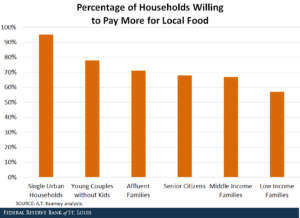
“Among its findings was that consumer demand may be driving the recent growth in the regional food industry. One analysis found that a majority of consumers across the income spectrum are willing to pay more for locally sourced foods, as shown in the figure below.”

“The Economic Impact of Locally Produced Food,” by Andrew Dumont. On The Economy Blog- Federal Reserve Bank of St. Louis (December 5, 2017).

The St. Louis Fed update pointed out that, “The demand for local food has helped support an industry that had been in decline, with the number of small farms ever decreasing and the median age of farmers continually rising.

“Studies have shown that the financial impacts of selling into regional markets are greater for fruit and vegetable farms with gross annual revenue under $350,000. Farms of that size that sell in regional markets are shown to be more likely to earn positive net farm income and have lower operating expense ratios, resulting in increased farm viability.”

Posted in Agriculture Law | Comments closed

Increase Seen in All Cash Home Sales

Laura Kusisto and Christina Rexrode reported yesterday at The Wall Street Journal Online that, “Five years after the housing market hit rock bottom, mortgage credit is finally returning to the healthy levels of the early 2000s, before the boom-bust cycle began. But all-cash deals remain well above normal levels, even as prices in many markets have pushed to record highs.

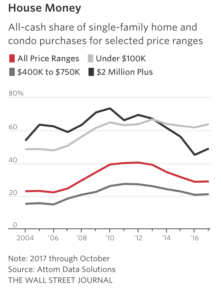
“In all, 28.8% of U.S. home sales this year have been all-cash transactions, according to Attom Data Solutions, a data provider. That was down from the peak of more than 40% in 2011 and 2012, when investors were buying homes at a furious pace to turn into rentals. But the percentage of cash deals stands much higher than the 20% or so common in the early 2000s, and it has edged up from 28.6% last year, according to Attom.”

“Want That House? You’d Better Pay in Cash,” by Laura Kusisto and Christina Rexrode. The Wall Street Journal Online (December 5, 2017).

The article noted that, “Cash deals are attractive to sellers because they don’t need to wait around for a bank to make a mortgage. Closings are quicker, and risks are lower. Many sellers choose all-cash offers over higher offers that come with a mortgage attached.”

The Journal writers added that, “Cash sales are spreading even to sleepier markets away from the coasts, as middle-class buyers sell homes in San Francisco or Portland and move to cheaper areas. More than 20% of homes under $250,000 in the Boise area sold for cash in October, up from 15% a year ago, according to the Boise Regional Realtors.”

Posted in Real Estate Law | Comments closed

Big Investors Back Fund for ‘Flyover’ Start-Ups

Andrew Ross Sorkin reported yesterday at The New York Times Online that, “For the past several months, there has been a torrent of press around how [Steve Case, the billionaire co-founder of AOL] and [J.D. Vance, author of ‘Hillbilly Elegy,’ the best-selling book about the industrial decline of the Midwest] have teamed to try to revive entrepreneurship in what elites often derisively refer to as the so-called flyover states. As my colleague Steve Lohr wrote recently, Mr. Case and Mr. Vance have been barnstorming various cities in a painted bus, holding entrepreneurship competitions as if they were politicians on the campaign trail.

“But until now, at least to some skeptics, it seemed like a do-gooder vanity project.”

The article noted that, “It turns out that while they were publicly crisscrossing America, they were also privately holding meetings with some of the wealthiest individuals and families in the country, urging them to not only invest in a new fund but become partners with some of the companies that will benefit from it.

“On Tuesday, the fund, called Rise of the Rest, will disclose its investors, which has turned into a Who’s Who of American business.”

“The idea — far grander than the money itself, which is only $150 million to start, pocket money for most of the investors — was to assemble a dream team and create a network effect for entrepreneurs in the middle of the country to align with the biggest names in business,” the Times article said.

Mr. Sorkin also pointed out that, “The fund, said Mr. Vance, was meant to construct an ecosystem like the one in Silicon Valley that will provide support and connections to entrepreneurs in small towns.”

The Times article added that, “Mr. Case and Mr. Vance hope to seed investments in start-ups in underserved cities and then bring in some of their big names to invest even more money in them. ‘We’ll be curating interesting companies,’ Mr. Case said.”

Posted in Start-up Company Law | Comments closed

Illiana Vegetable Growers Symposium

A news release yesterday from Purdue University indicated that, “Commercial vegetable farmers and market gardeners will be able to network and gain invalauble tips on how to improve their business during the Illiana Vegetable Growers Symposium.

“The event will be 8 a.m. to 4 p.m. (CST) on Jan. 4 at Teibel’s Family Restaurant, 1775 U.S. 41, Schererville, Ind.

“The program is a collaboration of Purdue and the University of Illinois Extension services. Presenters will include several Extension specialists from both universities.”

Yesterday’s update noted that, “Registration is available online through the Education Store at www.edustore.purdue.edu. For more information, contact Nikky Witkowski at nikky@purdue.edu or 219-755-3240, or Kym Schwinkendorf at kschwink@purdue.edu or 219-386-5232.”

Posted in Agriculture Law | Comments closed

Few Iowa Farmers Face Estate Tax

Jason Noble reported recently at The Des Moines Register Online that, “If the tax reform packages that have now passed the U.S. House and Senate become law, at least one thing appears likely: The federal estate tax will be slashed and perhaps eliminated altogether.

“That will represent a victory for Republicans in Iowa’s congressional delegation, who have consistently opposed the tax and argued it unfairly lumps in the state’s farmers with some of the country’s richest families.

“But a review of federal tax data and nonpartisan research on the subject shows that family farmers and small business owners represent a tiny share of estate tax payers, and that the taxes they owe rarely force them to sell land or quit farming.”

Mr. Noble stated that, “The number of Iowans paying the estate tax actually numbers in the dozens each year, out of roughly 1.4 million who file federal tax returns each year. IRS data from the last five years shows the number of Iowa taxpayers owing estate taxes ranged from 32 in 2012 to 61 in 2015, and that the vast majority of those probably were not farmers or small business owners.”

The Register article also pointed out that, “The estate tax is a 40 percent tax on wealth assessed when a person dies, and currently is applied to assets above $5.5 million for individuals and $11 million for couples. The House and Senate bills double those exemptions to $11 million and $22 million, and the House version abolishes the tax completely in 2024.”

Posted in Agriculture Law | Comments closed

2018 Indiana Small Farm Conference

A news release last week from Purdue University indicated that, “Small-scale farming has become an increasingly important part of Indiana’s $11.2 billion agricultural industry. According to the 2012 U.S. Census of Agriculture, approximately 75 percent of Hoosier farms were less than 180 acres. Other studies show that nearly half the farms in the state are 50 acres or fewer.

“The annual Indiana Small Farm Conference and trade show provides both novice and experienced small-scale producers with an opportunity to learn about the latest trends, network with fellow farmers and get practical, hands-on guidance from nationally recognized experts on a wide range of critical topics, from crop production and equipment to marketing, new business development and legal issues.

“Registration is now open for this year’s conference, scheduled for March 1-3 at the Hendricks County 4-H Fairgrounds and Conference Complex, 1900 E. Main Street, Danville.”

The news update added that, “This year’s conference begins with a series of daylong workshops on March 1. Topics include Regenerating Your Farm Using Diversified Livestock Systems, Farm Viability and Financial Management, and On-Farm Food Safety for Fruit and Vegetable Growers: Produce Safety Alliance Grower Training. There will also be an off-site farm tour focusing on four-season production using hoop houses and other methods.

“Educational sessions March 2-3 will cover topics ranging from urban agriculture, crop diversification, disease management, weed control and specialty crops to farm finances, marketing and employee relations.”

Posted in Agriculture Law | Comments closed