
“Habit,” A Nutrition Start-Up Based on DNA

Tracey Lien reported yesterday at the Los Angeles Times Online that, “When Liesl Bettencourt of Pleasanton, Calif., turned 50 recently, she decided it was time to get into shape. She signed up with Habit, an Oakland start-up that offers personalized nutrition recommendations, coaching and meals. And as soon as Habit sent her an initiation kit, she got nervous.

“The prospect of cutting out bread and cheese from her diet was hard enough, Bettencourt thought. Now she was being asked to use a lancet — a tiny needle that Habit sent her — to draw her own blood.”

The article noted that, “By requiring new users to submit three blood samples and a DNA swab, Habit has a higher barrier to entry than most companies in the nutrition and diet business. Starting a program requires more than ordering a week’s worth of meal-replacing drinks (a la Soylent), adding grass-fed cow’s butter to coffee (Bulletproof), or learning to grade different types of food using a proprietary rubric (Weight Watchers). In a sea of lifestyle and nutrition companies selling dieting life hacks, Habit is trying to set itself apart by emphasizing the ‘personal’ in personalized nutrition.

“For $299 (the cost of the metabolism test kit and Habit’s recommendations), the company studies each customer’s DNA to learn about dietary and digestive predispositions and offers nutritional advice and coaching based on the customer’s genotype (their genetic makeup) and phenotype (environmental influences). Aegis Sciences Corp. in Nashville, a toxicology lab that also does anti-doping testing for the NFL and Major League Baseball, tests how customers’ bodies process sugar, fat and carbs.”

Yesterday’s LA Times article stated that, “The company has so far attracted $32 million in funding from Campbell Soup Co., its sole financier, which also bought Plum Organics from Grimmer in 2013;” and added that, “With its $299 price tag, Habit’s personalized nutrition recommendations are aimed at a subset of affluent, diet-conscious customers. But with the U.S. weight-loss market valued at $66 billion in 2017, Morrison said Campbell is making a long-term bet on the start-up. Once customers shell out the initial fee, Habit can offer additional services: It plans to roll out prepared, customized meals across the country in the coming year, and will eventually sell meal plans, recipes and other products to help customers stay on track.”

Posted in Agriculture Law, General Interest, Start-up Company Law | Comments closed

Tax Law- Implications for Gig Workers

Noam Scheiber reported in the New York Times on Monday that, “The new tax law is likely to accelerate a hotly disputed trend in the American economy by rewarding workers who sever formal relationships with their employers and become contractors.”

The article explained that, “That’s because a provision in the tax law allows sole proprietors — along with owners of partnerships or other so-called pass-through entities — to deduct 20 percent of their revenue from their taxable income.

“The tax savings, which could be around $15,000 per year for many affluent couples, may prove enticing to workers. ‘If you’re above the median but not at the very, very top, one would think you’d be thinking it through,’ said David Kamin, a professor of tax law at New York University.

“The provision may also turn out to be a boon for employers who are trying to reduce their payroll costs. Workers hired as contractors, who tend to be cheaper, may be less likely to complain about their status under the new tax law.”

Nonetheless, Mr. Scheiber noted that, “But it could lead to an erosion of the protections that have long been a cornerstone of full-time work.

“Formal employment, after all, provides more than just income. Unlike independent contractors, employees have access to unemployment insurance if they lose their jobs and workers’ compensation if they are injured at work. They are protected by workplace anti-discrimination laws and have a federally backed right to form a union.

“Those protections do not generally apply to contractors. Nor do minimum-wage and overtime laws.”

The Times article added that, “David Weil, the administrator of the Labor Department’s Wage and Hour Division under Mr. Obama, believes the change will add fuel to a trend that has been several decades in the making.

“During that time, as Mr. Weil documented in a book on the subject, ‘The Fissured Workplace,’ employers have steadily pushed more work outside their organizations, paring the number of people they employ and engaging a rising number of contractors, temporary workers and freelancers.

“The tax law will accelerate the shift, he said, because employers who are already keen to reorganize in this way will recognize that even fewer workers are likely to object as a result of the tax benefits.”

Posted in Agriculture Law, General Interest, Real Estate Law | Comments closed

Warmer Texas Winter Negatively Impacting Bees

Dallas Morning News writer Jackie Wang reported late last month that, “Austin, Texas Honeybees usually take winters off. But when it’s 50 degrees and sunny, the bees are flying and dying faster.

“Beekeeper Blake Shook raises bees commercially in the Collin County town of Blue Ridge. The 27-year-old has been beekeeping since he was 13. He’s seen firsthand the decline in the insects’ health since 2006, when the great bee die-off from Colony Collapse Disorder was first reported.”

The article noted that, “Every year, billions of bees are sent to almond farms in California to pollinate the trees. Without them, almond production would take a nosedive.

“The U.S. bee industry lost 44 percent of its bees from 2015 to 2016 and 40 percent the year before that. This year, there were reports from south-central Texas of honeybees waking up early in January, when temperatures rose higher than usual, according to Agrilife Today, a Texas A&M agriculture publication. Whenever bees look for food and can’t find any, they end up eating stored honey and wear their bodies out faster.”

The article added that, “While beekeepers have developed methods to restore the numbers lost during the winter, it’s not a perfect system. At the current industry rate, bees will not reproduce at a fast enough rate to keep up with demand, Shook said.

“So the Texas Beekeepers Association plans to urge lawmakers to protect major nectar sources for bees so the bees can thrive. Shook, a board member, said the group has other ideas in the works, such as trying to get a honeybee license plate to fund research and lobbying during the 2019 legislative session to update the bees and honey chapter of the Agricultural Code.”

“‘It’s a complex issue, with these bees,’ [Chris Moore, president of the Texas Beekeepers Association] said. ‘Property is sold and developed every day. All your habitats for birds, deer, for bees everything’s diminishing, dwindling every day.'”

Posted in Agriculture Law, General Interest, Real Estate Law | Comments closed

Dicamba Issues: A Top Ag News Story in 2017

DTN writer Pam Smith reported today that, “Farmers may have had dicamba in their weed arsenal for more than 50 years, but the agronomic tool took a divisive turn in 2017.

“Unprecedented complaints of injury to sensitive crops were recorded across the U.S. during the first full year of the Roundup Ready Xtend Crop System, despite new, lower-volatility dicamba formulations and education campaigns on how to reduce spray drift.

“In October, a survey of Extension weed specialists estimated off-site movement of dicamba had injured 3.6 million acres of soybeans. Officially, there were 2,708 dicamba-related injury cases under investigation by various state departments of agriculture. Included in those cases were complaints that dicamba injured vegetable and fruit crops, trees and homeowner landscapes.”

Ms. Smith explained that, “Many had hoped the long list of complex restrictions the Environmental Protection Agency (EPA) placed on the Engenia, FeXapan and XtendiMax labels would help applicators keep the herbicide on-target. At the same time, the weed science community voiced stern warnings that those labels did nothing to address the inherently volatile nature of dicamba.

“As complaints of cupped and puckered leaves characteristic of dicamba injury started to mount in June and July, states such as Arkansas, Missouri and Tennessee, took action to temporarily restrict or ban applications.”

Today’s DTN article added that, “Who is liable for the loss associated with injury is also adding to the drama — both from the farmer and retailer applicator perspective. Recent issues with dicamba spray drift have highlighted the need for producers to understand third-party liability associated with all herbicide applications, said University of Missouri Extension economist Ray Massey.

“Product labels for 2018 labels also are so restrictive that the window for making legal applications could be very narrow. A Purdue University report during the December North Central Weed Science Society meeting calculated an applicator had 184 hours to spray XtendiMax or FeXapan during June 2017. Using the new 2018 label restrictions, and identical weather patterns, applicators will have only 44 hours to spray next June.

“Some individual states were also taking additional measures beyond federal labels as farmers were headed into seed selection season. In Arkansas, where the dialogue has been most heated, Monsanto and some farmers have been legally pushing for broader market access to dicamba. Legislators agreed in December and kicked a proposal to ban most in-season use back to the Arkansas State Plant Board for further consideration.”

Posted in Agriculture Law | Comments closed

Two 2017 Year End Tax Planning Opportunities

An update posted today at the farmdoc daily blog, “2017 Year End Planning Ideas,” by Dwight Raab, explained that, “With the recent passage of the Tax Cuts and Jobs Act (Congress passed on 12/20; President signed on 12/22) there are significant changes to the deductible amount of state income, property tax and real estate tax used in calculating itemized deductions beginning in tax year 2018. Under the new law, beginning in 2018, there is a $10,000 maximum combined limit of state income, property and real estate tax that may be deducted when itemizing deductions on IRS Form 1040, Schedule A. For 2017, there is no limit on the amount of these expenses. Thus, there are two tax planning opportunities with the potential to allow taxpayers to maximize the amount of these deductions if they take action prior to December 31, 2017. These two planning opportunities are available only to those using Form 1040, Schedule A to itemize certain deductions on their individual income tax return.”

The farmdoc update noted that, “The first planning opportunity involves the advance payment of property and real estate tax on the taxpayers’ personal residence or other personal use property prior to December 31, 2017. This advances payment of these taxes that would normally be paid in 2018 into 2017 and then itemizing them on IRS Form 1040, Schedule A.”

Mr. Raab added that, “The second planning opportunity involves paying any 2017 state income tax due by December 31, 2017 for personal income tax returns due in April 2018.”

Today’s farmdoc update stated that, “This is a ‘one-time’ potential strategy to put in place prior to the $10,000 limit on state income, personal and real estate tax is put in place and don’t forget that the standard deduction increases markedly beginning in 2018 which will make it more difficult to itemize deductions on Schedule A of IRS Form 1040.

“Before utilizing either of these strategies taxpayers should consult their tax advisor. Not all taxpayers will benefit from advancing the payment of these taxes into 2017.”

Posted in Agriculture Law | Comments closed

Conflict Over Hog Confinement Location in Minnesota

Associated Press writer Steve Karnowski reported earlier this month that, “A plan to build a large hog feedlot in southeastern Minnesota can move forward, the state Court of Appeals ruled [on December 18th].

“The decision by a three-judge panel affirmed a vote by the Goodhue County Board in February to approve the proposed 4,700-hog operation near Zumbrota.

“Opponents of the Circle K Family Farms project, including the Land Stewardship Project and Zumbrota Township residents, have been fighting it over concerns about odors and what they contend are high levels of toxic hydrogen sulfide at other hog farms in southern Minnesota owned by Jeff Kohlnhofer and his brothers Mike and Yon.”

The AP article stated that, “But the appeals court noted that the Minnesota Pollution Control Agency, after an extensive review, ‘concluded that the project did not pose a risk of potential significant environmental effects.’

“The Court of Appeals concluded that the county approval of a permit for the project ‘was neither unreasonable nor an abuse of discretion.’ The three judges noted that legal precedents obligated them to review the board’s decision ‘with particularly great deference’ and to uphold it ‘so long as its basis has even the slightest validity.'”

Mr. Karnowski added that, “At a news conference in Lakeville, Kristi Rosenquist, of Zumbrota Township, and other opponents said they planned to keep up the pressure on the Kohlnhofer family to drop the plan. They said they tried to deliver 687 postcards to the Kohlnhofer Insurance Agency in Lakeville that were signed by people from around the state, but it was closed so they picketed outside instead.”

Posted in Agriculture Law | Comments closed

Possible Considerations for Farmers in Response to Tax Reform

An update earlier this week from K·Coe Isom explained that, “The national ag accounting and business advisory firm K·Coe Isom said the tax bill passed by the U.S. House of Representatives today presents opportunities for many farmers but only if they develop plans taking into consideration changes to the tax code.”

The update stated that, “‘In consultation with their tax professional, farmers should consider the following year-end strategies:

  1. Defer income to next year and pay deductible expenses this year. Depending on your individual circumstances, you could have lower tax rates in 2018.
  2. Pay all assessed 2017 property tax and any likely amount of personal 2017 state income taxes. Note however that payments could be subject to limitations if you are subject to the alternative minimum tax.
  3. Make year-end purchases of new and used equipment. Under the tax bill, 100% bonus depreciation starts for property placed in service on or after September 28, 2017. This includes used equipment so there could be advantages to year-end purchases.
  4. The ability to carryback net operating losses for farming operations will be reduced from a five year carryback to two years after 2017, so this year will be your last opportunity to recoup some income taxes from five years ago.
  5. Make your charitable donations in 2017. If you are going to make charitable donations in 2018, consider making some or all of them in 2017 in case your standard deduction is more beneficial next year.”

The update added that, “In addition to year-end tax planning, K·Coe Isom recommends that businesses take a fresh look at their operations in 2018 and think about whether restructuring or adjusting operations will make sense in light of the changes in this bill.”

Posted in Agriculture Law | Comments closed

Farm Bureau Provides Tax Reform Overview For Farmers, Ranchers

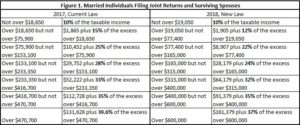
An update yesterday from the American Farm Bureau Federation’s Market Intel group indicated that, “The Tax Cuts and Jobs Act (H.R. 1) will deliver modest tax reductions for W-2 earners in the form of modified individual tax brackets, which are included below. The bill attempts to simplify tax preparation for taxpayers by eliminating deductions that impacted a fairly small number of filers and replacing them with a higher standard deduction. In 2017, the standard deduction for a joint return was $12,700. In 2018, the figure will climb to $24,000. In addition, individual rates have been adjusted downward and the brackets expanded so that a larger amount of income is subject to lower rates. Figure 1 compares the 2017 and 2018 individual tables.”

“What Do the Tax Cuts Mean for Farmers and Ranchers?” American Farm Bureau Federation, Market Intel (December 20, 2017).

The AFBF update noted that, “Given that 93 percent of U.S. farms file their taxes through the individual code, these changes are important. However, the business provisions that impact farms, ranches and other pass-through businesses offer the greatest chance of improvement for agriculture.”

Yesterday’s update added that, “The conference bill provides that individuals operating pass-through businesses will be able to take a deduction for 20 percent of their business income through Dec. 31, 2025. This is a small reduction from the Senate bill which would have allowed for a 23 percent deduction. As in the Senate version, the deduction is unlimited below a joint household income, though the threshold of $315,000 in the final bill is significantly lower than the $500,000 threshold in the Senate version.”

The Market Intel update also included a large- detailed table that compares the business provisions of current tax code and the Tax Cuts and Jobs Act; the table can be viewed here.

Posted in Agriculture Law | Comments closed

Cargill Inc. and Ecolab Look to Fund Ag Related Startups

Jackie Crosby reported earlier this week at the Minneapolis Star-Tribune Online that, “In an effort to jump-start innovation in the agriculture industry, Cargill Inc. and Ecolab said Monday they will launch a program to fund entrepreneurs and startups beginning in early 2018.

“The companies are working with Techstars on an initiative called the Farm to Fork Accelerator. The focus will include business ideas with potential to affect all areas of the food system, including food security, sustainability, ag tech and consumer goods.

“The first round of the three-year program will fund 10 promising startups. The application process begins in January.”

The article noted that, “Those selected will take part in a 13-week boot camp in the Twin Cities through Techstars, a Boulder, Colo.-based company that helps get promising ideas more rapidly into the marketplace.

“Entrepreneurs will learn how to build their businesses, develop technology and secure capital.

“Executives from Cargill and St. Paul-based Ecolab will serve as mentors as well as provide access to their companies’ market expertise, global connections and investment capital.”

Posted in Agriculture Law, Start-up Company Law | Comments closed

Farm Groups at Odds Over Tax Reform Measure

Teaganne Finn reported today at Bloomberg Government Online that, “Two prominent farm organizations disagree over how the tax bill compromise released by House and Senate lawmakers would affect the agriculture industry.

“The American Farm Bureau Federation, which focuses on making the farming business more profitable, supports the bill’s potential for lower farmer income taxes. But the National Farmers Union, founded by local producers concerned with stability and farm income says the tax cuts could threaten programs like crop insurance in the 2018 farm bill, as lawmakers look to offset the $1.5 trillion that the overhaul would add to the national debt over 10 years.

“The Tax Cuts and Jobs Act (H.R.1) is projected to add $1.455 trillion to the U.S. deficit over the next decade, according to a report released on Dec. 15 by the nonpartisan Congressional Budget Office. CBO says the final bill would reduce U.S. revenue by about $1.649 trillion and decrease outlays by about $194 billion over period from 2018 to 2027.

Ms. Finn stated that, “The bill would provide a 20 percent deduction for owners of pass-through businesses. With the majority of farms structured as pass-throughs, this could ‘help them have more profitable businesses and allow them to immediately deduct expenses,’ Patricia Wolff, tax policy specialist at AFBF, told Bloomberg Government.”

Today’ article added that, “The National Farmers Union’s biggest concern with the bill is the increase to the national debt and the possible cuts to agriculture programs in the next farm bill. The current one is set to expire at the end of the 2018 fiscal year.

“‘I don’t know how the agriculture industry gets better if we have to deal with the deficit,’ Zack Clark, NFU’s director of government relations, told Bloomberg Government.”

Posted in Agriculture Law | Comments closed