
Compared to Previous Law, the Tax Cuts and Jobs Act Would Have Lowered the Share of Farm Estates Required to File a Return in 2016

A recent update from USDA’s Economic Research Service (“Under the Tax Cuts and Jobs Act, Only 0.11 Percent of Farm Estates Would Have Owed Estate Taxes in 2016“) stated that, “For nearly a century, the Federal estate tax has applied to the transfer of property at death. Recently passed in December 2017, the Tax Cuts and Jobs Act (TCJA) not only changed the Federal income tax system but also doubled the estate tax exemption amount to $11.18 million per individual. This exemption amount has increased significantly since 2000, when the exemption was $675,000, resulting in fewer farm estates that must file a tax return or that owe estate taxes.

“Using an actuarial model and data from USDA’s Agricultural Resource Management Survey, ERS researchers estimated that 39,214 farm estates were created in 2016. Had the TCJA been in effect in 2016, only 0.58 percent of these farm estates would have been required to file an estate tax return. After accounting for adjustments, deductions, and expenses, only 0.11 percent of these estates would owe estate taxes. Across all estates that owe tax, the aggregate liability was estimated at $104 million.
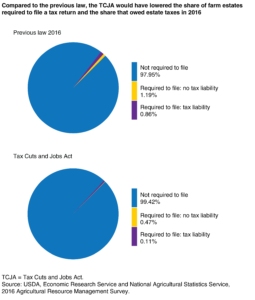
“Under the Tax Cuts and Jobs Act, Only 0.11 Percent of Farm Estates Would Have Owed Estate Taxes in 2016,” by Siraj Gustavo Bawa. USDA- Economic Research Service (September 04, 2018).

“By comparison, under the previous law in 2016, ERS estimated that 2.05 percent of farm estates were required to file an estate tax return, but only 0.86 percent of farm estates would owe estate taxes. Across all estates that owe tax, the aggregate liability was estimated at $496 million in 2016.”


Posted in Agriculture Law | Comments closed

U.S. Tariffs on China Impacting Tech Startups

Financial Times writer Richard Waters reported recently that, “The price of a new ‘smart home’ controller from US start-up Brilliant just went up $50 — even before it went on sale.

“The three-year old company joined the race to create intelligent home devices last week, launching a wall panel that combines a light switch with things such as music controls and a microphone to talk to Amazon’s Alexa smart speaker.

“The White House’s latest round of threatened tariffs on imports from China — where the device is manufactured — led the company to push the price up to $299 at the last minute, to absorb the expected costs. Brilliant hopes the typical customer will buy five of the panels for their home, says Aaron Emigh, chief executive, adding $250 to the cost of an installation.”

The FT article explained that, “In the technology industry, hardware start-ups face some of the longest odds for success. Until they reach high enough volumes to strike better deals with suppliers and support the costs of brand marketing it is hard to make the economics work, and profit margins are notoriously low.

“‘When you’re in hardware, a 25 per cent tariff can be a death knell to your business,’ says Nate Kelly, a supply chain expert who now heads TrackR, a company that makes Bluetooth devices. The lack of a financial cushion or a diversified set of products means many companies will not be able to ‘ride this out for six months or a year,’ he said.”

Mr. Waters added, “The impact is not limited to start-ups. At the end of last week, Apple said that it expected to pass on import levies on products such as its AirPod headphones and Home smart speaker to consumers — a warning that brought a tweeted riposte from Donald Trump, who told the company it should shift production to the US instead.

“But start-ups are likely to be hit hardest, whether their products are made in China or they import components and do the final assembly work in the US.”

Posted in Start-up Company Law | Comments closed

What Can Secondary Cities Do to Overcome VC’s Caution?

Noah Smith indicated recently at Bloomberg Online that, “The U.S. high technology industry looks like it may be too concentrated. One sign of this is the lack of geographic diversity in the venture capital industry, which is highly concentrated in a few technology hubs, mostly on the coasts.”

Smith stated that, “In 2017, three metro areas — San Francisco, New York and San Jose, California — took about two-thirds of the investment for the top 20 cities. Their share of the top 10 cities has actually increased since 2015, driven in part by super-sized late-stage financing rounds for companies like WeWork Inc., Uber Technologies Inc., and Lyft Inc.

“There are a few signs that VC is starting to look beyond the traditional hubs in its quest for returns. In 2015, Bloomberg recorded VC deals in 119 metro areas; by 2017, that number was up to 141. New startup hubs like Columbus, Ohio, and Indianapolis are getting more attention. But more needs to be done to accelerate the spread of venture investment.”

The Bloomberg item noted, “So how can VC dollars be lured out of traditional tech hubs? Back in 2007, Carole Carlson and Prabal Chakrabarti of the Federal Reserve Bank of Boston interviewed a number of VC leaders and recipients of VC funding, in an attempt to answer exactly this question.

“Carlson and Chakrabarti’s interviews suggest that VCs were more likely to invest in secondary cities  — those that aren’t traditional VC hubs — when those cities have a more established investor presence and when historical returns in those cities had been good. Obviously, both investor presence and historical returns are even stronger in traditional investment hubs, illustrating why moving is hard.”

Smith added, “What can secondary cities do to overcome VC’s caution? Carlson and Chakrabarti’s interviews suggest five main policies. First, cities and their corresponding state governments should invest in upgrading their local universities, in order to produce a pool of talented engineers and managers. In addition, they should encourage local investors to become angels, creating the nucleus of a local investor community. They should improve access for VCs, with good airports and quality hotels. They should boost quality of life with appealing downtowns, while investing in the arts. And perhaps most importantly, they should focus on narrow clusters — such as biotechnology, robotics or agricultural software — instead of trying to become the next Silicon Valley. This latter approach, which has been used by cities like Pittsburgh, not only harnesses clustering effects, but probably helps with marketing as well.”

Posted in Start-up Company Law | Comments closed

Startup Accelerator Program Launched by PepsiCo

Brittany De Lea reported last week at FOXBusiness Online that, “PepsiCo announced on September 6 it will be launching a North American branch of its accelerator program, aimed at fostering collaboration with innovative startups that focus on health and wellness.

“Through the program, called Nutrition Greenhouse, Pepsi will work with 10 start-ups based in the U.S. or Canada – which will be given $20,000 in grant money – during a six-month ‘business optimization program.’ The program includes mentorship from executives heading company-owned brands like Quaker, Stacy’s and Naked. At the end of the six months, one company will be awarded an additional $100,000, and the opportunity to continue the collaboration.

“Qualified startups will have a demonstrated sales track record, but no more than $5 million, Pepsi stipulates.”

The report added, “Not only is Pepsi giving up-and-coming industry trendsetters the chance to gain new exposure, but through its program, it can also learn from innovative companies as it seeks to adapt to shifting consumer tastes.

“‘Through this process, we can give back but also … learn a little bit more about the consumer and the broader landscape,’ Daniel Grubbs, managing director of the PepsiCo Ventures Group, told CNNMoney. ‘It gives us front-row seats to the most innovative startups seeking to address ever-changing consumer needs.’

“Grubbs added that the fund will focus on start-ups with products and purpose that center around nutrition and wellness.”

Posted in Start-up Company Law | Comments closed

USDA Launches Trade Mitigation Programs

A news release Tuesday from USDA’s Farm Service Agency (FSA) stated that, “U.S. Secretary of Agriculture Sonny Perdue today launched the trade mitigation package aimed at assisting farmers suffering from damage due to unjustified trade retaliation by foreign nations.  Producers of certain commodities can now sign up for the Market Facilitation Program (MFP), while USDA will also begin to purchase identified commodities under a food purchase and distribution program.  Additionally, USDA has begun accepting proposals for the Agricultural Trade Promotion Program (ATP), which will help American farmers find and access new markets for their products.  In total, USDA will authorize up to $12 billion in programs, consistent with World Trade Organization obligations.

“Perdue announced in July that USDA would act to aid farmers in response to trade damage from unjustified retaliation.  President Trump directed Secretary Perdue to craft a short-term relief strategy to protect agricultural producers while the Administration works on free, fair, and reciprocal trade deals to open more markets in the long run to help American farmers compete globally.  These programs will assist agricultural producers to meet some of the costs of disrupted markets.

“‘These programs will allow President Trump time to strike long-term trade deals to benefit our entire economy, including the agricultural sector, in the long run,’ Perdue said.  ‘Farmers will tell you that they would always prefer to sell a good crop at a fair price, rather than receive government aid, and that’s what long-term trade deals will accomplish.  But in the meantime, President Trump has promised that he will not allow American agriculture to bear the brunt of the unjustified retaliation from foreign nations.  Today we are putting the President’s promise into action.'”

The FSA update added, “The sign-up period for MFP is now open and runs through January 15, 2019, with information and instructions provided at www.farmers.gov/mfp.  The MFP provides payments to cotton, corn, dairy, hog, sorghum, soybean, and wheat producers who have been significantly impacted by actions of foreign governments resulting in the loss of traditional exports.  The MFP is established under the statutory authority of the Commodity Credit Corporation CCC Charter Act and is under the administration of USDA’s FSA. Eligible producers should apply after harvest is complete, as payments will only be issued once production is reported.

“A payment will be issued on 50 percent of the producer’s total production, multiplied by the MFP rate for a specific commodity.  A second payment period, if warranted, will be determined by the USDA.”

Posted in Agriculture Law | Comments closed

More Plaintiffs Alleging Monsanto Weedkillers Cause Cancer

Wall Street Journal writer Ruth Bender reported yesterday that, “Bayer AG said the number of American plaintiffs alleging its recently acquired weedkillers cause cancer has risen sharply, adding to concerns about potentially lengthy and costly litigation stemming from its acquisition of Monsanto.

“The German chemicals company on Wednesday also lowered its full-year earnings outlook because of delays in closing its $63 billion purchase of Monsanto, which included a portfolio of herbicides that contain glyphosate, notably flagship product Roundup.

“Bayer said it faced some 8,700 plaintiffs across the U.S. as of late August—mainly cancer patients who claim to have fallen ill after being exposed to the glyphosate-containing Monsanto herbicides. As of late July, the number of plaintiffs stood at about 8,000, up from 5,200 a few months earlier.”

The Journal article noted that, “Last month, not long after Bayer closed the acquisition, Monsanto was ordered to pay a plaintiff $289.2 million by a California state jury. It found that Monsanto’s Roundup and Ranger Pro products presented a ‘substantial danger’ to consumers, and that Monsanto knew or should have known of potential risks and failed to warn users.”

Ms. Bender added, “Bayer rejected the verdict as ‘wrong,’ and is seeking a review of the court decision. It said it would appeal if necessary, a process the company said could take up to a year. Such large jury awards are often ultimately reduced and in some cases overturned. Bayer hasn’t disclosed any provision for liabilities linked to the cases. The company argues some 800 studies have proven that the chemical is safe and doesn’t cause cancer.”

Posted in Agriculture Law | Comments closed

USDA Launches Webpage Highlighting Resources to Help Rural Communities Bridge the Broadband e-Connectivity Infrastructure Gap

A news update last week from the U.S. Department of Agriculture (USDA) stated that, “U.S. Secretary of Agriculture Sonny Perdue today unveiled a new webpage featuring information about the importance of rural e-Connectivity and the ways the [USDA] is investing to help deploy high-speed broadband infrastructure in rural America.

“‘Rural high-speed broadband e-Connectivity is as important for economic development as rail, roads, bridges and airports – and as vital as the buildouts of rural telephone networks were decades ago,’ Perdue said. ‘USDA is committed to being a strong partner with rural leaders in deploying this essential infrastructure.’

“Reliable and affordable high-speed internet e-Connectivity acts as a catalyst for rural prosperity by enabling efficient, modern communications between rural American households, farms, ranches, businesses, schools and health care centers. Yet, according to the Federal Communications Commission, 80 percent of the 24 million Americans who lack broadband access live in rural areas and on tribal lands.”

Last week’s update noted that, “In April 2017, President Donald J. Trump established the Interagency Task Force on Agriculture and Rural Prosperity to identify legislative, regulatory and policy changes that could promote agriculture and prosperity in rural communities. In January 2018, Secretary Perdue presented the Task Force’s findings to President Trump, which included 31 recommendations to align the federal government with state, local and tribal governments to take advantage of opportunities that exist in rural America.

“To view the report in its entirety, please view the Report to the President of the United States from the Task Force on Agriculture and Rural Prosperity (PDF, 5.4 MB). In addition, to view the categories of the recommendations, please view the Rural Prosperity infographic (PDF, 190 KB).”

Posted in Agriculture Law | Comments closed

More First-Time Homebuyers are Entering the Market

A recent report from Genworth indicated that, “First-time homebuyers should continue to play an important role in the housing market. While the first-time homebuyer market has grown by close to 40 percent since 2014, there are still 2.7 million missing first-time homebuyers. They represent vast, largely untapped opportunities for the housing industry over the coming years. Despite the headwinds of rising interest rates and low inventory in the housing market, first-time homebuyers are entering the market at the fastest pace in the first six months of 2018 than any year since 2005.”

“The Daily Shot: More First-Time Home Buyers Are Taking the Plunge.” The Wall Street Journal Online (September 4, 2018).

The Genworth report noted that, “A historically large first-time homebuyer market since 2016 suggests that a large number of young families are becoming homeowners. This is beginning to show in the rising homeownership rate among younger households. Even without any growth, the current size of the first-time homebuyer market is already very large—relative to the total number of households—which is helping to raise homeownership rates among younger households.”

The report added, “In the mortgage market, the expansion of the rst-time homebuyer market has restarted the growth in household mortgage debt, creating opportunities for mortgage lenders and investors.”

Posted in Real Estate Law | Comments closed

2018 Net Farm Income Projected to Decrease

The U.S. Department of Agriculture’s Economic Research Service (ERS) indicated on Thursday that, “Net farm income, a broad measure of profits, is forecast to decrease $9.8 billion (13.0 percent) from 2017 to $65.7 billion in 2018, after increasing $13.9 billion (22.5 percent) in 2017. Net cash farm income is forecast to decrease $12.4 billion (12.0 percent) to $91.5 billion.”

The ERS update noted that, “In inflation-adjusted 2018 dollars, net farm income is forecast to decline $11.4 billion (14.8 percent) from 2017 after increasing $13.0 billion (20.3 percent) in 2017. If realized, inflation-adjusted net farm income would be just slightly above its level in 2016, which was its lowest level since 2002.”

Thursday’s report also indicated that,

  • Corn cash receipts are forecast down $0.8 billion (1.8 percent) due to lower expected quantities sold, while wheat cash receipts are forecast up $0.5 billion (6.3 percent) due to higher prices.
  • Direct government farm payments—which include Federal Government farm program payments paid directly to farmers and ranchers but exclude insurance indemnity payments made by FCIC and USDA loans—are forecast to decline $2.0 billion (17.4 percent) to $9.5 billion in 2018, as declines in Agriculture Risk Coverage and Price Loss Coverage payments more than offset an expected increase in supplemental and ad hoc assistance and other programs.
  • Federal Crop Insurance Corporation indemnities—payments made by private insurance companies to farm operators for their insured commodity losses—are forecast to rise by $0.9 billion (17.4 percent), to $6.1 billion, in 2018. FCIC premiums paid are expected to decline by $0.2 billion (5.6 percent).
  • Total production expenses, including operator dwellings, are forecast to increase $11.8 billion (3.3 percent) in 2018 to $365.9 billion. Expenses for fuels/oils are forecast up $2.3 billion (17.8 percent) and interest expenses, including dwellings, are forecast up $3.2 billion (17.3 percent). Hired labor expenses are forecast to increase $1.5 billion (5.1 percent). Feed is forecast to increase $2.6 billion (4.8 percent).
Posted in Agriculture Law | Comments closed

EPA Approval of XtendiMax (Dicamba) Debated in Ninth Circuit Court of Appeals

Bloomberg writers Joel Rosenblatt and Lydia Mulvany reported yesterday that, “When it comes to killing weeds, Bayer AG’s crop chemical XtendiMax has become a powerful new tool for American farmers. But environmental groups say U.S. regulators ignored warnings about the herbicide’s main ingredient, dicamba, when they permitted its use in 2016.

“A federal appeals court in Seattle was asked Wednesday to overturn the Environmental Protection Agency approval after the unintended destruction of millions of acres of crops not treated with XtendiMax, from wine grapes and peach orchards to vegetables and soybeans. Bayer inherited XtendiMax when it acquired Monsanto Co. for $66 billion in June, and dicamba-based products are key to its growth strategy for herbicides and genetically modified seeds.

“Groups including The Center for Food Safety allege the EPA violated federal law by ignoring evidence from officials in various states that the chemical easily drifted onto untreated crops. In 2017, among soybean farms alone, 3.6 million acres of non-resistant crops were damaged, according to Kevin Bradley, a professor of plant sciences at the University of Missouri. After about 2,700 complaints last year, the EPA required a more detailed product label, mandatory application training, and more rigorous record keeping.”

The Bloomberg writers noted that, “At the hearing on Wednesday, the environmental groups asked the appeals court to invalidate the EPA’s 2016 approval of XtendiMax to make sales illegal.”

“Monsanto filed briefs supporting the EPA’s decision-making, arguing farmers need new tools to combat weeds that have grown resistant to Roundup and by 2012 covered more than 60 million acres of U.S. farmland,” the article said, adding that: “The court fight comes as the EPA’s approval of dicamba formulations expires Nov. 9, and Bayer expects a renewal decision before then.”

(The case is National Family Farm Coalition v. United States Environmental Protection Agency and Monsanto co., 17-70196, 9th U.S. Circuit Court of Appeals (Seattle)).

Posted in Agriculture Law | Comments closed