
USDA Announces Details of Assistance for Farmers Impacted by Unjustified Retaliation

A news update on Monday from the U.S. Department of Agriculture’s (USDA) Farm Service Agency (FSA) stated that, “U.S. Secretary of Agriculture Sonny Perdue today announced details of actions the [USDA] will take to assist farmers in response to trade damage from unjustified retaliation by foreign nations. President Donald J. Trump directed Secretary Perdue to craft a short-term relief strategy to protect agricultural producers while the Administration works on free, fair, and reciprocal trade deals to open more markets in the long run to help American farmers compete globally. As announced last month, USDA will authorize up to $12 billion in programs, consistent with our World Trade Organization obligations.

“‘Early on, the President instructed me, as Secretary of Agriculture, to make sure our farmers did not bear the brunt of unfair retaliatory tariffs. After careful analysis by our team at USDA, we have formulated our strategy to mitigate the trade damages sustained by our farmers. Our farmers work hard, and are the most productive in the world, and we aim to protect them,’ said Secretary Perdue.”

The FSA update noted that, “[FSA] will administer the Market Facilitation Program (MFP) to provide payments to corn, cotton, dairy, hog, sorghum, soybean, and wheat producers starting September 4, 2018.”

“Interested producers can apply after harvest is 100 percent complete and they can report their total 2018 production,” the FSA update said, adding that: “Beginning September 4th of this year, MFP applications will be available online at www.farmers.gov/mfp. Producers will also be able to submit their MFP applications in person, by email, fax, or by mail.”

And an update yesterday at the farmdoc daily blog (“Market Facilitation Program: Impacts and Initial Analysis“) stated that, “In Illinois, average payments are estimated at $53 per acre for soybeans, $1 per acre for corn, and $5 per acre for wheat.  MFP payments will significantly increase 2018 net farm incomes.  Payment rates for corn are low relative to those for other crops.”
Posted in Agriculture Law | Comments closed

Ninth Circuit Hears Arguments in Monsanto Dicamba Suit

Reuters writer Tina Bellon reported yesterday that, “A federal appeals court on Wednesday will hear oral arguments in a lawsuit brought by environmental groups who have asked the court to review the U.S. Environmental Protection Agency’s 2016 approval of Monsanto’s dicamba-based XtendiMax weed killer.

“The groups allege the EPA’s decision to allow the sale of the herbicide violates the Federal Insecticide, Fungicide, and Rodenticide Act because the agency failed to perform the required analysis of the risk posed to nearby crops and wildlife of dicamba drift.”

Meanwhile, an update earlier this month from Iowa State University (ISU) Extension indicated that, “While there has been a significant number of acres damaged by dicamba, I am sure it is less than five percent of Iowa’s nearly 10 million soybean acres. Due to this relatively small number of acres affected (in relation to total soybean acres), dicamba injury will not significantly impact Iowa’s productivity in 2018. However, if you are a farmer whose crop has been damaged by dicamba, the fact that the majority of soybean in the state were not affected is of little consolation.”

Posted in Agriculture Law | Comments closed

Illinois Applicators Call for More Dicamba Rules

DTN writer Pam Smith reported last week that, “How dicamba goes to the field in 2019 is still up in the air, but an Illinois group has joined similar efforts to make sure the U.S. Environmental Protection Agency (EPA) hears concerns and to offer alternatives to current regulations.”

Ms. Smith indicated that, “A historic number of pesticide complaints in the state prompted the Illinois Fertilizer and Chemical Association (IFCA) to make four suggestions that would further define labels for the three herbicides used in the Xtend cropping system. Those suggestions include:

1. Growers should submit the type of soybean trait planted on all sides of any Xtend field that is intended to be treated with dicamba, in a form signed by the grower and provided to the applicator, ahead of any commercial application.

2. Do not apply if sensitive crops are adjacent to the field of application in any direction. (Label currently states do not apply when wind is blowing toward adjacent sensitive crop)

3. Do not apply beyond the V6 growth stage for soybeans. (Current labels state R1)

4. Do not apply after June 30 of each calendar year.”

The DTN update added, “IFCA represents members of the agriculture input industry including chemical and fertilizer manufacturers, distributors, ag retailers and application equipment suppliers. Association President Jean Payne said the recommendations presented to EPA this week were not made lightly, and that she expects they will be viewed by many as going too far and others will deem they do not go far enough.”

Posted in Agriculture Law | Comments closed

Number of U.S. Lawsuits Against Monsanto Jumps to About 8,000

Reuters News reported yesterday that, “The number of U.S. lawsuits brought against Bayer’s newly acquired Monsanto has jumped to about 8,000, as the German drugmaker braces for years of legal wrangling over alleged cancer risks of glyphosate-based weedkillers.

“Bayer had previously disclosed 5,200 such lawsuits against Monsanto, which it acquired in a $63 billion deal completed in June.

“‘The number of plaintiffs in both state and federal litigation is approximately 8,000 as of end-July. These numbers may rise or fall over time but our view is that the number is not indicative of the merits of the plaintiffs’ cases,’ Bayer Chief Executive Werner Baumann told analysts in a conference call on Thursday.”

The article indicated that, “Bayer shares have lost more than 10 percent since Monsanto was ordered on Aug. 10 to pay $289 million in damages in the first U.S. lawsuit over glyphosate-based weedkillers such as Roundup and Ranger Pro.

“The legal headache adds to a number of distractions for Bayer, such as falling consumer care product sales and a rebuke on production practices from the U.S. drugs watchdog, as it seeks to strengthen its drug development pipeline and has begun integrating Monsanto into its organisation.”

Posted in Agriculture Law | Comments closed

Governor Vetoes Bill to Create Urban Agriculture Zones in Illinois

Alex Ruppenthal reported earlier this week at WTTW Television (Chicago) Online that, “Gov. Bruce Rauner on Monday vetoed a bill to facilitate urban agriculture zones in Chicago and other Illinois cities, delivering a blow to advocates who said the legislation could have helped to break up food deserts and revitalize underserved communities.

“The bill would have allowed local governments to provide incentives such as reduced water rates and utility fees and property tax abatements for farmers in urban agriculture zones established at the municipal or county level.

“Introduced last year by state Rep. Sonya Harper, D-Chicago, the bill received support from both environmental advocates and groups focused on increasing access to healthy foods in urban areas.”

The WTTW update noted that, “This spring, the legislation passed the Illinois House by a vote of 86-22 and the state Senate by a unanimous 55-0 vote.

“But Rauner issued an amendatory veto Monday, proposing to strip the bill of property tax abatements and other incentives that would have benefitted urban farmers.

“Using property tax abatements to incentivize growing ‘would continue a problematic pattern of shifting property taxes to other taxpayers who may or may not directly benefit from the creation of these Urban Agriculture Zones,’ Rauner said in his veto message. ‘Abatements like this simply redistribute property taxes, when homeowners are already struggling under the immense weight of their own tax burdens.'”

The update added: “‘We didn’t see any real organized opposition in either chamber,’ [Jen Walling, executive director of the Illinois Environmental Council] said. ‘We had worked with the Department of Agriculture and the [Illinois] Farm Bureau and felt like we had a great bill.'”

Posted in Agriculture Law | Comments closed

Legal Battle Persists in Multiple Federal Courts Over Waters of the U.S. Rule

DTN writer Todd Neeley reported yesterday that, “A federal court has been asked to stay a nationwide injunction that effectively makes the 2015 waters of the United States, or WOTUS, rule the law of the land in 26 states. This is according to a motion filed by agriculture groups on Monday in the U.S. District Court for the District of South Carolina.

“On Aug. 16, WOTUS took effect in 26 states after a federal judge issued a nationwide injunction on the EPA rule that delayed the implementation of the Obama-era regulation. The 2015 rule remains on hold in 24 states after a series of district court decisions in North Dakota and Georgia.

“The groups led by the American Farm Bureau Federation filed an appeal with the U.S. Court of Appeals for the Fourth Circuit in Richmond, Virginia. They are attempting to overturn the South Carolina district court ruling that threw out the EPA’s rule to delay the implementation of the 2015 WOTUS rule by two years until 2020.”

Mr. Neeley indicated that, “In the motion filed on Monday, the farm groups asked for a stay pending that appeal.

“‘The complications of such a patchwork regime are severe,’ the ag groups said. ‘As just one example, what are the agencies to do when a multi-state project implicates earth-moving activities in small, isolated features characterized as wetlands across portions of Missouri, Kentucky and Tennessee? That single project will now be subject to two fundamentally different regulatory regimes — with only the portion in Illinois likely to demand federal permitting (at great expense and even greater delay) for activity in those isolated features. The problem would be multiplied many times over throughout the country in similar cases.'”

The DTN article added, “The groups said ‘irreparable injuries inflicted by the WOTUS rule’s enforcement are immediate. As we have explained, the ability of plaintiffs’ members to plan their projects and organize their affairs is highly sensitive to the scope of the agencies’ regulatory jurisdiction under the Clean Water Act. Allowing the WOTUS rule to come into effect in 26 states will prove enormously disruptive to their operations, and indeed to the entire national economy.'”

Posted in Agriculture Law | Comments closed

Court Fight Continues Over EPA Waters of the U.S. Rule

DTN writer Todd Neeley reported yesterday that, “With the 2015 waters of the United States, or WOTUS, rule now in effect in half of the country, a number of agriculture and other industry groups are continuing the court fight.

“The groups have turned to the U.S. Court of Appeals for the Fourth Circuit in Richmond, Virginia, in an attempt to overturn a South Carolina district court ruling that threw out the EPA’s new rule to delay the implementation of the 2015 WOTUS rule by two years.

“In addition, the groups led by the American Farm Bureau Federation, National Cattlemen’s Beef Association, National Corn Growers Association, National Pork Producers Council, South Carolina Farm Bureau, Texas Farm Bureau and U.S. Poultry and Egg Association, have asked the U.S. District Court for the Southern District of Texas in Galveston, to issue a national injunction on the 2015 rule.”

Mr. Neeley noted that, “The legal wrangling that has occurred since Obama’s EPA finalized the 2015 rule still leaves the nation divided on the Clean Water Act rule, with the rule in effect in some states but not in others. The rule redefined which wetlands and small waterways are covered by the Clean Water Act. Many farmers and ranchers feared the change would lead to increased government regulation of their land.”

Posted in Agriculture Law | Comments closed

IRS Tax Guidance, Farm Issues

DTN writers Katie Dehlinger and Chris Clayton reported earlier this month that, “The Internal Revenue Service outlined the rules on how farmers and others with pass-through business entities can claim the new Section 199A tax deduction, and tax experts said it includes several provisions favorable for farmers.

“The new deduction allows businesses structured as sole proprietorships, partnerships, trusts and S corporations, to deduct 20% of their qualified business income. It does not apply to C corporations, which are tied to the 21% tax rate detailed in the new tax law.

“The regulations released [August 8th] encompass 184 pages, though most of the text explains why the IRS made the interpretations of how certain income will be treated. The rules also provide a 45-day comment period that would give the IRS time to make changes depending on the response.”

The DTN article noted that, “‘I thought, overall, it was fairly favorable to taxpayers on the farm side,’ said Paul Neiffer, a farm accounting expert with the firm CliftonLarsonAllen.

“Neiffer and American Farm Bureau economist Veronica Nigh agree that one of the most favorable provisions guides how multiple farm entities are treated. As Neiffer noted, most commercial farm operations these days may have multiple LLCs owning different pieces of land, an S Corporation that owns the machinery and/or another business entity that runs farming operations. The regulations allow farmers to group all of those entities together if they meet certain criteria and treat it as one entity.

“‘I think it’s a pretty clear win that farmers will be able to aggregate these entities under one business as long as they can show common ownership,’ Nigh said. Usually, farmers will need to show 50% common ownership, which Nigh doesn’t see as a big hurdle. The regulation also allows farmers to aggregate wages, a decision that could save farmers a lot of paperwork.”

The DTN writers added, “The IRS rules released [earlier this month] do not address how Section 199A will work for farmer cooperatives. The IRS stated that issue will be dealt with in a later regulatory release.”

Posted in Agriculture Law | Comments closed

DTN: EPA’s Waters of the U.S. Regulation Now in Effect in 26 States

DTN writer Todd Neeley reported yesterday that, “The 2015 waters of the United States, or WOTUS, now is in effect in 26 states after a federal judge in South Carolina issued a nationwide injunction on a recent EPA rule that delayed the implementation of the Obama-era regulation.

“The legal wrangling that has occurred since Obama’s EPA finalized the 2015 rule still leaves the nation divided on the Clean Water Act rule, with the rule in effect in some states but not in others. The rule redefined which wetlands and small waterways are covered by the Clean Water Act. Many farmers and ranchers feared the change would lead to increased government regulation of their land.

“A federal judge in the U.S. District Court for the District of South Carolina ruled on Thursday that the EPA did not follow the Administrative Procedures Act in finalizing its rule to delay the 2015 WOTUS for two years. That action by EPA was designed to allow the agency to complete a rewrite of WOTUS. A proposed new definition of WOTUS currently is under review by the Office of Management and Budget.”

Mr. Neeley noted that, “With the ruling on Thursday, the 2015 rule now is in effect in Iowa, Illinois, California, Washington, Oregon, Tennessee, Texas, Vermont, Virginia, New Hampshire, New Jersey, New York, Ohio, Oklahoma, Pennsylvania, Rhode Island, Mississippi, Minnesota, Michigan, Massachusetts, Maryland, Maine, Louisiana, Hawaii, Delaware and Connecticut.

“Because of court actions in other cases, the 2015 rule remains on hold in Georgia, Alabama, Florida, Indiana, Kansas, North Carolina, South Carolina, Utah, West Virginia, Wisconsin, Kentucky, South Dakota, Missouri, Alaska, North Dakota, New Mexico, Idaho, Arizona, Nebraska, Montana, Arkansas, Nevada, Colorado and Wyoming.”

Yesterday’s DTN article added, “American Farm Bureau Federation President Zippy Duvall said in a statement to DTN that the recent court action means the EPA needs to act quickly.

“‘To avoid widespread uncertainty and potential enforcement against ordinary farming activities in these already uncertain times, we call on the administration to take immediate steps to limit the impact of this dangerous court decision,’ he said.”

Posted in Agriculture Law | Comments closed

New Monthly Residential Construction Update, July 2018

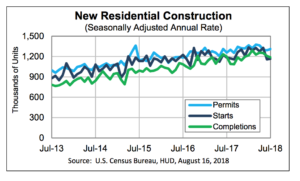
An update today from the Census Bureau stated that, “Privately-owned housing units authorized by building permits in July were at a seasonally adjusted annual rate of 1,311,000. This is 1.5 percent above the revised June rate of 1,292,000 and is 4.2 percent above the July 2017 rate of 1,258,000.”

“Privately-owned housing starts in July were at a seasonally adjusted annual rate of 1,168,000. This is 0.9 percent above the revised June estimate of 1,158,000, but is 1.4 percent below the July 2017 rate of 1,185,000.”

Monthly New Residential Construction, July 2018 Release Number: CB18-123.

Today’s update added, “Privately-owned housing completions in July were at a seasonally adjusted annual rate of 1,188,000. This is 1.7 percent below the revised June estimate of 1,209,000 and is 0.8 percent below the July 2017 rate of 1,197,000.”

Posted in Real Estate Law | Comments closed