
Legal Wrangling Continues Over WOTUS

DTN writer Todd Neeley reported yesterday that, “The waters of the United States saga continues, as the American Farm Bureau Federation asked a federal court in Georgia on Wednesday to issue a national injunction on the 2015 WOTUS rule.

“A series of ongoing court actions has left the rule in a state of chaos, as currently 28 states are exempted and 22 are not.

“The AFBF is leading a coalition of business groups in asking the U.S. District Court for the Southern District of Georgia in Brunswick to extend a previous injunction on 11 states to the remaining 22 states where the rule is in effect.”

Mr. Neeley noted that, “An appeals court in Cincinnati had issued a national stay on the rule in 2015. The national stay ended when the U.S. Supreme Court ruled that challenges to WOTUS belong in district courts.”

The DTN article added: “In the AFBF motion filed on Wednesday, the group said the multiple court rulings have created confusion.

“‘This is a deeply troubling state of affairs,’ the motion said. ‘A rule this fundamental to the (Clean Water Act’s) regulatory scheme should not apply in a patchwork manner.'”

Posted in Agriculture Law | Comments closed

Minnesota Co-op Customers Urged to File Claims

DTN writer Todd Neeley reported yesterday that, “The Minnesota Department of Agriculture is urging farmers who conducted business with the now-closed Ashby Farmers Cooperative in Ashby, Minnesota, to collect any evidence they have to prove they are owed money by the co-op or had grain stored at the facility in order to file a bond claim with the department.

“The MDA issued an advisory to farmers on Tuesday to begin the process of trying to recover at least some of the losses.

“The 307,000-bushel-capacity grain elevator closed earlier this month after it was discovered the elevator’s former manager had allegedly stole about $2 million from the business before disappearing.”

The DTN update noted that, “Bob Zelenka, executive director of the Minnesota Grain and Feed Association, said the Ashby case is like no other in the state.

“‘It is certainly unfortunate when something like this happens because it reflects poorly on the whole industry,’ he said. ‘In my 38 years with this industry, I have never witnessed anything as unusual as the situation in Ashby.’

“According to the MDA, farmers with claims against the elevator should start by completing a grain bond proof of claim form. The form can be accessed at: http://www.mda.state.mn.us/…

“Along with the form, farmers need to provide supporting evidence, which can include scale tickets, purchase agreements, purchase receipts, non-sufficient-funds checks, contracts, warehouse receipts and assembly sheets.”

Posted in Agriculture Law | Comments closed

Elevator Manager Under Investigation After Millions Go Missing From Co-op

DTN Ag Policy Editor Chris Clayton reported late last week that, “Roughly 150 farmers attended a meeting Tuesday night in Ashby, Minnesota, looking for answers about the closed Ashby Farmers Cooperative Elevator and its former manager, who allegedly stole at least $2 million from the elevator before disappearing earlier this month.

“An audit of the grain cooperative’s books is continuing to detail actual losses, and investigators are looking into the alleged fraud by former elevator manager Jerry Hennessey. He had managed the elevator since 1989, but has not been seen in Ashby since it became clear the elevator was missing funds.

“Erik Ahlgren, an attorney hired to sort through the losses and find a possible buyer for the 307,000-bushel-capacity grain elevator, said roughly half the people in the crowd raised their hands when he asked how many farmers were still owed money from the cooperative.”

Mr. Clayton noted that, “Minnesota requires bonding, but the bond for the cooperative is valued at $125,000. Farmers can file claims with the state, but officials won’t know the exact total of claims filed and possible payout per farmer until at least six months from now. The pool of claims is determined, then divided pro rata among all of those who file, Ahlgren said.

“Insurance on the elevator for crimes is $100,000 per loss. That raises questions of how single losses are defined and whether that will cover a larger amount. In a statement to farmers announcing the closure, Ahlgren stated the co-op board did not expect to have funds to pay the co-op’s outstanding obligations.

“Beyond what is owed to farmers, the Ashby Farmers Cooperative also owes $8 million to the Farm Credit lender CoBank.”

The DTN article added, “The cooperative has about 300 members who are defined as having at least $500 in transactions with the elevator over the last year.”

Posted in Agriculture Law | Comments closed

Bayer wants California Judge to Overturn Jury Verdict and $289 Million Damage Award

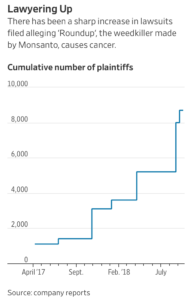
Wall Street Journal writers Jacob Bunge and Ruth Bender reported last week that, “Bayer AG is stepping up the legal defense of its flagship weedkiller, after a recent verdict in a case alleging the chemical causes cancer sent shares down sharply and raised the prospect of costly plaintiff payouts.

“The German company on Tuesday said it wants a California state court judge to overturn the jury’s verdict, order a new trial or reduce damages, according to a court filing. The $289 million award granted in August came in one of the first of thousands of cases filed by gardeners, farmers and others claiming Bayer’s Roundup herbicide gave them cancer.

“The jury in that case ruled unanimously in favor of a former groundskeeper who sought to hold the maker of Roundup liable for his non-Hodgkin lymphoma. The verdict came only two months after the pharmaceutical and chemical conglomerate sealed its takeover of Monsanto, the U.S. agriculture giant that invented the herbicide.”

“Bayer Steps Up Legal Fight Over Weed Killer Blamed for Cancer,” by Jacob Bunge and Ruth Bender. The Wall Street Journal Online (Sept. 19, 2018 ).

The Journal writers explained that, “Legal academics said successful challenges to jury verdicts aren’t uncommon. Last October, another California state judge overturned a $417 million judgment against Johnson & Johnson after a woman alleged that the company’s baby powder contributed to her developing ovarian cancer.

“In January, a judge in Pennsylvania state court overturned a jury’s verdict and $28 million in damages and ruled in Bayer’s favor in a lawsuit alleging the company and Johnson & Johnson didn’t properly warn about internal bleeding risks from the drug Xarelto.”

Last week’s article added, “Bayer has sometimes settled product lawsuits. In 2005, Bayer paid $1.15 billion to settle some 3,000 death and injury claims over the cholesterol-lowering drug Baycol, which it no longer sells.”

Posted in Agriculture Law | Comments closed

Iowa Now Exempt From 2015 WOTUS Rule

DTN writer Todd Neeley reported Tuesday that, “Add Iowa to the list of now 28 states not under the jurisdiction of the 2015 waters of the United States rule thanks to a ruling by the U.S. District Court for the District of North Dakota on Tuesday.

“Iowa Republican Gov. Kim Reynolds asked the court for the injunction after a series of court rulings left Iowa on the list of states required to abide by WOTUS.

“A South Carolina court recently ruled EPA violated the Administrative Procedures Act in finalizing a suspension rule that delayed WOTUS until 2020. As a result, the 2015 rule took effect in Iowa and a number of other states.”

Mr. Neeley explained, “As a result of this latest ruling, WOTUS is now on hold in 28 states: Iowa, Texas, Mississippi, Louisiana, Georgia, Alabama, Florida, Indiana, Kansas, North Carolina, South Carolina, Utah, West Virginia, Wisconsin, Kentucky, South Dakota, Missouri, Alaska, North Dakota, New Mexico, Idaho, Arizona, Nebraska, Montana, Arkansas, Nevada, Colorado and Wyoming.

“The 2015 rule now is in effect in 22 states: Illinois, California, Washington, Oregon, Tennessee, Vermont, Virginia, New Hampshire, New Jersey, New York, Ohio, Oklahoma, Pennsylvania, Rhode Island, Minnesota, Michigan, Massachusetts, Maryland, Maine, Hawaii, Delaware and Connecticut.

“The North Dakota court is one of several district courts where WOTUS lawsuits were filed in 2015.”

Posted in Agriculture Law | Comments closed

Floodwaters Have Caused Worst Damage to North Carolina’s Hog Farms in Nearly Two Decades

Wall Street Journal writers Kris Maher and Ben Kesling reported yesterday that, “Floodwaters have caused the worst damage to North Carolina’s hog farms in nearly two decades, with more than 5,000 animals dying and several dozen waste lagoons releasing pollutants into waterways.

“Hog industry officials said Wednesday they didn’t expect much more damage to farms, despite some rivers continuing to rise in the state. But environmental groups are calling for the industry to relocate lagoons in floodplains to lessen the risks during major storms going forward.

“Flooding was expected in North Carolina through Saturday, and many roads remain under water, the National Weather Service said.”

The Journal article noted, “‘This is the most significant storm that we have faced probably ever,’ said Andy Curliss, chief executive of the North Carolina Pork Council.

“Mr. Curliss said farmers moved 20,000 hogs to higher ground, which prevented a higher death toll. ‘From our point of view, there’s a lot of heroics,’ he said, adding that media reports of damage to several of the state’s 3,300 active hog-waste lagoons was exaggerated.

“Hurricane Florence killed 5,500 of the state’s 8.9 million pigs and hogs, the state said. That is more than the 2,800 hogs that died during Hurricane Matthew in 2016, but far less than the 21,000 hogs that died during Hurricane Floyd in 1999, according to pork council numbers.”

The Journal writers added, “An estimated 3.4 million chickens and turkeys were killed by Florence, the North Carolina Department of Agriculture and Consumer Services reported Wednesday.”

Posted in Agriculture Law | Comments closed

Indigo Raises $250 Million

Bloomberg writer Austin Weinstein reported yesterday that, “Bacteria-based agriculture is starting to become big business. On Tuesday startup Indigo Ag Inc. announced it had raised $250 million from investors, bringing its funding total to more than $650 million.

“Investors in the round included Baillie Gifford, the Investment Corporation of Dubai and the Alaska Permanent Fund. It comes on the heels of a $203 million financing round last year which valued the Boston-based company at $1.4 billion.

“‘If you rank the largest industries in the world, agriculture is third, fourth or fifth in any given year,’ said Indigo Chief Executive Officer David Perry. ‘It’s also really the last big industry that has yet to be impacted by new technologies and new business models.'”

The Bloomberg article added, “Indigo is one of a number of firms using microbes to improve agricultural output, which could potentially curtail the use of synthetic pesticides, fertilizers and genetically modified seeds. In April, Bloomberg reported that Indigo’s microbe coatings boosted cotton yields by an average of 14 percent in full-scale commercial trials in Texas.

“The company plans to use the new funding in part to expand its digital grain marketplace, which connects farmers directly to buyers, and allows buyers to select for specific attributes. For example, one large consumer packaged-goods company, aiming to cut back on its water use, opted to buy corn that was grown without irrigation, Perry said. The marketplace already lists more than $6 billion of grain inventory.”

Posted in Agriculture Law | Comments closed

Update: Hurricane Florence Widespread Impact on North Carolina Agriculture, Including Some Hog Lagoons, Cotton, and Tobacco

An update posted yesterday at the BartellPowell Blog regarding the impacts of Hurricane Florence on North Carolina agriculture, noted that, “North Carolina’s hog-manure lagoons have stayed contained so far, according to the state…”

However, Bloomberg writers Mark Niquette, Shruti Singh, and Megan Durisin reported Tuesday that, “There have been at least two breaches of hog-manure lagoons in North Carolina amid the record-setting, still-rising floods that have been unleashed by deadly Hurricane Florence, according to a state agency.

“One of the sites is in Duplin County and contains more than 300,000 cubic yards of waste, which can be described as a ‘total loss,’ said Megan Thorpe, a spokeswoman for the state’s Department of Environmental Quality.

“The state has about 4,000 of the lagoons, Governor Roy Cooper said Sunday. The lined earthen pits that hold treated waste had been a major environmental concern as unprecedented rain lashed the state. North Carolina is home to more pigs than any state besides Iowa, and its farms are concentrated in eastern counties, government data show.”

Tuesday’s article added, “Rising waters are spurring ‘widespread impacts‘ in eastern regions, the North Carolina Pork Council said in a statement on its website Monday. The group said it was aware of one lagoon breach in Duplin County and four other lagoons there were inundated by the floodwaters.”

In a separate Bloomberg article Tuesday, Jen Skerritt, Megan Durisin, and Shruti Singh reported that, “The record-setting, still-rising floods unleashed across North Carolina by deadly Hurricane Florence are soaking crops after the storm wreaked havoc on cotton and tobacco.

“The number of cotton fields rated in good or excellent condition fell by 14 percentage points to 48 percent as of Sunday from a week earlier, the U.S. Department of Agriculture said in a report Monday. Conditions also declined for corn and soybeans, and agriculture officials in the state cited damage from wind and rains to tobacco plants.

“No one is certain just how many tobacco, corn, soybean, cotton, peanut and sweet potato fields are still under water or experiencing flooding, said Lynda Loveland, spokeswoman for North Carolina Farm Bureau. It will take several days to properly assess crop damage as the water still needs to recede, she said in an email.”

Posted in Agriculture Law | Comments closed

North Carolina Governor Says Hog Lagoons Stay Contained During Florence

Reuters writers Patrick Rucker and Jessica Resnick-Ault reported late last week that, “Tropical Storm Florence could taint North Carolina waterways with murky coal ash and toxic hog waste as heavy rains test environmental rules written with milder weather in mind, carrying the risk of contaminating water with bacteria like salmonella, officials said on Friday.

“Many of the state’s environmental codes were written to withstand a 25- or 100-year storm. But Florence promises heavy rains that some regions might not see in a thousand years, straining systems meant to keep state residents safe.

“The deluge could push industrial waste sites to the limit, Governor Roy Cooper said on Friday.”

However, Bloomberg writer Olivia Carville reported Sunday that, “North Carolina’s hog-manure lagoons have stayed contained so far, according to the state, as the region continues to get pelted with rain from the remnants of Hurricane Florence.

“The state’s 4,000 lagoons are holding out, even though huge swaths of farmland in the state’s eastern corner are underwater, Governor Roy Cooper said. The lined earthen pits that hold treated waste had been a major environmental concern as unprecedented rain lashed North Carolina, with at least 30 rivers breaching their banks.

“‘We are closely monitoring hog lagoons, and we haven’t had any reports of issues,’ Cooper said in a media briefing Sunday.”

The Bloomberg article added, “Hog farming is one of the biggest industries in North Carolina. Duplin County, where two people have died due to flash flooding, is home to 45 times as many hogs as its human population. Lagoons in the state’s east have flooded in previous hurricanes, causing serious health and safety hazards. In 1999, Hurricane Floyd flooded dozens of hog-manure lagoons and swine farms, leading to widely circulated photos of pigs clinging to roof tops. Hurricane Matthew submerged 14 lagoons in 2016.”

Posted in Agriculture Law | Comments closed

DTN: Three States Granted WOTUS Injunction

DTN writer Todd Neeley reported yesterday that, “A Texas court has issued an injunction against the 2015 waters of the United States, or WOTUS, rule after the Texas attorney general’s office told the court it was ready to appeal to a higher court.

“As a result of a South Carolina court’s recent ruling, the rule was in effect in 26 states and on hold in 24 states. The South Carolina court on Aug. 16 ruled that the EPA did not follow the Administrative Procedures Act in finalizing its rule to delay the 2015 WOTUS for two years.

“On Wednesday, the U.S. District Court for the Southern District of Texas in Galveston granted a request for a temporary injunction of the rule in Texas, Mississippi and Louisiana.”

Mr. Neeley noted that, “As a result of this latest ruling, WOTUS is now on hold in 27 states: Texas, Mississippi, Louisiana, Georgia, Alabama, Florida, Indiana, Kansas, North Carolina, South Carolina, Utah, West Virginia, Wisconsin, Kentucky, South Dakota, Missouri, Alaska, North Dakota, New Mexico, Idaho, Arizona, Nebraska, Montana, Arkansas, Nevada, Colorado and Wyoming.

“The 2015 rule now is in effect in 23 states: Iowa, Illinois, California, Washington, Oregon, Tennessee, Vermont, Virginia, New Hampshire, New Jersey, New York, Ohio, Oklahoma, Pennsylvania, Rhode Island, Minnesota, Michigan, Massachusetts, Maryland, Maine, Hawaii, Delaware and Connecticut.

“The Texas court’s ruling came after the Texas attorney general’s office wrote a letter to the court, requesting a decision or the three states would appeal to a higher court.”

Posted in Agriculture Law | Comments closed