Number of New Houses on the Market Highest Since January 2009

Bloomberg writer Sho Chandra reported yesterday that, “U.S. purchases of new homes fell more than estimated in September to the weakest pace since December 2016, adding to signs that a lack of affordability is crimping demand, according to government data Wednesday.

“The results fell below all forecasts in Bloomberg’s survey of economists and showed downward revisions for the prior three months, signaling that the market ended the quarter on a weak note.

“A gauge of homebuilder stocks erased gains and was down 1 percent as of 1 p.m. in New York, bringing its decline this year to 35 percent.”

“U.S. New-Home Sales Tumble to Lowest in Almost Two Years,” by Sho Chandra. Bloomberg News (October 24, 2018).

The Bloomberg article added that, “The results are the latest signs that the housing market is losing momentum. While a strong job market and healthier finances signal demand is unlikely to suddenly collapse, potential buyers are increasingly constrained by rising property prices, higher mortgage rates and a scarcity of affordable listings.”

Posted in Real Estate Law | Comments closed

Behind Bayer’s Tough Defense of Roundup

Sara Randazzo, Jacob Bunge and Ruth Bender reported yesterday at The Wall Street Journal Online that, “Bayer AG’s $63 billion acquisition of Monsanto Co. this year made the German drug and chemicals company the world’s biggest supplier of crop seeds and pesticides—and brought it thousands of lawsuits alleging Monsanto’s Roundup herbicide causes cancer.

“But Bayer has a history of fighting big-ticket litigation and has seen much worse. So officials are projecting calm, even after a judge Monday rejected Bayer’s request to reverse an August jury verdict against the company in the first Roundup case to go to trial.

“Like other pharmaceutical giants, Bayer has for decades battled mass tort lawsuits in the U.S. alleging its drugs and medical devices sicken or kill people. Bayer has typically denied liability, arguing it acted responsibly in marketing its products and warning of side effects. In legal circles, the company has developed a reputation for negotiating when it feels the situation requires that approach, but fighting back and pushing to trial when it believes it can win, even if it takes years to play out.”

The Journal writers explained that, “The 155-year-old company also faces actions from some 24,300 plaintiffs alleging Bayer’s best-selling blood thinner Xarelto causes severe bleeding and even death. Another 17,000 claims are pending over its discontinued permanent birth-control implant Essure, which plaintiffs allege causes injuries ranging from depression to hysterectomy, and 2,700 over its longterm birth control device Mirena. Bayer denies liability and is fighting the suits.

“The Monsanto deal added claims from at least 8,700 plaintiffs targeting its flagship weedkiller Roundup. [Bayer Chief Executive Werner Baumann] and other Bayer executives in recent weeks have vowed to contest mounting lawsuits.”

Yesterday’s Journal article added that, “A Bayer spokesman said while each case is unique, the scientific and regulatory records of a product play a big part. In the Roundup litigation, he said, ‘Bayer is confident in both of these factors because its glyphosate-based products are among the most-studied of their kind, and the four decadelong body of scientific research confirms they are safe when used as directed, and that glyphosate is not carcinogenic.’

“Defending everyday products can also be more difficult than defending drugs, experts say, because it is harder for the company to argue that any risk is worth the potential upside. A drug with potentially serious side effects, for instance, could still save lives.”

Posted in Agriculture Law | Comments closed

Judge Reduces Jury Award Against Bayer’s Roundup to $78.5 Million

Wall Street Journal writers Sara Randazzo and Jacob Bunge reported today that, “A California judge on Monday reduced by more than $200 million a jury verdict linking Bayer AG’s Roundup weedkiller to cancer but upheld the jury’s findings that the company acted with malice.

“San Francisco Superior Court Judge Suzanne Ramos Bolanos said the $250 million in punitive damages awarded by the jury must be slimmed down to match the $39.25 million in compensatory damages that the jury found appropriate. If the plaintiff agrees to the reduction by Dec. 7, no new trial is needed.

“Bayer shares dropped on the news, down 6.7% in early trading Tuesday, as investors and analysts had been hoping the judge would go even further, reducing also compensatory damages or ordering a new trial.”

The Journal writers noted that, “Bayer inherited thousands of Roundup-related lawsuits in its recently closed acquisition of Monsanto Co. and has worked to assuage investor concerns about potential liability from the litigation.”

Yesterday’s article added: “Monsanto attorneys argued that comments made by the plaintiff’s counsel, Brent Wisner, during closing arguments inflamed the jury. They included comparisons to the tobacco industry and a remark that Monsanto executives were waiting to pop champagne in their boardroom if they won the case.”

Posted in Agriculture Law | Comments closed

Federal Court in Texas Asked to Vacate 2015 WOTUS Rule

DTN writer Todd Neeley reported Friday that, “Three states, along with the American Farm Bureau Federation, asked a federal court in Texas on Thursday to vacate the 2015 waters of the United States, or WOTUS, rule in the latest in a long series of court actions.

“In separate motions filed with the U.S. District Court for the Southern District of Texas in Galveston, the states of Texas, Mississippi and Louisiana and the American Farm Bureau Federation (AFBF) asked the court to throw out the rule for a number of reasons.

“AFBF has been aggressively pursuing legal avenues to kill the 2015 rule with motions filed over the past week in federal courts in both Texas and Georgia.”

Mr. Neeley noted that, “Currently, the rule is in effect in 22 states and on hold in 28 states, as a result of a long legal battle. The EPA continues to draft rules to repeal the 2015 rule and replace it by September 2019.

“The agency had finalized a rule to delay the implementation of the 2015 rule to 2020, but that has since been struck down by another court.

“The AFBF argues the EPA violated the Administrative Procedures Act by not allowing the public to comment on the rule ‘before making substantive changes’ before it was finalized.”

The DTN article added: “The states ask the court to vacate the rule based on a number of constitutional issues.”

Posted in Agriculture Law | Comments closed

Grain Elevator Assets to Be Sold After Millions of Dollars Went Missing

DTN Ag Policy Editor Chris Clayton reported yesterday that, “The members of a Minnesota farmers’ cooperative have voted to dissolve and sell the cooperative’s assets after the former elevator manager allegedly stole millions of dollars before disappearing in September.

“The Ashby (Minnesota) Farmers Cooperative discovered it was in trouble in early September when it was uncovered that the long-time former manager, Jerry Hennessey, had written millions of dollars in unauthorized checks. Erik Ahlgren, an attorney hired by the cooperative, said Thursday auditors have identified $4.9 million in unauthorized checks.

“‘I can’t tell you it’s a final figure,’ Ahlgren said. ‘There certainly could be more. I don’t think we have found all the problems yet, and we may never actually learn all of the problems.'”

The DTN article noted that, “Hennessey is a big-game hunter known for taking safari trips overseas, and at least some of the lost cooperative funds went to pay a Cabela’s credit card, taxidermy services and hunting trips. So far, Hennessey remains in hiding from state and county investigators.”

Mr. Clayton added that, “Minnesota requires bonding, but the bond for the cooperative is valued at $125,000. Farmers can file claims with the state, but officials won’t know the total projected losses until roughly five months from now. The pool of claims is determined, then divided pro rata among all of those who file.”

Posted in Agriculture Law | Comments closed

Bayer Could Win a New Trial for Roundup

Wall Street Journal writer Jacob Bunge reported earlier this month that, “Bayer AG could win a new trial to defend its Roundup weed killer.

“A California judge on [October 10th] issued a tentative ruling for a new trial on the $250 million in punitive damages awarded to a groundskeeper, who sought to hold the Roundup maker liable for his non-Hodgkin lymphoma.

“If finalized, Judge Suzanne Ramos Bolanos’s ruling would grant a motion by Bayer arguing that sum wasn’t justified and that the evidence didn’t prove the company intended to harm the plaintiff. It isn’t clear when the judge may finalize the ruling, issued ahead of a court hearing [on October 10th].”

The Journal article noted that, “The plaintiff, Dewayne Johnson, is likely to appeal the ruling if it is finalized.”

Mr. Bunge added: “A Bayer spokesman said the judge is considering its motions for a new trial on the liability verdicts and reduction of the $39 million in compensatory damages the jury awarded. Bayer ‘continues to believe that the evidence at trial does not support the verdict and the damage awards,’ he said.”

In addition, Bloomberg writer Joel Rosenblatt reported earlier this month that, “The lawyer most responsible for winning a $289 million verdict against Bayer AG may end up wiping it out.

“Brent Wisner was the lead trial attorney who in August convinced a jury that Monsanto Co.’s Roundup weed killer caused his client’s cancer. His compelling arguments and marshaling of evidence resulted in a blockbuster verdict that has spooked investors looking ahead to thousands of similar lawsuits across the U.S. pending against Monsanto, which Bayer acquired in June.

“But Wisner’s closing arguments at trial irked the judge handling the case so profoundly that she’s considering tossing the verdict and ordering a new trial. The lawyer told jurors that Monsanto executives in a company board room were ‘waiting for the phone to ring’ and that ‘behind them is a bunch of champagne on ice,’ according to a court filing. He said that ‘if the damages number isn’t significant enough, champagne corks will pop.'”

The Bloomberg article indicated that, “The judge is examining the company’s arguments that there no basis for the jury to conclude that Monsanto is liable for plaintiff Lee Johnson’s non-Hodgkin lymphoma based on his exposure to the key ingredient in Roundup, glyphosate.”

Posted in Agriculture Law | Comments closed

Organic Field Crop Acreage Grows While Non-GMO Acreage Declines

DTN writer Katie Dehlinger reported yesterday that, “Acreage planted to organic field crops is on the rise while land planted to non-GMO corn and soybeans declined, according to a new report from Mercaris, a market data and trading platform for the identity-preserved grain industry.

“The number of farms certified under USDA’s National Organic Program increased 3% in 2018 to 17,648, with the biggest gains coming in the Northeast, Corn Belt and West Coast.

“Mercaris estimates the number of certified organic acres in 2018 will total 6.5 million, up 2% from last year.”

The DTN article added that, “Mercaris also released an estimate of crops raised from non-genetically modified seed by extrapolating from USDA data on overall acreage and biotechnology usage rates.

“In 2018, farmers planted fewer total acres of corn and soybeans and used more genetically modified seed varieties. As a result, overall non-GMO acreage declined 5% from 2017 to 12.1 million acres.

“Total U.S. non-GMO corn acreage declined for the second year in a row.”

Posted in Agriculture Law | Comments closed

Three Farmers Agreed to Plead Guilty to Fraudulently Marketing Non-Organic Corn and Soybeans

The Associated Press reported late last week that, “Three farmers have agreed to plead guilty to fraudulently marketing non-organic corn and soybeans as certified organic as part of a lengthy, multi-million-dollar scheme.

“Documents filed in federal court in Iowa show that Tom Brennan, James Brennan and Michael Potter each intend to plead guilty to wire fraud.

“All three are identified in court papers as farmers from Nebraska, but additional information about them wasn’t immediately available. Their attorneys didn’t immediately reply to phone messages.”

The AP article noted that, “Prosecutors allege that the three sold non-organic grains to an Iowa company that marketed them nationwide with an organic label…[and]…the scheme allegedly lasted from 2010 until 2017 and netted at least $10.8 million.”

Posted in Agriculture Law | Comments closed

Mortgage Rates Increase, Cost of borrowing, highest in Over Seven Years

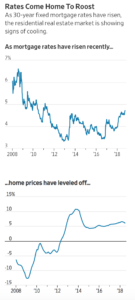
Wall Street Journal writers  Laura Kusisto and Christina Rexrode reported last week that, “Mortgage rates hit their highest level in more than seven years this week at nearly 5%, a level that could deter many home buyers and represents another setback for the slumping housing market.

“The average rate for a 30-year fixed-rate mortgage rose to 4.9%—the largest weekly jump in about two years—according to data released Thursday by mortgage-finance giant Freddie Mac.

“Lenders and real-estate agents say that, even now, all but the most qualified buyers making large down payments face borrowing rates of 5%.”

“Mortgage Rates Fast Approaching 5%, a Fresh Blow to Housing Market,” by Laura Kusisto and Christina Rexrode. The Wall Street Journal Online (October 11, 2018).

The Journal article added that, “A 5% mortgage rate isn’t that high by historic standards. During much of the decade before the financial crisis, these rates hovered between 5% and 7%. But a return to more normal lending rates won’t feel normal to many buyers who have become accustomed to getting a mortgage loan at 4% or lower, and they could experience sticker shock at what they would have to pay now for a home loan.”

Posted in Real Estate Law | Comments closed

Corn Futures Advance as USDA Cuts Outlook for Domestic Yield

Bloomberg writers Megan Durisin and Shruti Singh reported yesterday that, “After months of dealing with gloom in the grain markets, corn bulls were delivered some relief as the U.S. Department of Agriculture forecast smaller-than-expected domestic production. But the euphoria didn’t last when it came to soybeans and wheat.

“In one of the biggest recent surprises for the corn market, the USDA cut its outlook for domestic yields. Reductions for Illinois and Iowa helped pulled the national number lower. While it’s still projected at a record high, that little bit of respite was enough to get the market moving. Corn futures in Chicago jumped as much as 2.8 percent, the most since Oct. 1.”

The Illinois corn yield forecast for October was two bushels below the September estimate. USDA- National Agricultural Statistics Service (October 11, 2018).

The Bloomberg article added that, “For soybeans, U.S. stockpiles won’t bulge as much as some analysts had feared, while they’re still forecast at an all-time high. That could signal a storage crunch ahead in the Midwest.”

“As the soybean harvest accelerates, analysts and traders are also tracking snow in the Dakotas and recent rains in other parts of the Midwest that have hampered crop gathering,” the Bloomberg article noted.

Posted in Agriculture Law | Comments closed