Things to Consider When Undertaking a Startup

The column pointed to advice entrepreneurs should consider when undertaking a new startup venture.

While discussing the first tip, “Good friends make bad business partners,” the FT article stated that, “‘So many people have fantastic ideas in their basement or garage, but they lack clarity over each other’s expectations and what each person is bringing to the business,’ says Jeff Roberts, head of the corporate and commercial team at the law firm Collyer Bristow, who supplied the above cautionary tale.

“It is easy to make assumptions about your partners’ aspirations; it is much better to make a proper business plan. The mantra is: protection, protection, protection, says Mr Roberts.”

Mr. Thompson noted that, “Every entrepreneur should think about the day they want out. Do your partners want the same or do they want to sell after two years and buy a yacht?

“‘Thinking about the exit will help you set up the beginning — a proper constitution, tax planning up front if you think you’re going to be the next unicorn, [and] a sensible structure. Work out the end and then the staging posts on how you’re going to get there,’ says Mr Roberts.”

Other tips in the FT article included the following:

  • Guard your intellectual property
  • Investigate your investors
  • Keep an eye on the equity
Posted in Start-up Company Law | Comments closed

As Rates Rise, Mortgage Applications Fall

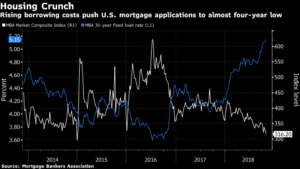
Bloomberg writer Scott Lanman reported today that, “A gauge of U.S. mortgage applications fell last week to the lowest level in almost four years as borrowing costs hit the highest since 2010, adding to challenges for the housing market.

“U.S. Mortgage Applications Hit Lowest Since 2014 as Rates Rise,” by Scott Lanman. Bloomberg News (November 7, 2018).

“The Mortgage Bankers Association’s market composite index fell 4 percent in the week ending Nov. 2 to 316.2, the lowest reading since December 2014, according to a report Wednesday from the Washington-based group. The survey’s contract rate on a 30-year fixed loan rose to 5.15 percent from 5.11 percent, while a gauge of applications to purchase homes dropped 5 percent to the lowest in about two years.”

The Bloomberg article noted that, “The data signal higher mortgage costs are an ever-growing headwind for U.S. homebuyers, who already face a dearth of affordable listings. Residential investment has been a drag on economic growth for five of the past six quarters, and recent data show cooling in sales in construction.”

Posted in Real Estate Law | Comments closed

Home-Price Gains in 20 U.S. Cities Slowest Since 2016

Bloomberg writer Sarah Foster reported recently that, “Home-price gains in 20 U.S. cities cooled in August to the slowest pace since 2016, as high borrowing costs and property values limit buyer interest, according to S&P CoreLogic Case-Shiller data released Tuesday.

“August marks the fifth consecutive month that annual price gains in the 20-city index decelerated, reinforcing signs that the housing market is cooling. Other recent reports showed purchases of previously-owned U.S. homes fell in September to the weakest pace in three years, while new-home sales tumbled to the lowest since December 2016. Housing starts also declined in September amid disruptions from Hurricane Florence.”

The article noted that, “Continued job gains and elevated consumer sentiment have helped boost demand for housing, but shortages in available and affordable listings persist. Meanwhile, mortgage rates near a seven-year high have limited buyer interest.”

Posted in Real Estate Law | Comments closed

Iowa Startup Develops Autonomous Grain Cart System, “AutoCart”

A recent Star Tribune article reported that, “Driverless tractors have long been on the cusp, but they are still not widely used, bogged down by safety concerns, legal obstacles, the difficulties of offering technical support to a large number of farmers using a single product, and lingering doubts about the business case.”

The article stated that, “At the Farm Progress Show in August, the nation’s largest farm trade show, one of the exhibitors was Smart Ag, an Iowa startup that is commercializing a system that allows a farmer, from a combine, to summon an autonomous tractor pulling a grain cart. The product, called AutoCart, costs about $40,000.

“Colin Hurd, the founder of Smart Ag, said transferring harvested grain from the combine to a grain cart is one of the key bottlenecks in farming. It’s tough to find someone to drive that extra tractor. Some kids come back from college to help. Retired neighbors drive the tractor. Spouses take days off work.”

The article added that, “AutoCart consists of software and hardware that allows the farmer to summon a tractor pulling a grain cart, and allows the tractor to drive itself into position alongside the combine and stay there as the combine keeps moving and empties grain into the cart. It also includes sensors that can spot obstacles and people and avoid them. The system works with John Deere 8000 series tractors. Five AutoCarts have been installed. Ten dealers have signed up to sell the system.”

Posted in Agriculture Law | Comments closed

More Information on EPA’s Dicamba Decision

An update yesterday by Tricia Braid, which was posted at the Illinois Corn Growers Association (ICGA) Online, stated that, “EPA has extended the registration for dicamba but you should know these two key points: 1) it prohibits over-the-top application of dicamba on soybeans 45 days after planting, and 2) applications are limited, as they were previously, to two over the top.

“Illinois Corn Growers Association President Aron Carlson says that the EPA’s decision to extend the registration of dicamba for two years for ‘over-the-top’ use (application to growing plants) to control weeds in fields for cotton and soybean plants genetically engineered to resist dicamba is a welcome indication that the collaborative nature of the registration process was well informed by input from and extensive collaboration between EPA, state regulators, farmers, academic researchers, pesticide manufacturers, and other stakeholders.

“‘Dicamba, and other products regulated by EPA are important tools in our business,’ said Carlson. ‘ICGA supports access to products that have been proven to be safe by scientific standards. We also support education and training programs so that farmers and other applicators are well versed in on-label use so that we can continue to have access to these types of products over time.'”

Yesterday’s ICGA update added that, “The following label changes were made to ensure that these products can continue to be used effectively while addressing potential concerns to surrounding crops and plants:

“Dicamba registration decisions for 2019-2020 growing season

  • Two-year registration (until December 20, 2020)
  • Only certified applicators may apply dicamba over the top (those working under the supervision of a certified applicator may no longer make applications)
  • Prohibit over-the-top application of dicamba on soybeans 45 days after planting and cotton 60 days after planting
  • For cotton, limit the number of over-the-top applications from 4 to 2 (soybeans remain at 2 OTT applications)
  • Applications will be allowed only from 1 hour after sunrise to 2 hours before sunset
  • In counties where endangered species may exist, the downwind buffer will remain at 110 feet and there will be a new 57-foot buffer around the other sides of the field (the 110-foot downwind buffer applies to all applications, not just in counties where endangered species may exist)
  • Clarify the training period for 2019 and beyond, ensuring consistency across all three products
  • Enhanced tank clean-out instructions for the entire system
  • Enhanced label to improve applicator awareness on the impact of low pH’s on the potential volatility of dicamba
  • Label clean up and consistency to improve compliance and enforceability
  • The registration for all dicamba products will automatically expire on December 20, 2020, unless EPA further extends it.”
Posted in Agriculture Law | Comments closed

EPA Allows Farmers to Keep Using Dicamba

Wall Street Journal writer Jacob Bunge reported yesterday that, “The Environmental Protection Agency will continue to allow farmers to spray crops with a controversial weedkiller, while tightening restrictions, the agency said.

“The EPA extended by two years its approval of XtendiMax, a version of the herbicide dicamba made by Bayer AG, which some farmers and researchers have blamed for damaging millions of acres of crops over the past two years.

“The decision is a win for Bayer, which also markets soybean and cotton seeds genetically engineered to survive the chemical. Bayer this year acquired U.S. seed and pesticide giant Monsanto, which in 2018 sold about 50 million acres’ worth of dicamba-tolerant soybean and cotton seeds to farmers while training them how to spray the herbicide and avoid damaging other crops.”

Mr. Bunge noted that, “Monsanto said its new version of dicamba was far less prone to drift. But some farmers and weed scientists blamed dicamba for hundreds of damaged fields. Monsanto officials attributed the vast majority of harmed fields to farmers spraying on windy days and other errors.

“University of Missouri researchers in July estimated 1.1 million acres of soybeans were affected this year, including 500,000 acres in Illinois, the top soybean-producing state.”

Posted in Agriculture Law | Comments closed

Fewer Consumers Opting for that Weekly Box of Veggies

Chicago Tribune writer Greg Trotter reported earlier this month that, “In the heart of corn and soybean country, Hans and Katie Bishop of PrairiErth Farm are cultivating an unconventional dream, one pesticide-free, dirt-encrusted sweet potato at a time.”

“Their passion remains strong, but they’ve had to adapt to a changing food industry rife with new competitors,” the Tribune article said.

Mr. Trotter explained that, “Farmers like the Bishops have seen competitors offering their own organic fruits and vegetables sprout up like weeds in recent years. From large grocers with robust selections of organic produce to meal kit startups touting healthy and quick foods, consumers have an abundance of options. Once the province of hippy co-ops and farmers markets, organic produce can be purchased at any Walmart, Jewel-Osco or Aldi — or home-delivered via Amazon and other online retailers.

“This rush of competition has hurt revenue at many small farms in Illinois — particularly those that rely on sales through what’s known as community supported agriculture programs, or CSAs. Some farms have scaled back operations or closed altogether. Others, like PrairiErth, have changed their business models to survive.”

The Tribune article pointed out that, “CSAs, where community members pay a certain amount for a weekly box of vegetables from the harvest, are designed to support local farming ‘so that the farmland becomes, either legally or spiritually, the community’s farm,’ according to a definition on the U.S. Department of Agriculture’s website. The model gives farmers a consistent revenue stream with relatively low overhead costs.

“But many Illinois farmers say their CSA sales peaked three or four years ago and that the concept has since fallen out of favor with consumers, who value convenience and customization.”

Mr. Trotter added that, “On a recent crisp autumn morning on the PrairiErth Farm in downstate Atlanta, a small crew of workers pulled sweet potatoes and carrots from the soil, vegetables that would be sold to customers in the Bloomington area and through wholesalers in Chicago. Hans and Katie Bishop are doing many of the things experts say farmers need to do. They’re expanding their wholesale business, partnering with other farms and allowing their CSA members to select what goes into their boxes for an additional cost.

“And the business is growing — with projected gross annual sales of $475,000, up about 5 percent from last year — despite the competitive challenges.”

Posted in Agriculture Law | Comments closed

Freddie Mac Data Shows 78% of People Now Say that Renting is More Affordable than Owning

Wall Street Journal writer Laura Kusisto reported earlier this month that, “More than three-quarters of Americans now view renting as more affordable than owning a home, the latest sign that rising mortgage rates and higher home prices will continue to pressure home sales.

“Some 78% of people now say that renting is more affordable than owning, according to survey data to be released Tuesday by mortgage company Freddie Mac.  That is up 11 percentage points from only six months ago.

“The survey also indicates that demand for for-sale housing could remain soft in the coming months. Some 58% of renters now say they don’t currently have plans to buy a home—up from 54% in February, according to Freddie.”

The Journal article pointed out that, “Demand for rentals swelled after the recession, as millions of families lost their homes to foreclosure and tight credit made it difficult for young people to buy homes. Rents rose by double-digit percentages in many cities and the share of families who couldn’t afford their rent swelled to record highs.

“Meanwhile home prices plummeted and, for those who could qualify for mortgages, it was a great time to buy.

“But this year, that dynamic has reversed. Rent growth has slowed in line with inflation in the last few quarters, as new rental supply hits a three-decade high. At the same time, home prices continue to grow significantly faster than incomes and inflation and mortgage rates have risen nearly a percentage point from the beginning of this year. That has made it significantly more expensive to buy a home.”

Posted in Real Estate Law | Comments closed

Average Homeownership Tenure Increases

Bloomberg writer Alexandre Tanzi reported last week that, “There’s no place like home.

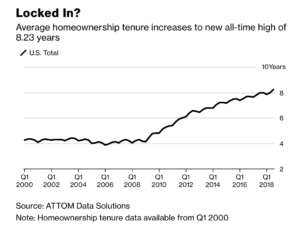
“The median length of time Americans have owned their homes rose to a record of more than eight years in the third quarter, according to ATTOM Data Solutions. That’s up from 4.5 years when the recession ended in June 2009.”

“U.S. Homeowners Staying Put as Mortgage Rates Lock Them In,” by Alexandre Tanzi. Bloomberg News (October 27, 2018).

The Bloomberg article added that, “With mortgage costs on the rise, moving will be ‘even less appealing as homeowners may not want to give up their rock-bottom interest rate to buy a new home at the now-higher rates,’ according to Daren Blomquist, senior vice president at the firm.”

Posted in Real Estate Law | Comments closed

ARC/PLC Payments Continue to Decline

DTN Farm Business Editor Katie Dehlinger reported last week that, “USDA began issuing checks, worth about $3 billion in total, for last year’s Agriculture Risk Coverage (ARC) and Price Loss Coverage (PLC) programs this month. While any form of cash assistance in these tough economic times is generally considered good news, that total is less than half of 2016’s $7 billion payout. At the same time, some early forecasts for 2018 payments on crops currently being harvested don’t show much of a payment at all.

“USDA’s press release stresses that even though the 2014 Farm Bill expired, it’s still making payments as mandated by statute.

“‘These program payments are mandated by Congress, but the Department has taken measures to ensure we meet our deadlines and get capital in the hands of those folks that need it most,’ Agriculture Secretary Sonny Perdue said. ‘Unfortunately, 2018 has proven to be another tough year for producers across the Nation, making the timeliness even more critical.'”

The DTN article noted that, “A recent FarmDoc Daily blog walks through how the 2017 ARC-CO payments are calculated for corn, soybeans and wheat in three different counties across the state. The blog also includes national maps for each crop, which highlights the pockets of production where farmers can expect payments. You can find it here: https://farmdocdaily.illinois.edu/…

“It shows that benchmark prices for corn in 2018 is $3.70 per bushel, 25 cents below last year. For soybeans, the benchmark price will be $1.23 lower per bushel at $9.63. Wheat’s price benchmark, at $5.66 per bushel, is 46 cents lower than 2017.

“County yields, and therefore reliable estimates of 2018 ARC-Co payments, won’t be determined until the National Agricultural Statistic Service releases county yields in February. But as the FarmDoc blog concludes: ‘ARC-CO payments likely will not be prevalent for 2018 production. Building $0 per acre into cash flow estimates for the 2018 payments that will be received in fall 2019 seems prudent at this point.'”

Posted in Agriculture Law | Comments closed