
Hurricane Michael Takes Aim at No. 1 Chicken Producer Georgia

Bloomberg writer Lydia Mulvany reported yesterday that, “Hurricane Michael is expected to whirl through areas of southern Georgia, South Carolina and North Carolina, idling chicken and egg farms and fertilizer mines.

“Preparations have already begun in Georgia, the No. 1 chicken-producing state, with companies closing down operations early and relocating birds, said Will Sawyer, an economist at CoBank. The storm will touch areas comprising 30 percent of the U.S. chicken market, Sawyer said.”
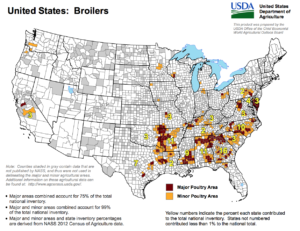
Unites States Broiler Production. Graphic from the U.S. Department of Agriculture’s Office of the Chief Economist.

The Bloomberg article added that, “‘I would expect to see bird losses in south Georgia over the next 24 hours’ due to flooding, Sawyer said by phone Wednesday.

“Cal-Maine Foods Inc., the biggest egg producer, on Wednesday closed down operations in Quincy, Florida, which has about 800,000 birds. The company isn’t expecting other locations to be affected. Meanwhile, Nutrien Ltd., a fertilizer producer, is shutting down mines and some plants at its White Springs, Florida, phosphate facility.”

“While the storm may idle plants and disrupt supply chains, it likely won’t move the needle on low breast-meat prices, Sawyer said.”
Posted in Agriculture Law | Comments closed

Veggie-Selling App Meicai is Said to Raise New Capital

Bloomberg writer Lulu Yilun Chen reported yesterday that, “Meicai, a Chinese startup that helps farmers sell vegetables to restaurants, raised at least $600 million in a funding round led by Tiger Global Management and Hillhouse Capital, people familiar with the matter said.

“The money will be used to expand as the startup competes for a bigger share of China’s fragmented food sourcing market, the people said, asking not to be identified as the details are private. According to one person familiar with the matter, the company raised about $800 million at a valuation of about $7 billion. Meicai was said to be valued at about $2.8 billion pre-investment in its previous funding round in January.

“Meicai, which means ‘beautiful vegetable,’ was founded in 2014 by Liu Chuanjun, a rocket scientist who set a goal of sourcing produce for about 10 million small- and medium-sized restaurants in China. Using a smartphone app, customers can order specialties such as bok choy and Sichuan peppercorns directly from farms, disrupting traditional wholesaling by cutting out middlemen. As of the end of last year, Meicai served close to a 100 cities revenue had surpassed 10 billion yuan.”

The Bloomberg article noted that, “The funding round is among the largest for a Chinese startup this year. Full Truck Alliance, the country’s biggest app for Uber-like long-haul services, raised $1.9 billion in April while Pinduoduo Inc., the Chinese social e-commerce company, raised more than $1 billion in the same month before holding its initial public offering.”

Posted in Agriculture Law, Start-up Company Law | Comments closed

Minnesota Startup “Raised Real” Delivers Nutritional Pouches to Assist with Meal Preparation

Kristen Leigh Painter reported recently at the Minneapolis Star Tribune Online that, “Jen Biswas spent every Sunday afternoon chopping, steaming and puréeing foods for her firstborn when he was a baby.

“With her second child, now 11 months old, she doesn’t have to. A startup company called Raised Real sends her a box of flash-frozen food pouches — each containing preportioned, prechopped, age-appropriate ingredients combined to maximize her baby’s nutritional intake — whenever her stash runs low.

“‘Now, I can use that time to hang out with my kids,’ Biswas said. ‘It’s super easy and convenient and I don’t have to think about whether my child is getting the right nutrients.'”

Ms. Painter noted that, “The Minneapolis mom is part of a wave of busy new parents turning to delivery-based baby food as a way to save time on meal prep without compromising their child’s nutrition.

“People have long sought convenient shortcuts for getting meals on the table. But the recent cultural shift toward less-processed and fresh foods is leading to new alternatives to one of the most recognized of food conveniences, the baby-food jar. At the same time, consumers are experimenting with meal kits and grocery delivery that also save a step or two.

“Raised Real, founded by University of Minnesota grad Santiago Merea, is based in San Francisco with production operations in Shakopee. Schwan’s, based in Marshall and Bloomington, recently became Raised Real’s largest investor, helping Merea turn the company from an idea into a nationally distributed product in less than a year.”

The Star Tribune article added: “Raised Real isn’t the only company to recognize the opportunity. Once Upon A Farm, a company founded by a four-person team including actress Jennifer Garner and former CEO of Annie’s Homegrown John Foraker, delivers cold-pressed fruit-and-veggie baby food pouches in temperature-controlled cases to households across the U.S. And Little Spoon, with tubs of cold-pressed baby purées, designed products to encourage little ones to eat with utensils. There are a host of other early-stage companies offering different variations on the baby meal kit, or prepared baby food delivery model.”

Posted in Start-up Company Law | Comments closed

DNA-altered Soybeans Escape GMO Designation in U.S. Decision

Bloomberg writer Lydia Mulvany reported Friday that, “For Pete Zimmerman, a Minnesota farmer, the age of gene-edited foods has arrived. While he couldn’t be happier, the hi-tech soybeans he’s now harvesting are at the crux of a long-running debate about a frankenfood future.

“Zimmerman is among farmers in three states now harvesting 16,000 acres of DNA-altered soybeans destined to be used in salad dressings, granola bars and fry oil, and sold to consumers early next year. It’s the first commercialized crop created with a technique some say could revolutionize agriculture, and others fear could carry as-yet unknown peril.

“In March, the top U.S. regulator said no new rules or labeling are needed for gene-edited plants since foreign DNA isn’t being inserted, the way traditional genetically modified organisms, or GMOs, are made. Instead, enzymes that act like scissors are used to tweak a plant’s genetic operating system to stop it from producing bad stuff — in this case, polyunsaturated fats — or enhance good stuff that’s already there.”

The Bloomberg article noted that, “In a March 28 statement, Agriculture Secretary Sonny Perdue said his department has no plans to regulate new plant varieties developed with gene editing, countering a European Union decision to designate the technique as producing GMO crops.

“In his statement, Perdue called gene-editing an ‘innovative’ technique that’s ‘indistinguishable from those developed through traditional breeding methods.’

“The end result: Gene-edited plants can be developed and marketed in the U.S. much more quickly and at less cost than GMOs that blend DNA from different plant varieties, a highly regulated technique with mandated field trials that can take a decade or more to develop.”

Posted in Agriculture Law | Comments closed

U.S. Soybean Exports Plunge in August

Bloomberg News writer Andrew Mayeda reported today that, “The U.S. trade deficit widened in August to the biggest in six months as soybean exports plunged and a measure of the gap with China hit a record, showing how the Trump administration’s trade war is dragging on economic growth.

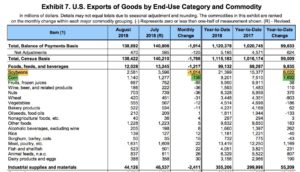
“The gap in goods and services trade increased 6.4 percent to $53.2 billion, from a revised $50 billion in the prior month, Commerce Department data showed Friday. Imports rose 0.6 percent and exports fell 0.8 percent. Soybean exports dropped $1 billion, or 28 percent, to $2.58 billion, reversing a run-up earlier this year ahead of retaliatory levies from China.”

“MONTHLY U.S. INTERNATIONAL TRADE IN GOODS AND SERVICES, AUGUST 2018.” U.S. Census Bureau and the U.S. Bureau of Economic Analysis (October 5, 2018).

The Bloomberg also noted that, “At the same time, trade tensions have eased with Canada and Mexico. This week, the U.S. reached a deal with the two nations on a revised North American Free Trade Agreement. Trump plans to sign the new deal, to be renamed the U.S.-Mexico-Canada Agreement, by the end of November.”

Posted in Agriculture Law | Comments closed

Despite Elevated Loss Rate Since 2006, U.S. Honey Bee Colony Numbers Are Stable

A recent update from USDA’s Economic Research Service (ERS) by Peyton Ferrier, stated that, “In 2006, large and mysterious losses of honey bee colonies led entomologists to classify a set of diagnostic symptoms as Colony Collapse Disorder (CCD) and spurred major efforts to measure, quantify, and understand pollinator loss. New data show that between 2007 and 2013, winter colony loss rates in the U.S. averaged 30 percent, which is approximately double the loss rate of 15 percent previously thought to be normal.   Although average loss rates fell to 24 percent between 2014 and 2017 and CCD symptoms are less frequently associated with colony losses, colony health remains a concern.”

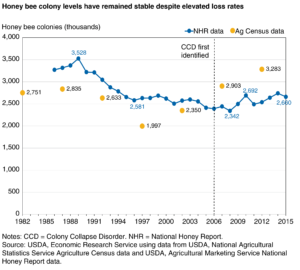
The ERS update noted that, “Elevated winter colony losses, however, have not resulted in enduring declines in colony numbers. Instead, the number of honey bee colonies in the U.S. is either stable or growing depending on the dataset being considered.”

“Despite Elevated Loss Rate Since 2006, U.S. Honey Bee Colony Numbers Are Stable,” by Peyton Ferrier. USDA- Economic Research Service (October 01, 2018).

The ERS article added that, “The stability of colony numbers and pollination services fees, however, suggests that beekeepers have, in aggregate, adjusted to elevated rates of colony loss. Since 2006, almond pollination fees have dropped slightly from earlier highs despite ongoing growth in almond acreage. At the State level, loss rates are statistically uncorrelated with year-to-year changes in the number of colonies, suggesting that beekeepers are able to replace lost colonies within the course of a calendar year.”

Posted in Agriculture Law | Comments closed

Fruit Trees in Orchards Possibly Damaged by Dicamba

Christy Couch Lee reported recently at Prairie Farmer Online that, “In his 81 years, Bill Flamm has seen many changes on his family’s Flamm Orchards in the rolling hills of Union County, Ill. But until mid-July of this year, the leaf curl and tree stress on the orchard’s peach and apple trees was foreign.

“Nephew Jeff Flamm says they’ve yet to get a definite answer on the cause.

“When leaf curl began to appear on peach trees, the Flamms sought expert opinions: a horticulturist from Southern Illinois University’s Department of Plant, Soil and Agricultural Systems; a representative from the Illinois Department of Agriculture; an Illinois Fertilizer and Chemical Association agronomist; a technical agronomist from Southern FS; and a representative from Bayer.”

The article stated that, “‘So far, everyone has told us the same thing — it’s a growth-regulating herbicide, likely dicamba — except for the Bayer rep, who didn’t really have an answer to what it is,’ Jeff says. ‘We’re basically left with more questions than answers. This is all-new territory.’

“According to IDOA, as of Sept. 17, the department had received 329 dicamba-related complaints — up from 240 at the same time in 2017.”

Ms. Lee added that, “The issue of dicamba drift as it relates to row crops has been widely debated. But what about chemical trespass as it relates to orchards and other specialty crops? It appears there are more questions than answers.”

“A decision by EPA on dicamba herbicide registrations was expected by late August. But as of mid-September, the agency has not yet acted…Raghela Scavuzzo, local foods program manager in governmental affairs and commodities with the Illinois Farm Bureau, says the organization is watching for a decision on the issue,” the article said.

Posted in Agriculture Law | Comments closed

Perspective on the Startup Pitch

In a column posted earlier this week at The Financial Times Online, Andrew Hill stated that, “The pitch — that moment when an entrepreneur briefly has a chance to market their idea to an investor — has acquired a hallowed status in the start-up world, and beyond.

“Manuals abound (Pitch Perfect, Life’s a Pitch, Perfect Pitch — you get the idea). Television formats such as Dragons’ Den have turned the mundane meeting in a windowless conference room into showbiz. Executives, film directors and innovators are urged to hone their ‘elevator pitch’. Ted Talks have become a sort of alternative pitching arena for ‘thought leaders‘, where success is measured in views rather than dollars.

“What wouldn’t any enthusiast with a bright idea give for an edge over their rivals? Researchers now claim to have identified that edge: hand gestures can make an investor on average 12 per cent more likely to back a business.”

The FT column noted that, “‘People who use figurative language and skilful gestures are more likely to be persuasive,’ according to Mark Healey of Alliance Manchester Business School, co-author of the study, soon to appear in the Academy of Management Journal.

“The idea that body language can help persuade people is not new, and sounds uncontroversial. But this is surprisingly unstable academic ground.”

Mr. Hill pointed out that, “Nobody wants to listen to a halfhearted presentation. But other research suggests passion has no direct impact on investors’ decisions to fund a venture. Preparedness — the content and the entrepreneur’s command over it — does.”

Mr. Hill concluded his FT column by stating that, “Despite the popular impression given by Dragons’ Den, in the real world investors hardly ever decide whether they are ‘in’ or ‘out’ based solely on the pitch. If you cannot communicate your idea at all, you may be in the wrong career. Style alone, though, will rarely triumph over substance.”

Posted in Start-up Company Law | Comments closed

Surging Organic Consumer Demand Led Startup to Establish ‘Indentity Preserved’ Venue

Financial Times writer Gregory Meyer reported yesterday that, “An American entrepreneur is building a wholesale commodity market to meet rising demand for food that is free from pesticides and bioengineering.

“Kellee James leads Mercaris, a US company that hosts online auctions for organic or non-genetically modified crops. Hundreds of thousands of bushels of grain and oilseeds now change hands on its platform every year.

“The auctions have brought an element of transparency to a hazy sector. Most deals for natural foodstuffs are struck in private. Mercaris allows approved buyers and sellers to make anonymous bids and offers in an active market where prices and volumes are disclosed.”

The FT article stated that, “The deals still account for less than 1 per cent of the total organic and non-GMO cash market in the US, Ms James estimates. Compared with the conventional agricultural commodities, the volume is minuscule.

“But the opportunity may be significant. The organic food market grew by 6.4 per cent to $45.2bn in the US last year, well above the 1.1 per cent growth in the overall food market, according to the Organic Trade Association. More than 90 per cent of the US corn and soya­bean crop sprouts from genetically engineered seeds, but that leaves millions of acres for non-GMO varieties.”

Mr. Meyer added: “[Lynn Clarkson, chairman of grain merchant Clarkson Grain, of Cerro Gordo, Illinois] says his merchandising team has been included in Mercaris auctions. ‘The auction supply path would not be my preferred one, but in putting together a total grain marketing package that can address some of the needs of identity preservation, I think Mercaris is offering a valuable service,’ he says.”

Posted in Agriculture Law, Start-up Company Law | Comments closed

Federal Court Says North Dakota Anti-Corporate Farm Law Constitutional

Last week, the Associated Press reported that, “A federal judge has upheld North Dakota’s Depression-era anti-corporate farming law.

“U.S. District Judge Daniel Hovland in Bismarck ruled Friday that the law meets constitutional requirements.

“North Dakota Farm Bureau sued in 2016 to do away with the law that voters approved in 1932 to protect the state’s family farming heritage.”

The AP article pointed out that, “The Farm Bureau and other plaintiffs argued the law limits farmers’ business options and interferes with interstate commerce by barring out-of-state corporations from being involved in North Dakota’s farm industry.”

“Farmers Union maintains that family farming is the backbone of North Dakota agriculture. The group led the fight to create the corporate farming law in the 1930s,” the AP article said.

Posted in Agriculture Law | Comments closed