Federal Judge Rules that Iowa’s ‘ag gag’ Law is Unconstitutional

Donnelle Eller and Lucas Grundmeier reported on the front page of today’s Des Moines Register that, “A federal judge has ruled that Iowa’s ‘ag gag’ law is unconstitutional, saying the industry-backed statute violates the First Amendment’s free-speech protections.

“Senior Judge James Gritzner granted summary judgment Wednesday to a group that sued over the law.

“‘Today’s decision is an important victory for free speech in Iowa,’ said Rita Bettis Austen, ACLU of Iowa legal director.”

The Register article noted that, “Attorney General Tom Miller’s office, a defendant representing the state, said the office is considering whether to appeal.

The 2012 Agricultural Production Facility Fraud law made it a crime for journalists and advocacy groups to go undercover at meatpacking plants, livestock confinements, puppy mills and other ag-related operations to investigate working conditions, animal welfare, food safety and environmental hazards, among other practices.”

Eller and Grundmeier pointed out that, “In defending the law, the state argued that its restrictions were constitutionally permissible because they ensured biosecurity and private property protections.

“Gritzner said that wasn’t enough to outweigh First Amendment presumptions.

“‘Defendants have produced no evidence that the prohibitions’ of the law ‘are actually necessary to protect perceived harms to property and biosecurity,’ he wrote.

Iowa already has laws that protect private property and addresses biosecurity concerns, Gritzner said, making ag-gag state law unnecessary.”
Posted in Agriculture Law | Comments closed

Secretary Perdue Statement on Extension of Market Facilitation Program Deadline

A news update yesterday from USDA noted that, “U.S. Secretary of Agriculture Sonny Perdue today extended the deadline for agricultural producers to apply for payments under the Market Facilitation Program as provided by the trade mitigation program administered by the U.S. Department of Agriculture (USDA).  The original deadline had been January 15, 2019, but farmers have been unable to apply for the program since the lapse in federal funding caused the closure of USDA Farm Service Agency (FSA) offices at the end of business on December 28, 2018.

“Secretary Perdue issued the following statement:

“‘President Trump instructed me, as Secretary of Agriculture, to craft a program that would protect farmers from unjustified retaliatory tariffs from foreign nations.  As part of that package, the Market Facilitation Program has been making payments directly to farmers who have suffered trade damage.  Using existing funds, we were able to keep FSA offices open as long as possible, but unfortunately had to close them when funding ran out.  We will therefore extend the application deadline for a period of time equal to the number of business days FSA offices were closed, once the government shutdown ends.  Farmers who have already applied for the program and certified their 2018 production have continued to receive payments.  Meanwhile, I continue to urge members of Congress to redouble their efforts to pass an appropriations bill that President Trump will sign and end the lapse in funding so that we may again provide full services to our farmers and ranchers.'”

Posted in Agriculture Law | Comments closed

U.S. Supreme Court Denies “Original Actions” on State Livestock Standard Laws

DTN Ag Policy Editor Chris Clayton reported yesterday that, “The U.S. Supreme Court on Monday denied attempts to make oral arguments before the court by 15 states in lawsuits against California and Massachusetts over claims of regulating agricultural production across state lines.

“Without commentary, the Supreme Court denied a pair of court cases, including Missouri and 12 other states versus California. The Supreme Court also denied a similar case led by Indiana and 12 other states against Massachusetts, though the court also noted that Justice Clarence Thomas would have granted the motion for a hearing.

The cases are similar, and most of the same states joined Missouri or Indiana in one or both cases. Missouri initiated a case against California’s law involving cage standards for egg-laying hens for those eggs to be sold in California. Massachusetts has a similar law blocking the sale of eggs, pork and veal in the state based on confinement standards, as well, prompting Indiana to lead a lawsuit.”

Mr. Clayton stated that, “Missouri and Indiana had each argued the cases should go directly to the Supreme Court as original jurisdiction. By letting the two laws stand, the high court essentially rejected the arguments by Missouri, Indiana and other states that the two related cases are ‘original actions’ that should first be heard by the Supreme Court rather than go through circuit and appeals decisions first.

“The Supreme Court had asked the Trump administration last summer to weigh in on whether the cases should be taken directly to the high court. In a brief filed in late November, the U.S. Solicitor General stated in separate briefs that the plaintiff states’ claims do not warrant the exercise of the Supreme Court’s original jurisdiction authority. The Solicitor General also stated in the California case that issues around economic impact of such regulations would be better decided in a case brought by someone who is being directly regulated by the California laws.”

The DTN article added that, “The cases were championed by national livestock groups affected by the state laws as well as advocacy organizations such as Protect the Harvest.”

Posted in Agriculture Law | Comments closed

Waters of the U.S. Rule May Soon Have Legal Answers from Court Decisions

DTN writer Todd Neeley reported late last month that, “Expected court decisions on the 2015 waters of the United States, or WOTUS, rule early in 2019 likely will clear up any confusion farmers, ranchers and other landowners have on jurisdictional questions.

“As a result of several ongoing lawsuits, the 2015 rule remains in effect in 22 states and is on hold in 28 states.

“Don Parish, senior director of regulatory relations for the American Farm Bureau Federation, told DTN the split has created uncertainty in the countryside.”

The DTN article noted that, “Parish said his group expects constitutional questions on the 2015 rule to be answered soon.

“AFBF is party to lawsuits where a court could declare the 2015 rule unconstitutional, he said. That is likely to come before an EPA proposal to abolish the 2015 rule altogether.

“AFBF and others have asked district courts in North Dakota, Georgia and Texas to declare the 2015 rule unconstitutional, on the grounds the EPA failed to follow the Administrative Procedures Act by including in the final rule distances from navigable waters in determining whether wetlands are jurisdictional. Ahead of finalizing the 2015 rule, the EPA did not offer a chance for public comment on those distances.”

Mr. Neeley pointed out that, “In addition, Parish said, a court may rule that the 2015 rule was ‘so broad and vague’ that it violates due process.”

Posted in Agriculture Law | Comments closed

Permit Denied for Large Swine Feedlot in Minnesota

Jeremy Olson reported recently at the Minneapolis Star Tribune Online that, “Minnesota’s top environmental regulator has denied a permit for a large swine feedlot in southeastern Minnesota, citing concerns about the region’s already-troubled groundwater, though the decision has not quashed the project.

“Commissioner John Linc Stine, of the Minnesota Pollution Control Agency (MPCA), said Tuesday he is denying Catalpa Ag’s request for a general permit for its 4,890-hog facility. But the company can still obtain a more rigorous individual permit if it takes additional steps to prevent leakage that would contaminate groundwater.

“Stine said he made the decision in the interests of the region, which is sensitive to water contamination because its porous, karst geology can allow surface contaminants to reach the groundwater ‘within a matter of minutes.'”

The article noted that, “Catalpa’s proposed facility wouldn’t be the largest feedlot in the state, but it drew unusual public interest, including hundreds of letters in opposition and two crowded hearings. Concerns ranged from the smell to traffic to the facility’s potential to exacerbate or increase the number of sinkholes in the soggy region.”

Mr. Olson also pointed out that, “Most of the state’s 1,300 feedlots are covered under general permits, but about 70 have received the more-rigorous individual permits, according to the MPCA.”

Posted in Agriculture Law | Comments closed

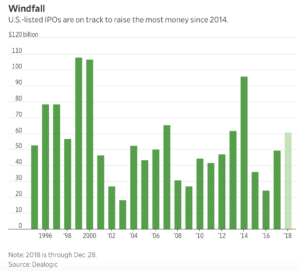
U.S.-Listed IPOs on Track to Raise the Most Money Since 2014

Wall Street Journal writers Maureen Farrell and Corrie Driebusch reported on Monday that, “A whipsawing stock market could mean a bumpy path to public markets in 2019 for some of the fastest-growing and most richly valued private companies ever, but it isn’t currently expected to derail them.

“Stock markets that have sold off sharply in recent months have been even more in tumult, thrashing up and down as the year ends. The Dow Jones Industrial Average notched its worst Christmas Eve ever and then logged the biggest point gain in its history the next trading day. In the past three months, the S&P 500 has fallen 15% and the technology-laden Nasdaq is off 18%.

Those declines are threatening to bleed into a 2019 that many anticipate could be a record-breaking year for initial public offerings in terms of money raised. A host of big-name tech companies for whom public investors have been waiting years, including Uber Technologies Inc., Lyft Inc., Pinterest Inc. and Slack Technologies Inc., is preparing for stock-market debuts as soon as the first half of next year.”

“IPO-Hungry Investors Look to Have Their Moment in 2019,” by Maureen Farrell and Corrie Driebusch. The Wall Street Journal (December 31, 2018).

The Journal article noted that, “Rajeev Misra, the chief executive of SoftBank’s $100 billion Vision Fund, says he expects the public markets to be a key source of future capital for the more than 70 companies his firm has invested in. In the second half of 2019, he expects one of the fund’s portfolio companies to go public each month on average.

“‘The IPO market is robust,’ he said, even in the face of the recent selloff and volatility.”

Monday’s article added that, “But there is no guarantee 2019 will break records, especially if stocks continue to sell off and swing wildly. As stock prices fall, share sales become less attractive to issuers, who naturally want to maximize proceeds. Lower prices aren’t always embraced by potential investors either, as they fear missing out on the opportunity to participate in a quick run-up they can cash in on.

“Still, advisers to many of the pre-IPO companies say their preparations continue. Either way, IPO experts don’t envision a smooth ride.”

Posted in Start-up Company Law | Comments closed

Index Signals that Home Sales May Remain in Slump

Wall Street Journal writer Sharon Nunn reported last week that, “The number of U.S. existing homes going under contract declined in November, signaling home sales may remain in a slump in the coming months.

“The National Association of Realtors on Friday said its pending home sales index, which tracks contract signings for purchases of previously owned homes, fell 0.7% from the prior month to 101.4 in November. Sales, unless they fall through, typically close within a month or two of signing.

“Economists surveyed by The Wall Street Journal had expected a 1% jump.”

The Journal article noted that, “The index was down 7.7% in November from a year earlier, marking the 11th-straight month of annual declines.

Rising borrowing costs and lackluster housing supply are driving up the cost of purchasing a home, keeping many potential buyers off the market.”

Ms. Nunn added that, “Mortgage rates have moved higher since mid-2017, making purchasing a home more expensive too. The average interest rate on a 30-year fixed-rate mortgage in November was 4.87%, up from 4.03% in January, according to Freddie Mac.

“Outside of the already difficult housing landscape, Lawrence Yun, the trade group’s chief economist, said Friday morning that the government shutdown will harm the housing market.

“‘Unlike past government shutdowns, with this present closure, flood insurance is not available,’ Mr. Yun said. ‘That means that roughly 40,000 homes per month may go unsold because purchasing a home requires flood insurance in those affected areas.'”

Posted in Real Estate Law | Comments closed

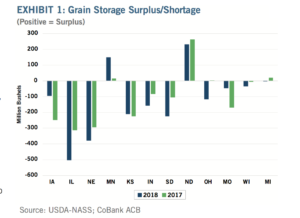
Grain Elevator Outlook 2018/2019

In a report last month from CoBank (“Grain Elevator Outlook 2018/2019“), Will Secor indicated that, “Storage capacity will be pushed to the limit in some regions this year.  2018 is the fifth consecutive year that U.S. corn and soybean yields are above trend for the nation.

“Grain Elevator Outlook 2018/2019,” by Will Secor. CoBank Report (November 2018).

“However, some regional storage surpluses have started to emerge for two reasons. First, a slow Midwestern harvest has increased corn yield losses to around 10-15 percent in some areas. Second, 2018 acreage shifted significantly in favor of soybeans. As a result, some elevators, especially in the Western Corn Belt are finding it difficult to gain ownership of harvest bushels.

Slow soybean exports will force many elevators to store more soybeans longer. This will increase storage costs for many elevators due to the higher price of soybeans relative to corn and wheat.”

Mr. Secor noted that, “Future interest rate hikes will be an important factor for elevators holding crops this year. The Fed is expected to increase the federal funds rate in December and two times in 2019. This potential 75 basis point increase in interest rates would increase the cost of carry by around 15 percent.

As interest rates rise, the cost of carry increases.  Futures market carry will need to widen to accommodate this going forward. Additionally, elevators will face higher storage costs than usual as they will likely be carrying more soybeans.”

The CoBank report also pointed out that, “The keys to watch in the year ahead will be for any resolution to the trade dispute as well as the South American crop. If the trade dispute is resolved, China will buy U.S. soybeans again, but they are unlikely to return to the same levels as before. New relationships were built during this disruption with non-U.S. suppliers. Chinese buyers will not switch back right away and may not return to previous levels for several years.”

Posted in Agriculture Law | Comments closed

Top 10 Agricultural Law Issues in 2018

Attorneys at the National Agricultural Law Center have compiled the top legal and policy developments that affected agriculture in 2018.

The top two are listed below:

(1) For pesticides and herbicides, several important legal developments occurred, specifically affecting dicamba, glyphosate, and chlorpyrifos.

“In late October, EPA extended the registration of dicamba through Dec. 20, 2020. The extension came with several new restrictions on ‘over-the-top’ use on cotton and soybeans, which leaves it to affected states to determine whether they will establish state-specific rules more strict than the new federal rules.

“In August, a jury awarded nearly $300 million (later reduced to $78 million) to a plaintiff who alleged that his exposure to glyphosate was the cause of his cancer. There are at least 8,000 similar cases filed nationwide.

“Finally, in August the Ninth Circuit Court of Appeals ordered EPA to ban chlorpyrifos  specifically to cancel all registrations and revoke all tolerances within 60 days of the ruling. The 60 day timeline is currently halted while the litigation plays out.”

“(2) In terms of international trade, 2018 has been perhaps the rockiest year in many decades.

“The ‘new NAFTA’  the United States – Mexico – Canada Agreement (USMCA) — was agreed to by the U.S., Mexico, and Canada. USMCA must still be ratified by Congress, consideration of which will occur in 2019 under the new Congress.

The back-and-forth trade dispute between the U.S. and China continued as we exited 2018, with much uncertainty as to whether the dispute will escalate in 2019. Both countries slapped tariffs and threats of more tariffs on each other, resulting in economic hardship for many in the U.S., especially U.S. soybean producers, affected by the loss of ag commodity trade with China.”

Posted in Agriculture Law | Comments closed

Hog Production: Minnesota Nearing Move Into Second Place

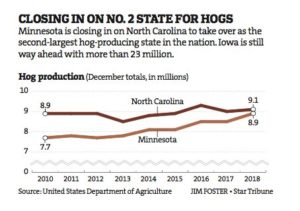
In a front page article in the Business section of Tuesday’s Minneapolis Star Tribune, Adam Belz reported that, “Minnesota is closing in on North Carolina to be the second-largest hog-producing state in the nation.

“Minnesota closing in on No. 2 spot for hog production,” by Adam Belz. The Minneapolis Star Tribune (December 25, 2018).

“According to new data from the U.S. Department of Agriculture, Minnesota’s pig population on Dec. 1 was 8.9 million, or 400,000 more than a year earlier. The state is now producing only 200,000 fewer hogs than North Carolina.

Iowa is by far the largest hog state, with 23.3 million pigs.”

The article noted that, “In 2017, North Carolina was 500,000 hogs ahead of Minnesota in December. But North Carolina added only 100,000 hogs this year while Minnesota added 400,000.

“Minnesota has already surpassed North Carolina when it comes to the number of pigs it finishes for market, but North Carolina still raises large numbers of baby pigs that are shipped to farms in Ohio, Indiana and Illinois, where they are fed to market size and shipped to the slaughterhouse, said Dave Preisler, executive director of Minnesota Pork Producers Association.

“Despite its remoteness from the Corn Belt, North Carolina became a major hog-producing state in the late 1980s and 1990s after the U.S. government stopped subsidizing tobacco farms.”

Mr. Belz added that, “Compared to other states, Minnesota’s hog industry has room to grow. In a statement, Christensen Farms said that Minnesota has more than double the number of crop acres per pig marketed than Iowa, and 4.4 times as many as North Carolina.”

Posted in Agriculture Law | Comments closed