Debt, Delinquencies are Rising, Raising Fears of Broader Turmoil in U.S. Agriculture

Reuters writer PJ Huffstutter reported yesterday that, “A third-generation farmer, Matt Gibson eyed a big expansion of his family’s business in late 2011, as grain prices soared in a searing Midwestern drought.

“By August of 2012, days before corn prices peaked, the Gibson family had borrowed nearly $18 million in a series of loans from Chicago-based BMO Harris Bank.

“The Gibsons took on more debt after the drought broke the following spring, sending grain prices tumbling. By 2015, with grain prices at half their peak, BMO and others creditors sued the Gibson businesses seeking to recoup more than $30 million.”

The article stated that, “The travails of Matt Gibson, 39, and his family are emblematic of a new class of ‘go-go farmers,’ a term coined by fellow Midwest growers and agricultural economists. Many, like the Gibsons, borrowed heavily to expand their farms, then borrowed more in an effort to plant their way out of a commodity price crash, according to dozens of interviews with Midwest farmers, lenders and agriculture experts.

“Their distress could foreshadow broader economic turmoil in the grain sector, which includes corn, soybeans and wheat.”

The Reuters article noted that, “A Reuters analysis of federal data on agricultural lending in the grain-producing ‘I-states’ – Illinois, Indiana and Iowa – shows that delinquency rates on farmland and production loans are rising sharply.”

Graph From Reuters

Ms. Huffstutter explained that, “The total dollar amount of nonperforming bank farm loans in the three states shot up to $288.2 million in the second quarter of 2016, up from $132.5 million in the second quarter of 2013, the year after corn and soybean prices peaked, according to data from the Federal Deposit Insurance Corporation.”

The article added that, “The growing distress of Midwest farmers illustrates the myriad threats now facing U.S. agriculture: intense competition for land; competing demands for limited water; a strong dollar that raises U.S. export prices; extreme weather patterns; and rising foreign competition.”

Posted in Agriculture Law | Comments closed

FSA Announces Enrollment Period for Safety Net Coverage in 2017

The U.S. Department of Agriculture’s Farm Service Agency (FSA) indicated on Friday that, “[FSA] Administrator Val Dolcini today announced that producers on farms with base acres under the safety net programs established by the 2014 Farm Bill, known as the Agriculture Risk Coverage (ARC) or Price Loss Coverage (PLC) programs, can begin visiting FSA county offices starting Nov. 1, 2016, to sign contracts and enroll for the 2017 crop year. The enrollment period will continue until Aug. 1, 2017.

“‘FSA issued more than $7 billion in payments in October 2016 under the ARC-County and PLC programs for the 2015 crop to assist enrolled producers who suffered a loss of price or revenue or both,’ said Dolcini. ‘Since shares and ownership of a farm can change year-to-year, producers on the farm must enroll by signing a contract each program year. I encourage you to contact your local FSA office today to schedule an appointment to enroll.’

“If a farm is not enrolled during the 2017 enrollment period, the producers on that farm will not be eligible for financial assistance from the ARC or PLC programs for the 2017 crop should crop prices or farm revenues fall below the historical price or revenue benchmarks established by the program. Producers who made their elections in 2015 must still enroll during the 2017 enrollment period.”

Posted in Agriculture Law | Comments closed

USDA Invests $1.7 Billion to Protect Sensitive Agricultural Lands through CRP

A news release on Friday from the U.S. Department of Agriculture indicated that, “The [USDA] will issue nearly $1.7 billion in payments to more than half of a million Americans who have contracts with the government to protect sensitive agricultural lands. The investment, part of the voluntary USDA Conservation Reserve Program (CRP), will allow producers to protect almost 24 million acres of wetlands, grasslands and wildlife habitat in 2016.

“CRP provides financial assistance to farmers and ranchers who remove environmentally sensitive land from production to be planted with certain grasses, shrubs and trees that improve water quality, prevent soil erosion, and increase wildlife habitat. In return for enrolling in CRP, USDA, through the Farm Service Agency (FSA), provides participants with rental payments and cost-share assistance. Landowners enter into contracts that last between 10 and 15 years.”

Friday’s update added that, “During its 30-year history, CRP has reduced nitrogen and phosphorous runoff by 95 and 85 percent, respectively, and restored 2.7 million acres of wetlands. It has also protected more than 170,000 stream miles with riparian buffers, enough to go around the world seven times. The program provides 15 million acres that are beneficial to pollinators, and hundreds of thousands of acres of wildlife habitat that has resurrected waterfowl and gamebird populations, like pheasants, quail and prairie chicken.

“CRP has sequestered an annual average of 49 million tons of greenhouse gases, equal to taking nine million cars off the road, and prevented nine billion tons of soil from erosion, enough to fill 600 million dump trucks.”

Posted in Agriculture Law | Comments closed

Robust Soybean Exports Not Enough to Boost Overall Farm Economy

Reuters writer Mark Weinraub reported on Friday that, “Surging soybean exports that helped drive U.S. growth in the third quarter have done little to boost the domestic farm economy, where grain prices are mired well below peaks hit in 2012 and incomes are forecast to be the lowest since 2009.

“Abundant supplies of beans after three years of record harvests, with another bumper crop just rolling in, have filled up storage bins and left many farmers little option but to sell.

“And while recent gains in soybean futures have likely allowed some farmers to break even on the crop or even eke out a small gain, depressed corn and wheat prices continue to weigh on overall profitability.”

Mr. Weinraub explained that, “Current soybean prices are likely to be the best that farmers can hope for this marketing year as overseas buyers turn their attention to South America in the coming months when harvest in Brazil and Argentina ramps up.

“‘For soybeans, we are sort of looking at two tales for the marketing year where you have the real enthusiasm for demand in the first half (Sept. 1-Feb. 28) and then you have anticipation of growing supply and a slowdown in the rate of purchases in the second half,’ said Christopher Hurt, professor of agricultural economics at Purdue University in Indiana.

“With another record U.S. harvest just rolled in and massive production on its way from South America, low prices are likely to continue to keep farm incomes depressed even with record exports forecast.”

Friday’s article added that, “A 10 percent jump in soybean shipments during the third quarter helped spur the biggest gross domestic product gains in two years, the Commerce Department said on Friday. And the U.S. Agriculture Department is already forecasting a record 2.025 billion bushels of overseas sales for the 2016-17 crop year, 4.6 percent higher than the 2015-16 crop year that ended on Aug. 31.

“But a large portion of U.S. farmers’ profitability stemming from the growing export demand is tied to China, the world’s top buyer whose demands analysts say can be fickle. China is expected to account for about 63 percent of global soybean imports during the current crop year.”

Posted in Agriculture Law | Comments closed

Cash Rents: While National Trends Important, it’s Critical to Keep an Eye on Local Conditions

An update this week by David A. Widmar at AgEconomists Online (“Farmland Cash Rental Rates in 2016: Where Cash Rents are Falling“) stated that, “Just as rising farm incomes place upward pressure on farmland values and cash rental rates, falling farm incomes place downward pressure on farmland values and cash rental rates. In August, the USDA released its annual update on farmland market conditions. Much attention focused on the slight drop in U.S. cropland values and unchanged pasture values. This week’s post takes a look at the changes in cash rental rates at the national, state, and county-level.”

“In figure 1, the U.S. average cash rental rate for cropland is shown. After a surge in rental rates that began in 2008, the national average for cropland cash rent fell 6%, to $136 per acre, in 2016. The only other decline in national cropland cash rental rates since 1998 was a 3% decline in 2007.

Figure 1

Dr. Widmar pointed out that, “While the national trend was for lower cropland rental rates, it’s important to keep in mind conditions often vary at the state and county levels. In figure 2 changes in the state average cropland rental rates are shown (2016 compared to 2015). Overall the changes were quite variable. In the Midwest, cash rents dropped the most in Minnesota and Iowa – more than 6% lower – while most of the Midwest and Great Plains were also lower. On the other hand, Michigan and Wisconsin actually reported higher cash rental rates in 2016.”

Figure 2

Furthermore, this week’s article indicated that, ‘Drilling even deeper, changes in non-irrigated cropland rental rates at the county-level are available and shown in figure 3. More specifically, figure 3 shows the percentage change in rental rates in 2016 compared to 2014 (county level data in 2015 were not collected by the USDA). Similar to the results in figure 2, rental values fell the most in Minnesota, Iowa, Northern Missouri, and Northern Illinois.

Figure 3

Dr. Widmar added that, “While cash rents have turned lower at the national level, conditions at the state and county levels vary significantly. Some states have felt significant downward pressure on cash rental rates while others have actually reported an increase in rates.

“Looking ahead, it will be important for producers and observers to keep in mind that the impacts of lower net farm income and the ag economy slowdown will vary across the county. While the national trends are important, it’s critical to also keep an eye on local conditions.”

Posted in Agriculture Law | Comments closed

Insights into the State of the Ag Economy- Kansas City Federal Reserve Report

The Federal Reserve Bank of Kansas City indicated in a report this week (“Farm Lending Declines, But Remains Elevated“) that, “Farm lending at commercial banks declined in the third quarter of 2016, but remained elevated as lenders continued to assess the downturn in the U.S. agricultural economy. The need for short-term financing in the farm sector remained high as profit margins remained weak. Alongside growing risk in the sector and slight declines in loan performance, agricultural bankers made additional adjustments to loan terms and continued to rely more heavily on farm real estate as collateral. Farmland values continued to decline at a modest pace, which may put further pressure on agricultural credit conditions for some borrowers.”

The Fed report noted that, “[T]he volume of other non-real estate farm loans, which are loans used for a variety of farm purposes, dropped sharply in the third quarter. This decrease may reflect other cutbacks farmers may have made during a time of tight profit margins.”

“Lenders also further adjusted loan terms as profit margins in the agricultural sector generally remained weak,” the Fed report said.

With respect to farmland values, the Fed report stated that, “The weak farm economy and downbeat credit environment across Federal Reserve districts also continued to affect farmland values. Responses to Federal Reserve surveys indicate cropland values declined in most states in the second quarter (Map). Although values of nonirrigated cropland have continued to rise in the Dallas District, the Kansas City, Minneapolis and Chicago districts have recorded declines, or no change, in the value of nonirrigated cropland each quarter since 2015.”

Graph From Federal Reserve Bank of Kansas City

And yesterday’s update added that, “The need for agricultural financing generally remained high in the third quarter despite a modest decline in farm loan volumes. Banks continued to meet financing needs, and manage risk stemming from gradual deterioration in the U.S. agricultural economy, by making modest adjustments to loan terms. However, if weak profit margins persist, loan performance continues to deteriorate, and farmland values continue to decline, agricultural banks may face greater challenges to manage the risk associated with lending in agriculture.”

Posted in Agriculture Law | Comments closed

U.S. EPA Looks for Signs of Improper Dicamba (Herbicide) Use

Reuters writer Mark Weinraub reported on Tuesday that, “The U.S. Environmental Protection Agency executed search warrants in parts of southeastern Missouri earlier this month to look for signs of improper use of the herbicide dicamba, the agency said on Tuesday.

“The searches stemmed from complaints that dicamba, which has only been approved for application on fields before planting season or after harvest, damaged 41,000 acres (16,600 hectares) of soybeans and other crops. The complaints allege that improperly applied dicamba drifted into neighboring fields.

“Dicamba can injure crops that are not resistant to dicamba, reducing final yields.”

Mr. Weinraub explained that, “The warrants were executed the week of Oct. 10 at sites in Cape Girardeau, Dunklin, New Madrid and Stoddard counties as part of a criminal investigation, the EPA said. The agency did not specify what sites it searched.”

An update yesterday at FarmWeekNow Online pointed out that, “Illinois Department of Agriculture Deputy Director Warren Goetsch reported the state ag department received only a couple of dicamba complaints, and he was not aware of U.S. Environmental Protection Agency Region 5 taking any action.

“Goetsch credited the proactive response of the state’s agriculture stakeholders and ‘our producers doing the right thing.’

“The EPA, USDA and Food and Drug Administration have approved dicamba-tolerant crop seed for planting in the U.S. However, restrictions remain in place on spraying dicamba-based herbicides.”

Posted in Agriculture Law | Comments closed

U.S. home prices rose 5.1% in August

The Associated Press reported this week that, “U.S. home prices climbed at a solid pace in August as more buyers competed for fewer available properties.

“The Standard & Poor’s CoreLogic Case-Shiller 20-city home price index rose 5.1% in August, after a 5% gain in July. Portland, Seattle and Denver reported the strongest year-over-year increases for the seventh month in a row, with gains of 11.7%, 11.4% and 8.8%, respectively.”

The AP article noted that, “Steady hiring, low mortgage rates and some early signs of rising pay have encouraged more Americans to buy homes. Sales of existing properties increased 3.2% in September from August, the National Assn. of Realtors said last week.

“Yet the number of homes for sale has fallen nearly 7% from a year ago, the trade group said. Just 2.04 million homes were for sale in September.”

The AP article added that, “Developers are building more new homes, but not quickly enough to restrain price increases. Builders broke ground on 783,000 single-family homes at a seasonally adjusted annual rate in September, up 5.4% from a year earlier. Apartment construction fell sharply.”

Posted in Real Estate Law | Comments closed

Ag Tech Investment Rises to Record

Bloomberg writer Shruti Singh reported this week that, “Investments by companies and venture capitalists in agricultural technology reached a record of as much as $25 billion globally in 2015, and that figure will probably grow again this year, according to a private report.

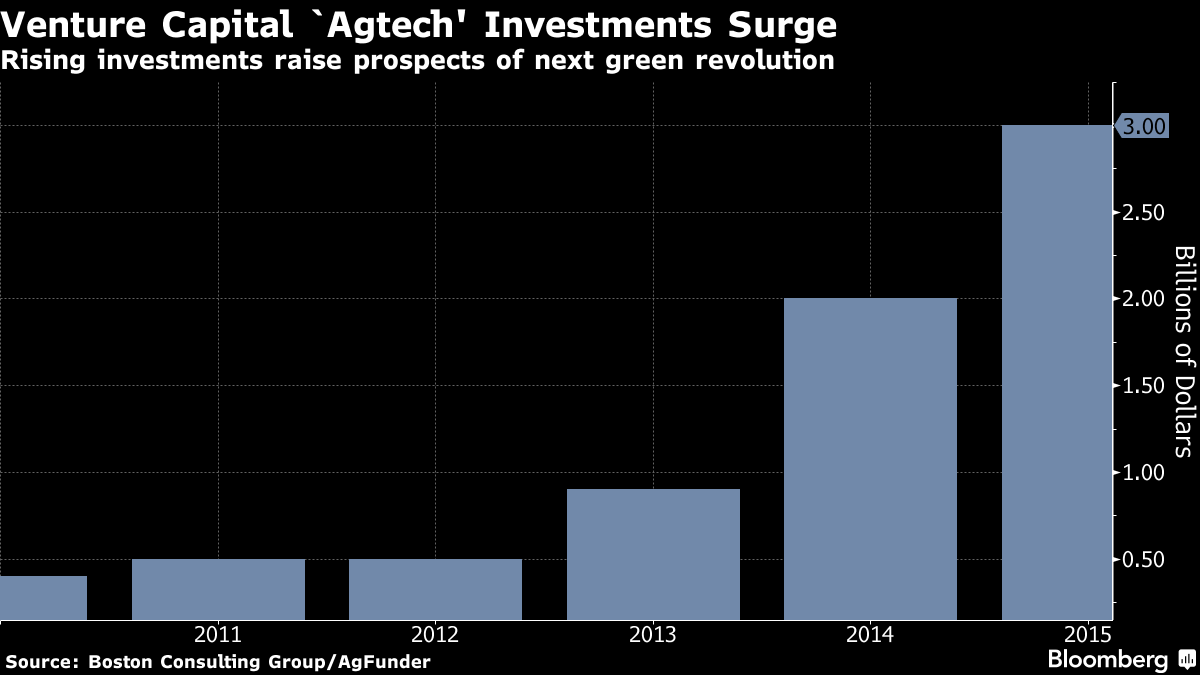
“Real-time data analytics, sensors and robots are raising the prospect of the ‘next green revolution’ and are spurring start ups, according to the report released Tuesday by Boston Consulting Group and AgFunder, which connects investors with agricultural companies and proposals online. The investments include research and development, deals, partnerships, equity stakes and technology centers. Early-stage funding from venture capital firms reached $3 billion globally, up from $900 million in 2013 and $400 million in 2010, the groups said.”

Graph From Bloomberg

The Bloomberg article noted that, “Slumping grain, meat and dairy prices have eroded agriculture incomes, sparking more farmers to adopt so-called precision-agriculture methods to help increase efficiency. Companies including Deere & Co. are joining the race to create new products for the market that Goldman Sachs Group Inc. estimates could be worth $240 billion by 2050. The U.S. Department of Agriculture said in a report last week that the new technologies are helping to boost profits.”

Ms. Singh added that, “The technologies encompass everything from granular data analysis that enhances planting decisions to drones that provide field views around the clock. The report’s findings reflect a survey of more than 50 executives from seed, fertilizer, meat, grain and farm-equipment companies as well as 15 venture-capital investors.”

Posted in Agriculture Law, Start-up Company Law | Comments closed

Senators Request Appropriators to Authorize a Refund to Dairy Farmers for $73 Million Paid into the DMPP

A news release last week from Senate Ag Committee member Kirsten Gillibrand (D., N.Y.) indicated that, “U.S. Senators Charles E. Schumer and [Gillibrand] were joined by Susan Collins (R-ME), Jack Reed (D-RI), Bernard Sanders (I-VT), Angus King Jr. (I-ME), Barbara Boxer (D-CA), Al Franken (D-MN), Elizabeth Warren (D-MA), Ron Wyden (D-OR), Jeanne Shaheen (D- NH), Patrick J. Leahy (D-VT), Chris S. Murphy (D-CT), Richard Blumenthal (D-CT), Kelly A. Ayotte (R-NH), Robert P. Casey Jr. (D-PA), Edward J. Markey (D-MA), and Sheldon Whitehouse (D- RI) urging federal appropriators to include funding for dairy farmers across the nation in the Fiscal Year (FY) 2017 budget. Specifically, the senators in the bipartisan letter requested appropriators to authorize the Secretary of Agriculture to refund farmers for the $73 million that they paid into the Dairy Margin Protection Program (DMPP) in 2015. The senators are also calling on the committee to allow the USDA to provide emergency assistance to dairy farmers and take greater action to support dairy producers by excluding any provision preventing the USDA from implementing clause 3 of Section 32 of the Agricultural Adjustment Act of 1935 or from engaging in surplus removal and price support activities under section 5 of the Commodity Credit Corporation Charter Act.”

A letter from the Senators to the Leaders of the Senate Appropriations Committee, and the Ag Appropriations Subcommittee, the lawmakers noted that, “We write to urge you provide critical assistance for our nation’s dairy farmers in appropriations legislation for Fiscal Year 2017.

“As you know, dairy farmers across the country are struggling to stay in business. This year alone, dairy farms in a number of states have been forced to close at alarmingly high levels. Milk prices have dropped by more than 40 percent over the past two years, and the U.S. Department of Agriculture (USDA) predicts low prices to continue for the near future. Dairy production costs continue to rise, and severe drought in some regions of the country has driven these costs up further.”

The letter added that, “We further request that $3 million within the budget of the National Agricultural Statistics Service (NASS) be designated for a survey of average feed costs by state. NASS estimates that such a survey will take 18-24 months, so it must begin this work as soon as possible in order for its results to be ready when Congress considers the next Farm Bill. Accurate information on regional variation in feed costs is critical for designing a program that better supports small and family farms in all regions of the country.

“Additionally, we ask that the Committee consider authorizing the Secretary of Agriculture to refund farmers for the $73 million that they paid into the DMPP in 2015. While we understand that the price tag on this request may make this move difficult, we hope that the Committee can understand the frustration and disillusionment of cash-strapped farmers who lost thousands of dollars expecting financial support that was never provided.”

Recall that last month, the National Farmers Union sent a similar request to Congress.

Posted in Agriculture Law | Comments closed