
Stine Seed GMO Pilot Program, Saving Seeds, Creates Tensions with Bayer

Reuters writer Tom Polansek reported on Tuesday that, “Major producers of genetically modified seeds, including Monsanto Co and Bayer AG, have long barred U.S. farmers from saving seeds after harvest to replant – a condition that allows the companies to charge every year for the technology.

“Now, a smaller challenger, Stine Seed, wants to disrupt that practice.

“Next year, family-owned Stine says it will give about 200 farmers in a pilot program the chance to replant genetically modified soybean seeds. The program is expanding after launching this year with about 50 farmers.”

Graph From Reuters News

Mr. Polansek explained that, “If Stine’s program succeeds and expands further, it would represent the renewal of a technique that major seed developers view as a threat to the commercial value of their intellectual property.

“Seeds in Stine’s program will include those containing a genetic trait called LibertyLink, which was developed by Bayer and licensed by Stine, and that’s created tension between the companies.

“Bayer ‘does not support saved seed,‘ spokesman Jeff Donald said. He declined to comment specifically on Stine’s program.”

The Reuters article noted that, “Genetically modified seeds are sold by independent companies, such as Stine, and by major players, including Monsanto, Bayer and Syngenta AG. Stine and other independent seed sellers often pay to license genetic traits from the larger companies to put into seed.

“Monsanto, the world’s largest seed maker, has successfully sued U.S. farmers who saved genetically modified seed after pledging in contracts with the company to use it for only one crop. Other trait developers make U.S. farmers sign similar agreements.”

Mr. Polansek added that, “In Argentina – where farmers are legally allowed to save seed – Monsanto has stopped launching new soybean technologies, following a dispute with exporters and the government over royalties paid for saved seed.”
Posted in Agriculture Law | Comments closed

Missouri Farmer files Dicamba case against Monsanto

DTN Crops Technology Editor Pam Smith reported on Monday that, “Bill Bader stood during a question-and-answer session at a Bootheel dicamba forum last July and told how drift from the herbicide had clobbered his orchard for the past two years. Bader, the largest peach grower in the state of Missouri, has now made another statement by filing a lawsuit against Monsanto Company over the losses.

“Bader Farms, Inc., et al v. Monsanto Company, Case No. 16DU-CC00111 alleges the St. Louis-based firm knowingly marketed its dicamba-tolerant Xtend cotton and soybean seeds to farmers without a safe herbicide for use. The lawsuit was filed by the Kansas City law firm, Randles & Splittgerber LLP, on behalf of Bader Farms, Inc. and Bill Bader, individually in Dunklin County, Missouri.”

The DTN article explained that, “Dicamba-tolerant cotton, broadly known as Xtend, was planted in 2015 and 2016 without a registered herbicide to use over-the-top. Xtend soybeans came to market for the first time in 2016, but again the Environmental Protection Agency (EPA) failed to register an approved herbicide to use in-crop on the trait in time for use this season. Problems emerged when farmers reached for existing dicamba formulations such as Banvel and Clarity and those applications drifted onto sensitive crops. Extension weed specialists have told DTN that movement from volatility was one issue, but damage also resulted from physical particle drift.

“The Missouri Bootheel was the hot bed for damage complaints. Sarah Alsager, Missouri Department of Agriculture spokesperson, told DTN that the department received 124 dicamba-related complaints in 2016. All investigations are currently open, Alsager said. Arkansas, Tennessee and Mississippi also registered dicamba injury complaints.”

With respect to Monsanto, the DTN article stated in part that, “Monsanto spokesman Kyel Richard provided a prepared statement to DTN with regard to the Bader lawsuit. The company statement noted that: ‘Both prior to and throughout the 2016 season, Monsanto took many steps to remind growers, dealers and applicators that dicamba was not approved for in-crop use at the time, and we do not condone the illegal use of any pesticide…‘”

Ms. Smith added that, “In November, EPA approved a DGA (same salt as Clarity) based formulation for use in the Xtend crop system that Monsanto claims is lower in volatility. The XtendiMax with VaporGrip label comes with a long list of spray requirements such as specific nozzles, wind-speed limits and tank-mix limitations [more details here].”

Posted in Agriculture Law | Comments closed

USDA Organic Livestock Practices Rule at OMB- Differing Viewpoints

A recent update at National Hog Farmer Online indicated that, “USDA’s Organic Livestock and Poultry Practices rule now is pending at the White House Office of Management and Budget, the last step in the rulemaking process before it becomes final. The National Pork Producers Council is urging the USDA to withdraw the rule, or if it’s approved before Jan. 20, the Trump USDA to repeal it. In comments in opposition to the rule submitted in July, the NPPC says the regulation’s new animal welfare standards for the National Organic Program, if enacted, would be the first time such criteria are codified in federal law and would present serious challenges to livestock producers.”

(Recall that the BartellPowell blog highlighted the this rule previously– first in April of this year, and again in May).

The National Hog Farmer article pointed out that, “NPPC requested that USDA reconsider the proposed animal welfare standards, arguing that, because animal welfare is not germane under the Organic Foods Production Act, USDA does not have clear authority to promulgate such rules.”

On the other hand, a joint statement yesterday from Rep. Chellie Pingree (D., Maine) and Rep. Peter DeFazio (D., Ore.) regarding the United States Department of Agriculture rule on organic livestock welfare indicated that:

“Earlier this year, the United States Department of Agriculture issued a proposed rule that improves organic livestock welfare standards. This important rule clarifies existing requirements and strengthens protections to ensure organic products meet the same baseline welfare standards across the country. We believe the rules are necessary to meet the expectations that consumers have when they purchase organic products. Additionally, this rule is over a decade in the making and has broad support from the organic industry.

“We support USDA’s work to preserve consumer confidence in the organic label, and we urge the Office of Management and Budget to quickly finalize the organic livestock welfare rule.”

Posted in Agriculture Law | Comments closed

Thoughts on Farmland Values


DTN Executive Editor Marcia Taylor reported late last week that, “Chicken Little alert: The sky isn’t falling on land values, argues Bruce Sherrick, director of the TIAA Center for Farmland Research at the University of Illinois. True, average prices have dipped the past two years. ‘But adjustments have been far less extreme than the change in income or commodity markets, debunking what you hear in the popular press,’ he says.

“‘I’m not going to predict where markets are headed,’ Sherrick told attendees at DTN-The Progressive Farmer’s Ag Summit this week. ‘But capitalization rates of Illinois farmland values (rents divided by land values) closely track with 10-year Treasury bonds. Since 1970, the only time it’s been out of whack is the 1980s. If we’re in a farmland bubble, I can’t see it.'”

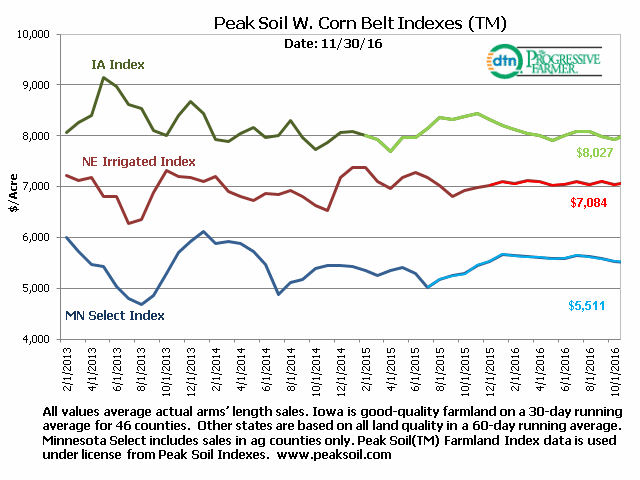
Ms. Taylor noted that, “Admittedly, Iowa’s values may have slipped about 12%, according to Peak Soil Indexes — more than other I-states. But Iowa also experienced a larger uptick during corn’s boom years. Actual sales of good-quality Iowa cropland even bounced back over $8,000 an acre in November (see chart). Both Minnesota and irrigated Nebraska cropland remained relatively stable in those same studies, supporting Sherrick’s thesis.”

The DTN article added that, “But lenders remain cautious should more sales filter through the market in the year ahead. MetLife Agricultural Finance, one of the nation’s leading mortgage lenders, expects U.S. farmland’s ‘first significant corrections since the mid-1980s’ with an average 20% slump from peak values by 2018. Thirty years ago, land values crashed more than 40% in the space of a few years.

“Rabo AgriFinance analyst Sterling Liddell believes Midwest land values already may be off 10% to 15% from highs in many areas, with prospects for up to 25% decline from peak by 2018. He worries that ‘new corn’ regions in the central Dakotas, eastern Nebraska and Kansas could contract even more as low corn prices weed out least-productive farmland.”

The DTN item also pointed out that, “Even a 20% to 25% haircut in peak land values is no catastrophe. Most row-crop areas in the U.S. saw double-digit, year-on-year growth in nine of the 12 years prior to 2014, Rabobank says. Midwest farmland will ultimately be settling at about 2012 values, Liddell believes, with most farm landowners retaining plenty of their lifetime wealth in real estate.”

Posted in Agriculture Law | Comments closed

Lawmakers May Launch Drive to Repeal Federal Estate Tax

Alan K. Ota reported yesterday at Roll Call Online that, “South Dakota Sen. John Thune and other top Republicans will launch a new drive to repeal the estate tax next year, while pulling back on efforts to force a year-end vote aimed at blocking a proposed Treasury Department rule that would tighten levies on inheritances.

“Thune, a senior Finance Committee member, has voiced confidence that there would be consensus support for his proposal to repeal the estate tax as part of a broad tax overhaul in the 115th Congress.

“‘If we can get into a debate about comprehensive tax reform, the odds are good that we can repeal the estate tax,’ the South Dakota Republican said in an interview.”

The Roll Call article indicated that, “But Thune and allies such as House Ways and Means Chairman Kevin Brady of Texas argue that the current threshold for the exemption excludes a number of family-run businesses and farms, forcing heirs in some cases to liquidate assets to pay estate taxes. Last year, seven Democrats joined 233 House Republicans to pass Brady’s estate tax repeal bill on a 240-179 vote.

“Republicans promote estate tax repeal as a way to preserve jobs and save small businesses. But liberals such as Minnesota Democratic Rep. Keith Ellison argue that full repeal would mainly provide a windfall to wealthy investors, including Trump and his family and some of the billionaires and millionaires he has selected for his Cabinet.”

Recall that The Wall Street Journal recently reported that, “Under current law, about 0.2% of Americans who die in 2017, or about 5,200 people, are expected to have taxable estates, according to the Tax Policy Center in Washington.”

Posted in General Interest | Comments closed

Estate Tax Issues

Laura Saunders reported on Friday at The Wall Street Journal Online that, “The American estate tax turned 100 this year. It probably won’t live to see 101.

“Both President-elect Donald Trump and Republicans in the House of Representatives have issued proposals to end the tax, and Senate Finance Committee Chairman Orrin Hatch (R., Utah) has opposed it as well. Launched in 1916, the tax was first imposed to help finance World War I and more recently was meant to limit concentrations of wealth.”

Graph from The Wall Street Journal.

Graph from The Wall Street Journal.

Ms. Saunders indicated that, “Of course, there is no certainty the tax is dead, since it is difficult to predict exactly what Congress will do—or when. Meanwhile, people should sign wills and continue to make certain types of gifts, while postponing others, tax advisers say.

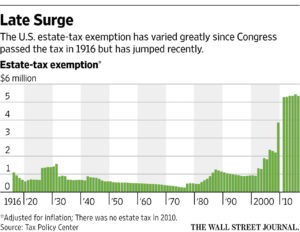
“Under current law, about 0.2% of Americans who die in 2017, or about 5,200 people, are expected to have taxable estates, according to the Tax Policy Center in Washington. This small sliver is far below the high-water mark of 7.7% in 1976, when the estate-tax exemption was $60,000.”

“This shrinkage is due to the growth of the estate-tax exemption. Today, the combined federal estate- and gift-tax exemption is $5.45 million per individual, or $10.9 million per married couple. Inflation indexing will raise it to $5.49 million in 2017,” the Journal article said.

Ms. Saunders added that, “Less clear is what will happen to the gift tax, which applies to transfers during life, and to an income-tax provision known as the ‘step-up.’ The step-up often allows assets held at death to bypass capital-gains tax. This provision applies to all assets, including those that have been held for decades and are highly appreciated.

“Mr. Trump’s proposal appears to say that the step-up would disappear above an exemption of up to about $10 million. Beyond that, the dead person’s cost of the asset—the starting point for measuring capital-gains tax—would transfer to the heir.”

The Journal article also stated that, “Don’t wait to sign a will. Whether or not you are subject to estate tax, it is important to have a valid will—period.”

Posted in General Interest | Comments closed

USDA Report- Global Stockpiles of Corn at Record High

Wall Street Journal writer Jesse Newman reported on Friday that, “Global stockpiles of corn, soybeans and wheat will reach record highs next year, the U.S. Department of Agriculture said Friday, extending an unprecedented glut of agricultural commodities.

“The USDA in a monthly crop report increased its forecasts for production in countries like Australia and Brazil, with bigger harvests pushing stockpiles to fresh peaks next year. The USDA stood by its bet that U.S. crop inventories will stay high.”

The Journal item pointed out that, “Global soybean inventories for the 2016-17 season were pegged at 82.9 million metric tons, which would be the highest ever. The world will also have the most wheat on hand thanks in part to near-perfect weather in Australia, which increased harvests there. The USDA said world wheat reserves will likely hit 252.1 million metric tons.”

Ms. Newman explained that, “Soybean futures for January delivery rose 10 1/2 cents, or 1%, to $10.37 1/2 a bushel at the Chicago Board of Trade.

“Corn futures closed higher as the USDA also left unchanged its projection for U.S. inventories next August at 2.403 billion bushels. Analysts had expected the government to boost its projection to 2.416 billion bushels.”

Despite record global stocks, Friday’s report also stated that, “The projected range for the season-average corn price received by producers is raised 5 cents on both ends to $3.05 to $3.65 per bushel, on continued higher-than-expected early-season prices…[and]…The U.S. season-average soybean price for 2016/17 is forecast at $8.70 to $10.20 per bushel, up 25 cents on both ends of the range.”

Posted in Agriculture Law | Comments closed

Midwest Vegetable Production Guide for Commercial Growers

A news release yesterday from Purdue University stated that, “The 2017 Midwest Vegetable Production Guide for Commercial Growers is now available for purchase or free download from Purdue Extension’s The Education Store.

“The guide is an annual summary of state-specific information on vegetable varieties, fertility, seeding rates, fertilizer rates, weed control, insect control and disease management.

“Lead author Dan Egel, Extension plant pathologist, said the new edition covers a large portion of the Midwest – Illinois, Indiana, Iowa, Kansas, Minnesota, Missouri, Ohio and this year, Michigan.”

The news release added that, “The publication includes a “What’s New” section and producers can also subscribe to the Vegetable Crops Hotline at https://vegcropshotline.org/ for regular updates.”

Posted in Agriculture Law | Comments closed

Fact Sheet: Crop Insurance for Organic Farming Practices

The U.S. Department of Agriculture’s Risk Management Agency (RMA) recently published a Fact Sheet titled, “Crop Insurance for Organic Farming Practices.”

The RMA item stated that, “Organic farming has become one of the fastest growing segments of U.S. agriculture. [RMA] recognizes organic farming practices as good farming practices and continues to move forward in improving crop insurance coverage for organic producers and producers transitioning to organic production to make viable and effective risk management options available.  In general, regulations governing the insurability of organic and transitional practices are the same as for conventional practices.”

The Fact Sheet noted that, “RMA provides coverage for:

-  Certified organic acreage; and

-  Transitional acreage (acreage transitioning to certified organic acreage in accordance with an organic plan).

“Insurance can only be provided for any crop grown using organic farming practices when a premium rate for an organic practice is specified in the actuarial documents or there is an approved written agreement.”

The RMA sheet also pointed out that, “RMA continues to expand premium organic price elections to extend the safety net provided by crop insurance and to provide fair and flexible solutions to organic producers. Premium organic price elections now exist for the majority of crops insured by RMA. RMA continues to evaluate all crops to establish organic price elections in future crop years.

“A list of crops that have a premium organic price elections can be found at www.rma.usda.gov/news/currentissues/ organics/organiccroplist.html.”

For additional information, the Fact Sheet indicated that, “You can find definitions related to organic practices in the most current Common Crop Insurance Policy, Basic Provisions, at www.rma.usda.gov/policies/2017policy.html. You can find crop insurance policies, crop provisions and handbooks on the RMA Organic Crops Page at www.rma.usda.gov/news/currentissues/organics/.”

Posted in Agriculture Law | Comments closed

Tyson Foods Creates Venture Fund to Invest in Food Startups

John Kell reported on Monday at Fortune Online that, “Tyson Foods has unveiled the launch of a venture capital fund that will invest as much as $150 million into food startups, a venture that aims to target alternative proteins and other entrepreneurial ideas within the world of food manufacturing.

“Called Tyson New Ventures LLC, the meat producer’s VC fund is just the latest bet by a large manufacturer of foods to seek to link up with upstart brands that have disrupted the local grocery aisle. Tyson Foods’ TSN 0.39% VC fund news comes after several rivals, including General Mills, Kellogg, and Campbell Soup, have all set up VC investment vehicles.”

The article explained that, “Big Food—lingo for major manufacturers with billions in annual sales—has faced dwindling sales of late as some of the largest, decades-old brands face stagnant sales as consumers favor food startups or fresher foods, the latter of which often doesn’t come with any Big Food branding. Campbell Soup CEO Denise Morrison has cited the data point that an estimated 400 food startups have scored more than $8 billion in funding since 2010.

“These VC investments can benefit both parties. For the Big Food makers, they get a peek at a hot startup and can help support research and development, sourcing, and boost distribution through their existing relationships with retailers. If all goes well, a full buyout can be inked later on. But if the startup’s idea clearly isn’t a winner, the Big Food maker didn’t make an all-in bet too early at too expensive of a price.”

The Fortune article added that, “It isn’t entirely clear what food startups Tyson New Ventures will look to invest in next, though the company said it would focus on three areas: alternative proteins, the elimination of food waste, and bets on innovative trends in technology. The VC fund will be based in Chicago and led by Mary Kay James, who has been named vice president and general manager. She previously served as managing director of DuPont Ventures.”

Posted in Agriculture Law, Start-up Company Law | Comments closed
