
Home Mortgage Demand Down in Fourth Quarter

Annamaria Andriotis reported last week at The Wall Street Journal Online that, “Demand for mortgages fell substantially during the last three months of 2016 after rates spiked by more than half a percentage point in the wake of Donald Trump’s election. Total mortgage applications dropped 21% from the third quarter, led by demand for refinances which fell 31%, according to Mortgage Bankers Association data.

“The numbers were up slightly when compared with the same period a year earlier, but not enough for mortgage lenders to close the year on an optimistic note.”
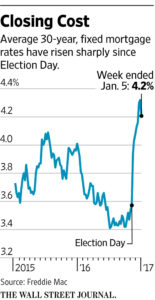
Graph from The Wall Street Journal.

Graph from The Wall Street Journal.

The Journal article noted that, “Average rates on 30-year fixed mortgages ended the quarter 0.82 of a percentage point higher than the end of September, according to MortgageNewsDaily.com. The increase began before the election and accelerated afterward as yields on benchmark U.S. government debt rose.”

Last week’s article added that, “On a broader level, the spike in mortgage rates left many lenders scrambling in the fourth quarter to figure out how to keep loan volume going as consumers have become accustomed to seeing rates below 4%. The latest MBA estimates show refinances are expected to fall to $479 billion in 2017, down 47% from last year.”


Posted in Real Estate Law | Comments closed

U.S. Supreme Court Decides Not to Hear Wetlands Case

David Ganje indicated last week at the Bismarck Tribune (N.D.) Online that, “On Monday, Jan. 9, The U. S. Supreme Court denied the Petition of a Miner County South Dakota farm couple who were fighting a USDA wetlands designation. USDA enforces rules in which it declares as ‘wetlands’ farmland that has been converted by a farmer from wetlands to arable working land. When such a federal designation is made the farmer loses his right to participate in USDA programs and benefits. Under USDA maps about two thirds of North Dakota, one half of South Dakota and the western part of Minnesota is covered by prairie potholes and wetlands.”

Recall that DTN writer Todd Neeley reported on this case last month, and he explained that, “[The Miner Country farmer, Arlen Foster], who is represented by the Pacific Legal Foundation, told DTN in September that winter dumps piles of snow nearly every year along a tree belt near a 0.8-acre tract of land on his farm in the southeastern part of the state. Spring melt drains onto his field, often making it impossible to farm.

“As a result, the 0.8 acre tract was declared a wetland based on a USDA process Foster asked the court to review. That process uses so-called reference sites when a tract of land being reviewed has been farmed, making it difficult to determine the presence of wetlands.

“This month, USDA and attorneys for Foster filed briefs with the court on whether it should hear the case.”

Posted in Agriculture Law | Comments closed

USDA Analysis: Ethanol Better for the Environment Than Previously Expected

Reuters writer Chris Prentice reported yesterday that, “The U.S. government on Thursday said that ethanol is better for the environment than previously expected in a report boosting the country’s biggest biofuel a week ahead of a new administration that has some in the industry concerned.

“The report, the first of its kind from the U.S. Department of Agriculture (USDA) to examine the actual impact of ethanol, said the biofuel reduces greenhouse gas (GHG) emissions by 43 percent relative to gasoline.

“That marks a potential blow to critics who have questioned whether ethanol, the foundation of the country’s biofuels program, is better for the environment than petroleum-based fuels.”

Yesterday’s article noted that, “Greenhouse gas emissions from ethanol are less than some forecasts because less land use was dedicated to it than expected and corn yields have risen, the analysis showed. The analysis compared the biofuel with 2005 gasoline, before regular blending of the fuel with ethanol. Now, most gasoline is blended with about 10 percent ethanol.

“USDA Agriculture Secretary Tom Vilsack said in a statement that the ‘report provides evidence that corn ethanol can be a GHG-friendly alternative to fossil fuels, while boosting farm economies.’

“The analysis forecasts the emissions cuts, versus gasoline, to rise to 50 percent by 2022 if trends in corn yields, fuel switching and efficiency continue.”

For more information, see this update yesterday at the USDA blog, “Innovation is Driving Down Greenhouse Gas Emissions from Corn-based Ethanol.”

Posted in Agriculture Law | Comments closed

Online Ag Real Estate Websites Not a Perfect Substitute for Human Appraisal

DTN Executive Editor Marcia Taylor reported last week that, “Online ag real estate websites like AccuAcre.com, AcreValue.com and WhatsMyFarmWorth.com are making headway with farmland valuations, but they are not yet perfect replacements for human appraisers. I tried to make that point in a recent article on these ‘Zillow-like’ websites for agriculture (‘Ag’s Real Estate Robots Gain Ground,’ https://www.dtnpf.com/…). At the moment, what the sites do best is accumulate other types of real estate information, such as soil types, historic yields, comparable sales, field boundaries and who owns the land. As one economist pointed out, they might reduce your chance of buying a lemon.

“But Dennis Reyman, an accredited appraiser in Storm Lake, Iowa, cautions not to be too quick to dismiss the expertise of human appraisers.

“‘These websites are not terribly different than the databases that appraisers already use, except that a good appraiser has verified sale data which has been analyzed and adjusted for various factors,’ Reyman says. ‘These robotic programs can give folks enough info to be dangerous. It’s not uncommon to see these programs produce values which are off of actual results by as much as 20-30%. Try telling someone their farm is worth $7,000 when the computer says $9,000. Since its human nature to want to believe the best financial news, that can be a challenging conversation.'”

The DTN article also noted that, “Another problem which is hard for computers to differentiate are nuances which can affect land values significantly, Reyman adds. ‘Since land rarely trades hands, it takes a long view of sales history and neighborhood influences to understand these things. The human appraiser not only uses his eyes but also his ears to know how recent economics might be affecting demand in the neighborhood. Are we in a neighborhood where 100-year family dynasties make the market? Are we in a neighborhood where recent livestock losses will remove some potential bidders, or are most of the livestock feeders more than able to keep moving along with it? I don’t think the computers are that good yet. It can be challenging enough for the astute human.'”

Ms. Taylor concluded her DTN article by indicating that, “There’s a wealth of information at your fingertips with these new ag real estate websites. But given the unpredictability of land markets, they shouldn’t affect human appraisers’ job security any time soon.”

Posted in Agriculture Law, Real Estate Law | Comments closed

USDA Announces Accreditation Program for Transitional Agricultural Products- Step to Boost Organic Food Production

Reuters writer Tom Polansek reported yesterday that, “The U.S. Department of Agriculture on Wednesday took a step toward increasing the production of organic foods – which has not kept pace with demand – by launching a program to certify farmland that growers are in the process of switching to organic.

“Obtaining certification under the program will allow farmers to sell products raised in accordance with organic guidelines for higher prices than conventionally-grown goods, according to the Organic Trade Association, an industry group. That should help growers cover the extra costs associated with transitioning to organic farming, the group said.

“Demand for organic foods has been strong as consumers are increasingly seeking products considered to be more natural and healthy. In 2015, total organic product sales hit a new high of $43.3 billion, up 11 percent from the previous year’s record level, according to the Organic Trade Association.”

Mr. Polansek indicated that, “Those who are switching farmland to organic production must follow the same regulations as those who have already been fully certified, the trade group said. So far, however, farmers have not been able to designate their crops as being in transition in an attempt to sell the products for higher prices.

“Producers of grains, such as wheat, will benefit most from the new certification program because that is the sector in which demand is most outstripping supply, said Nate Lewis, farm policy director for the trade association. Farmers are also grappling with weak prices for conventional grains because of a global supply glut.

“Organic grains have seen heavy demand to feed organically-raised livestock and to make organic breads and cereals for humans.”

Posted in Agriculture Law | Comments closed

USDA Grants Help Expand Local Food Opportunities

An update posted today at the USDA Blog by Elanor Starmer, the Agricultural Marketing Service Administrator, indicated that, “If there is one word that best embodies agriculture, it is entrepreneurship. Over the course of my time at USDA, I’ve had the chance to meet with farmers, ranchers and food business of all sizes and in all parts of the country. The faces of these entrepreneurs and their innovative strategies and business models reflect the diversity that makes this country strong. Each year, USDA helps thousands of agricultural producers and businesses enhance their marketing efforts and bring healthy, nutritious food to communities– and I’m excited that this week, we’ve announced another opportunity to support their work.

“My agency, USDA’s Agricultural Marketing Service (AMS), announced the availability of more than $27 million in grants to help ensure the livelihoods of our nation’s farmers and ranchers while strengthening rural economies. The announcement included $26 million in AMS grant funding from the Farmers Market and Local Food Promotion Program through the Local Food Marketing Promotion Program (LFPP) and the Farmers Market Promotion Program (FMPP).

“There is also nearly $1 million available from the Federal-State Marketing Improvement Program (FSMIP) through matching grants with state departments of agriculture, colleges or universities. These funds will support research projects to address challenges and opportunities in marketing, transporting, and distributing U.S. agricultural products domestically and internationally.”

Today’s update added that, “Over the past 10 years, the FMPP has awarded more than 870 grants totaling over $58 million. These efforts have been highlighted in the report, Farmers Market Promotion Program 2016 Report (PDF), demonstrating how USDA is helping create economic opportunities for producers by supporting local and regional projects like these that increase access to fresh, healthy food for rural and urban communities. All of these grants work together to help communities maintain their agricultural heritage and strengthen the local economy.”

Posted in Agriculture Law | Comments closed

Rusty Patched Bumblebee Named to the Endangered Species List

Kris Maher reported yesterday at The Wall Street Journal Online that, “The rusty patched bumblebee was named to the endangered species list Tuesday, the first bee species in the continental U.S. to receive that designation amid widespread bee losses in the past two decades.

“A prodigious pollinator, the rusty patched bumblebee has disappeared from much of its range on the prairies and grasslands of the Upper Midwest and Northeast. Its population has crashed by 87% since the late 1990s, according to federal officials, putting it on the brink of extinction.

“‘Pollinators are small but mighty parts of the natural mechanism that sustains us and our world,’ said Tom Melius, Midwest Regional Director of the U.S. Fish and Wildlife Service, which made the designation. ‘Listing the bee as endangered will help us mobilize partners and focus resources on finding ways right now to stop the decline.'”

The Journal article noted that, “The Fish and Wildlife Service blamed several factors on the bee’s decline, including loss of habitat, parasites, disease and pesticides. Mr. Melius said people should plant native flowers, even in small urban plots, and limit the use of pesticides, to help the bee recover. Experts said the listing could affect the approval process for some construction sites and other land use.”

Meanwhile, Tatiana Schlossberg and John Schwartz reported in today’s New York Times that, “Federal wildlife officials noted that the process of listing a species as endangered can take years, sometimes even decades. More than 300 species have been listed during the Obama administration, second only to the more than 500 species listed under President Bill Clinton.”

The Times article added that, “The incoming Trump administration, however, would need to undertake a lengthy process to declare the rusty-patched bumblebee population recovered if it wished to reverse this week’s decision, and it would be required by law to justify its action on scientific grounds.”

Posted in Agriculture Law | Comments closed

Investor Favors Discipline Over Brilliance When Evaluating Start-Ups

Kathleen Gallagher reported in Sunday’s Milwaukee Journal Sentinel that, “Shortly after selling agricultural machine maker Miller St. Nazianz Inc., John W. Miller jumped into a riskier endeavor: start-up investing.

“‘I could have gone anywhere after selling the company, but I decided I wanted to stay and build more in Wisconsin,’ said Miller, who sold Manitowoc County-based Miller St. Nazianz in 2014. ‘I’m only 42, so I still have some interest in taking an informed gamble on things.’

“Miller’s attitude, along with his appetite for start-up investing, is increasingly common in the state, particularly in the Milwaukee area. He is among a growing number of younger ‘angel’ investors who are sorting through the state’s youngest companies so they can put money into those that appear to be the most promising.”

The article noted that, “Their names are new to much of the public. Adam Berger, Mark Grosskopf and Mia Moe don’t have the visibility of their more established counterparts. But with every investment, they’re becoming more known.”

Sunday’s article added that, “Starting a company takes an enormous amount of commitment, energy and ‘intense discipline,’ said Grosskopf, chief executive officer and owner of New Resources Consulting, which helps large companies deploy their technology, and two other companies.

“When he evaluates start-ups, Grosskopf said he tends to favor discipline over brilliance.

“‘You need a little bit of both, but certainly I would take someone hard-working over brilliant,’ he said. ‘There’s just a lot of heavy lifting that needs to happen.'”

Ms. Gallagher added that, “The new angel investors are definitely investing to make profits, not donations to charity, said Rob Barnard, CEO and founder of Black Maple Capital, a Milwaukee hedge fund. But investing locally makes you feel good, he said.”

“Milwaukee lags the national scene in terms of entrepreneurship, but the climate for start-ups is much healthier now than it was a decade ago, Barnard said.”

Posted in Start-up Company Law | Comments closed

Illinois Corn Farmers Seek New Markets as Prices Remain Lackluster

Jesse Newman reported in today’s Wall Street Journal that, “Instead of selling all of this fall’s record corn harvest to ethanol plants or foreign livestock farmers, Jim and Jamie Walter are turning a portion into a more lucrative product: whiskey.

“The father-and-son Illinois farmers are among a small group finding unique ways to wring money from their crops, while a commodity glut pushes grain prices to multiyear lows. They hope satisfying a consumer shift toward locally made, high-quality products will be more reliably profitable than turbulent global grain markets.

“‘It was obvious to us that it was not a long-term business model,’ Jamie Walter said of the farm’s reliance on crop prices that have swung wildly this decade. Now, the fifth-generation farming family that owns Walter Farms is branching out with their Whiskey Acres Distilling Co., in its third year crafting corn and wheat into liquor for sale 60 miles away in Chicago.”

Ms. Newman pointed out that, “Corn and wheat prices on the Chicago Board of Trade have plunged nearly 60% since recent peaks in 2012. Soybeans have decreased 44% during the same period. As a result, farm incomes have fallen by half from record highs in 2013. Many farmers will lose money this year, economists say.

Graph from The Wall Street Journal.

Graph from The Wall Street Journal.

“Since World War II, grain farmers have sought to boost profits mostly by increasing yields, driving down costs and expanding their operations. Bigger, more sophisticated equipment and high-tech seeds have encouraged a trend toward larger, more capital-intensive farms. Now, growing demand for locally produced food and drinks is coinciding with concerns about volatile crop prices, providing an opportunity for farmers to try shrinking the gap between their crops and consumers.”

Today’s Journal article added that, “Dairies and orchards long ago opened their doors to day-trippers eager to buy artisanal cheeses and apple cider direct from farmers. Livestock producers have introduced heritage breeds and grass-fed animals that put their names on the menus of high-end restaurants. These days, some farmers are converting their grain into booze and flour for baked goods themselves. Growers have opened mills on their farms, or switched to planting grains used to make tortillas and chips.”

Posted in Agriculture Law, Start-up Company Law | Comments closed

Wisconsin Considers State Subsidies for CAFO Waste Management

Lee Bergquist reported on the front page of Sunday’s Milwaukee Journal Sentinel that, “Faced with mounting criticism over pollution problems from cow manure, Gov. Scott Walker’s administration is turning to a private initiative as a remedy to treat massive quantities of animal waste.

“State officials could spend up to $20 million in subsidies for systems to clean up manure and harness the waste as a source of natural gas.

“The initiative is chiefly targeting northeastern Wisconsin and the Lake Michigan basin, where concentrated animal feeding operations, or CAFOs, proliferate and the region’s fractured bedrock can create conditions allowing manure to percolate through the soil and pollute groundwater. Runoff from manure also has been linked to algae blooms and tainted wells.”

Mr. Bergquist noted that, “Manure pollution has become a growing political issue as the number of large-scale farms have grown from about 50 in 2000 to more than 200 today, according to state figures.

“Last week, officials released documents that asked farms and companies for proposals for improved manure management that would, among other goals, keep pathogens from animal waste from being spread on farmland.

“The scale of one or more systems could be unprecedented and the cost could approach $100 million in private investment, public documents suggest. The $20 million in subsidies would come from funds paid by utility customers for a state program that encourages energy efficiency and the use of renewable energy.”

Sunday’s article stated that, “Officials envision private interests to set up consortiums to build and operate hub-and-spoke systems to move liquid manure through a vast network of pipelines from farms to central sites.

“A biodigester would take the bacteria from manure to break down organic material and capture methane. Nutrients like phosphorus and nitrogen would be removed and packaged as a fertilizer for later use. And a key feature: wastewater treatment systems commonly used by municipalities to clean polluted water would be installed.”

The Journal Sentinel article added that, “The Wisconsin Office of Energy Innovation commissioned a $50,000 study last year concluding that a manure handling system on a massive scale in Kewaunee County was feasible.”

Posted in Agriculture Law | Comments closed