EPA Pesticide Decision and Bee Colony Health

Los Angeles Times writer Geoffrey Mohan reported recently that, “The U.S. Environmental Protection Agency backed away from tough restrictions on how pesticides can be used while honeybees are pollinating crops, and it declared that three of the pesticides most closely associated with bee deaths are safe in most applications.

“The assessments, released late Thursday [Jan. 12th], conclude that clothianidin, thiamethoxam and dinotefuran can kill bees and their larvae individually, but that in ‘most approved uses’ they ‘do not pose significant risks to bee colonies‘ at the exposure levels expected to be found on fields.

“Those conclusions are likely to allow growers to keep using the chemicals — which are ingredients in dozens of products — to protect millions of acres of soybeans, corn, cotton, vegetables, fruit and nuts, including 439,000 acres in California.”

Mr. Mohan indicated that, “The federal agency also released an assessment Thursday [Jan. 12] of how a fourth chemical, imidacloprid, affects aquatic life; a study of imidacloprid’s effect on bees was released last year. All four are in a category known as neonicotinoids, which have been linked to a precipitous decline in bee colony populations since 2006.

“The moves came as the EPA prepares for its transition to the Trump administration. President-elect Donald Trump’s pick to head the agency, former Oklahoma Atty. Gen. Scott Pruitt, has sued the agency over its enforcement of the Clean Water Act and other regulations.”

“The risk assessments will form the scientific foundation for labeling requirements on the chemicals under federal pesticide laws, expected to be completed next year. Those rules are strictly enforceable, and the process of writing them is closely watched by growers, the agrochemical industry and environmentalists,” the L.A. Times article said.

Posted in Agriculture Law | Comments closed

Lower Rate of USDA-NASS Survey Returns a Concern

Reuters writer Michael Hirtzer reported last week that, “Record-low responses from farmers to surveys threaten the U.S. Department of Agriculture’s status as the gold standard in crop data collection and potentially open up trading advantages to big firms, the agency’s chief economist said on Thursday.

“Response rates have been on a precipitous decline in recent years, falling below 60 percent in some cases, from rates of 80-85 percent in the early 1990s, chief economist Robert Johansson said in a study published by the University of Illinois (bit.ly/2jRehym).

“The study, co-authored by Johansson, said reduced response rates could introduce bias or error to the USDA’s estimates – for example, if farms producing higher yields dropped out.”

Graph from farmdoc daily, January 19, 2017.

Graph from farmdoc daily, January 19, 2017.

Mr. Hirtzer noted that, “The USDA surveys tens of thousands of farmers for detailed planting and harvesting data for dozens of crops. The data is viewed as the ‘gold standard’ by the agency because of its scope and methodology, the study said.

“Data at the county level is used to help calculate compensation payments to farmers under the 2014 Farm Bill.”

The Reuters article added that, “The USDA is one of the top 10 spenders of federal funds, with a budget of $156 billion in 2016.”

Posted in Agriculture Law | Comments closed

Arkansas, Missouri Take Action on Dicamba Use

Bryce Gray reported in Sunday’s St. Louis Post-Dispatch that, “Crop damage from the last growing season is done, but Missouri and Arkansas lawmakers are taking steps that aim to prevent future devastation from dicamba, the herbicide widely blamed for a rash of illegal spraying that sowed financial pain and discord in farming communities across the region.

“Arkansas set a bold example last week, when the state’s Plant Board passed restrictions that would only permit the use of certain types of dicamba and would only allow one variety to be applied from April 15 through Sept. 15 — when warm temperatures make the herbicide more susceptible to forming vapor and drifting to nearby fields, where it can damage any crops that aren’t genetically modified to tolerate it.”

Mr. Gray explained that, “Interestingly, the variety approved for use throughout the growing season in Arkansas is Engenia, from chemical company BASF, and not Xtendimax, the new herbicide from Creve Coeur-based Monsanto. Xtendimax, which Monsanto has touted as being less volatile , was not approved for use by the Environmental Protection Agency until late 2016 even though the company started selling crop varieties resistant to the herbicide in 2015.

“Despite its absence for two full growing seasons, many growers with dicamba-tolerant seed are suspected of spraying illegal alternatives not authorized for use. Drift from those ‘off-label’ forms of dicamba is the presumed culprit behind scores of crop damage complaints in southeast Missouri, and is even believed to have incited deadly violence, with a Missouri man facing murder charges in the October shooting death of an Arkansas farmer just across the state line.

“Under Arkansas’ new policy, Engenia will even be eligible for use on Monsanto’s dicamba-tolerant cotton and soybean varieties.”

The Post-Dispatch article added that, “In Missouri, meanwhile, state Rep. Don Rone, R-Portageville, has introduced three bills aiming to avoid a repeat of the scenario that unfolded on farms across his Bootheel district last summer.

“Rone last week introduced two bills that would amend the approval process for herbicides and herbicide-resistant seed in Missouri. One of them, House Bill 605, would require the Missouri Department of Agriculture to determine whether herbicides sold in the state are ‘inherently volatile‘ and develop usage restrictions for those meeting certain criteria. The other, HB 606, would prohibit the sale of herbicide-resistant seed if the corresponding herbicide has not also garnered approval.

“But Rone described the legislation introduced Thursday as the biggest of the three. He said that bill, HB 662, would raise existing fines for illegal herbicide use from $1,000 per field to $1,000 per acre.”

“Farmers have criticized existing fines for being woefully insufficient to deter wrongdoers. Rone said he did not want to pursue restrictions like those implemented in Arkansas, arguing that growers need access to new herbicides,” yesterday’s article said.

Posted in Agriculture Law | Comments closed

Farm Finances: A Closer Look at the Coverage Ratio

Dale Lattz indicated last week at the farmdoc daily blog (“Understanding Coverage Ratio, a Measure of the Ability to Repay Loans“) that, “Completing financial statements and having a good understanding of where their business stands will be very important as farmers meet with their lender when initiating and renewing loans for 2017. The last three to four years of low farm incomes have resulted in tight cash flows, placing lenders in a much more cautious state of mind. From a lender’s standpoint, just as important as having adequate collateral to back up a loan is the ability to project adequate cash flow to repay existing and new loan obligations.

“Financial statements will need to be prepared and include an income statement and balance sheet. These two statements measure the business’s profitability for the year just completed and the equity or solvency of the business. Just as important will be preparing a 2017 projected cash flow statement, which provides a measure of the business’ ability to meet debt obligations. The desired result is for the business to demonstrate that it can generate enough cash flow to meet family living needs, pay income taxes and have cash remaining to meet term debt obligations. The Coverage Ratio, which equals cash flow divided by term debt requirements, measures this ability. The Coverage Ratio needs to be a at least 1.0 but ideally a higher ratio is preferred to allow for any unexpected shortfalls in the projected cash flow. These shortfalls can come about due to lower prices, lower yields and/or higher costs than what the original projections used.”

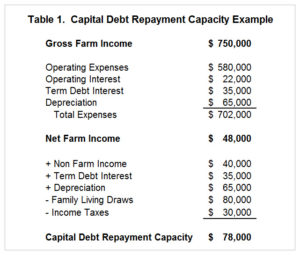
Mr. Lattz noted that, “The two major components of the coverage ratio are the Capital Debt Repayment Capacity (CDRC) [Table 1] and the Annual Debt Service Requirements (ADSR) [Table 2].

fdd180117_tab1

Table 1, from farmdoc daily, January 2017.

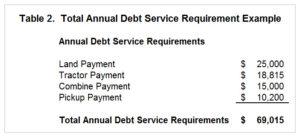
Meanwhile, “Table 2 illustrates an example of Annual Debt Service Requirements.”

fdd180117_tab2

Table 2, from farmdoc daily, January 2017.

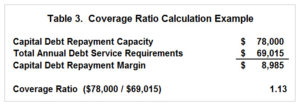
The farmdoc update then noted that, “Once these two components have been calculated, the Capital Debt Repayment Margin and Coverage Ratio can be calculated. The Capital Debt Repayment Margin is simply CDRC minus the ADSR. The Coverage Ratio is calculated by dividing the CDRC over ADSR.”

fdd180117_tab3

Table 3, from farmdoc daily, January 2017.

Mr. Lattz added that, “In today’s agricultural economy with lower grain prices, some farm operations may be projecting a Coverage Ratio of less than 1.0. In 2015, the Coverage Level averaged less than 1.0 in Illinois (farmdoc daily, October 4, 2016). If this is the case, the next question is how much is the shortfall and does the business have adequate working capital to cover the shortfall. This maybe a short-term solution but depending on the magnitude of the shortfall and level of working capital might not and should not be a long-term solution.”

Posted in Agriculture Law | Comments closed

Venture Capital Funding Slows

Washington Post writer Abha Bhattarai reported recently that, “Venture capital investments in Washington-area companies fell by nearly one-half, to $136.25 million, during the fourth quarter, down from a peak of $260.45 million a year earlier, according to recently released data from the National Venture Capital Association.

“The drop in funding — to the lowest level in four years — mirrors a national trend. Investors pulled back as companies found it harder to go public during the turmoil of the election season and corporate exits became more difficult, lowering expectations for large paydays. Many big-name upstarts saw their valuations lowered.”

The Post article noted that, “‘The Washington region is a good reflection of what’s going on nationally,’ said John Backus, managing partner of Reston-based New Atlantic Ventures and an NVCA board member. ‘If you look at the big picture, venture investments peaked in 2014 and 2015, and now it’s coming back down.’

“Nationally, fourth-quarter venture capital deals tumbled 25 percent, to $12.71 billion, from $16.89 billion a year earlier. There were a total of 1,744 deals during the quarter, down from 2,376 for the same period in 2015, according to PitchBook, a research company that provided the data for the association’s report.”

“Nationally, 39 venture-backed firms had initial public offerings in 2016, down from 77 a year earlier,” the Post article said.

Posted in Start-up Company Law | Comments closed

Farmland Leases: General Variables to Consider

Lee R. Schroeder indicated in a recent column at the The Lima (Ohio) News Online that, “Many farm leases are year-to-year verbal leases, despite many potential pitfalls. A written farmland lease does not need to be lengthy or be prepared by an attorney. However, I have found that effective farmland leases include at least four components.

“First, the landlord and the tenant should be defined.”

“[I]f the current owner of the land owns the land through a life estate or under a life lease, the lease’s landlord should be defined to include the people who would own the land if the current owner dies before the lease terminates.”

Mr. Schroeder added that, “Second, the character of the lease should be defined. Traditionally, there were two types of farmland leases: cash rent and crop-share. A cash rent lease is usually structured as a payment or series of payments from the tenant to the landlord in exchange for the tenant’s ability to raise crops and keep all revenue earned from those crops.”

“In crop-share leases, the landlord has traditionally paid the real estate taxes and half of the cost of inputs such as seed, fertilizer and herbicides. The tenant would provide all labor and pay the other ‘share’ of input expenses. The annual crop would be split between the landlord and the tenant.”

Mr. Schroeder pointed out that, “Recently, ‘hybrid leases‘ have become more prevalent. These leases usually include a base cash rent and bonuses to the landlord for good yields, good crop prices or both. A tricky part of hybrid leases is that the bonus calculation can be confusing or hard to verify.”

Last week’s update noted that, “Third, the duration of the lease should be specified in the lease. The lease should have a definite end date or unquestionably clear automatic renewal provisions. Such clarity allows tenants to conduct advance marketing of grain and make timely orders and purchases of inputs for the following year. This also gives landlords income and expense certainty in budgeting their enterprises.

“Fourth, the lease should set forth the rent amount or rent formula, along with specific rent-due dates in cash rent leases.”

Posted in Agriculture Law | Comments closed

Several Recent Policy Developments for Producers Considering a Switch to Organics

DTN Ag Policy Editor Chris Clayton reported yesterday that, “Farmers considering a switch or transition to organic crops have a lot to read right now if they want to keep pace with changes happening in the industry.

“Several changes in the organic industry have happened just over the past week. USDA on Wednesday finalized a rule on organic livestock and poultry management practices. On Tuesday, USDA also opened up a comment period on a possible organic checkoff program. Last week, the department approved a new ‘transitional certification’ program. A cost-share program to help farmers transition is also moving agencies at USDA to make it more accessible to farmers.”

The article noted that, “Hopefully, the program changes are helpful and the premiums for organic corn or soybeans are still going be there in three years for farmers such as Wendel Lutz, who farms near Dewey, Illinois, and is just starting to make the transition on 80 acres. A landlord had asked some tenants if they would be interested in converting to organic production. Lutz had known others who grew organic crops and wanted to give it a shot.

“‘I really like the people and what they are trying to accomplish, and now I get a chance to try it out myself,’ Lutz told DTN. ‘It will be quite an experience, but I’m looking forward to it, and it’s only 80 acres. If it goes over good, and there are good markets like they claim there is, we’ll see about expanding more ground in years to come.'”

Mr. Clayton added that, “In other efforts to promote organics, the Farm Service Agency also just took over the organic cost-share certification program from Agricultural Marketing Service. Starting in March, farmers will be able to go to FSA offices to apply for USDA funds to help offset the costs of both the transitional and organic certification.”

Posted in Agriculture Law | Comments closed

College Debt Stymies Start-Up Opportunities

New York Times writer John F. Wasik reported recently that, “Saddled with $40,000 in college loans, Catherine Berendsohn, 29, struggled to get a web design business off the ground after graduating from Florida State University in 2010. Ms. Berendsohn, an artist-entrepreneur, wanted to rent a storefront and start a roving studio in Monterey, Calif. Her student loans, however, prevented her from getting the money she needed.

“As she tried to expand her business, Ms. Berendsohn was denied a personal credit card. Her college loan payment was $400 a month at the time. She took on a website project and began to accept other clients in Carmel Valley Village, Calif. But then she lost a commission for a local mural project. Unable to continue to pay her monthly expenses, she shut down her business after three months and moved back home to Miami.”

The Times article noted that, “Because of the corrosive impact of student debt on start-ups, millennials seem to be the new lost generation of entrepreneurs.

“Although it is difficult to pin down a direct relationship between college loans and entrepreneurial activity, the weight of student debt appears to be deterring some would-be business owners.”

Mr. Wasik explained that, “Many young entrepreneurs are unlikely to go to venture capital firms or business incubators, preferring to ‘bootstrap’ — finance their companies with their own money or funds from friends and family members. But being in debt for student loans makes self-financing that much tougher.

“Even graduates who have begun promising start-ups have found that securing financing when carrying student loans was brutally difficult.”

The article added that, “Still, there are options for budding entrepreneurs facing credit challenges. Crowdfunding sites like Indiegogo.com and GoFundMe.com don’t ask for credit reports. Nor is there much, if any, paperwork. Sometimes, simple business concepts can attract thousands of dollars, although getting a lot more than that requires a strong promotional campaign that gets a lot of attention.”

Posted in Start-up Company Law | Comments closed

Northwestern Mutual Life Insurance Co. Establishes Venture Fund to Invest in Start-Ups

Paul Gores reported last week at the Milwaukee Journal Sentinel that, “Northwestern Mutual Life Insurance Co. said Thursday it has established a $50 million venture fund to invest in start-up companies that are developing new financial technology and other innovations the company could offer to clients.

“Investments from the new Northwestern Mutual Future Ventures Fund — ranging between $500,000 and $3 million each — will develop tools to help accelerate digital technology and ‘create value for the company’s clients,’ Northwestern Mutual said. The plan is to invest the $50 million over the next five or six years.

“The company said the fund will focus on four priority investment areas: consumers’ changing preferences, ‘reimagining’ the client experience, the digital health revolution and transformational analytics and technologies.”

Mr. Gores added that, “The new Future Ventures Fund isn’t Northwestern Mutual’s first major commitment to technology. In 2015, the company acquired the online financial planning firm LearnVest Inc. Northwestern Mutual then used the know-how of LearnVest employees to develop a new online financial planning platform tailored to its clients.”

Posted in Start-up Company Law | Comments closed

USDA Expands Grasslands Conservation Program to Small-Scale Livestock Producers

A news release from USDA’s Farm Service Agency (FSA) on Friday indicated that, “[FSA Administrator] Val Dolcini today announced that USDA will accept over 300,000 acres in 43 states that were offered by producers during the recent ranking period for the Conservation Reserve Program (CRP) Grasslands enrollment with emphasis placed on small-scale livestock operations. Through the voluntary CRP Grasslands program, grasslands threatened by development or conversion to row crops are maintained as livestock grazing areas, while providing important conservation benefits. Approximately 200,000 of the accepted acres were offered by small-scale livestock operations.”

The release noted that, “The most recent ranking period closed on Dec. 16, 2016, and included for the first time a CRP Grasslands practice specifically tailored for small-scale livestock grazing operations to encourage broader participation. Under this ranking period and for future periods, small-scale livestock operations with 100 or fewer head of grazing cows (or the equivalent) can submit applications to enroll up to 200 acres of grasslands per farm. Larger operations may still make offers through the normal process. USDA met its goal of 200,000 acres under this small-scale initiative. The new practice for small-scale livestock grazing operations encourages greater diversity geographically and in all types of livestock operations. Visit http://go.usa.gov/x9PFS to view the complete list of acres accepted by state.”

The table indicates that Illinois will accept 1,636 acres.

Friday’s news release also noted that, “USDA selects offers for enrollment based on six ranking factors: (1) current and future use, (2) new farmer/rancher or underserved producer involvement, (3) maximum grassland preservation, (4) vegetative cover, (5) environmental factors, and (6) pollinator habitat. Offers not selected in a ranking period are rolled over into the next ranking period.

“Small livestock operations or other farming and ranching operations interested in participating in CRP Grasslands should contact their local FSA office. To find your local FSA office, visit http://offices.usda.gov. To learn more about FSA’s conservation programs, visit www.fsa.usda.gov/conservation.”

Posted in Agriculture Law | Comments closed