“Colony Collapse”- Severe Test for Large Beekeepers

Earlier this month, New York Times writer Stephenie Strom reported that, “Pollination services, as the bees’ work is known in the industry, has risen this year to between $180 to $200 a hive from an average of $154 a hive in 2006, [Bob Curtis, director of agricultural affairs at the Almond Board, a trade group for almond growers] said.

“There would be no almond crop — not to mention avocados, apples, cherries and alfalfa — without honeybees. Of the 100 crops that account for 90 percent of the food eaten around the globe, 71 rely on bee pollination, according to the United Nations Food and Agriculture Organization.”

The Times article explained that, “Demand for [Bret Adee’s (America’s largest beekeeper)] bees is soaring in part because a poorly understood plague, known as colony collapse, has decimated the nation’s bee population in the last decade. The cause is widely debated: Some cite climate change affecting habitat, others the proliferation of certain pesticides, but most believe the problem has multiple factors.

“Whatever the reason, in the year that ended in April 2016, 44 percent of the overall commercial bee population died. In a typical year before the plague, only 10 percent to 15 percent would have died, and Mr. Adee’s losses would have been between 3 and 7 percent.”

Ms. Strom noted that, “During pollination season, the bees are loaded onto a dozen flatbed trucks and nine or 10 tractor-trailers and ferried to work, starting first in the almond orchards in late January, then moving to other California crops like broccoli and avocados. About 10 percent of the Adee bees are dispatched to Oregon and Washington State, where they pollinate cherry and apple trees.

“They work until early May, when the trucks take them to the Midwest for the summer.

“Like other commercial beekeepers struggling with the population decline, Mr. Adee has stayed afloat, in part, by acquiring the colonies of other beekeepers: The number of commercial beekeepers (those with more than 300 hives) has dropped, though no one is certain by how many.”

The article stated that, “He has also been forced to split his colonies to rebuild his stocks, a process that entails moving some bees out of one colony and fooling them into building colonies around new queens.

“Nonetheless, his losses were so high last year that he had to borrow bees to fulfill his contracts. This year, thanks in part to the acquisition another beekeeper’s business, he had bees still waiting for work as he deployed his hives across California in late January.”

The Times article added that, “James Frazier, a bee expert at Pennsylvania State University, agreed. The bee shortage has to do with the overall health of bees, and not one or two specific things. Bees are exposed to a variety of pesticides, all of which can affect their immune systems, he said. That in turn makes them less resistant to diseases and parasites carried by the varroa mite and enables the spread of viruses.

“‘It’s more complicated than trying to cure cancer,’ Dr. Frazier said, because bees are outside, where you have all these uncontrollable things working on them.

“Bees from one keeper are mixing with those from other populations as their numbers fall. That may aid in the spread of diseases and parasites, said Ann Bartuska, the acting under secretary for research, education and economics at the Agriculture Department.”
Posted in Agriculture Law | Comments closed

U.S. Organic Corn / Soybean Growers- Robust Imports May Not Face Similar Standards

Jacob Bunge reported on Tuesday at The Wall Street Journal Online that, “Organic grain is flooding into the U.S., depressing prices and drawing complaints from domestic organic farmers who fear their harvests are held to stricter standards than foreign-raised crops.

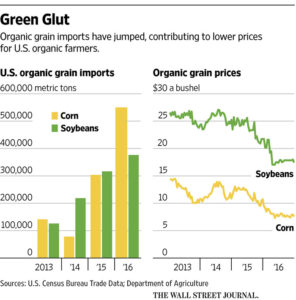
“Turkey, for instance, vaulted ahead to become by far the biggest supplier of organic corn and soybeans to the U.S. last year. The Mediterranean country in 2016 shipped to the U.S. 400,000 metric tons of organic corn, nearly quadrupling its prior-year total, while its soybean shipments climbed by more than eight times, U.S. Agriculture Department data show. Other key suppliers to U.S. organic-food companies are now Ukraine, Argentina, Romania and India.”

Mr. Bunge explained that, “U.S. organic-farming groups say that influx of foreign grain has been a chief factor in slashing prices for organic corn by about 30% in 2016, along with a 20% decline for organic soybeans. Those declines came despite robust growth in U.S. sales of organic foods—and far underperformed prices for nonorganic corn and soybeans. USDA-certified organic food sales in 2016 climbed 10% to $12.3 billion, versus a 0.7% increase in conventional grocery sales, according to Spins LLC. Those figures don’t include sales from Whole Foods Market Inc., a major organic retailer.

“Some organic farmers in the U.S. contend that overseas organic farms benefit from looser oversight, giving them an edge over domestic farms. They point to past failures among foreign-based organic operations in following U.S. organic standards, and occasional cases of fraud. Now U.S. groups want U.S. authorities to step up scrutiny of organic operations in Turkey and other Eastern European countries, and provide more support for U.S. organic farmers.”

Graph from The Wall Street Journal.

The Journal article added that, “Typically, farmers shifting to organic have to sell their crops at lower, conventional prices during that changeover period, which takes about three years. U.S. organic farmers say that competing against cheap imports has diminished the payoff from a tougher method of raising crops.

“Michael Konen, who raises organic corn, soybeans and wheat on 150 acres near Sugar Grove, Ill., said that when he converted to organic farming eight years ago he was getting $11 to $16 per bushel more for his organic corn versus conventional varieties. Over the past two years, he said, that premium has shrunk to about $4 to $8, though his costs haven’t changed.”

In conclusion, the Journal article pointed out that, “Lynn Clarkson, president of Illinois-based Clarkson Grain Co., which deals in organic crops that are raised domestically and overseas, said that organic food’s reputation relies on strict enforcement of farming standards. ‘The biggest threat to organic is the loss of credibility,’ he said.”

Posted in Agriculture Law | Comments closed

Spreading Venture Capital to “Everybody, Everywhere”

Wall Street Journal writer Deborah Gage reported this week that, “Silicon Valley continues to attract more venture capital and more startups than anywhere in the U.S., but Steve Case says that has to change. The AOL co-founder and chief executive of investment firm Revolution LLC says ‘everybody, everywhere‘ should get a shot at the American dream.

“Revolution has invested $840 million in startups outside of California, New York and Massachusetts, and its Rise of the Rest startup bus tours—a series of weeklong tours of startups, meetings with elected leaders, speeches at incubators and pitch competitions—focus on entrepreneurs outside those states. Mr. Case has personally invested $4 million in pitch-competition winners.

“People in the middle of the country especially are feeling ‘left out and left behind,’ Mr. Case says, and he talked to The Wall Street Journal about why that needs to change.”

Mr. Case indicated that, “I think many of the answers will be in the middle of the country, because for many of the perspectives that are needed—for instance, to reimagine agriculture—it’s helpful to be working with farmers and be close to farmers. If you really want to rethink health care, spending time in Cleveland at the Cleveland Clinic or in Rochester at the Mayo Clinic or in Texas at MD Anderson or in Baltimore at Johns Hopkins is important.”

Mr. Case also pointed out that, “I’m bullish on Silicon Valley—I don’t want to sound overly critical—but we do need to figure out ways to make sure this next wave of entrepreneurship, particularly in the U.S., is more inclusive, and that includes regional inclusivity and also different people.”

Posted in Start-up Company Law | Comments closed

Start-up Developing Calorie Sensing Smartphone

A recent article at the Food Navigator (Asia) Online reported that, “The world’s first material-sensing smartphone, which could potentially tell you how many calories you’re about to eat, will launch in China later this year, its manufacturer has said.

“The Changhong H2, featuring components made by a Consumer Physics, boasts a tiny near-infrared spectrometer that can analyse the pattern of light it reflects to determine the composition of an object.”

The article added that, “‘The smartphone can be used to detect materials and analyse their makeup instantly,’ said Dror Sharon, chief executive of the Israeli molecular sensor manufacturer.

“He said that consumers will be able to use it to analyse body metrics and the properties of foods and liquids, effectively giving them new ways to ‘select the best fruits and vegetables, stick to their diets and nutritional needs and verify product authenticity in ways never before thought possible.'”

Posted in Start-up Company Law | Comments closed

Food Giants Create Venture Capital Funds to Invest in Startups for Innovation

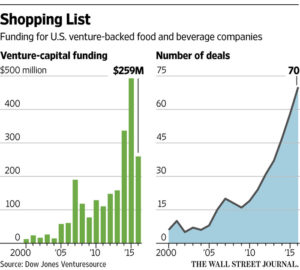
Wall Street Journal writer Annie Gasparro reported late last week that, “When General Mills Inc. and Kellogg Co. couldn’t beat the startups appearing on store shelves next to their Yoplait yogurt and Froot Loops cereal, they decided to invest in them.

“Food giants are starting venture capital funds to invest in startups focused on healthier and less-processed foods, betting the younger companies can teach them to be more entrepreneurial and innovative. Slow to recognize consumers’ shift toward those products, global titans have found themselves stuck in a rut.”

Graph from The Wall Street Journal.

The Journal article explained that, “‘It’s hard for consumer companies to step out of what they’ve been locked into for 60 or 80 years,’ said Ryan Caldbeck, founder and chief executive of CircleUp, a business that connects private-equity firms with food startups. CircleUp says large consumer-goods companies lost $18 billion in market share to smaller competitors between 2011 and 2015.”

“In total, venture capital funds made 66 food-and-beverage-related deals last year, up 20% from 2015. About a fifth were backed by big food companies, according to Dow Jones VentureSource,” the Journal article said.

Ms. Gasparro added that, “Rhythm Superfoods Chief Executive Scott Jensen said many of his peers are more open to a minority investment than a full acquisition. Some have heard cautionary tales of startups that slipped after teaming with big food makers, like Kellogg’s rocky pairing with cereal-maker Kashi.”

Posted in Agriculture Law, Start-up Company Law | Comments closed

Strengths and Challenges in Building Local Food Systems

Leigh Adcock indicated in an Iowa State University Extension publication that, “As demand for locally grown foods continues to rise, more Iowans are taking a look at the factors that affect the creation of expansion of local food systems in their communities. As the name implies, a local food system encompasses many factors, including producers, markets, nutritional education, institutional buyers such as schools and hospitals, built infrastructure, processing, and much more.

“To get an accurate picture of the enabling and hindering factors affecting a community takes strategic analysis and candid, sometimes difficult, conversations. One process that communities can use to analyze their strengths and challenges is through the ‘community capitals’ framework: examining how community members rank their own status in seven areas: social capital, human capital, political capital, cultural capital, built capital, financial capital, and natural capital.”

Ms. Adcock provided this summary of recent research related to “community capitals” analysis:

  1. Relationships are key to creating a successful local food system.
  2. Availability of skilled farm labor can be a challenge, particularly in rural areas.
  3. Couching local foods efforts in terms of personal and community health can increase interest from general audiences in local foods work.
  4. Federal farm policy had was not viewed as having much of an impact on local foods systems, positive or negative.
  5. All communities reported challenges with engaging diverse populations in their local foods systems work.
  6. Communities value their food coops, food hubs, and natural food stores, not only as markets and sources of healthy, locally grown foods, but as hubs for information and education for the general public on the value of local food systems.
  7. Researching, writing, and collaborating on grant proposals is time-consuming and challenging, but can pay off for large-scale projects. Successfully completing and publicizing a grant project can lead to more funding opportunities in a region.
  8. Natural capital was not a significant factor for any of the communities.

More details regarding the Iowa State research on local food systems is available here: “Determining Factors for Local Food System Success.”

Posted in Agriculture Law, Start-up Company Law | Comments closed

St. Louis Post-Dispatch Recaps Suit Against Monsanto Over Dicamba Damage

Bryce Gray reported on Friday at the St. Louis Post-Dispatch Online that, “Like many farmers across southeastern Missouri and in states beyond, Steven and Dee Landers faced heavy crop damage last summer, losing nearly half of their yields and taking a financial hit that crept into six figures.

“They think illegal use of the drift-prone herbicide dicamba is what afflicted their soybeans and corn. Now the couple near the tiny town of Lilbourn are spearheading a class action lawsuit against the biotech giant Monsanto, arguing that rampant herbicide drift was a predictable consequence of the company’s rollout of dicamba-tolerant crop varieties before the appropriate herbicide was approved for use.”

Mr. Gray explained that, “The suit, filed Jan. 26 in U.S. District Court in Cape Girardeau, is open to farmers across 10 states where dicamba complaints have been documented, ranging from Texas to Minnesota and as far east as North Carolina.

“But Missouri’s Bootheel area and surrounding regions have been at the epicenter of the crisis.”

The Post-Dispatch article noted that, “The suit states that there have been nearly 200 drift complaints in Missouri since Monsanto first released dicamba-resistant seeds in 2015;” and added that: “The form of dicamba Monsanto developed for use with the crops — which is supposedly less prone to vaporizing and drifting off target — was not approved by the EPA until November. Without it available for two growing seasons, the lawsuit argues it was inevitable that some farmers would turn to unauthorized forms of dicamba when faced with the ‘unenviable choice’ of allowing their fields of dicamba-tolerant crops to be overrun by weeds, or to illegally spray older varieties that would not harm their own fields but jeopardize nearby growers who planted nonresistant seed.

“Monsanto maintains that the company is not liable for the wrongdoing of others.

“‘This baseless lawsuit seeks an unprecedented expansion of the law by attempting to impose liability on a company that did not make the product that allegedly caused the damage, did not sell the product that allegedly caused the damage, and, in fact, warned against the very use of the product alleged in the complaint,’ the company said in a statement.”

Mr. Gray added that, “Monsanto is facing a similar lawsuit filed in November on behalf of Bill Bader, a farmer who runs Missouri’s largest peach orchard near the Bootheel town of Campbell.”

Posted in Agriculture Law | Comments closed

Deere Co. Raises Profit Forecast

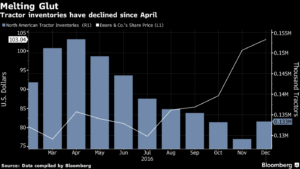
Bloomberg writer Mario Parker reported today that, “Deere & Co., the world’s largest manufacturer of farming machinery, raised its 2017 profit forecast and said there are signs the worst may be over in a market that’s suffered a sustained slump lasting years.

“Net income will be about $1.5 billion in the year through October, Deere said Friday in a statement, exceeding both its own previous forecast and the average estimate among analysts, both of which were $1.4 billion. It also sees net sales increasing by about 4 percent for the year, from 1 percent previously. The shares rose as much as 3.9 percent to a record high in pre-market trading in New York.

“‘We are seeing signs that after several years of steep declines key agricultural markets may be stabilizing,’ Chief Executive Officer Sam Allen said in the statement. ‘Deere continues to perform far better than in agricultural downturns of the past.'”

Graph from Bloomberg Business News.

Mr. Parker pointed out that, “There have been positive signs recently in the machinery market. North American tractor inventories through December, while at a record seasonally, have declined 13 percent since April, data compiled by Bloomberg show. Deere’s shares have rallied over the last several months, which may be one reason why Warren Buffett’s Berkshire Hathaway Inc., once Deere’s second-biggest shareholder, disclosed earlier this week that it sold its entire stake during the fourth quarter.”

Nonetheless, today’s article noted that, “Still, market conditions remain tough. The U.S. Department of Agriculture earlier this month forecast American farmer incomes will fall for a fourth year to their lowest since the financial crisis. That would be the longest streak of declines in 40 years.”

Posted in Agriculture Law | Comments closed

Federal Reserve Surveys Show Decline in Land Values, Farm Incomes

David Nicklaus reported earlier this month at the St. Louis Post-Dispatch Online that, “Farm incomes and farmland prices both fell in the fourth quarter of 2016, a survey by the St. Louis Federal Reserve Bank finds.

“The Fed polled agricultural bankers in its district, which covers all of Arkansas and parts of six other midwestern and southern states. The bankers estimated that prices of crop land fell 8 percent last year while the value of pasture or ranch property fell 3.5 percent.

“The survey showed a decline in farm income for the 12th straight quarter. The bankers also said farmers cut back their household and capital spending in response to lower crop prices.”

Mr. Nicklaus added that, “The Fed also asked questions about the market for farmland. Bankers said they expected the volume of land sales to be about the same this year as it was in 2016. Sixty-nine percent of bankers said the majority of land sold in their area was purchased by farmers, as opposed to investors or developers.”

For a more detailed recap of the St. Louis Fed report, as well as other ag survey reports from the Chicago and Kansas City Fed, see this FarmPolicyNews update from earlier this week.

Posted in Agriculture Law | Comments closed

Some Farmers Shopping Online for Inputs, in Lieu of Local Co-Op

Jesse Newman and Jacob Bunge reported today at The Wall Street Journal Online that, “Brandon Sinclair spent $26,000 on herbicides for his corn and soybean fields last year, roughly half what he says he used to pay at his local co-operative.

“The savings came from a source many U.S. farmers have been slow to tap: the internet.

“Farmers have long made pilgrimages to farm stores and co-operatives to purchase seeds, fertilizer and weed and pest killers. Now, with a commodity glut pressuring crop prices and pushing farm incomes to an eight-year low, farmers are scouring the web for better deals on the products they use to grow their crops.”

Today’s article stated that, “The shift could upend a decades-old system built around small-town suppliers that also offer farming advice and sell services such as spraying for weeds. Mr. Sinclair says the math is simple: Using savings found online, the 31-year old Illinois farmer was able to spring for a helicopter to wrangle his herd of cattle. Now he is urging his neighbors to shop online, too.”

The Journal writers explained that, “Farmer proponents of online shopping say they have discovered local prices for crop supplies can vary widely across the country. Weedkillers can cost up to four times as much in one part of the country as in another, according to Farmers Business Network Inc., a San Francisco-area startup backed by Google Ventures.”

Graph from The Wall Street Journal.

Newman and Bunge added that, “Farmers have long tracked crop prices on their home computers and were early adopters of GPS technology; now increasingly tech-savvy young people are taking over family farms.

“‘Everything can be done at home,’ said Chad Smith, a 30-year-old former seed salesman in Elk Mound, Wis., who now sells insurance. ‘You don’t need to go into the co-op and eat peanuts and talk to the salesman anymore.'”

Posted in Agriculture Law | Comments closed