
Indoor Farming Startup Looks to Redefine How Vegetables are Grown

Jacob Bunge and Eliot Brown reported this week at The Wall Street Journal Online that, “In a renovated warehouse by San Francisco Bay, plastic towers sprouting heads of lettuce, arugula, and herbs rise 20 feet to the ceiling, illuminated by multicolored LED lights that give the room a futuristic feel.

“A group of tech entrepreneurs and investors including billionaires Jeff Bezos and Eric Schmidt are betting this facility, 100 miles north of California’s ‘salad bowl’ produce-farming epicenter, can redefine how vegetables and fruits are grown for local consumption.

“If all goes to plan, the 51,000-square-foot warehouse run by startup Plenty United Inc. will yield as much as 3 million pounds of leafy greens each year. In the coming months, the company plans to begin marketing produce bred for local tables rather than shipping durability.”

The Journal article noted that, “Plenty is among a wave of startups seeking to shift part of the $49 billion U.S. retail produce market from sun-kissed crop fields to giant warehouses, old factories and repurposed shipping containers. These indoor facilities are tricked out with sensors that measure temperature and moisture, automated systems that pump in water and nutrients, and strips of LED lights to provide energy—with no need for sunlight or soil.

“Companies like Plenty, AeroFarms LLC and Freight Farms Inc. have raised tens of millions of dollars, spurred by declines in the cost of LED lighting and heating and cooling systems. The startups aspire to produce for nearby restaurants and grocery stores, whether during the sizzling summers of New Mexico or the frigid winters of Minnesota.”

Bunge and Brown added that, “Even tech giant Alphabet Inc., the parent of Google, tried its hand at growing grain indoors, but shut down the project in 2015 after it failed to be energy-efficient enough.

“Plenty believes it can lower costs by farming in big warehouses on cheap land outside city centers, and improve efficiency by using a technique called machine learning that enables computers to review huge data sets and make decisions.”
Posted in Agriculture Law, Start-up Company Law | Comments closed

Community Banks Hopeful About Potential Regulatory Changes

Associated Press writer Joyce M. Rosenberg reported recently that, “Community banks and small businesses are optimistic about changes the Trump administration and Congress have promised to laws that tightened supervision of the banking industry after the 2008 financial crisis.

“The number of small, local banks has declined since the Great Recession, a change that advocates feel was intensified by the paperwork the increased oversight entails. That’s disappointing to many small business owners, who find it easier to form relationships with community bank branch managers and bankers than with those at regional or international banks. A community banker can advise them and steer business their way, for example, connecting a company owner with a new accountant.”

The article explained that, “According to the Federal Deposit Insurance Corp., the U.S. had 5,521 community banks as of Sept. 30. That’s down more than 25 percent from 7,442 at the end of 2008, when the banking crisis was still in its early days, according to a figure provided by the Independent Community Bankers of America, an industry group. The FDIC has reported nearly 500 bank failures since 2009, most of them small banks. Others have merged to cut costs and stay in business, but many have struggled even as the economy has recovered.

“Industry groups blame increased regulation, including the Dodd-Frank bill passed by Congress in 2010. Last week, President Donald Trump signed an executive order directing the Treasury secretary to review Dodd-Frank and its thousands of regulations. Changes in the law would have to be made by Congress, and House Financial Services Committee Chairman Jeb Hensarling of Texas has proposed modifying portions that affect smaller banks.

“Dodd-Frank has created additional procedures and paperwork for all banks, but community banks have a harder time meeting the requirements because they have far smaller staffs than regional or national financial institutions, says Paul Merski, the ICBA’s chief economist.”

The AP article added that, “The changes were intended to protect against failures like Lehman Brothers in 2008, and community banks don’t pose a similar threat, the ICBA says. Community banks are likely to have several billions of dollars in assets each, according to the FDIC, while regional banks may have assets in the hundreds of billions of dollars and international banks like Bank of America and Wells Fargo have assets into the trillions. Small business advocates say they’re feeling the reverberations.

“‘The overregulation has caused costs to go through the roof, many banks have been shut down and that has hit small businesses,’ says Javier Palomarez, president of the United States Hispanic Chamber of Commerce.”

Posted in General Interest | Comments closed

Iowa Supreme Court Rules on State Issues in Des Moines Water Works Case

An update last week at the farmdoc daily blog by Jonathan Coppess (“Dead Zones & Drinking Water: Update on the DMWW Lawsuit“) stated that, “On January 27, 2017, the three Iowa drainage districts sued by the Des Moines Water Works (DMWW) over nitrates in the drinking water supply won a significant victory in a decision by the Iowa Supreme Court. This article follows previous discussions about the nutrient loss issues and the DMWW lawsuit with a review of the Iowa Supreme Court’s decision. The Major Pleadings, Orders and Decisions can all be found on Iowa State University’s Center for Agricultural Law and Taxation website.”

Mr. Coppes provided this succinct recap of ruling handed down by the Iowa Supreme Court, “In short, the Iowa Supreme Court responded that Iowa drainage districts possess immunity from damages claims and immunity from equitable remedies under Iowa law. The Iowa Supreme Court also answered that DMWW as one subdivision of state government cannot sue another subdivision of state government claiming protections under the Iowa Constitution, and that this also held true for the claims of a taking of DMWW property.”

Last week’s farmdoc update also pointed out that, “The Iowa Supreme Court’s decision on the four questions certified to it by the Federal District Court was a significant victory for the drainage districts and a setback for DMWW. The conclusions of the court, however, only applied to the state law claims. The court explicitly emphasized that its decision did not relate to the Federal claims under the Clean Water Act. As such, the Iowa Supreme Court’s decision was a victory for the drainage districts but not a complete one. It remains to be seen how the Federal court will decide on the CWA claims and DMWW’s novel argument that the drainage infrastructure constitutes a point source, removing it from the agricultural storm water exemption in the statute.”

Posted in Agriculture Law | Comments closed

Minnesota Livestock Case, Feedlot Raises Water Issues

Josephine Marcotty reported in Sunday’s Minneapolis Star Tribune that, “A bitter three-year community fight over a hog feedlot in Dodge County has landed before three state Court of Appeals judges who are now being asked to decide a question that environmentalists see as critical to the future of clean water in Minnesota.

“What obligation do county governments in rural areas have to protect their citizens from the impact of a growing livestock industry?”

Yesterday’s article noted that, “‘There is absolutely no effort on the county’s part to address serious public health concerns or the serious environmental concerns relating to these factory farms,’ said Sonja Trom Eayrs, who grew up in Dodge County and has been leading the fight against the feedlot.

“Paul Reuvers, attorney for Dodge County, said the county has gone above and beyond what it is required to do according to local and state rules.

“‘We are an agricultural county, and if you live in an agricultural district you might have to deal with the odor, noise and dust associated with agricultural uses,’ he said.”

Ms. Marcotty explained that, “The case involves 2,400 of the 8.3 million hogs that are now raised in Minnesota, the third leading state in the country for pork production. But the number of hog farms has been steadily growing in many counties across the state as demand for pork rises globally, particularly in China and Mexico. Since 2006, the number of hogs in Minnesota has increased by 1.4 million.”

The Star Tribune article stated that, “A Dodge County judge ruled that local officials violated their own rules when they approved the feedlot [in 2014] because the proposal failed to provide critical information to the public, including a plan for how and where the manure would be distributed…[B]ut then the County Board voted to change its rules, creating a simpler two-page application for a feedlot permit that required far less information.”

Yesterday’s article then noted that, “The judge ruled that in regulatory decisions, courts are obliged to give deference to the government bodies that make the rules.

“Now the issue lies with the state Court of Appeals. And it’s attracted the support of many environmental and animal welfare groups…”

After additional analysis looking at more details of the case, the article concluding by stating that, “It’s possible that the appeals court could throw out the case on a legal technicality — Reuvers has argued that the original complaint was not properly served on county officials. A decision is expected within 90 days.”

Posted in Agriculture Law | Comments closed

Farmers Face Steep Slide as Net Farm Income Slips

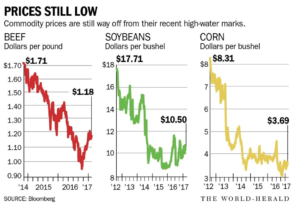
Cole Epley reported in Sunday’s Omaha World-Herald that, “This year, U.S. farmers are expected to net profits of $62.3 billion, or one-half of the record $123 billion they reaped in 2013, according to last week’s USDA report. For many producers facing a fourth consecutive year of declines amid persistently depressed commodities prices, breaking even is a best-case scenario in 2017.

“For Jeff Metz, who raises cattle and grows wheat on 5,000 acres of land near the Panhandle community of Bridgeport, the outlook is bordering on untenable…[M]etz also has endured cratered cattle prices that today ring up at only half of last year’s levels. Selling calves for $800 a head after they brought up to $2,000 in recent years only magnifies input costs for expenses like property taxes and feed, Metz said.”

Graph from Sunday’s Omaha World-Herald.

Sunday’s article noted that, “Then there’s the wheat business.

“The government forecast for wheat prices pegged a year-over-year decline of $1.4 billion, or 17 percent. Record harvests around the world have led to a global glut, and that in combination with a stronger dollar has crumbled the export market to decades-low levels.”

The article pointed out that, “‘We’re losing a dollar for every bushel that we produce,’ Metz said, ‘and it isn’t going to take long before I’ve got a wheat farm for sale.’

“Such financial stresses remain evident in regional banking data recently assessed by the Federal Reserve Bank of Kansas City…Nathan Kauffman is the Kansas City Fed’s Omaha branch executive and sees growing apprehension from both lenders and borrowers when it comes to taking on additional debt. Last year a ‘relatively small’ group of borrowers were facing real financial problems, Kauffman said, and the odds are increasingly in favor of that group growing.

“That could be why demand for new loans suddenly dropped in the fourth quarter.”

The World-Herald article indicated that, “Among banks in the Fed’s 10th district, which includes Nebraska, new originations of non-real estate farm loans fell off by 40 percent in the fourth quarter, according to a report Kauffman wrote late last month. It’s been almost 20 years since bankers recorded such a decline, and the precipitous drop capped a year in which bankers reported historic or near-historic demand for operating loans.

“Kauffman theorizes that many borrowers and lenders finally have sated their appetites for risk and debt as they buckle up for another year of low commodities prices.”

Sunday’s article added that, “Borrowers in business with First National Bank of Omaha, which has about $1.5 billion in farm loans and is perennially neck-and-neck with cross-town competitor Pinnacle in terms of such loans, already have dialed back, says Tom Jensen, the bank’s senior vice president of ag lending…[F]irst National has tempered its outlook in terms of what it expects to see for farm loan demand in 2017. For those that stay, the odds are good for many that they are due for drastic changes.

“‘After the (farm crisis in the) ’80s, we thought we would have more weekend farmers and see more of them carrying jobs during the week,’ First National’s Jensen said. ‘I think there will be more of that.'”

Posted in Agriculture Law | Comments closed

Drone Technology and Automated Pollination, Still Work to be Done

Los Angeles Times writer Amina Khan reported last week that, “One day, gardeners may hear not just the buzz of bees among their flowers, but the whir of robots, too. Scientists in Japan say they’ve managed to turn an unassuming drone into a remote-controlled pollinator by attaching horsehairs coated with a special, sticky gel to its underbelly.

“The system, described in the journal Chem, is nowhere near ready to be sent to agricultural fields, but it could help pave the way to developing automated pollination techniques at a time when bee colonies are suffering precipitous declines.”

The article noted that, “Animal pollinators are needed for the reproduction of 90 percent of flowering plants and one-third of human food crops, according to the U.S. Department of Agriculture’s Natural Resources Conservation Service.

“Chief among those are bees — but many bee populations in the United States have been in steep decline in recent decades, probably because of a combination of factors, including agricultural chemicals, invasive species and climate change.

“Just last month, the rusty patched bumblebee became the first wild bee in the United States to be listed as an endangered species (although the Trump administration just put a halt on that designation).”

Khan added that, “Thus, the decline of bees isn’t just worrisome because it could disrupt ecosystems, but also because it could disrupt agriculture and the economy. People have been trying to come up with replacement techniques, the study authors say, but none of them is especially effective yet — and some might do more harm than good.”

Posted in Agriculture Law | Comments closed

Startup Focuses on Lithium Battery Power

Russ Mitchell reported this week at the Los Angeles Times Online that, “[B]uyers of high-tech batteries to power electric vehicles and store electricity for utilities, businesses and homes, [are all going on lithium].”

Mr. Mitchell explained that, “The fast-growing market for the new-style batteries, which run on a chemical mix based on lithium ion technology, could be worth $140 billion by 2026, according to research firm IDTechEx.

“[Michael Patterson’s] battery startup, Romeo Power, needs only a piece of it to score big in a fast-growing new industry, which was kickstarted by Tesla.”

The LA Times article noted that, “Hundreds of young companies around the world want in, but Romeo Power is local — based in Vernon, an industrial zone skirting the southeast border of Los Angeles.

“The company is taking off on a chancy adventure. Plenty of risks lie ahead: technical, financial and execution risks. But the rewards could be substantial, not only for Romeo Power but for the L.A. area, which is trying to establish itself as a major player in new-tech transportation.

“The aim is to sell the company’s battery packs to motor vehicle makers as they scale up their electric-powered ambitions.”

This week’s article added that, “The idea, said Patterson, is to ‘level the playing field for everyone else who is not Tesla.’

“‘All these automakers want to compete with Tesla because they’re losing a lot of business to them,’ Patterson said.”

“Battery packs are the company’s main product. They look like anonymous black boxes, usually long and thin enough to fit under the floor of a car. They contain enormous reservoirs of energy,” the article said.  “Tying all those volatile cells together to achieve maximum power while avoiding a disastrous explosion is tricky. The battery companies that do that best, and for the lowest cost, are the most likely to succeed.”

Mr. Mitchell pointed out that, “Like most startups, Romeo Power is cloaked in trade secrets. Exactly how it plans to boost battery pack performance is unclear.”

Posted in Start-up Company Law | Comments closed

Lawsuit Filed by Poultry Farmers Garners Additional Attention

Recall that a recent update at the BartellPowell blog noted that, “A group of U.S. chicken farmers sued the country’s biggest poultry processors for allegedly conspiring to depress their pay.”

Associated Press writer David Pitt reported yesterday that, “Former chicken farmers in five states have filed a federal lawsuit accusing a handful of giant poultry processing companies that dominate the industry of treating farmers who raise the chickens like indentured servants and colluding to fix prices paid to them.

“The farmers located in Alabama, Mississippi, North Carolina, Oklahoma and Texas allege that the contract grower system created by Tyson Foods, Pilgrim’s Pride, Perdue Farms, Koch Foods, and Sanderson Farms pushed them deep into debt to build and maintain chicken barns to meet company demands.”

The AP article explained that, “Under the contract system, farmers provide the barns and labor to raise the chickens and the company provides chicks, feed and expertise to raise birds to slaughter weight.

“The companies named haven’t yet responded to the lawsuit in court, but one denied the allegations.

“‘We want our contract farmers to succeed and don’t consult competitors about how our farmers are paid. These are false claims,’ said Gary Mickelson, a spokesman for Tyson.”

The article added that, “On Tuesday, Tyson Foods said it has been subpoenaed by the Securities and Exchange Commission for an investigation it believes is tied to allegations that it violated antitrust laws, issues raised in two other lawsuits. Both of those lawsuits related to alleged price fixing and collusion.”

Posted in Agriculture Law | Comments closed

Growing Organic Demand Provides Opportunities for Producers

A recent article in Amber Waves (“Growing Organic Demand Provides High-Value Opportunities for Many Types of Producers,” USDA’s Economic Research Service (ERS)) indicated that, “Organic agriculture began developing in the first half of the 20th century as an alternative to conventional production systems that use synthetic chemical inputs. USDA set national organic standards in 2000, providing a single set of rules for U.S. organic farmers and handlers and replacing the patchwork of State and private standards that had emerged by the early 1990s.”

The article noted that, “While U.S. organic food sales still account for a relatively small share of total U.S. food sales, they have exhibited double-digit growth during most years since 2000 and the organic share has been growing rapidly. In 2015, the Organic Trade Association estimated U.S. organic retail sales at $43.3 billion. Along with natural food supermarkets, restaurants, and direct marketers, most major U.S. food retailers—including Costco, Walmart, and Target—have expanded their organic food offerings in recent years.

“Rapid expansion in consumer demand continues to provide opportunities for U.S. organic producers to enter high-value markets in the United States and other countries. Although the United States and the European Union (EU) are the two biggest markets for organic products, most countries have growing domestic markets.”

The ERS item explained that, “Organic products have shifted from being a lifestyle choice for a small segment of consumers to being consumed at least occasionally by many Americans. In 2014, Gallup included questions on organics in its annual food consumption survey for the first time and found that 45 percent of Americans actively tried to include organic foods in their diets.”

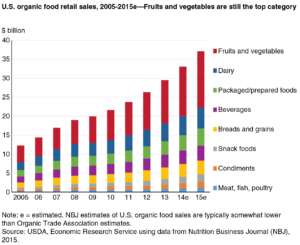
The Amber Waves article also pointed out that, “While fresh fruits and vegetables were still the top selling organic category, organic sales in all the other food categories also grew between 2005 and 2015. ”

Graph from Amber Waves, February 6, 2017 (USDA-ERS).

Graph from Amber Waves, February 6, 2017 (USDA-ERS).

The article added that, “ERS analysis of U.S. organic sales data for five major retail food categories shows that the organic market share increased for most categories between 2009 and 2014.”

Graph from Amber Waves, February 6, 2017 (USDA-ERS).

Graph from Amber Waves, February 6, 2017 (USDA-ERS).

Nonetheless, the article stated that, “Despite potentially higher per-acre returns, the adoption of organic production systems for corn and soybeans has been slow. This is due to factors such as achieving effective weed control and the processes involved with organic transition and certification. Organic corn and soybean production was, on average, conducted on farms with less total acreage and less field crop acreage than conventional farms.”

More broadly, ERS also pointed out that, “U.S. consumer demand for organic food has outpaced domestic production since the national standards were set in 2000. Public and private sector initiatives could further boost demand. In 2010, USDA set its first priority goal for organic agriculture: expanding the number of U.S. certified organic operations by 25 percent over a 5-year period. To facilitate transition to organic production, USDA developed new provisions in risk management, conservation, research, and other farm programs to widen access to these programs for organic and transitioning producers. USDA also expanded U.S. agricultural trade efforts to include bilateral negotiations to facilitate organic trade. In addition, Congress boosted funding for a number of organic programs in the 2014 Farm Act to assist producers with organic certification costs, expand organic research, and improve technical assistance and crop insurance.”

Posted in Agriculture Law | Comments closed

Midwest Startup Focus: Minneapolis, Omaha

Kavita Kumar reported last week at the Minneapolis Star Tribune Online that, “Within the past year, the accelerator scene in the Twin Cities has taken off.

“There are now at least three boot-camp programs for early-stage firms up and running around town aimed at helping them overcome the odds and succeed in a market in which most start-ups fail. Meanwhile, others such as San Francisco-based Hax have started bringing their classes of start-ups here on field trips to make pitches.

“The draw?

“In many cases, it’s because start-ups are looking to partner with major retailers such as Minneapolis-based Target Corp. and Richfield-based Best Buy to have them either carry their products or integrate their tech services. It also comes at a time when the number of start-ups has been exploding amid the growth in Internet of Things-related gadgets and shows like ‘Shark Tank’ that inspired a new generation of entrepreneurs.”

The Star Tribune article noted that, “There are many different kinds of accelerators. The traditional model is one in which investors offer deep mentorship and guidance through 10- to 13-week-long boot camps in which they help companies fine-tune their strategies and focus. The goal for start-ups is often to strengthen their business models and to secure more funding.”

Meanwhile, Steve Jordon reported this week at the Omaha World-Herald Online that, “Ideas, capital and hardworking, talented people.

“Those ingredients are starting to turn Omaha into a fertile home for new businesses, according to three entrepreneurs recently named to one-year fellowships with Pipeline, a program with seminars, mentors and advisers to help startups succeed.”

Mr. Jordon explained that, “But all three said Omaha’s emerging startup environment is helping turn their ideas into profit-making, job-creating businesses that could reach national and even international markets.”

The article added that, “The Midwest and Nebraska got a late start in the tech startup arena, said Dr. Rod Markin, executive director of UneTech, a joint business incubator effort by the University of Nebraska at Omaha and the University of Nebraska Medical Center.

“‘But we’re getting there,’ Markin said. ‘A lot of people are interested in seeing Nebraska develop as a tech space for this part of the country.'”

Posted in Start-up Company Law | Comments closed
