Housing Starts in U.S. Fall in March

Laura Kusisto and Ben Leubsdorf reported this week at The Wall Street Journal Online that, “U.S. housing starts declined in March, but not enough to signal a reversal from the long-term trend of improvement in new home construction.

“Starts decreased 6.8% to a seasonally adjusted annual rate of 1.215 million from a month earlier, the Commerce Department said Tuesday.

“The decline comes after an unusually strong winter, buoyed by temperate weather in most parts of the country. Single-family housing starts in February hit their highest level since October 2007.”

However, the Journal article indicated that, “Residential building permits, which can signal future home construction and tend to be a less volatile measure, rose 3.6% to an annual pace of 1.260 million last month and were up 17% compared with the same month last year.

“The permit numbers ‘should quash any concerns that home builders might be pulling back,’ said Ralph McLaughlin, chief economist at home-tracker Trulia.”

This week’s article added that, “[T]he trend for the year so far is one of steady improvement. New home construction was up 8.1% in the first quarter from the same period in 2016. Permits in the first three months of 2017 jumped 10.4% from a year earlier.”

Posted in Real Estate Law | Comments closed

Steve Case: Cities Who Don’t Mentor and Invest in Startups Do So at Their Own Peril

Des Moines Register writer Kevin Hardy reported this week that, “Last year, more than half of all the nation’s venture capital funneled to entrepreneurs in California, leaving startups in the other 49 states to fight over the remaining pot of cash.

“Steve Case, who co-founded AOL in 1985, says that must change so cities in middle America like Des Moines can share in the technological revolution.

“‘Some call it the flyover country,’ Case told the Des Moines Register on Wednesday. ‘It’s not really taken as seriously as I think it should be as a center of innovation.'”

Mr. Hardy noted that, “To bolster the heartland, Case says cities and entrepreneurs need to do a better job of telling their startup success stories. But fundraising remains a major hurdle for emerging businesses outside of major tech hubs. Cities who don’t mentor and invest in startups do so at their own peril, he said. He cited research from the Kauffman Foundation that shows startups lead the way in creating jobs, not small businesses or large corporations.

“‘Fortune 500 companies started startups,’ Case said. ‘If you’re using the farm analogy, they’re the seed corn. If you’re not planting that seed corn — some of which will end up dying off, but some of which will grow — you’re not going to have a strong, vibrant community 25 years from now. You just aren’t.'”

The Register article added that, “Case argues that state incentives meant to boost jobs should flow to startups, not necessarily large corporations and small businesses. In Iowa, more than $110 million is spent annually on tax credits and cash payments to existing companies looking to expand here. Less than $3 million is set aside to invest in startups and emerging companies, according to records from the Iowa Economic Development Authority

“Regional tech booms are already reversing so-called ‘brain drain,’ encouraging natives to ‘boomerang’ back home after fleeing their home cities for career opportunities elsewhere, Case said.

“To encourage local tech growth, he said cities must play to their regional expertise. In the case of Des Moines, that means doubling down on ag tech or financial services startups. As technology becomes more pervasive in every part of life, successful tech ventures will need more expertise on specific subjects — not just knowledge of how to code.”

The Register article also pointed out that, “Central Iowa is already playing to its regional strengths, housing both the newly formed Ag Tech Accelerator and the established Global Insurance Accelerator, each funded by businesses in their respective industries.”

Posted in Start-up Company Law | Comments closed

Community Bee Keeping- Modeled After Community Gardens, Gaining in Popularity

The Associated Press reported today that, “Finding places for beekeeping can be a challenge for city dwellers. But apiaries modeled after community gardens have become a popular option.

“Community beekeeping operations usually consist of shared sites on public or private properties, organized by or for people trying to turn out fresh plants or products.

“Some, like the community apiary inside The Hudson Gardens & Event Center in Littleton, Colorado, also educate. Its objectives are to train, mentor and provide fellowship for hobbyist beekeepers, promote interest in beekeeping, and boost plant pollination in Hudson Gardens and around the neighborhood, said Amanda Accamando, the center’s education and volunteer manager.”

The AP article noted that, “Bee stings and liability are obvious concerns, and the public garden’s hobbyist beekeepers are required to follow city codes. Hives must be placed at least 25 feet from property lines, and bee flyways are directed away from private dwellings. No visitors are allowed to approach the hives without a beekeeper escort, and each guest must sign a waiver before entering the apiary.

“Burgh Bees in Pittsburgh established the first urban community apiary in the United States.

“‘We realized more and more people in the city were interested in beekeeping,’ said Stephen Repasky, a master beekeeper and Burgh Bee president. ‘We wanted to help find places for them to do that so we adopted the community garden example.'”

Today’s article added that, “The beekeepers eventually found a vacant piece of land and signed a lease with the city for $1 a year to landscape and manage it.

“‘We went from having a gravel lot full of used needles and garbage to a fenced property with perennials and pollinators,’ Repasky said. ‘It’s going so well that we hope to open a second apiary sometime this summer.'”

Posted in Agriculture Law | Comments closed

Hog Feedlots- Quality of Rural Living

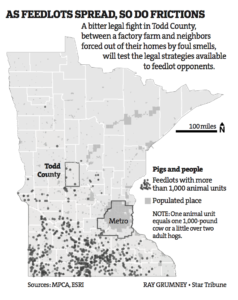
Josephine Marcotty reported on the front page of the Minneapolis Star Tribune this week that, “A bitter three-year legal battle between a Todd County hog farm and neighbors forced out of their homes by foul smells has become a flash point in the larger fight over Minnesota’s expanding pork business and the power of rural residents to protect their tranquil way of life.

“The struggle has spilled over into the Legislature, where pork producers are trying to limit so-called nuisance suits brought by feedlot neighbors.

“Together they illustrate how dramatically rural life in Minnesota has changed as farms grow bigger and more mechanized.”

Graph from, “As hog feedlots grow, neighbors ask: What about our rights?” by Josephine Marcotty, The Minneapolis Star-Tribune, April 17, 2017.

The article noted that, “Opponents to the proposed law point out that such lawsuits are exceedingly rare in Minnesota — there have been only a handful in the past 15 years — and say banning them would deprive rural residents of one of their last remaining protections against large livestock operations. Moreover, they say, it’s an attack on a centuries-old property right that protects citizens’ ability to use and enjoy their homes, one that could quickly extend to conflicts beyond feedlots.

“Leaders in the hog industry, however, say such cases are on the rise elsewhere, and, like the one in Todd County, are supported by national advocacy groups fundamentally opposed to practices essential to the modern livestock industry. No one, they say, should have the right to sue them for being a nuisance if they comply with the law.”

Graph from, “As hog feedlots grow, neighbors ask: What about our rights?” by Josephine Marcotty, The Minneapolis Star-Tribune, April 17, 2017.

The Star-Tribune article added that, “Leaders in the Minnesota pork industry say it’s not the neighbors they fear as much as the attorney who represents them: Charlie Speer, a Missouri-based lawyer, who has built a career on winning tens of millions of dollars for clients in similar lawsuits across the country. And by his side is an attorney for the Humane Society of the United States, which has been involved in similar lawsuits across the country.”

For more on state activity relating to large animal production operations, see these BartellPowell updates: Iowa, Illinois, and North Carolina.

Posted in Agriculture Law | Comments closed

Farm-to-Table Presence of Minnesota Grapes Continues to Grow

A news release yesterday from the University of Minnesota Extension Service indicated that, “The farm-to-table presence of Minnesota grapes-turned-into-wine continues its growth as the latest University of Minnesota cultivar, the Itasca, is planted for the first year.

“An analysis by the University of Minnesota Extension found the economic impact of the state’s vineyards and wineries grew to $80.6 million in economic activity, up from $53.6 million four years earlier. On average, each winery reported average sales of $580,000 in 2015, from $311,000 in 2011.

“Other indicators of growth include:

  • Visits to tasting rooms doubled, from 6,800 to 13,600
  • Percent of hours provided by paid labor went from 22 to 30 percent
  • Average cost charged per bottle went from $13 to $15″

The release added that, “With lower acidity and higher sugar content than other cold-hardy grapes developed here, the new white grape Itasca will broaden Minnesota winemakers’ opportunities, said Matt Clark, Extension specialist and assistant professor of horticulture at the University. The first Itasca vines are being planted this spring; commercial wine made from Itasca will arrive in another two to three years.

“‘Minnesota is showing growth rates similar to other emerging wine markets like Oregon, which has grown dramatically in the last 25 years. And we have a lot of enthusiasm for local foods,’ Clark said. ‘Wine is made in the vineyard, with the quality of grapes. At the University, we’re focused on helping build best practices in the growing community and sharing them.'”

Posted in Agriculture Law | Comments closed

U.S. Bee Production, USDA Update

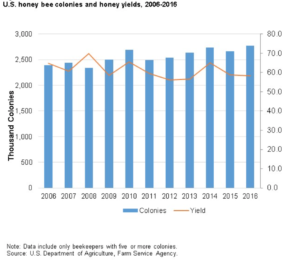
Yesterday, USDA’s Economic Research Service (ERS) released its monthly Sugar and Sweeteners Outlook, which stated in part that, “U.S. honey production in 2016 totaled 161.9 million pounds, a 3.4-percent increase from 2015 based an increase in colonies. There were 2.775 million colonies in honey production in 2016, a 4.3-percent increase from the previous year and the highest number of colonies in production since 1994. Honey yields of 58.3 pounds per colony were down a slight 0.9 percent from 2015 but were in line with levels of the past 5 years.”

Graph from, “Sugar and Sweeteners Outlook.” April 17, 2017 (USDA-ERS).

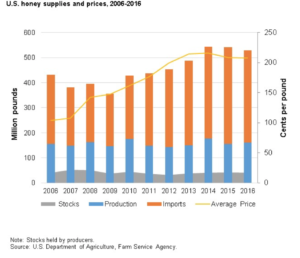
The ERS update noted that, “Stocks held by honey producers totaled 41 million pounds in 2016, a 2.3-percent decline from the previous year. Stock levels in 2016 were in line with the 10-year average, however. National average honey prices were 207.5 cents per pound, which is 0.4 percent below the revised 2015 price. It also represents the second consecutive year of annual decline in national honey prices. Honey producers have experienced a sustained upward trend in prices since the late 1990’s through 2014 as apparent domestic honey use increased. As demand has leveled off the past few years, prices have also plateaued, although both prices and demand remain substantially higher than in any historical period.”

Graph from, “Sugar and Sweeteners Outlook.” April 17, 2017 (USDA-ERS).

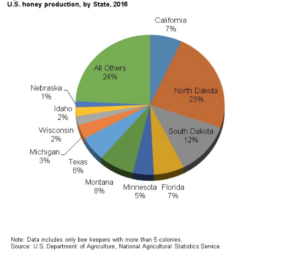
Yesterday’s USDA report also explained that, “Trends in production of individual States are well reflected in the number of colonies producing honey in each State; production is influenced by honey colony yields, which can vary widely due to conditions that change from year-to- year, such as weather. Many States have had a gradual increase in colonies over the past 5 years, with growth leveling off or even slightly declining in the last 2 or 3 years. California, which once had the greatest number of colonies in the country–peaking at over 500,000 in 1999–has seen honey bee colonies declining steadily since 2010; although the number rebounded slightly in 2016. This trend is likely due to a combination of factors, including sustained drought conditions in recent years and competition for bee colonies in the pollinator markets, which are in high demand in the State, rather than a focus on honey production.”

Graph from, “Sugar and Sweeteners Outlook.” April 17, 2017 (USDA-ERS).

The ERS update stated that, “By contrast, honey bee colonies in the aggregate All Other States have had the strongest and most sustained growth over the past 5 to 10 years. This could indicate that honey producers are finding demand within their local markets, although there is limited data on honey marketings for concluding how honey production and consumption interact from a geographical and industrial organization standpoint.”

Posted in Agriculture Law | Comments closed

Iowa Bill Puts Craft Liquor on Level Playing Field With Craft Beer, Wineries

Brianne Pfannenstiel and William Petroski reported in today’s Des Moines Register that, “A bill allowing Iowa’s craft liquor distillers to mix cocktails at their manufacturing facilities gained final legislative approval Monday, with both Democrats and Republicans praising the bill as a good step for economic development.

“The issue has been under discussion in the Legislature for years as distillers tried and failed to advance legislation they say puts them on a level playing field with Iowa’s craft breweries and wineries, which already are able to open lounges and tasting rooms where patrons can buy a glass of beer or wine made on-site.

“‘We are so pleased that the Legislature was able to reach across the aisle and put together a solution that everyone could come together on,’ Garrett Burchett, owner and distiller at Mississippi River Distilling Co., a family-owned small batch distillery in Le Claire, Iowa, said in a statement.”

The Register article noted that, “[Sen. Roby Smith, R-Davenport] predicted more people will visit Le Claire, stopping at local tourist attractions, staying at local hotels and eating at restaurants, as well as spending money in the Quad Cities.

“‘This bill is great for Iowa’s economic development and small businesses,’ Smith said.”

Posted in Agriculture Law, Start-up Company Law | Comments closed

Farm Business Management: Transfer Issues

An update last week at the farmdoc daily blog (“Transferring Business Management“) indicated that, “Transferring business management between generations is one of the most critical steps in transitioning the business from an older generation to a younger generation. Having said that, in numerous instances, this step is given little thought. Transitioning management cannot be done overnight, and often requires a trial and error approach before it can be determined how each generation fits into the multiple generation business. This article briefly describes some of the key factors that need to be considered when transitioning business management from an older generation to a younger generation.”

The farmdoc item explained that, “In addition to adapting a method to make business decisions, it is important to think about how daily management responsibilities are divided between the two generations. Again, this occurs after the younger generation has been given a chance to manage part of the business. Dividing management responsibilities between parties often leads to more expedient and better decisions. Obviously, individual interests and skills should be considered when dividing responsibilities. There are two primary methods that can be used to divide responsibilities. The first method divides responsibilities by enterprise. The second method divides responsibilities by function (e.g., finance, marketing, personnel, or production). Under both of these methods, decisions that affect the entire business would need to be made by both parties using the general manager or equal voice approach. It is also common to make joint decisions regarding major asset purchases, regardless whether these assets pertain to just one enterprise or function.

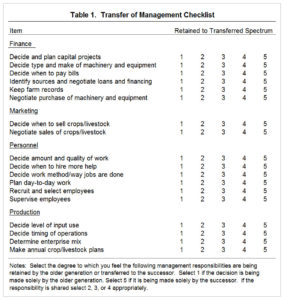
“The discussion above makes the management transfer process seem smooth with few hiccups. This is often not the case. Given that this is the case, it is often helpful to use a management transfer worksheet or checklist. Table 1 contains a checklist that can be used to keep track of the transfer of specific duties. This checklist was adapted from Baker (2006). The duties are separated by function. Both short-term and long-term management tasks are included in the table.”

Table from, “Transferring Business Management.” farmdoc daily Blog, April 7, 2017, by Michael Langemeier.

Last week’s update added that, “Every two-generation arrangement reaches the point where the older generation withdraws from active management of the business. This is often a difficult time for the older generation. To the extent that they are interested, keeping the older generation involved in the operation by helping during peak labor periods (e.g., planting or harvesting), and asking for their advice can ease their transition out of an active management role.”

“After concluding that both generations are committed to adding someone to the operation and determining that there will be sufficient income for both parties; it is imperative to develop a transition plan involving management transfer. This plan needs to address goals and objectives of both parties, the initial management transfer steps, decision-making authority, and division of management responsibility,” the farmdoc update said.

Posted in Agriculture Law | Comments closed

Delaware Lawmakers Seek to Expand Agritourism

The Associated Press reported last week that, “State lawmakers are seeking to promote agritourism in Delaware by expanding the definition of the word.

“State law defines agritourism activity as any activity that allows members of the general public to view or enjoy rural activities, such as farming, boating, picnicking and hiking.

“A bill introduced last week expands the list of agritourism activities to include microbreweries, distilleries, rural weddings, farm-oriented miniature golf, petting zoos, mazes, rodeos and other events and attractions.”

The AP article noted that, “The bill has been assigned to the [Delaware] House Agriculture Committee.”

For more background on Agritourism see this BartellPowell update from March 27th.

Posted in Agriculture Law | Comments closed

New York: New Tax Credit for Farmers Donating Fruits/Vegetables to Foodbanks

Earlier this week, the Associated Press reported that, “Anti-hunger advocates in New York are cheering the passage of a new tax credit for farmers who donate fruits and vegetables to foodbanks.

“The initiative was included in a $153 billion state budget that won final legislative approval on Sunday.

“Farmers already donate millions of pounds of food every year, but say a tax credit for donations would reduce the costs of harvesting and transporting surplus crops that would otherwise go to waste.”

The AP article added that, “The credit is limited to $5,000 per year.”

Posted in Agriculture Law | Comments closed