Federal Rule Change Could Help Startups Find Local Investors

A recent Associated Press article by Cara Lombardo indicated that, “Startups across the country could soon get a boost thanks to changes in federal rules that will make it easier for them to find local investors.

“In the past five years, more than 30 states have legalized state crowdfunding, an offshoot of equity crowdfunding that allows small companies to sell stock but limits the sales to residents of their own states. Fewer than 200 companies have tried it, partly because most are prohibited from sharing links to their crowdfunding campaigns on social media, crowdfunding’s primary fuel.”

The AP article added that, “Supporters of state crowdfunding say part of the appeal is that local investors can help grow local companies. But it’s risky for investors since many startups fail.”

Posted in Start-up Company Law | Comments closed

First Lawsuit Against Syngenta Over GMO Corn- China Export Losses– Goes to Court

Associated Press writer Steve Karnowski reported earlier this week that, “The first of tens of thousands of U.S. lawsuits is about to go to trial against Swiss agribusiness giant Syngenta over its decision to introduce a genetically engineered corn seed variety to the U.S. market before China had approved it for imports.

“The lawsuits allege that Syngenta’s move wrecked an increasingly important export market for U.S. corn, and that the resulting price drops hurt all producers. Court filings show that Syngenta aggressively marketed the seeds even when it knew that Chinese approval was going to be a problem.

“Plaintiffs’ experts estimate the economic damage to be about $5 billion, while Syngenta denies its actions caused any losses for farmers.”

The AP article noted that, “The first test case goes to trial Monday in state court in Minneapolis. The second goes to trial in federal court in Kansas City, Kansas, on June 5. The two cases are meant to provide guidance for how the complex web of litigation in state and federal courts could be resolved.”

Mr. Karnowski added that, “With U.S. government approval, Syngenta began selling Viptera in the U.S. for the 2011 growing season. But China didn’t approve it until December 2014.

“Court papers show that Syngenta initially assured stakeholders that China would approve MIR162 in time for the 2011 crop. But the date kept slipping. Some exporters sent shipments containing the trait to China anyway. After two years of accepting them, China began rejecting them in late 2013.

“One expert working for the plaintiffs estimated the damage to U.S. farmers to be $5.77 billion; another pegged it at $4.68 billion.”

This week’s article indicated that, “Most plaintiffs didn’t grow Viptera, but China excluded their grain, too, because elevators and shippers typically mix grain from large numbers of suppliers, making it difficult to source corn that was free of the trait. So they say all farmers were hurt by the resulting price drop.”

Posted in Agriculture Law | Comments closed

Wisconsin- Large Dairy Farms and Locals Debate

Lee Bergquist reported on the front page of the Milwaukee Journal Sentinel on Sunday that, “Lee Kinnard’s new barn stretches the length of six football fields. It’s so big he once flew a drone inside to get a bird’s eye view of all the cows.

“The family farm milks 6,500 cows in Kewaunee County, where the cattle population has grown faster than anywhere in the state.

“Since 1983, cattle numbers in the county have jumped by 62% to 97,000 at a time when the statewide cattle population has tumbled by 20%, according to the state agriculture department.”

The Kinnard dairy farm stages cows in long barns with a sleeping area made of a recyclable sand mixture for comfort and stability. Photo by Rick Wood, Milwaukee Journal Sentinel.

The article noted that, “But the size of dairy herds and managing cattle waste have become increasingly contentious in northeastern Wisconsin and figure prominently in a larger debate over how best to address water problems tied to farming.

“Tucked beneath Door County, Kewaunee County has emerged as the flash point in these tensions. At the heart of the debate: Can manure from so many cattle be safely spread on the land?”

Bergquist pointed out that, “But becoming one of the state’s largest dairy farms has wounded relations with some neighbors and spurred a protracted court fight. Also, by virtue of its size and the attention it receives, Kinnard Farms has helped fuel controversy over truck traffic, odors and pollution from farming when it is done on a grand scale.”

The Journal Sentinel article added that, “In Wisconsin, the number of concentrated animal feeding operations, or CAFOs, has grown by 400% from 50 in 2000 to 252 in 2016, agency figures show, and has played a key role in growing milk production as farm numbers are falling.

“In a report, University of Wisconsin-Madison economists estimated that farms of 500 or more cows accounted for 40% of state milk production in 2013 compared to 22% in 2007.”

For more on state activity relating to large animal production operations, see these BartellPowell updates: Minnesota, Iowa, Illinois, and North Carolina.

Posted in Agriculture Law | Comments closed

Drop In 30-Year Fixed-Rate Mortgage Could Encourage Home Buyers

Laura Kusisto reported this week at The Wall Street Journal Online that, “Mortgage rates dropped below 4% for the first time since November, providing more kindling to an already hot housing market as the crucial spring selling season gets under way.

“The average rate on a 30-year fixed-rate mortgage dropped to 3.97% for the week ended April 20, from 4.08% a week earlier and 4.3% in mid-March, according to data released Thursday by mortgage company Freddie Mac.

“The drop could help encourage buyers who had been put off by rising mortgage rates to dive into the market and prompt others to rush to buy homes before rates rise again.”

Graph from The Wall Street Journal.

The Journal article noted that, “After the November election, optimism that the U.S. economy would get a boost from Republican plans for a tax overhaul, increased infrastructure spending and reduced regulations helped drive interest rates sharply higher as investors bet on faster growth.

“But the tide is turning. Treasury yields, which move in the opposite direction of prices, approached a five-month low last week as many investors worried that turmoil in Syria and North Korea, as well as election uncertainty in France and the lack of progress on tax and spending policy under President Donald Trump, would lead to slower economic growth in the months ahead.”

Ms. Kusisto added that, “The impact of a decline in mortgage rates of about a third of a percentage point would be relatively small in many areas of the U.S. The monthly mortgage payment for a home at the median price of $236,400, assuming a down payment of 20%, would be about $40 less today than a month ago.

“The effect would be much more pronounced, however, in high-cost markets, such as California.”

Posted in Real Estate Law | Comments closed

Iowa State University Online High Tunnel Course

An update on Monday from the Iowa State University Extension Service indicated that, “Iowa State University Extension and Outreach has published an online Introduction to High Tunnels (HORT 3070) course for producers interested in high tunnel production. The course includes five modules designed to assist producers with the decision of whether or not to construct a high tunnel on a farm.

“‘This course will walk users through how to properly select a location, test soil, determine what crops to grow in a high tunnel, expected costs and potential returns from your high tunnel and resources to help in the process,’ said Christa Hartsook, small farms program coordinator for ISU Extension and Outreach.”

The news update added that, “This course was developed for those wanting to learn more about high tunnel production, but unable to attend a face-to-face training. The self-directed course allows users to complete the video lessons at their own pace. Worksheets at the end of each module provide users the opportunity to enter information specific to their own operation. Once submitted, those same worksheets provide a method for individual feedback from the course instructors, Hartsook and Joe Hannan, commercial horticulture specialist with ISU Extension and Outreach.”

Posted in Agriculture Law | Comments closed

Former Georgia Governor Sonny Perdue Confirmed as Secretary of the Agriculture Department

Jacob Bunge reported yesterday at The Wall Street Journal Online that, “The U.S. Senate on Monday confirmed former Georgia Governor Sonny Perdue as secretary of the Agriculture Department, ending a three-month vacancy atop the sprawling agency as the food sector confronts potential changes to U.S. trade policy and farm-level regulations.

“Mr. Perdue, a Republican who grew up on a dairy farm and has managed agribusinesses, was confirmed in an 87-11 vote, garnering significant support from Democratic senators who saw him as an experienced manager who will maintain supports for U.S. farmers navigating a crop-price slump.

“Awaiting Mr. Perdue is the worst farm-economy slump in decades, with U.S. net farm income projected to fall for a fourth consecutive year to $62.3 billion, half the record $123 billion farmers earned in 2013, according to USDA projections. The agricultural sector, which heavily relies on exports, has also watched warily as President Trump’s administration has moved ahead with an overhaul of U.S. trade policy, including withdrawing from the Trans-Pacific Partnership, which farm groups generally had backed.”

Mr. Bunge added that, “The vote makes Mr. Perdue among the last members of Mr. Trump’s cabinet to be confirmed, though many other senior vacancies remain. Robert Lighthizer, Mr. Trump’s nominee for U.S. trade representative, and Alexander Acosta, nominated to head the Labor Department, still await confirmation.

“It also fills a gap that troubled some crop and livestock producers across U.S. farm states, which heavily factored into Mr. Trump’s electoral victory in November. The president’s focus on deregulation resonated with farmers and ranchers who chafed under federal environmental and regulatory restrictions that some saw as onerous.”

Posted in Agriculture Law | Comments closed

Agriculture- Less of a “Fallow Field” for Silicon Valley Venture Capitalists

Nancy Pfund indicated on a recent column at The Wall Street Journal Online that, “Across the heartland, planting season is getting into full swing. Farmers are revving up their tractors and rural towns are coming to life. Sitting in my office in San Francisco, I am taken back to a moment last winter when my perspective on agriculture shifted.

“It was a freezing December day in Omaha, Neb., and I was relieved to duck into the warmth of the conference hall. Technology expos are my natural habitat as a venture capitalist. But I had never experienced an event like this one. The hall was filled with more than 1,000 farmers from across the Midwest. Scattered amid the bluejeans, plaid shirts and cowboy boots was the occasional hat reading ‘Make America Great Again.’ That’s when the Silicon Valley bubble burst inside my head.”

Ms. Pfund indicated that, “In 2014 [Amol Deshpande and Charles Baron] founded a company called Farmers Business Network, based in San Carlos, Calif., with a national operating center in Sioux Falls, S.D. For an annual $600 membership fee, farmers who join FBN get access to the combined data of its 3,500 members. FBN also sells agricultural inputs online to compete with local branches of large farm stores—like Amazon but for fertilizer.

“Agriculture had been a relatively fallow field for Silicon Valley’s venture capitalists. Farming was out of sight and out of mind, and investors who seek a social impact, as my firm does, had looked more often to urban challenges. By 2014 it was time to change this investment monoculture. My company’s first investment in FBN was about $3 million, and we were in good company. Kleiner Perkins had helped to hatch the company. Later the venture arms of Google and the Campbell Soup Co. joined as well. It was a marriage of the West Coast and the heartland.

“But the importance of bridging the cultural gap didn’t hit me until FBN’s conference in Omaha. The sessions had titles like ‘The Start Up Farmer,’ and presenters offered concrete suggestions for picking which seeds to plant, saving money on essential inputs by buying online, and getting higher prices for ‘identity preserved’ crops.”

The column added that, “Venture capitalists often speak abstractly of technology’s power to transform whole industries, and that’s what FBN aims to do with agriculture. But that cold day in December helped remind me that new tools can also change lives for the better—one farmhouse at a time.”

Posted in Agriculture Law, Start-up Company Law | Comments closed

Startups Struggle to Adjust as Investment Frenzy Ends

Eliot Brown reported on the front page of today’s Wall Street Journal that, “Eighteen months ago, Beepi Inc. was rapidly expanding its online used-car business to 16 U.S. cities where people could buy cut-rate vehicles adorned with giant shiny bows.

“Beepi doesn’t exist anymore. After burning through more than $120 million in capital, the startup failed to raise more cash and shut down in February. Its roughly 270 employees cleared out of the cavernous Mountain View, Calif., headquarters, leaving behind the ping-pong table and putting green.

“Beepi’s rapid demise offers a glimpse into the changing fortunes of Silicon Valley startups, many of which have struggled to adjust since a two-year investment frenzy came to an end.”

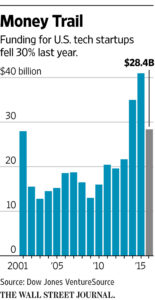
Graph from today’s Wall Street Journal.


Today’s article noted that, “In 2014 and 2015, mutual funds, hedge funds and other investors pumped billions into companies that they now see as overvalued, and unlikely to pull off an initial public offering. As venture capitalists became more discerning, investment in U.S. tech startups plummeted by 30% in dollar terms last year from a year earlier.”

The Journal article explained that, “Venture-capital firms remain flush with cash: They raised $44 billion last year, the most since the dot-com boom.

“But investors are staying away from scores of initially well-funded startups that once looked like relatively safe bets, forcing these companies to fight for survival as they burn through their stockpiles of cash and scramble for new money or buyers.”

Mr. Brown added that, “Seemingly every week lately, a well-funded startup is slashing jobs or pulling the plug.

“In recent months, mobile-search startup Quixey Inc. shut down after raising over $100 million, health-benefits broker Zenefits—which has raised more than $500 million—laid off nearly half of its staff, and blogging platform Medium cut one-third of its employees after raising $132 million.

“Such closures and cutbacks were rare two years ago when venture capitalists encouraged startups to expand rapidly to edge out competitors. Then when capital became scarcer, investors urged companies to turn profitable, which isn’t an easy pivot.”

Posted in Start-up Company Law | Comments closed

Some Local Food Growers Have to Get Creative to Find Land in Urban Areas

Hannah Covington reported on the front page of yesterday’s Minneapolis Star Tribune that, “With planting season looming and no place to sow her seeds, organic farmer Jessica Mutunga posted an earnest plea on a neighborhood social network: Can I use your yard?

“After her recent move from Oregon, Mutunga looked forward to tapping into the Twin Cities’ robust appetite for locally grown food. She soon discovered the farm-to-table movement has created intense demand for affordable urban farmland across the metro area.

“‘It was much more challenging than I anticipated,’ said 33-year-old Mutunga, who plans to raise and sell vegetables on an acre of yard space she cobbled together from several homeowners.”

Front page of Sunday’s Minneapolis Star Tribune.

Yesterday’s article noted that, “‘There is a real desire for local food,’ said Jesse Davis, of the Minnesota Farmers’ Market Association. And the Twin Cities, he said, is known nationally as a local food hub.

“That has set off a scramble for the land to grow those vegetables and fruits, especially 1- to 10-acre parcels close to metro area markets. Only about 30 percent of the seven-county metro was still being farmed in 2010 — the most recent data available — according to the Metropolitan Council. That number was much smaller in a place like Hennepin County, with a total closer to 12 percent, and projected to shrink.”

Ms. Covington added that, “Newly sprouted farmers are looking for acreage anywhere they can. Some have hunted for the right acreage for years. Others have snatched up community garden plots for their commercial enterprises. More than 20 new community gardens were planted in the metro area in 2016, according to the Minneapolis-based nonprofit Gardening Matters. Last year, it counted 608 community gardens in the Twin Cities, up from 166 in 2009.”

Posted in Agriculture Law, Start-up Company Law | Comments closed

Startups Making Products From Food Waste

Washington Post writer Caitlin Dewey reported this week that, “Flour milled from discarded coffee fruit. Chips made from juice pulp. Vodka distilled from strawberries that nobody seems to want.

“At one point not so long ago, such waste-based products were novelties for the Whole Foods set. But in the past three years, there’s been an explosion in the number of start-ups making products from food waste, according to a new industry census by the nonprofit coalition ReFED.

“The report, which was released Tuesday and tracks a number of trends across the food-waste diversion industry, found that only 11 such companies existed in 2011. By 2013, that number had doubled, and ReFED now logs 64 established companies selling ugly-fruit jam, stale-bread beer, and other ‘upcycled’ food products.”

The Post article noted that, “The companies have diverted thousands of pounds of food waste from landfills, a major source of greenhouse gas emissions. They’ve also become a model for larger, multinational food companies, which are starting to realize that upcycling peels and piths can be good business.”

Ms. Dewey added that, “Dan Kurzrock, the 27-year-old co-founder of San Francisco start-up ReGrained, suspected that from the beginning. As a college home-brewer, making beer in his garage, Kurzrock noticed that a whole lot of nutritionally valuable ‘spent grain,’ mostly barley, gets thrown out.

“Kurzrock and his business partner, Jordan Schwartz, spent the next five years testing possible uses for it. In 2016, they formally launched a line of snack bars made from almonds, oats, quinoa and grains sourced from urban brewers.

“‘We’re a food business with an environmental and social mission,’ Kurzrock said.”

Posted in Agriculture Law, Start-up Company Law | Comments closed