The Race is On to Become the AgTech home for Big Agriculture

Orlando Saez indicated in an opinion item posted recently at Crain’s Chicago Business Online that, “As the innovation ecosystem in Chicago and the Midwest expands with almost breathtaking speed, we are establishing ourselves as best-of-class in fields such as nanotechnology, robotics, digital and financial tech, material science and advanced manufacturing. I want to add one more area in which the Midwest can be recognized as the world’s leader in innovation. It is perhaps the most obvious and least recognized of all—agriculture.

“The Chicago region has obvious advantages in terms of both tradition and the vibrancy of its innovation ecosystem. Leadership in agricultural innovation on a large scale is there for the taking. But we are not the only ones to know that. The race is on to become the AgTech home for Big Agriculture (or Big Food), with creation of an enormous number of jobs and value up for grabs.”

The column noted that, “As an entrepreneur, I look for opportunity. Big Food presents some of the best opportunities in the last few years. Here are some reasons why. The International Association of Agricultural Economics projects worldwide population will grow 35 percent by 2050, leading to a 59 to 98 percent increase in demand for food. There are two ways to meet this hunger. Cut down more forests to open more arable land—an approach that is both unwise and unsustainable—or find new ways through bioengineering and precision farming to increase yields from existing farmland.

“The latter is where opportunity lies for the Midwest economy. We have the talent, the resources and tradition as the breadbasket of the world to emerge quickly as the leader in new approaches to production-scale agriculture.”

Saez added that, “There is no greater need in the world than sustainable ways to feed the growing number of people on earth. There is no more logical place for Big Food research, entrepreneurial activity, systems development, to take place than right here.”
Posted in Start-up Company Law | Comments closed

Farm Banks Increase Ag Lending in 2016

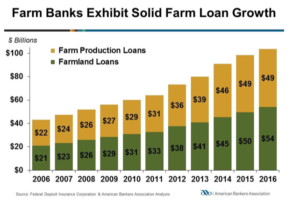
Earlier this week the American Bankers Association (ABA) indicated in a news release that, “Farm banks increased agricultural lending by 5.3 percent in 2016 and held $103.4 billion in farm loans at the end of the year, according to the American Bankers Association’s annual Farm Bank Performance Report.

“Asset quality remained healthy at the nation’s 1,912 farm banks as non-performing loans have fallen to a pre-recession level of 0.54 percent of total loans. ABA defines farm banks as banks whose ratio of domestic farm loans to total domestic loans is greater than or equal to the industry average.”

Graph from, “2016 Farm Bank Performance Report.” American Bankers Association (May 3, 2017).

The update noted that, “Farm banks continued to build high-quality capital over the year. Equity capital at farm banks increased 3.7 percent to $48.4 billion in 2016, while Tier 1 capital increased by $2.6 billion to $45.9 billion. Farm banks have built strong high-quality capital reserves and are well-insulated from risks associated with the agricultural sector.”

The ABA news item added that, “Farm banks added more than 2,600 jobs, a 3 percent increase, and employed more than 91,000 rural Americans. Since 2007, employment at farm banks has risen 24.3 percent.”

Posted in Agriculture Law | Comments closed

Secretary of Agriculture Sonny Perdue Meets With Producers

Wyatt Bechtel reported this week at AgWeb Online that, “Producers are excited to have a Secretary of Agriculture who has first-hand experience working in agriculture and growing up on a farm.

“On April 28, three days after former Georgia Gov. Sonny Perdue was sworn in as Secretary of Agriculture he visited Kansas City, Mo. for his first official trip away from Washington D.C. representing the U.S. Department of Agriculture. Perdue spoke in front of a crowd of more than 450 people made up of farmers, ranchers, allied industry members, students and FFA members at the American Royal.”

Mr. Bechtel noted that, “The confirmation of Perdue as Secretary of Agriculture is exciting because there are common values shared by the leadership at USDA with farmers and ranchers, says Ramona, Kan. cattle rancher Tracy Brunner. Last year Brunner served as National Cattlemen’s Beef Association president.

“‘As a trained and practicing veterinarian, he brings so much understanding of the livestock industry to the office,’ Brunner says.”

The AgWeb update added that, “Perdue told the crowd about his communication with President Trump on getting U.S. beef into China. Trump even asked Perdue to make some remarks for a letter that will be addressed to the Chinese President in an effort to open up beef exports.

“He also believes Iowa Gov. Terry Branstad will be a major part in getting beef access to China once Branstad is confirmed as U.S. Ambassador to China.

“‘Gov. Branstad has done a good job selling Iowa soybeans. We want him to sell some Kansas, Missouri and Heartland beef over there,’ Perdue says of trade with China.”

Posted in Agriculture Law | Comments closed

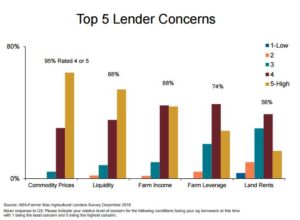
Ag Lender Survey– Commodity Prices Top Concern

A news release on Monday from the American Bankers Association (ABA) indicated that, “Nearly 90 percent of agricultural lenders have seen an overall decline in farm profitability in the last 12 months, according to a joint survey by the American Bankers Association and the Federal Agricultural Mortgage Corporation. The survey of more than 350 agricultural lenders representing institutions of all sizes across the country revealed that when it comes to their producer customers, lenders are most concerned about commodity prices, liquidity and farm income.”

“Winter 2016/2017 Agricultural Lender Survey Results.” American Bankers Association and the Federal Agricultural Mortgage Corporation (May 1, 2017).

The ABA update noted that, “Ninety-five percent of lenders indicated commodity prices — particularly grains, beef cattle and dairy — are a top concern. While concerns about commodity prices varied by region, overall, lenders are most concerned about grains (80 percent rated it a four or five on a scale of one to five) followed by beef cattle (63 percent), dairy (55 percent), swine (40 percent), poultry (21 percent), vegetables (20 percent), and fruits and nuts (17 percent).

 “The decline in commodity prices has led to a fall in farm income, and subsequent tightening in profitability.”
Posted in Agriculture Law | Comments closed

NAFTA Trade and U.S. Meat Exports

James Mintert indicated on Monday at the farmdoc daily blog (“Weekly Outlook: NAFTA Trade Is Important for Meat Industry”) that, “The 2016 election cycle created a lot of confusion about the importance and benefits of trade in general. In particular, a good bit of the election year rhetoric focused on trade within the NAFTA trade bloc (U.S., Canada and Mexico).”

Beef

Mintert noted that, “Looking at the individual country data from USDA indicates that about 12 percent (308 million pounds) of all U.S. beef exports were shipped to Canada in 2016. The U.S. shipped even more beef to Mexico than Canada as beef exports to Mexico totaled 394 million pounds, about 15 percent of all U.S. beef exports, in 2016. Combined, the two NAFTA trading partners absorbed 27 percent of all U.S. beef exports in 2016. Looking at rankings of U.S. beef export customers, Japan (26 percent) was the largest beef export customer and South Korea (18 percent) was the second largest. Mexico and Canada were the third and fourth largest U.S. beef export customers, respectively, in 2016.”

Pork

The farmdoc update added that, “By 2016 U.S. pork exports were more than 40 times as large as in 1985, reaching a total of 5.2 billion pounds (Figure 1).”

Mintert, J. “Weekly Outlook: NAFTA Trade Is Important for Meat Industry.” farmdoc daily (7):79, Department of Agricultural and Consumer Economics, University of Illinois at Urbana-Champaign, May 1, 2017.

Monday’s update also pointed out that, “Looking at the individual country data, the largest single customer for U.S. pork in 2016 was Mexico. U.S. pork exports to Mexico totaled 1.6 billion pounds during 2016, which was almost 31 percent of U.S. pork exports. Pork exports to Canada in 2016 totaled 537 million pounds, approximately 10 percent of U.S pork exports. On a combined basis, Mexico and Canada absorbed approximately 41 percent of U.S. pork exports. In comparison, the next largest U.S. pork customer, Japan, received 23 percent of U.S. pork shipments in 2016.”

The farmdoc item also stated that, “[T]his review does make clear how important meat trade has become to U.S. animal agriculture producers and the potential impact a disruption in trade with NAFTA partners Canada and Mexico would have on the U.S. animal agriculture sector and, in turn, producers of feed grains and oilseeds.”

Posted in Agriculture Law | Comments closed

Montana’s Summer- Impacting Honey Production

A recent update from the Montana State University College of Agriculture indicated that, “Honey is probably not one of the primary agricultural products that most people associate with Montana, but in fact, Montana was the third largest honey producing state in 2016. Montana produced over 12 million pounds of honey in 2016, and it ranked fifth in the country for number of honey bee colonies.”

The update explained that, “The number of commercial honey bee operations in the United States has grown in recent years, partly in response to agricultural demands for pollinators during bloom.

“Many larger-scale producers transport honey bees from crop-to-crop throughout the winter and spring, returning the bees to northern states like Montana to produce honey in the summer. Montana summers, with their long days, cool nights, and wide variety of flowering plants, provide a good environment for honey production.

“Commercial pollination season begins in February in the flowering almond groves of California. Cross-pollination is vital to almond production. Every almond farm has at least two varieties of almond trees, but bees are needed to transfer pollen from one variety to the other. During almond blossom, the bee colonies work in a state of energy deficit, producing no excess honey. After the almond blossom, beekeepers begin moving their bees north again, leasing the bees to pollinate various crops along the way. The beekeepers retain rights to the honey as the bees pollinate, but honey production and flavor vary across crops. Fees paid for pollination are lower for crops that yield more marketable honey (Rucker, Thurman, and Bugett, 2012).”

The Montana State article added that, “After an intense season of pollinating almonds and other crops, beekeepers usually allow the bees to rest and produce honey. Figure 4 [below] plots honey production in Montana over time, both in pounds and value of honey production. The figure indicates that honey production has risen over the past 3 decades. Figure 5 [below] shows a simultaneous rise in the number of honey producers and bee colonies in Montana since 1997. (Note that some beekeepers keep their bees in Montana year-round, using the bees only for honey production). These figures suggest that honey production is an important and growing industry in Montana, and it is closely linked with crop production in other states.”

Graph from, “Montana: A Honey State” by Diane Charlton. Montana State University (May 1, 2017).


Graph from, “Montana: A Honey State” by Diane Charlton. Montana State University (May 1, 2017).

Posted in Agriculture Law | Comments closed

A Closer Look at “Organic” Milk

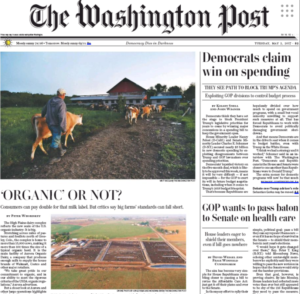
Peter Whoriskey reported on the front page of today’s Washington Post that, “The High Plains dairy complex reflects the new scale of the U.S. organic industry: It is big.

“Stretching across miles of pastures and feedlots north of Greeley, Colo., the complex is home to more than 15,000 cows, making it more than 100 times the size of a typical organic herd. It is the main facility of Aurora Organic Dairy, a company that produces enough milk to supply the house brands of Walmart, Costco and other major retailers.”

Front page of today’s Washington Post.

The Post article noted that, “But a closer look at Aurora and other large operations highlights critical weaknesses in the unorthodox inspection system that the Agriculture Department uses to ensure that ‘organic’ food is really organic.

“The U.S. organic market now counts more than $40 billion in annual sales and includes products imported from about 100 countries. To enforce the organic rules across this vast industry, the USDA allows farmers to hire and pay their own inspectors to certify them as ‘USDA Organic.’ Industry defenders say enforcement is robust.

“But the problems at an entity such as Aurora suggest that even large, prominent players can fall short of standards without detection.”

Today’s article explained that, “With milk, the critical issue is grazing. Organic dairies are required to allow the cows to graze daily throughout the growing season — that is, the cows are supposed to be grass-fed, not confined to barns and feedlots. This method is considered more natural and alters the constituents of the cows’ milk in ways consumers deem beneficial.

“But during visits by The Washington Post to Aurora’s High Plains complex across eight days last year, signs of grazing were sparse, at best. Aurora said its animals were out on pasture day and night, but during most Post visits the number of cows seen on pasture numbered only in the hundreds. At no point was any more than 10 percent of the herd out. A high-resolution satellite photo taken in mid-July by Digital Globe, a space imagery vendor, shows a typical situation — only a few hundred on pasture.”

The Post article added that, “If organic farms violate organic rules, consumers are being misled and overcharged.

“In the case of milk, consumers pay extra — often double — when the carton says “USDA Organic,” in the belief they are getting something different. Organic dairy sales amounted to $6 billion last year in the United States.”

“The failure to comply with organic standards also harms other farms, many of them small. Following the rules costs extra because grazing requires more land and because cows that dine on grass typically produce less milk,” today’s article said.

Posted in Agriculture Law | Comments closed

Startups Seeing Better Days in the U.S.- Bloomberg Startups Barometer

Nico Grant reported on Friday at Bloomberg that, “After a prolonged retrenchment, startups in the U.S. are finally seeing better days.

“The Bloomberg U.S. Startups Barometer rose 0.6 percent from a year earlier, marking the first year-over-year increase since the end of 2015. Bigger funding totals and more exits buoyed the index.”

The article noted that, “Snap Inc. and MuleSoft Inc. are among the companies that went public in recent weeks. Initial public offerings give investors a chance to cash out and reinvest their money into younger businesses, making them a leading indicator of the funding environment for startups.

“‘We think there will be anywhere from 30 to 35 venture-backed IPOs this year,’ said Scott Raney, a partner at Redpoint Ventures, which manages $4 billion of investments. ‘By all measures, it feels like it’ll be a much better year.’

“Companies choosing to remain private have also helped the index. Rising deal sizes have been driven by mega financing rounds, including $1 billion raised by Airbnb Inc. and $300 million raised by WeWork Cos.”

Graph from Bloomberg News.

Nonetheless, Grant added that, “Two components of the Bloomberg U.S. Startups Barometer—the number of deals, and the number of companies that raise money for the first time—have still continued to decline from a year earlier.”

Posted in Start-up Company Law | Comments closed

NAFTA and Agriculture- Some Important Considerations

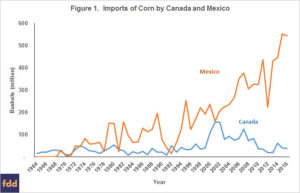
Gary Schnitkey, Kathy Baylis, and Jonathan Coppess indicated on Friday at the farmdoc daily blog that, “Recent news from the Trump Administration has sowed confusion about the President’s intentions with respect to the North American Free Trade Agreement (NAFTA). Early this week, President Trump suggested that the United States would pull out of NAFTA. Later in the week, he said the US will stay in NAFTA, but that the agreement would be reopened for renegotiations. NAFTA is a trade agreement between the Canada, Mexico, and the United States and was put in place in 1994. For Midwest farmers, renegotiating NAFTA is a concern because Canada and Mexico import significant amounts of corn and soybeans.”

The update explained that, “Mexico is a substantially larger market for corn than Canada. From 1991 to 1993, Mexico imported 67 million bushels of corn. Similar to Canada, Mexico’s imports of corn increased after 1994. From 2014 to 2016, Mexico imported an average 513 million bushels of corn per year.”

Schnitkey, G., K. Baylis, and J. Coppess. “A Reminder on NAFTA and Agriculture.” farmdoc daily (7):78, Department of Agricultural and Consumer Economics, University of Illinois at Urbana-Champaign, April 28, 2017.

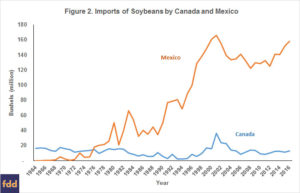
The farmdoc item noted that, “Similar to corn, soybean imports into Canada and Mexico have substantially increased since the passage of NAFTA in 1994.”

Schnitkey, G., K. Baylis, and J. Coppess. “A Reminder on NAFTA and Agriculture.” farmdoc daily (7):78, Department of Agricultural and Consumer Economics, University of Illinois at Urbana-Champaign, April 28, 2017.

Schnitkey, Baylis, and Coppess explained that, “Exports are important sources of use of corn and soybeans, and particularly so for soybeans. Mexico and Canada are important customers of U.S. products. Potential disruptions in the movements of grains could have negative impacts on prices.

“The importance of export to domestic agriculture is likely to grow in the future. Technological changes will continue to occur in the United States, leading to higher yields and more corn and soybean supply. At this point, one of the areas of continued growth in use of U.S. corn and soybeans is likely to be exports. If exports do not grow, negative impacts can be anticipated for corn and soybean prices.

“Being a reliable supplier is an important characteristic of agricultural exporters. If an exporter is not viewed as reliable, other countries may look elsewhere for grain supplies. Some reactions along these lines have taken place because of trade discussions coming from the U.S. Early in 2017. For example, Mexico has threatened to place a tax on U.S. corn imports in response to the President’s comments about NAFTA and has also begun to buy corn from Argentina and Brazil. Whether these efforts have long term negative impacts on U.S. agricultural trade remains to be seen.”

Posted in Agriculture Law | Comments closed

Questions to Ask Before Joining a Startup

Geoff Donaker indicated this week at Forbes Online that, “Many people consider joining a startup during their career, and virtually all of them also have natural doubts. When asked aloud, this sounds like, ‘I am thinking about leaving my relatively-stable job to join Startup X. Do you think I should?‘

“There is no certainty, so you’re going to have to make a bet. But there are factors that can help guide your decision. To help determine your fit with any given startup, I suggest asking yourself these five questions”

Mr. Donaker added that:

“1. Can you afford it financially? To answer this question honestly, you should assume the equity will be worth zero.

“2. Do you believe this business can be financially successful?…The real question is: would you invest your own savings in this business?

“3.  Do you hit it off with the founders? You are going to be spending more time with these people than your family and friends.

“4. Are you interested in their mission or product? It doesn’t have to be your favorite product ever, but can you get interested enough that you will want to read the related books and articles about your competition, meet other people in this industry and think about it during your commute?

“5. Is there a natural role for you to play?”

Mr. Donaker explained that, “If you answered ‘no‘ to any two questions, that’s a red flag…A ‘no‘ to one question is a still a serious yellow flag. Think hard about this question and try to resolve it before taking the next step.”

Posted in Start-up Company Law | Comments closed