
Americans Buying More Organic Products Than Ever, Survey Shows

Kristen Leigh Painter reported on the front page of the business section in today’s Minneapolis Star Tribune that, “Americans are buying more organic food and household products than ever, according to a new survey.

“The research — released Wednesday by the Organic Trade Association, the nation’s leading organic industry group — offers a glimpse into how the market is developing and where there is the greatest demand for organic products.

“Sales of organic food and goods crested at $47 billion in 2016, an increase of more than 8 percent over the previous year.”

Graph from The Minneapolis Star Tribune.

The article noted that, “And while there are a growing number of organic personal care and household products on the market, food still accounts for the vast majority of all organic sales, with $43 billion last year. Organic food now boasts more than 5 percent of the nation’s total food sales.”

Ms. Painter added that, “Fresh fruits and vegetables are most consumers’ gateway purchase into organic. It is easier to understand the potential benefits of buying raw produce that was grown using organic methods than it is to grasp how organic standards translate into a processed or packaged food, or especially household products.
“Meat and poultry is another segment showing strong consumer demand for organic. Sales of organic meat and poultry grew more than 17 percent to $991 million last year, marking the category’s biggest yearly gain.”
Posted in Agriculture Law | Comments closed

Small Investors Show Little Interest in U.S. Startups

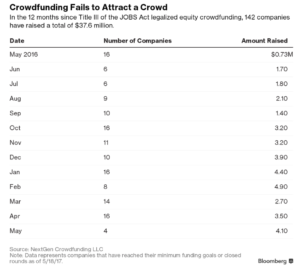
Bloomberg writer Lizette Chapman reported last week that, “It’s been a year since U.S. rules went into effect enabling anyone — not just the ultra-wealthy — to buy a slice of a startup.

“Turns out, few are interested.

“Investors sprinkled about $38 million across 142 companies since May 2016 when Title III of the JOBS Act allowed equity crowdfunding for non-accredited investors, according to data from industry tracker NextGen Crowdfunding LLC.”

Graph from, “U.S. Startups Fail to Attract Crowd of Small Investors,” by Lizette Chapman. Bloomberg News (May 19, 2017).

The Bloomberg article noted that, “The slow start is a rounding error in the larger system — venture investors plowed more than $69 billion into startups during 2016, according to the National Venture Capital Association — and a little surprising, according to Richard Swart, a founding board member of the Crowdfunding Professional Association.

“‘Everyone in the industry thought there’d be more uptake,’ said Swart, who also serves as chief strategy officer at NextGen. ‘We all expected these numbers to be 2X to 5X what these numbers were.’

“Swat said the practice is still in its infancy. Wefunder, StartEngine and SeedInvest are the primary crowdfunding platforms, and many founders aren’t aware that equity fundraising is an option. Of those who explore it, many decide it’s not worth the hassle and expense.”

Last week’s article added that, “Technology startups, quite understandably, have largely ignored the new fundraising option because they benefit more from the existing system. Founders can raise an unlimited amount of money from accredited investors without spending a dime or having to broadly publicize company financial information. Cash from those investors is more valuable, too, because it comes with investors’ expertise and personal networks that founders can tap to hire employees and win customers.”

Posted in Start-up Company Law | Comments closed

FarmStart Surpasses $10 Million in Investments to Startup Agriculture Ventures

A news release last week from Farm Credit East stated that, “FarmStart, an innovative Northeast program to help individuals get started in farming, announced it has invested more than $10 million in beginning farmers’ businesses. Since the program’s inception just over 11 years ago, it has committed more than 10 million dollars to 221 beginning farmers.

“‘Farm Credit East has a long-term commitment of helping individuals get started in farming, forest products and commercial fishing,’ said Bill Lipinski, Farm Credit East CEO. ‘We recognize the demands for capital and financial management skills that can make it difficult to establish a new business, so we’re pleased to provide through FarmStart the capital and support to get them started.’

“‘Surpassing $10 million in FarmStart investments is an exciting milestone and indicates the continued interest of young entrepreneurs to enter the industry,’ commented Lynn Weaver, FarmStart program manager.”

The update added that, “The first initiative of its kind in the United States, FarmStart helps to fulfill Farm Credit’s vision of a vibrant, entrepreneurial agricultural community today and tomorrow. The program invests working capital of up to $75,000 to help new northeast agricultural businesses become operational. A FarmStart advisor also works with each participant to help the new business stay on track toward achieving their business objectives. In addition to the 221 beginning farmers, FarmStart has also invested in a startup farmer-owned cooperative and a food hub enterprise.”

Posted in Agriculture Law, Start-up Company Law | Comments closed

Two Purdue Agricultural Startups Receive Funding

A news release yesterday from Purdue University indicated that, “Two Purdue University agriculture-based startups each have received $50,000 investments from the Purdue Ag-celerator, a plant sciences innovation fund operated by Purdue Ventures, the capital access arm of the Purdue Foundry, with assistance from the Purdue College of Agriculture, Purdue Research Foundation’s Office of Technology Commercializationand the agricultural industry.

“One recipient is Akanocure Pharmaceutical Inc., a startup commercializing an innovative synthesis platform that will allow them to synthesize complex polyketide building blocks to act as crop protection agents (fungicides and herbicides). The other is VinSense LLC, a company developing a software platform to help grape growers and winemakers optimize quality and yields in their vineyards.”

The news item noted that, “The Ag-celerator is a $2 million fund supported through a Purdue Moves initiative and designed to provide critical financial support for Purdue innovators wishing to commercialize patented intellectual property or Purdue know-how technologies in plant sciences, including areas of research in crop optimization, hybrid and seed development and precision agriculture.”

Yesterday’s update added that, “Previous Ag-celerator investments went to Phicrobe LLC, a startup commercializing an innovative method for the inexpensive and rapid detection of pathogenic E. coli in food and food product environments, that received $75,000 in funding and Hydro Grow LLC, a startup developing a refrigerator-sized automated device to grow vegetables in consumers’ homes, that received $25,000.”

Posted in Agriculture Law, Start-up Company Law | Comments closed

Retail Real Estate Continues to Slide

Adam Samson reported earlier this week at The Financial Times Online that, “Shares in companies that own and manage US shopping malls and other retail properties dropped on Tuesday, the fourth-straight decline, amid mounting anxiety over disappointing sales at department stores and clothing retailers.

“The S&P 500 retail real estate investment trust index dropped 1.9 per cent on Tuesday, and has tumbled 6 per cent since the end of trade last Wednesday.”

The FT article stated that, “Investors have been fixated on a string of sales misses in recent days disclosed by the best-known US department stores, such as Macy’s, Kohl’s and JC Penney.”

Mr. Samson added that, “In a sign of the rising jitters, shares in Simon Property Group, the biggest US mall operator, have slid 7 per cent since last Wednesday to $154.13.”

Posted in Real Estate Law | Comments closed

USDA Approves Modifications to Margin Protection Plan of Insurance

A news release this week from USDA’s Risk Management Agency (RMA) indicated that, “[RMA] today announced greater crop insurance options for farmers against unexpected decreases in their operating margin. Offered through the federal crop insurance program, margin protection insurance for corn, wheat, rice and soybeans will be available in more states and have updates designed to better clarify the real input costs covered beginning in 2018.

“‘The federal crop insurance program is a prime example of how USDA works with producers to create products that fit their needs, making the farm safety net stronger for the economic health of our rural communities,’ said RMA Acting Administrator Heather Manzano.

“The RMA is expanding margin protection for corn and soybeans to Illinois, Indiana, Kansas, Michigan, Minnesota, Missouri, Nebraska, North Dakota, Ohio, South Dakota, and Wisconsin. The RMA also reevaluated how the liabilities and deductibles were identified and has increased the maximum coverage level available to 95 percent. In addition, the program was updated to add a harvest price option for all margin protection crops, which will allow farmers to get the greater of the projected price or the harvest price to further result in a more effective safety net for farmers.”

The RMA update added that, “A producer may choose coverage from 70 percent to 95 percent of their expected margin. A higher level of coverage will have a higher premium rate. The last day to purchase a margin protection policy for corn, soybeans, and spring wheat is Sept. 30, 2017. The last day to purchase margin protection for rice is the same as the sales closing date for the underlying rice insurance policy, which varies by county. Maps of eligible counties and other resources can be found on the margin protection webpage.

“Crop insurance is sold and delivered solely through private crop insurance agents. A list of crop insurance agents is available at all USDA Service Centers and online at the RMA Agent Locator.

“Learn more about crop insurance and the modern farm safety net at www.rma.usda.gov.

Posted in Agriculture Law | Comments closed

Cash Rents- Iowa State University Extension Survey

A recent update from University of Iowa Extension indicated that, “The cash rental rate information presented in this publication is from a survey of farmers, landowners, agricultural lenders, and professional farm managers. They supplied information based on their best judgments about typical cash rental rates for high, medium, and low quality cropland in their counties, as well as for land devoted to production of hay, oats, and pasture. Information about rents for individual farms was not collected. The rental rates summarized in this publication do not include the value of any buildings or storage structures, manure application contracts, or seed production contracts.”

Graph from, “Cash Rental Rates for Iowa, 2017 Survey.” Iowa State University Extension (May 2017).

The Iowa State update added that, “This summary can be used as a referencepoint for determining an appropriate cash rental rate for a particular farm. The following may justify a higher or lower than average rent in specific cases:

  • Small size or unusual shape of fields
  • Terraces or creeks that affect the time it takes to plant and harvest crops
  • Difficult or restricted access to fields
  • High or low fertility levels or pH index
  • Existence of contracts for growing seed or specialty grains, or manure application
  • Above-average local grain prices due to proximity to biofuel plants or feed mills
  • USDA program variables, such as crop bases and assigned yields
  • Longevity of the lease
  • Other services performed by the tenant.”
Posted in Agriculture Law | Comments closed

USDA Certifies Rural Business Investment Fund

A news release today from the U.S. Department of Agriculture stated that, “Acting Deputy Under Secretary Roger Glendenning today announced that USDA has certified the Innova Ag Innovation Fund IV LP as an investment pool for small and startup rural businesses.

“‘This certification is another tool USDA provides to help rural businesses, to create jobs and to attract private-sector capital to rural communities,’ Glendenning said. ‘Geography should not be a barrier to economic success. This pool will offer rural business owners the same access to capital as their counterparts in metropolitan areas.’

“The fund will support 30 to 45 companies that have the potential to generate more than $200 million in economic activity and create 600 jobs. It will provide capital for high-growth companies in the biosciences, technology and agricultural technology industries. The fund is the second USDA has certified under the Rural Business Investment Program (RBIP). RBIP funds support USDA’s strategy for rural economic growth.”

Today’s update noted that, “The Ag Innovation Fund is being managed by Innova Memphis RBIC, LLC. Innova has three other funds that are not part of the Rural Business Investment Program. Those three funds collectively have invested $20 million in 75 startup companies, attracted $90 million of outside capital and created approximately 250 jobs.

“Farm Credit System members are contributing $31 million to the Ag Innovation Fund. The Farm Credit System is a nationwide network of banks and lenders specifically chartered to serve agriculture and the U.S. rural economy.”

Posted in Agriculture Law, Start-up Company Law | Comments closed

Reps. Pingree, Newhouse, and Panetta Introduce Legislation to Increase Funding for USDA’s Flagship Organic Research Program

A news release on Tuesday from Rep. Chellie Pingree (D., Maine) indicated that, “Today [Rep. Pingree], Dan Newhouse (R-WA), and Jimmy Panetta (D-CA) will introduce the Organic Agriculture Research Act to support the continued growth of the nation’s booming organic agriculture industry.

“The legislation increases funding for USDA’s flagship organic research program, the Organic Research and Extension Initiative (OREI), from $20 million to $50 million annually. The program funds applied research projects across the country that help organic farmers improve their operations and meet the growing consumer demand for organic food.”

Graphic from, “Congresswoman Pingree leads bipartisan bill to support continued growth in organic agriculture industry” (May 16, 2017).

The news update indicated that, “U.S. organic product sales currently exceed $43 billion per year, up from less than $19 billion in 2007 and $3.5 billion in 1997. Almost 13 percent of the produce sold in the U.S. is now organic.

“Organic farms are 35 percent more profitable than the average farm.  Premiums paid to organic farmers can range from 29 to 32 percent above non-organic prices. The difference in on-farm net income in many cases is what makes staying on the farm possible.”

This week’s press release added that, “Unfortunately, domestic production is not keeping up with consumer demand for organic products—a missed opportunity for American farmers. One problem is that the dramatic increase in consumer demand has not been met with an increase in public investment in organic research. Funding for OREI has remained around the same level since 2010.”

Posted in Agriculture Law | Comments closed

Startups Focus on Urban Agriculture, Food Grown Closer to Where People Live

Betsy McKay reported in yesterday’s Wall Street Journal that, “Billions of people around the world live far from where their food is grown.

“It’s a big disconnect in modern life. And it may be about to change.

“The world’s population is expected to reach 9.7 billion by 2050, 33% more people than are on the planet today, according to projections from the United Nations. About two-thirds of them are expected to live in cities, continuing a migration that has been under way around the world for years.”

Ms. McKay indicated that, “Now more startups and city authorities are finding ways to grow food closer to home. High-tech ‘vertical farms’ are sprouting inside warehouses and shipping containers, where lettuce and other greens grow without soil, stacked in horizontal or vertical rows and fed by water and LED lights, which can be customized to control the size, texture or other characteristic of a plant.

“Companies are also engineering new ways to grow vegetables in smaller spaces, such as walls, rooftops, balconies, abandoned lots—and kitchens. They’re out to take advantage of a city’s resources, composting food waste and capturing rainwater as it runs off buildings or parking lots.”

The Journal article noted that, “Urban farming isn’t easy. It can require significant investment, and there are bureaucratic hurdles to overcome. Many companies have yet to turn a profit, experts say. A few companies have already failed, and urban-farming experts say many more will be weeded out in the coming years.

“But commercial vertical farms are well beyond experimental. Companies such as AeroFarms, owned by Dream Holdings Inc., and Urban Produce LLC have designed and operate commercial vertical farms that aim to deliver supplies of greens on a mass scale more cheaply and reliably to cities, by growing food locally indoors year round.”

Yesterday’s Journal article added that, “One of the first commercial vertical-farming companies in the U.S., FarmedHere LLC, closed a 90,000 square-foot farm in a Chicago suburb and merged with another company late last year. ‘We’ve learned a lot of lessons,’ says co-founder Paul Hardej.

“Among them: Operating in cities is expensive. The company should have built its first farm in a suburb rather than a Chicago neighborhood, Mr. Hardej says. Real estate would have been cheaper.”

Posted in Agriculture Law, Start-up Company Law | Comments closed