Affordable Housing Scarcity Puts Pressure on Friendlier Laws for Builders

Peter Grant reported on Tuesday at The Wall Street Journal Online that, “The real-estate industry is having increasing success in using the scarcity of affordable housing in the U.S. to convince lawmakers to give builders more legal protection.

“Colorado Gov. John Hickenlooper last week signed a measure making it harder for condominium associations to sue builders over allegedly shoddy construction. Backers, who have been pushing for the change for years, argued that Colorado’s former law, one of the toughest in the country, aggravated the state’s shortage of affordable housing by discouraging condo development.”

The Journal article note that, “A similar measure passed the Minnesota legislature this month and is now before Gov. Mark Dayton. The real-estate industry in that state also argued that current rules have been limiting new supply of relatively inexpensive condominiums by encouraging litigation and driving up insurance costs and other builder expenses.

“Developers in both states predict legal changes will lead to a flurry of new construction.”

Mr. Grant added that, “Trial lawyers and homeowner associations that battled the bills raised doubts the measures will trigger much new supply of affordable condos. Opponents accused the real-estate industry of exploiting growing concern about affordable housing availability to advance its agenda.”

Posted in Real Estate Law | Comments closed

Update on Minnesota Buffer Law

Tom Meersman reported in today’s Minneapolis Star Tribune that, “Minnesota farmers will be given extra time and in some cases financial help to comply with the state’s buffer law that requires them to plant perennial vegetation between crops and creeks.

“The changes were included in bills signed Tuesday by Gov. Mark Dayton.

“But farm groups say the changes don’t go far enough, and environmental leaders object to how the measure would be funded.”

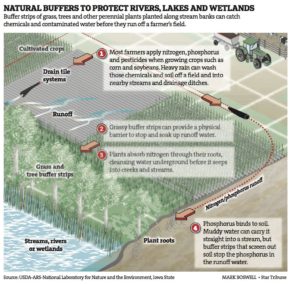
Graphic from today’s Minneapolis Star Tribune.

Today’s article explained that, “The law, passed in 2015, seeks to improve water quality by requiring buffer strips along ditches and waterways to help slow down and filter runoff from farm fields that might contain sediment, phosphorus, pesticides and other chemicals.

“It was set to go into effect Nov. 1, and requires strips at least 30 feet wide and an average of 50 feet from public streams, creeks, rivers and lakes, or an alternative method of conservation that provides equal or better water quality benefits. It also applies to public ditches that feed into waterways, and requires 16.5-foot buffers along them to be planted by Nov. 1, 2018.

“Farmers and farm groups complained that the deadlines were unrealistic, but Dayton considers the law one of his signature accomplishments and pushed back against attempts to delay or weaken it.”

Mr. Meersman added that, “In the end, lawmakers and the governor’s office agreed on a plan that allows farmers to apply for an automatic waiver that gives them until July 1, 2018, to install buffers or alternative measures along the public waterways. The deadline for ditches was not changed.”

Posted in Agriculture Law | Comments closed

Organic Agriculture in Iowa on the Rise

An update last week from Iowa State University Extension indicated that, “Organic agriculture continues to grow in Iowa, with the state boasting the sixth-largest number of organic farms nationally and ranking 10th in total organic sales. The state’s 800 organic farms produce $103 million toward the farm economy.

“Farmers looking to transition to organic production need specialized training that can be provided through an Iowa State University course titled Transitioning to Organic Agriculture. The 16-week course was taught during the Spring 2017 semester by Kathleen Delate, professor and extension organic specialist in horticulture and agronomy at Iowa State, and was available both to students on and off campus through a classroom setting and online. Forty-four people took the class, which was offered not only to Iowa State undergraduate and graduate students, but to interested farmers who sought to increase their knowledge about organic agriculture.”

The Iowa State University update also noted that, “Jane Richards, along with her sister Beth, are working to transition their family farm to organic production. Jane enrolled in the class to learn more about land stewardship and how they can transition a farm that previously had been a conventional crop operation.

“‘Taking this class helped me learn about organic grain farming and whether that might be a feasible option for us,’ Richards said. ‘Organic grain farming no longer seems like an impossible undertaking. Any conventional farmer interested in organics should participate in this class. I think they might be surprised how useful and thought-provoking the information is. They will gain a new perspective from which to evaluate their current operation, which given the current farm economy is particularly valuable.'”

Posted in Agriculture Law | Comments closed

Startup Snapshot: The Difficulties of Breaking Into a Highly Regulated Industry

Randall Smith reported in today’s New York Times that, “On a warm morning early last year, a start-up founder named Matt Burton addressed a group of 175 investors and executives at the sleek glass IAC building in Chelsea.

“Mr. Burton described how his company, Orchard Platform, already a provider of loan data to financial institutions, would soon unveil its own trading platform for loans.

“It had all the earmarks of a successful plan. Mr. Burton and the other Orchard founders had worked at an online ad exchange called Admeld, sold to Google for $400 million. Venture capital firms and Wall Street heavyweights including John Mack and Vikram Pandit had invested in Orchard. And Lending Club, the leading start-up offering online loans, had not yet been engulfed in scandal.”

The Times article noted that, “More than a year after Mr. Burton revealed his big plans, Orchard has completed just a scattering of transactions. Over that time, it burned through more than $5 million in legal fees and other expenses. A regulatory snarl over whether the loans would be treated as securities caused delays. Major lending platforms were reluctant to participate. And the market for loans was thrust into upheaval by a wave of defaults and a scandal that broke last May at Lending Club.

“Next month, hoping to add momentum, Orchard plans to unveil a scaled-back version of the platform, eight months later than first planned.

“But regardless of the company’s fate, its struggles thus far reveal just how hard it can be for a new entrant — even one with successful founders, a promising service and big-name investors — to break into a highly regulated industry.”

Mr. Smith pointed out that, “When Orchard was founded in 2013, marketplace lending was just taking off. Unlike banks — which take deposits, make loans and hold capital to absorb loan losses — marketplace lenders match investors and borrowers directly, with the investors taking the risk of losses in exchange for higher interest rates.

“Orchard began by offering institutional investors an automated service to analyze the loans and buy them from different online lenders. But its long-term plan always included creation of what Mr. Burton calls a ‘many-to-many’ trading platform.”

Today’s article stated that, “But building an auction-style exchange for loans proved to be significantly more complex than building a marketplace for online ads.

“As Matt Harris, a start-up investor at Bain Capital Ventures, put it, ‘Building a trading venue and attracting liquidity is somewhere between difficult and impossible.’ He still believes Orchard can get there eventually.”

Mr. Smith added that, “Standardizing data was daunting because each loan platform had its own legal and data formats, such as different definitions of debt-to-income, said Ram Ahluwalia, chief executive of PeerIQ, which tracks alternative lending…[and]…in July, S.E.C. officials told Orchard that they would consider loans being traded as securities, potentially imposing a tougher level of oversight. That made some lenders nervous about participating. Some lenders were also concerned about exposing investors they had cultivated to loans from competitors.”

“As it moves forward, Orchard has played down the regulatory issue, proceeding without an explicit formal S.E.C. ruling on whether the loans are securities. It is a potentially risky move, but one the company believes will work in part because it has dropped its goal of legal standardization, cutting the need for lending platforms to agree on regulation issues. The S.E.C. declined to comment,” the Times article said.

Posted in Start-up Company Law | Comments closed

Which Annual Flowers Are Likeliest to Attract Bees?

An update last week from University of Minnesota Extension indicated that, “Minnesotans eager to help pollinators now can turn to research at the University of Minnesota Extension, which looked at which annual flowers likeliest to attract bees, butterflies, moths and other insects.

“Zinnias topped the list of 24 varieties Extension Master Gardeners studied for eight weeks in 2016.”

The Extension update pointed out that, “Native grasses are attractive, low-maintenance additions to the landscape that also benefit pollinators.

“Extension horticulturist Mary Meyer has studied native grasses for nearly 30 years. She recommended little bluestem, big bluestem, blue grama, switch grass, side-oats grama, lake sedge and prairie dropseed as larval food for native skipper butterflies.

“‘The decline of native grasses caused the loss of habitat for many grassland butterflies and moths,’ Meyer said.”

Last week’s update added that, “Native grasses need little, if any, watering once they’re established and require no fertilizer. As they establish, they help minimize erosion and increase organic matter, creating better soil conditions.”

Posted in Agriculture Law | Comments closed

State Funded Missouri Startup Fund Sees Cut in Budget Allocation

David Nicklaus indicated today in the St. Louis Post Dispatch that, “When Pfizer shut down its St. Louis research operation in 2010, Joseph Monahan decided to stay.

“He founded a new company, Confluence Life Sciences, that now employs 40 scientists, including many ex-Pfizer colleagues. Confluence has attracted millions of dollars of capital from firms in Texas and Maryland and has built a successful contract-research business while working on its own new drugs, which show promise in treating autoimmune disorders and colorectal cancer.

“It wouldn’t exist, Monahan says, without the state-funded Missouri Technology Corp. MTC has invested $1.4 million in Confluence, including critical seed money back in 2011.”

The article indicated that, “MTC has made similar investments in 90 agriculture, technology and medical startups, the majority of which are in the St. Louis area. It has cashed out of a few, including Yurbuds, the ear-bud maker that was sold in 2014.

“Leaders of startup-support organizations, which are also funded by MTC, cite the state money as a major accelerant behind St. Louis’ entrepreneurial renaissance. Without it, they say, we wouldn’t have so many new firms popping up in places such as downtown, the Cortex district and Creve Coeur.

“The money, however, is about to slow to a trickle. The Legislature cut MTC’s appropriation to $2.5 million for fiscal 2018, which begins July 1, from nearly $23 million this year.”

The Post Dispatch article added that, “Officials haven’t decided how to allocate the smaller pot of money. The MTC funds three main programs: operating funds for innovation centers; grants to support groups such as Arch Grants and ITEN; and direct investments in startup companies.”

Posted in Start-up Company Law | Comments closed

Iowa State University Extension Bulletin: Forms of Property Ownership

A recent update from Iowa Sate University Extension (“Evaluating Your Estate Plan: Forms of Property Ownership“) pointed out that, “One of the major goals of any estate plan is to distribute or dispose of property after death. To make decisions in this regard, it is important to understand classifications of property as well as the various ways that property can be owned. How property is transferred upon death may be dictated by the method of ownership. In particular, when property is co-owned by two or more people, the method of co-ownership may determine who eventually owns the property.”

The Extension item noted that, “Real property includes land as well as whatever is built upon the land or attached to the land. This may include buildings, fences and subsurface tiling. Mineral rights may also be a consideration in regard to real property.

“Personal property may be either tangible or intangible. Tangible personal property includes anything that can be touched – from household goods, jewelry and clothing, to livestock, machinery, stored grain, vehicles and inventory items. Intangible personal property includes assets such as bank or brokerage accounts, stocks, bonds and insurance policies. These intangible properties may be represented by a piece of paper, but the actual property is intangible.”

The update discussed methods of property ownership in greater detail, highlighting: Fee Simple Ownership of Real Property, Tenancy in Common, Joint Tenancy, Tenancy by the Entirety, and Life Estates.

A PDF copy of the Iowa State update is available here.

Posted in Agriculture Law | Comments closed

Crop Insurance Deadline Nears

A news release yesterday from Purdue University indicated that, “Indiana corn producers have until June 5 to get their crops planted or replanted in order to qualify for full federal crop insurance benefits. The deadline for soybean growers is June 20.

“Coverage is reduced by 1 percent per day for crops planted during the late-planting period, which lasts 25 days after the planting deadline for each crop.

“Michael Langemeier, Purdue University agricultural economist and Purdue Extension cropping systems specialist, said farmers should check with their insurance agent for specific details of the policy they enrolled in last March.”

The news update explained that, “‘Policies differ,’ Langemeier said. ‘With the significant rainfall and planting delays we’ve experienced this year, it is very important for producers to know what their policy will and will not cover.’

“Prevented planting coverage could become an issue in some locations, he said. Under some policies, farmers can plant a cover crop on land they have claimed for prevented planting coverage, but cannot harvest forage until after Nov. 1.

“Prevented planting coverage is intended to protect growers if they are unable to plant their crops by the deadline or in the late-planting period. Benefits apply to machinery, land rent, fertilizer, field preparation, labor and repairs and other planting costs but do not cover lost revenue.”

Posted in Agriculture Law | Comments closed

Lack of Slaughter Capacity an Issue for Farm-to-Table Restaurants

Bloomberg writer Deena Shanker reported earlier this week that, “Despite ever-increasing customer demand for noncommodity meat, there aren’t enough slaughterhouses to keep up. It’s a major hitch in the supply chain—keeping supplies down, prices up, and making the already grueling job of farming even harder.”

The article indicated that, “Even at Blue Hill, which exemplifies the aspirational closed-loop, farm-to-table meal, slaughter of pigs and sheep requires a trip off premises. Under USDA regulations, farm staff must take these animals to a federally inspected facility to serve it at the restaurant or sell it at the Stone Barns store, though an exemption for small amounts of poultry staying in the state allows them to slaughter their chickens, turkeys, and ducks in an on-site, state-certified facility.

“Stone Barns is more fortunate than many other farms, said Jack Algiere, the Center’s farm director. The slaughterhouse is ‘very close, considering,’ he says. Others are forced to ‘drive two, three, four hours for processing.'”

The Bloomberg article added that, “While the situation varies from species to species and state to state, sellers of noncommodity pork, beef, and chicken agree: there simply aren’t enough facilities to humanely and safely kill their animals.

“The numbers are stark. In 1967 there were 9,627 livestock (cattle, calf, hog and sheep) slaughtering establishments in the U.S. That same year, Congress passed the Wholesome Meat Act, requiring producers to use a USDA-inspected facility if they sell meat across state lines. A mass consolidation of the meat industry followed. Today, commodity meat is dominated by large companies. Just four companies sell about 85% of America’s beef and the pork and chicken markets are similarly controlled by huge corporations. By 2016, there were only about 1,100 federally inspected meat and poultry slaughterhouses in the country.

“But customers are increasingly demanding free-range meat from smaller producers that, largely because of the lack of slaughterhouse, aren’t able to supply it fast or cheap enough. Volume sales for free-range meat, for example, was up 26.9 percent in 2016, while conventional was down 0.5 percent, according to data from Nielsen Fresh.”

This week’s article stated that, “Just a handful of large slaughterhouses handle a disproportionate amount of that American meat: Of those approximately 1,100 facilities, 215 large slaughter establishments (defined as 500 or more employees) produce about 75 percent to 90 percent of the country’s volume. At the Smithfield plant in Tar Heel, N.C., for example, approximately 30,000 to 34,000 hogs are reportedly slaughtered each day. At the other end of the spectrum is Dealaman, the only federally inspected hog slaughterhouse in New Jersey, which processes a paltry 1,200 pigs a week.

“The explanations for the struggles of the small slaughterhouses vary but inevitably come down to two interrelated factors—regulations that favor large meatpackers and uneven enforcement of those regulations.”

Posted in Agriculture Law | Comments closed

House Approves Reducing Regulatory Burdens Act of 2017, Upending an EPA Pesticide Rule

Associated Press writer Michael Biesecker reported yesterday that, “The House on Wednesday passed a Republican-backed measure reversing an Environmental Protection Agency requirement that those spraying pesticides on or near rivers and lakes file for a permit.

“The chamber voted largely along party lines to approve the Reducing Regulatory Burdens Act of 2017. In the preceding floor debate, the bill’s supporters said the rule requiring a permit under the Clean Water Act before spraying pesticides is burdensome and duplicative. EPA already regulates pesticide safety under a different law that gives the agency authority to place restrictions on when and where spraying can occur.

“The current EPA rule was put in place after a lawsuit was filed by environmentalists and commercial fishermen. They claimed the agency was failing to adequately prevent pesticide contamination in protected waters. A federal appeals court agreed in 2009, forcing EPA to start requiring the permits.”

The AP article explained that, “The bill now heads to the GOP-dominated Senate, where a similar version previously failed to pass under threat of a veto by then-President Barack Obama. Supporters now hope to send the measure to the desk of Trump, a Republican who has made rolling back government regulations a focus of his administration.”

Posted in Agriculture Law | Comments closed