
Latest GOP Tax Plan: Estate Tax Repeal Delayed

Los Angeles Times writer Lisa Mascaro reported yesterday that, “The much-anticipated House GOP tax plan will keep the current top tax rate of 39.6% for the most affluent Americans but will make that bracket apply only to ‘substantially’ higher incomes than the current $470,700 for couples, House Speaker Paul D. Ryan told a group of conservative interest groups Tuesday.

“The plan will also delay any repeal of the estate tax for two to three years, the speaker told the group, according to participants in the private meeting.”

Ms. Mascaro noted that, “House leaders have been planning to introduce their bill on Wednesday, but GOP leaders indicated that may slip to Thursday amid continued negotiations over some parts of the measure.

“Some Republicans are urging a gradual phase-down of the corporate rate as a way to reduce the costs of the sweeping GOP tax-cut package. In order to pass in the Senate, the tax plan may not add more than $1.5 trillion to the deficit over 10 years.”

Yesterday’s article added that, “Other key elements remain under discussion, including how to limit state and local deductions and whether to impose caps on tax-deferred 401(k) retirement accounts.”
Posted in Agriculture Law | Comments closed

USDA Announces Enrollment Period for Safety Net Coverage in 2018

A news release yesterday from USDA’s Farm Service Agency (FSA) stated that, “The [USDA] today announced that starting Nov. 1, 2017, farmers and ranchers with base acres in the Agriculture Risk Coverage (ARC) or Price Loss Coverage (PLC) safety net program may enroll for the 2018 crop year. The enrollment period will end on Aug. 1, 2018.

“‘Since shares and ownership of a farm can change year-to-year, producers must enroll by signing a contract each program year,’ said Farm Service Agency (FSA) Acting Administrator Steve Peterson. ‘I encourage producers to contact their local FSA office to schedule an appointment to enroll.’

“The producers on a farm that are not enrolled for the 2018 enrollment period will not be eligible for financial assistance from the ARC or PLC programs for the 2018 crop should crop prices or farm revenues fall below the historical price or revenue benchmarks established by the program. Producers who made their elections in previous years must still enroll during the 2018 enrollment period.”

The FSA update added that, “For more information, producers are encouraged to visit their local FSA office. To find a local FSA office, visit http://offices.usda.gov.”

Posted in Agriculture Law | Comments closed

Illinois Department of Agriculture Receives Funds for Specialty Crops

The Associated Press reported yesterday that, “Ten agriculture-related projects that are looking for ways to expand the availability of fresh, locally-grown produce in Illinois will be sharing $550,000.

“[A news release indicated that] the Illinois Department of Agriculture will receive the money through the most recent federal Specialty Crop Grant Program.

“The grants will go to programs that will study such issues as the best produce washing and handling techniques for farmers and look to give the poor greater access to fresh produce.”

The AP article added that, “Illinois Agriculture Director Raymond Poe says it is important to support the state’s specialty crop industry — which includes fruits, vegetables, nursery crops, tree nuts, horticulture and dried fruits. He adds it’s important to make these crops more available throughout the state.”

Posted in Agriculture Law | Comments closed

More Homeowners Choose to Stay Where They Are and Renovate

Laura Kusisto and Christina Rexrode reported yesterday at The Wall Street Journal Online that, “Despite rising home prices and a growing economy, U.S. homeowners’ mobility rate is stuck at a 30-year low as many opt to stay put rather than move to pursue job opportunities or trade up for more space.

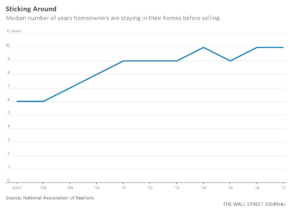
“The median duration of owners in their homes in 2017 was 10 years, according to data soon to be released  by the National Association of Realtors. That matched last year’s duration, which, along with 2014, was the highest level since the NAR started tracking the data in 1985.

“Americans aren’t moving in part because inventory levels have fallen near multidecade lows and home prices have risen to records. Many homeowners are choosing to stay and renovate, in turn making it more difficult for renters to enter the market.”

“Stuck in Place, U.S. Homeowners Hunker Down as Housing Supply Stays Tight.” The Wall Street Journal Online (October 29, 2017).

The Journal writers added that, “Housing starts fell 4.7% in September, the Commerce Department said, and remain about 40% below the 50-year average, which is unusual considering the economy and job markets are expanding strongly. In September, sales of previously owned homes declined on an annual basis for the first time since July 2016 as the shortage of homes continues to take a toll on the housing market.

“The lack of new-home construction has helped create a bottleneck in the market in which owners of starter homes aren’t trading up to newly built homes, which tend to be pricier, in turn creating a squeeze for millennial renters looking to get into the market. Economists said baby boomers also aren’t in a hurry to trade in the dream homes they moved into in middle age for condominiums or senior living communities because many are staying healthy longer or want to remain near their children.”

Posted in Real Estate Law | Comments closed

AP: “Owners Sometimes Hate the Small Businesses They Used to Love”

Associated Press writer Joyce M. Rosenberg reported last week that, “No matter how much small business owners love their companies, they also have moments — maybe even weeks or months — when they hate what they’re doing and feel ready to give up.”

The AP article noted that, “Many owners find a way to get through tough times is to get some support, either from family members, mentors or other business owners. They realize the go-it-alone mindset common among entrepreneurs have doesn’t always work when products don’t sell or associates let them down. And some realize they need a break to reconnect with the non-business parts of their lives.”

The article stated that, “In the three decades Jeff Hoffman has owned ACT Network Solutions, he’s had to respond to tectonic shifts in the computer industry. His Cary, Illinois-based business began as a retailer selling computers and software to consumers, but was getting beaten by superstores with lower prices.

“‘I went to the office one day resigned to the fact that I was going to have to shutter the company,’ Hoffman says. But an order for 50 computers revived his spirits, and he has been able to shift his business model several times to keep pace with the industry. Now, ACT focuses on computer security and protecting customers’ data.

“That first blow didn’t make Hoffman immune to despair: ‘Each event hits you like a baseball bat alongside the head, so you never really get used to it.'”

The AP item added that, “Rafael Romis’ website design business just wasn’t taking off; six months after starting Weberous in 2012, he had few clients and was barely covering his expenses.

“‘I started thinking, maybe I screwed up with this one. Maybe I should have gone and gotten a steady job‘ says Romis, who lives in Los Angeles. The disappointment even became a cloud over plans for his wedding.

“Romis realized he needed help. He began following founders of other web design firms on social media, reading their posts about how they overcame obstacles in their companies. He contacted some near him, and took one out to lunch.  The man became something of a mentor to Romis, telling him, ‘To be successful, you need to knock on doors.’

“Romis began reaching out to local businesses and convincing them they needed websites. When they hired him, he asked them to refer other businesses to him. That began to work.”

Posted in General Interest | Comments closed

Iowa’s Largest Pork Producer Expanding, While Some Seek Moratorium on Growth

Donnelle Eller reported yesterday at The Des Moines Register Online that, “Iowa’s largest pork producer is rapidly expanding, adding nearly 90,000 pigs at time when water quality issues have state and local leaders calling for a moratorium on industry expansion, says a grassroots activist group.

“Iowa Citizens for Community Improvement says Iowa Select is adding at least 19 hog confinements and the Des Moines group wants the Iowa Department of Natural Resources to extend the permitting period to 90 days so residents and county supervisors can ‘review this onslaught of factory farm proposals.’

“Iowa Select says its growth in Iowa helps farmers add value to grain operations and improve profits, provides an organic fertilizer for growers, and brings jobs to rural Iowa. The Iowa Falls-based company says it employs 1,200 workers and works with 650 contractors.”

Ms. Eller indicated that, “Iowa leads the nation in pork production, marketing about 45 to 50 million pigs a year.

“Iowa pork production has climbed 2.3 percent over the past decade, while it’s bumped up 1.2 percent nationally, according to Iowa State University calculations.”

The Register article added that, “Profit on livestock production is expected to help push U.S. farm income 3.1 percent higher this year, the U.S. Department of Agriculture projects.

“Dermot Hays, an Iowa State University economics professor, said pig production expands with improved profits for producers.

“And new processing plants should help with that.

“‘Packers have been making all the money, because they own scarce capacity,’ Hayes said. ‘But with these new plants coming online, some of that money will flow to the live hog producer.'”

Posted in Agriculture Law | Comments closed

CAFO Air Emissions- EPA Guidance Released

Jacqui Fatka reported yesterday at Feedstuffs Online that, “On Thursday, the Environmental Protection Agency released guidance documents to assist farmers in reporting air releases of hazardous substances from animal waste at farms. EPA is making this information available to give farmers time to review and prepare for the reporting deadline, which is currently set for Nov. 15, 2017.

“Although large feeding operations were previously exempt from filing the paperwork, a court ruled earlier this year that EPA’s 2008 rule could not exempt animal feeding operations from the Comprehensive Environmental Response, Compensation & Liability Act (CERCLA) hazardous substance reporting requirements or exempt all but the largest feeding operations from state and local reporting requirements under the Emergency Planning & Community Right-to-Know Act (EPCRA).

“‘EPA is working diligently to address undue regulatory burden on American farmers,’ EPA Administrator Scott Pruitt said. ‘While we continue to examine our options for reporting requirements for emissions from animal waste, EPA’s guidance is designed to help farmers comply with the current requirements.'”

The Feedstuffs article noted that, “The EPA guidance information includes links to resources that farmers can use to calculate emissions tailored to specific species of livestock. View EPA’s guidance and frequently asked questions on reporting air emissions from animal waste at https://www.epa.gov/epcra/cercla-and-epcra-reporting-requirements-air-releases-hazardous-substances-animal-waste-farms.

“EPA will revise this guidance, as necessary, to reflect additional information to assist farm owners and operators to meet reporting obligations. Interested parties may submit comments or suggestions by Nov. 24, 2017, to cercla103.guidance@epa.gov.”

Posted in Agriculture Law | Comments closed

Honey: Start-Up Finds Discount Codes for Shoppers

David Pierson reported earlier this week at the Los Angeles Times Online that, “Ryan Hudson was trying to order pizza online for his two children when he was prompted to enter a coupon code at checkout.

“Hudson knew better than to bother searching for a discount. His kids were hungry and he didn’t have time to scan the internet for coupons that had either expired or didn’t apply to the cheese pizza he wanted to order.

“‘And then it hit me. Why can’t I just automate the process?‘ said Hudson, a computer engineer turned entrepreneur.”

The LA Times article explained that, “The software Hudson cobbled together that night would form the basis for a start-up he cofounded called Honey.

“Headquartered in downtown Los Angeles, Honey offers a free extension for Google Chrome, Firefox and Safari that aggregates discount codes for whichever shopping site a user visits.

“When it comes time to make an online purchase, the extension automatically applies any code it finds that saves the shopper the most money. Since there’s no need for customers to navigate away from a checkout page in search of coupons, shoppers who use Honey’s extension are 55% more likely to complete a transaction than those that don’t, the company says.”

Mr. Pierson added that, “The company makes money from commissions earned by directing users to specific merchants. Honey splits those commissions with users who sign up for a no-cost rewards program called Honey Gold.

“Hudson and [George Ruan, Honey’s other cofounder] scraped together $100,000 to launch the company, but have since raised $40.8 million in venture backing — most of which came from a previously unreported $26 million Series C funding round in March led by Santa Monica’s Anthos Capital.

“The infusion of cash has helped Honey launch a hiring spree. The company started the year with 30 employees. It now has 100 and has plans to add another 50 staffers.”


Posted in Start-up Company Law | Comments closed

New York Grant Program to Help Veterans Become Farmers

The Associated Press reported earlier this week that, “New York is working to help veterans interested in becoming farmers.

“The state announced a new grant program that provides financial assistance to former military service members turned farmers. The money can be used to purchase new farm equipment, machinery or supplies or pay for the cost of building or upgrading farm structures.”

The AP article added that, “Democratic Gov. Andrew Cuomo says the investment will support a major sector of the state’s economy while also giving valuable assistance to veterans and people who are new to the agricultural industry.”

Posted in Agriculture Law | Comments closed

DTN: “Congress Tweaks Bankruptcy Code to Protect Farmers from Taxes”

DTN Ag Policy Editor Chris Clayton reported today that, “Not that this is a situation any farmer wants to find themselves in, but Congress on Tuesday gave final approval to a change in bankruptcy law to help farmers deal with the Internal Revenue Service.

“The Family Farmer Bankruptcy Clarification Act, sponsored by Sens. Charles Grassley, R-Iowa, and Al Franken, D-Minn., was attached to an appropriations package that breezed through the U.S. Senate on a 82-17 vote.

“The bill corrects a 2012 U.S. Supreme Court ruling on an earlier bankruptcy law. The law will clarify congressional intent to allow a family farm to reorganize in bankruptcy court while restricting the IRS’s ability to ‘veto’ the farmer’s decision. Essentially, farmers in bankruptcy that are forced to sell farm assets would be allowed to treat the capital-gains taxes as a general unsecured claim.”

The DTN article indicated that, “The bill now goes to President Trump and he is expected to sign the supplemental appropriations that would enact the bankruptcy change.”

Posted in Agriculture Law | Comments closed