
Dicamba: Monsanto Legal Action Against Arkansas State Plant Board

Jacob Bunge reported today at The Wall Street Journal Online that, “A fight over one of the most powerful new weapons against hard-to-kill weeds, developed by agricultural giant Monsanto Co., is spilling into the courts.

“Monsanto’s new version of the herbicide, called dicamba, is part of a more than $1 billion investment that pairs it with new, genetically engineered seeds that are resistant to the spray. But some farmers say their nonresistant crops suffered after neighbors’ dicamba drifted onto their land.

“The agricultural giant in October sued the Arkansas State Plant Board following the board’s decision to bar Monsanto’s new herbicide and propose tougher restrictions on similar weed killers ahead of the 2018 growing season. Monsanto claims its herbicide is being held to an unfair standard.”

Mr. Bunge indicated that, “Arkansas has been a flashpoint in the dispute: About 900,000 acres of crops were reported damaged there, more than in any other state.

“Arkansas agriculture officials have scheduled a hearing Wednesday to discuss stiffer dicamba controls, which Monsanto and some farmers are fighting. The new controls are subject to the approval of a subcommittee of state legislators.”

The Journal article stated that, “Scott Partridge, Monsanto’s head of strategy, is expected to testify, as are proponents of tighter restrictions. Monsanto has criticized some Arkansas state agricultural officials and academics involved in researching and regulating dicamba, accusing them of bias and overstepping their authority. ‘The process they used in Arkansas is broken,’ Mr. Partridge said. ‘Growers need access to this tool,’ he said.”

Today’s Journal item added that, “Even with the reports of widespread damage, farmers and crop researchers say many affected fields recovered, thanks to good weather over the latter half of the growing season. The USDA is projecting a record U.S. soybean crop. The outcome could have been worse with drier weather, researchers said.

“Farmers are exploring their own legal options. Some have joined class action lawsuits against Monsanto and BASF, seeking compensation for damaged crops. The companies are contesting those lawsuits.”
Posted in Agriculture Law | Comments closed

Tax Reform Issue: Bill Could Subject Farm Rental Receipts to Self-Employment Taxes

DTN Ag Policy Editor Chris Clayton reported yesterday that, “The House tax-reform bill meant to lower taxes could lead to a self-employment tax hitting every landowner who leases land to a farmer and farmers who lease farmland to a family partnership.

“The tax bill would be 15.3% higher under a formula that makes 70% of rental income subject to self-employment taxes. Currently, rent is not subject to self-employment (SE) taxes.”

Mr. Clayton stated that, “So landlords and others with passive income might get a lower income-tax rate of 25%, but rental income would be subject to self-employment taxes. Self-employment taxes combine two areas: a 12.4% tax for Social Security and a 2.9% tax for Medicare.

“The House Ways and Means Committee started on Monday what is expected to be a weeklong process of debating and moving the tax-reform bill out of committee. The Senate Finance Committee will eventually release a bill as well. Senators have made it clear they will have some different provisions in their bill.”

The DTN update noted that, “According to a 2014 USDA survey, roughly 80% of farmland landlords, or about 1.85 million people, are non-operators. Nearly 1.1 million lease land as an individual while the rest are in partnerships, trusts, corporations or other structures. In 2014 when the survey was released, those 1.85 million non-farmer landlords also leased out more than 283 million acres of farm and ranch ground.”

Yesterday’s article also pointed out that, “Farmers who do those lease arrangements within families could choose to no longer do so because the tax advantages would be lost. Other farmer tenants could face the prospect of landlords passing that SE [self-employment] tax increase on to the cost of the farm ground they offer for lease. That would depend on how elastic or inelastic the current land market is, [Roger McEowen, an agricultural tax-law professor at Washburn University in Kansas] said.

“Older people could become more frustrated because they will be paying that self-employment tax knowing they will unlikely see any benefit out of it.

“The situation is different for the sole-proprietor farmer who files a Schedule F, or for a general partner in a partnership. They will see a tax decrease because those farmers already pay that 15.3% self-employment tax. So sole proprietors would get a cut because they would now only pay self-employment taxes on 70% of their income rather than 100%, McEowen said.”

Posted in Agriculture Law | Comments closed

Hog Farm Expansion Generates Concern

Emily Walkenhorst reported earlier this week at Arkansas Online that, “The owners of C&H Hog Farms and the international corporation that supplies the operation’s swine are planning to apply for a permit to operate another farm, this one in a flood-prone area just south of Hartman.

“The proposal has angered nearby farmers and some residents of Hartman and other parts of Johnson County who are concerned about possible flooding and odor from such a farm.

“JBS, the Brazilian company that is proposing the hog farm, said the location is advantageous for the company because of its proximity to related facilities and that it should be safe from flooding.”

Ms. Walkenhorst noted that, “JBS spokesman Cameron Bruett told the Arkansas Democrat-Gazette on Friday that the site of the farm ‘is not known to have flooded’ since a levee was constructed to protect it from the Arkansas River, but others in the area — including the Hartman mayor — disputed that claim.

“‘JBS nor the farm owners desire to build a farm where flooding is likely,’ Bruett said in an email.

“Arkansas Department of Environmental Quality regulations don’t note requirements related to flood plains.”

The article pointed out that, “C&H Hog Farms, near Mount Judea in Newton County, already has drawn the ire of many concerned about the environmental risk its hog manure poses to the Buffalo National River, the nation’s first national river.

“That operation sits on Big Creek, about 6 miles from where the creek converges with the Buffalo. Environmental groups and others fear that manure from the farm — the only federally classified large hog farm in the river’s watershed — could find its way into the Buffalo River and pollute the water, like what has happened in other states.”

Posted in Agriculture Law | Comments closed

Organic Leaders See Concerns with Direction of USDA Organic Program

Caitlin Dewey reported on Thursday at The Washington Post Online that, “The pioneers of the sustainable farming movement are mourning what they call the downfall of the organic program, following a Wednesday night vote by a group of government farming advisers that could determine the future of the $50 billion organic industry.

“At issue was whether a booming generation of hydroponic, aquaponic and aeroponic farms — which grow plants in nutrients without using soil, frequently indoors — could continue to sell their produce under the ‘organic‘ label.

“In a series of narrow votes, an advisory board to the U.S. Department of Agriculture voted to allow the majority of these operators to remain a part of the organic program, dealing a blow to the movement’s early leaders.”

Ms. Dewey noted that, “Organic pioneers have argued that including hydroponic produce under the label has undermined the integrity of the program they fought decades to establish, and at a time when it is already under intense scrutiny. Some have said they will consider leaving the USDA-regulated program entirely.”

The Post article also stated that, “Organic sales topped $47 billion in 2016, according to the Organic Trade Association, representing 5 percent of all U.S. food sales. That growth has not been driven by idyllic family farms, either. Increasingly, the organic market is dominated by industrial brands that look little different from their conventional counterparts.”

Posted in Agriculture Law | Comments closed

In All, Dicamba Damage in 25 States

Eric Lipton reported last week at The New York Times Online that, “A weed killer called dicamba has damaged more than 3.6 million acres of soybean crops, or about 4 percent of all soybeans planted in the United States this year, the Environmental Protection Agency said Wednesday in calling for an urgent federal response.

“‘It is not often that we hear about impacts of this magnitude,’ said Rick P. Keigwin Jr., the director of the E.P.A.’s pesticide program.

“Dicamba has been used starting this year on genetically modified soybean and cotton crops that are grown from seeds created to be tolerant to weed killers. The problem is that the herbicide can drift off the fields where it is being applied, landing on nearby farms where conventional soybean seeds have been planted.”

Mr. Lipton noted that, “The damage estimates were presented during a meeting Wednesdaycalled by the E.P.A. and attended by pesticide manufacturers, state agriculture officials, farmer groups and environmentalists.

“The research, compiled by a University of Missouri plant sciences professor, Kevin Bradley, found that damage complaints have been filed in more than two dozen states. Most of the complaints were related to soybeans, but the drift has also caused damage to other crops, including tomatoes, watermelon, cantaloupe, vineyards, pumpkins, organic vegetables, residential gardens, trees and shrubs, the researchers found.”

The Times article added that, “Monsanto, BASF and DuPont — the three companies that sell the dicamba formulations causing the problems — have signed off on the new instructions, which prohibit application of the herbicide when winds are greater than 10 miles an hour. Farmers will also be required to take additional steps to clean up tanks where the herbicide is stored to make sure contamination does not result when the same equipment is used on conventional fields.”

Posted in Agriculture Law | Comments closed

Group Calls GOP Tax Bill a “Mixed Bag” for Agriculture

An update yesterday from K Koe Isom stated that, “K·Coe Isom, the nation’s leading agricultural accounting and consulting firm, today had a mixed review of the House tax reform legislation and cautioned that the legislation released today could actually raise effective tax rates on many farmers and ranchers.

“‘We applaud Speaker Ryan and Chairman Brady for moving forward with tax reform but encourage them to modify the legislation to make sure it works for agriculture,’ said Jeff Wald, CEO of K·Coe Isom.  ‘The eventual phase-out of the estate tax will be welcome news for farms and ranches that would otherwise be subject to this tax.  We also applaud the bill for not limiting farmers’ ability to use the cash method of accounting.’

“Wald continued, ‘We are worried, however that provisions in the House tax bill could hamper growth for many farms and ranches and could actually increase the amount of taxes these operations pay.  These provisions include the restrictions on interest expense deductions, the curtailment on carry-backs of losses, the elimination of the Domestic Production Activities Deduction (DPAD), and limitations on like-kind exchanges.'”

Yesterday’s update noted that, “Wald called on Congress to modify the tax reform legislation to ensure that it doesn’t hurt America’s farms and ranches.  ‘As the House moves forward with tax reform, we would ask that they consider four changes to the bill.’

  • Exempt farm businesses from limits on interest deductions.
  • Allow farmers and ranchers to use like-kind exchanges for farm equipment.
  • Exempt agriculture from the elimination of the Domestic Production Activities Deduction (Sec. 199).
  • Allow agriculture to carry-back losses to offset taxes paid in previous good years.
Posted in Agriculture Law | Comments closed

House GOP Releases Tax-Reform, Tax-Cutting Plan

DTN Ag Policy Editor Chris Clayton reported yesterday that, “House Republicans released a long-awaited tax-reform and tax-cutting plan that lowers tax rates for corporations and families, but forces both businesses and families to give up or reduce some favorite long-standing tax breaks.

“‘This is a complete redesign of the (Tax) Code,’ said Rep. Kevin Brady, R-Texas, chairman of the Ways and Means Committee.

“Brady’s committee is set to mark up and debate the plan [full plan; summary] in committee starting next Monday.”

Mr. Clayton explained that, “The bill would cut the corporate tax rate from 35% to 20%, a foundation set early in the debate over tax reform. Businesses would get immediate expensing of capital costs, but business interest would be limited and other tax deductions and tax credits would go away.

“For individuals and families, the bill cuts individual tax brackets from seven to four: 39.6%, 35%, 25% and 12%. The standard deduction would be doubled, but limit state and local tax deductions, as well as other items on the Schedule A. The Child Tax Credit would be boosted for families from $1,000 per child to $1,600. A special $300 tax credit would be added for people who take care of a parent or another non-child dependent.

“The bill would limit mortgage interest deductions at $500,000. That prompted the National Association of Realtors and National Association of Home Builders to oppose the tax plan.”

The DTN article noted that, “In a victory for farm groups who pressed on the estate tax, the bill doubles the estate-tax exemption to $11 million for individuals, up from $5.49 million. The estate tax is phased out entirely after 2023.”

Yesterday’s article added that, “The National Council of Famer Cooperatives had warned last week that eliminating the deduction for domestic production activities would translate to $2 billion in lost tax breaks for farmers. Still, the deduction is eliminated in the bill.

“The National Biodiesel Board stated its members ‘are disappointed in this first draft’ of the legislation because it does not include an extension of biodiesel tax incentives. NBB added it would work with Congress ‘to craft a robust, biodiesel tax incentive.’

“In an area that could becoming a sticking point for farmers with high property-tax bills, the legislation limits the state and local-taxes deduction, capping them at $10,000.”

Posted in General Interest | Comments closed

Homeownership Rate Up in Third Quarter

Wall Street Journal writer Laura Kusisto reported on Tuesday that, “The homeownership rate inched up in the last several months to the highest level since 2014, as more households are finding a way to buy homes despite limited supply and rising prices.

“The homeownership rate climbed to 63.9% in the third quarter, up from 63.7% in the second quarter and 63.5% a year earlier, the Census Bureau said Tuesday.

“The increase isn’t considered statistically significant, but it marks the second consecutive quarterly gain, which suggests upward momentum. Home sales have been sluggish in recent months, while price gains are continuing to accelerate, raising concerns that demand is shrinking.”

The Journal article indicated that, “The increase in the homeownership rate was strongest in the Midwest, where home prices remain relatively affordable. The homeownership rate there climbed to 69.1% from 68% in the second quarter. The other parts of the country, where prices are increasing much more quickly, saw their homeownership rates remain flat.

“There are additional indications in Tuesday’s report that households are shifting to owning from renting. The number of owner households increased by 755,000 from a year earlier, while the number of renter households declined by 348,000, according to the Census.

“That nonetheless suggests that overall household formation is fairly weak, with just over 400,000 households formed in the third quarter.”

Posted in Real Estate Law | Comments closed

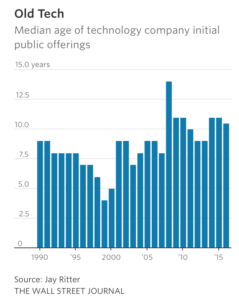
Startups Staying Private Longer

Justin Lahart reported on Tuesday at The Wall Street Journal Online that, “There are lots of good reasons for startups to stay private, and no one knows that better than Julie Wainwright.

“She is the founder of RealReal, a successful privately held online retailer that has gone through seven rounds of funding. Ms. Wainwright was also the CEO of Pets.com, which shut down when the cash ran out in Nov. 2000, seven months after going public.

“The flood of cash into startups has allowed companies to stay private for far longer than in the past. On the positive side, companies have more time to develop and grow. But the lack of a public market valuation also raises the question of whether many companies are worth the $1 billion-plus values private investors have attached to them.”

“Startups That Never Grow Up,” by Justin Lahart. The Wall Street Journal Online (October 31, 2017).

Mr. Lahart noted that, “A lot of richly valued startups are so old that saying they need time to develop and grow is a bit of a joke. Ride-hailing service Uber, which is valued at $68 billion, has been around for over eight years. Big-data analysis firm Palantir, valued at $20 billion, is 13 years old. SpaceX, the Elon Musk -led rocket maker valued at $21 billion, is 15 years old.”

The article added that, “With all that money riding on them, companies may be scared to go public during less-than perfect market conditions, worried that they will end up like food company Blue Apron. It was valued at $2 billion before going public this June and now has a market capitalization of less than $1 billion.

“Yet right now, with the U.S. economy in the ninth year of an economic expansion and the stock market clocking new highs, is the perfect time to go public. What are they waiting for?”

Posted in Start-up Company Law | Comments closed

St. Louis Federal Reserve Bank- “How Startups Differ from Mature Small Businesses”

An update posted yesterday at the “On the Economy Blog” (Federal Reserve Bank of St. Louis) indicated that, “Startups make up about one-third of U.S. small employer firms and tend to have bosses who are younger than those running a typical mature small firm, according to the 2016 Small Business Credit Survey: Report on Startup Firms.

“The survey, which was a collaboration of all 12 Federal Reserve banks, provides an in-depth look at startups and their financing and credit experiences, covering the second half of 2015 through the second half of 2016.”

Yesterday’s update explained that, “The youth of the startup is also reflected in the age of the firm’s boss: A startup is four times as likely to have a primary decision-maker who is under 36 than a mature small firm (17 percent versus 4 percent), while it is twice as likely (29 percent versus 14 percent) as a mature firm to have a primary decision-maker who is between 36 and 45.”

The blog update added that, “There are some differences in the industries where they work. For instance, startups are twice as likely as mature small firms (16 percent versus 8 percent) to operate in the leisure and hospitality industry. They are also more likely to be in the health care and education industry and the business support and consumer services industry. (See the figure below.)

“How Startups Differ from Mature Small Businesses.” On the Economy Blog. Federal Reserve Bank of St. Louis (October 31, 2017).

Posted in Start-up Company Law | Comments closed
