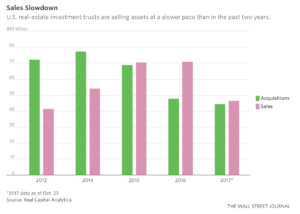
Commercial Property Transactions Slow

Esther Fung reported yesterday at The Wall Street Journal Online that, “Big U.S. real-estate companies have been selling assets at a slower pace this year, as the gap widens between their views on what their properties are worth and buyers’ willingness to pay high prices.

“After an eight-year bull run for commercial real estate, some investors have been anticipating a correction. But that hasn’t happened yet, and there is little consensus on how much longer the bull market has to run.

“Buyers, facing tighter lending conditions and slower income growth, are expecting lower prices and bidding accordingly, but sellers, including publicly traded property owners, are holding out for better deals.”

The Journal article stated that, “Listed real-estate investment trusts have sold $46.7 billion in assets as of Oct. 23 this year compared with $71 billion in assets sold in all of 2016, according to data from Real Capital Analytics. Acquisitions, on the other hand, have been at a roughly similar pace at around $44.6 billion as of Oct. 23 this year compared with $47.9 billion in 2016. There have been fewer major transactions especially in the office and retail real-estate sector.”

“Commercial Property Transactions Dry Up as Sellers Hold Out for Better Prices.” The Wall Street Journal Online (October 24, 2017).

Ms. Fung also noted that, “Strong growth in property rents in recent years has fueled deal making, as owners met their targeted yields earlier than expected and buyers were bullish on further appreciation. This year, by contrast, rent growth apart from the industrial sector has been subdued or flat, said Brian McAuliffe, president of institutional properties at real-estate consultancy firm CBRE Group.

“Unlike previous cycles, property owners aren’t overly leveraged and are still able to access the debt markets rather than be compelled to sell at unattractive prices.”

Yesterday’s article added that, “A dearth in transactions of top-tier malls this year has made it difficult for analysts and investors to make more accurate calls about market conditions.”

Posted in Real Estate Law | Comments closed

Tax Reform Plans: “A Lot of Variables Up In The Air” for Farmers

Sam Fleming reported yesterday at The Financial Times Online that, “Republican tax reform plans risk falling foul of one of the most politically influential constituencies in the US as agriculture lobbyists warn that some in their sector could end up paying higher taxes because of the overhaul.

“In their drive to lower tax rates and simplify the system, the Trump administration and lawmakers are considering the elimination of a range of items businesses can deduct from their tax bills. Agriculture lobbyists are ramping up meetings on Capitol Hill to ensure their sector does not lose tax breaks that they say are critical to keeping the sector profitable.

“The administration insists that farmers and ranchers will be better off under the president’s plan. But that depends on the details that emerge in Congress. Agriculture is just one example of a broad array of sectors and industries that are battling to preserve cherished carveouts and deductions, in a lobbying blitz that will dog efforts to pass a tax bill this year.”

The FT article added that, “Farmers rely heavily on debt to buy their land, finance equipment and purchase seeds and other raw materials every year, with government estimates putting total farm debt at $385bn, meaning the minority of farmers who operate as companies could be hurt by limits on interest deductibility. The GOP’s framework tax plan leaves open the position on deductibility of interest for non-incorporated businesses, which would affect a much broader range of farmers.”

Mr. Fleming noted that, “Danielle Beck, director of government affairs at the National Cattlemen’s Beef Association, said that agriculture had ‘good allies’ in Congress including on the ways and means committee and they had been listening to the sector’s concerns. When it came to tax reform, however, ‘there are a lot of variables up in the air.'”

Posted in Agriculture Law | Comments closed

WSJ Opinion Column: “Family Businesses Deserve a Tax Break”

In an opinion column posted recently at The Wall Street Journal Online, Brian Reardon indicated that, “The U.S. is unique in its prevalence of small and family-owned businesses. S corporations and other pass-throughs employ the majority of workers and are the foundation of thousands of local economies, ensuring that the benefits of economic growth aren’t concentrated in a few financial centers.

“The tax-reform debate has largely ignored this reality. Instead, it has been mired in claims that family businesses do not pay enough taxes. In reality, the combination of higher marginal rates, the individual alternative minimum tax, and the inability to shift income to lower-taxed countries results in S corporations, not C corporations, paying the highest effective tax rate. There is good reason to support cutting rates for C corporations, but there is an even better argument to apply those rate cuts to pass-through businesses.

“What about the tax on dividends and capital gains—the so-called corporate double tax? Only a small percentage of C corporations today pay any dividends, and most of that money goes to shareholders with limited or no tax liability, such as pensions, mutual funds, nonprofits and foreign investors. The Congressional Budget Office estimates that shareholder taxes add just 2 percentage points to the corporate effective tax rate.”

The opinion column noted that, “Pass-through businesses are more than law firms and hedge funds, too. There are 4.3 million active S corporations, and they are in every industry and every corner of the country. S corporations easily outnumber C corporations in manufacturing, construction, wholesale trade, agriculture, mining, transportation and food services.”

Mr. Reardon added that, “Large pass-through businesses are a major source of employment. A 2011 Ernst & Young report estimates that pass-through businesses with at least 100 workers account for nearly 1 in 6 private-sector jobs. The income from these businesses, even when reinvested in the company, helps to push their owners into the top tax brackets.

“Cutting the C corporation rate while leaving pass-through rates high would put these employers in a no-win situation: They could remain as they are and pay higher taxes. Or they could convert to C corporation status and pay higher taxes. Unlike most C corporations, these businesses would be subject to the entire double tax.

“Either option is unsustainable. A business that operates with effective tax rates in the mid-30s cannot long survive competing against companies paying effective rates in the low 20s or high teens.”

Posted in Agriculture Law | Comments closed

Female Business Owners Less Optimistic About Business Loans

Associated Press writer Joyce Rosenberg reported recently that, “Getting a bank loan is still a struggle for many women who own businesses.

“Kirsten Curry has had three rejections in the past six months and is waiting to hear from a fourth bank. Curry, owner of Seattle-based Leading Retirement Solutions, has applied to national banks, a regional bank and a credit union. The problem is that her 8-year-old retirement advisory firm lost money last year as it invested in technology to help it expand. Although revenue has consistently risen and her company has no debt, her expenses last year were a red flag.”

The AP article stated that, “A survey of businesses conducted this summer and released Wednesday found that 30 percent of companies owned by women were able to get bank loans during the previous three months, compared to half of all the owners surveyed. The survey conducted by researchers at Pepperdine University’s Graziadio School of Business and Management and Dun & Bradstreet Corp. questioned owners of companies with up to $100 million in annual revenue.

“Only 21 percent of the women surveyed said they expected it will be easy to raise debt financing — essentially loans — in the next six months, compared to 44 percent of all companies. Fewer of those owners said they were likely to pursue a bank loan, at 67 percent compared to 75 percent of all owners.

“Women were also more pessimistic about the impact on their companies of not being able to get financing — 64 percent predicted slower growth versus 44 percent of all business owners. Many women will turn to personal savings, friends and family, credit cards and other alternatives. Curry isn’t optimistic about an approval from the fourth bank, so she and her finance manager, Jaime Humphrey, are working with a referral program to link them up with other banks.”

Posted in General Interest | Comments closed

Senator Discusses Bill That Would Increase a Tax Deduction for Business Startups

Rick Barrett reported last week at the Milwaukee Journal Sentinel Online that, “Pitching legislation that would increase a tax deduction for business startups by fourfold, U.S. Sen. Tammy Baldwin was in Milwaukee on Saturday to meet with a group of entrepreneurs.

“Baldwin, a Democrat who faces re-election next year, met with small-business leaders at gener8tor, a program that supports the growth of companies through mentoring, connections to investors and technologists.

“Gener8tor also operates programs in Minneapolis and Madison. It’s ranked among the top 16 accelerator programs in the U.S. by the Seed Accelerator Rankings project.”

The article noted that, “Baldwin discussed legislation she introduced Thursday that would increase the startup tax deduction for new small businesses from the current $5,000 to $20,000, allowing business owners to put money back into their companies sooner.

“The deduction’s phase-out threshold would be raised from $50,000 to $120,000. Also, the current startup tax deduction would be extended to include organizational expenditures regardless whether a business is organized as a partnership or corporation.

“Baldwin said her legislation, named the ‘Support Our Start-Ups Act‘ is aimed at helping businesses as they are getting started.”

Posted in Start-up Company Law | Comments closed

Ranchers Divided Over USDA Reversal on Pricing Rules for Meatpackers

Tom Lutey reported yesterday at The Billings Gazette Online that, “Bill Bullard was hopeful President Donald Trump’s rhetoric about draining the political swamp would mean cracking down on powerful meat packing companies, too.

“Bullard, the CEO of the Ranchers-Cattlemen Action Legal Fund, United Stockgrowers of America, has for years preached against the federal farm policies he said benefited the nation’s big meatpackers to the detriment of ranchers.

“He thought he saw a kindred spirit in Trump, when the president pledged a rewrite of the North American Free Trade Agreement. But the R-CALF USA leader from Billings parted philosophical ways with Trump on Tuesday as the U.S. Department of Agriculture abandoned Obama-era plans to further regulate cattle sales for fairness.”

The article noted that, “In cattle country, the decision by Agriculture Secretary Sonny Perdue was hailed by ranchers comfortable with private contracts for their sold cattle.”

Mr. Lutey explained that, “It’s the middlemen who feel the pinch of the meat packer monopoly, said Jess Peterson, of the United Cattlemen’s Association. Calves like the ones Peterson was loading into stock trucks Tuesday near Custer are sold into feedlots, where they will be fattened up from 450 pounds to 900-plus.

“‘Fat cattle’ are then sold to meat packers. It’s the final sale to the packer where GIPSA is needed, Peterson said. Although there are four meat packers, each works a different region of the United States, rarely competing against the others.

“When a packer calls a feedlot to offer a price, it’s pretty much take it or leave it, Peterson said. GIPSA would have required meat packers to disclose the prices offered, which would have given feedlot owners a glimpse at prices outside their region and a good idea about whether they were being sold short.”

Yesterday’s article pointed out that, “It’s the fat cattle sales from feedlot to meat packer that present common ground for folks like Peterson and private sales advocates like Miles City rancher Fred Wacker.

“At the ranch level, Wacker has more than one buyer for his cattle. He doesn’t see the need to disclose his prices to the federal government for the sake of transparency. There are small sales of 30 cattle or fewer, sometimes between neighbors or family, that don’t need to be reported. Sales between feedlots and large meat packers are a different story.”


Posted in Agriculture Law | Comments closed

Direct to Consumer Food Sales

A news release yesterday from South Dakota State University (SDSU) Extension indicated that, “Consumers who want to know more about where and how their food is raised are creating a bigger voice nationally.

“‘The increasing sales of local foods provides a bright spot for agriculture and a way to bring young farmers into agricultural production,’ said Kari O’Neill, SDSU Extension Community Vitality Field Specialist.

“O’Neill referenced a U.S. Department of Agriculture statistic which found more than 160,000 U.S. farmers sold $8.7 billion of local food directly to consumers, retailers, institutions, and local distributors in 2015.”

The SDSU update added that, “Of those producers 81 percent sold all their food within 100 miles of their farm.”

Yesterday’s news release also pointed out that, “To aid American farmers wishing to sell local, Congresswomen Chellie Pingree of Maine introduced a bipartisan bill that would ease some of the hurdles small farmers face in the direct marketing of food products they raise. Readers who want to learn more can read about this in a Morning Ag Clips article found here.”

Posted in Agriculture Law | Comments closed

The Big Five and Start-Ups: Analysis of Interaction Between the Two

The tech giants are too big. But so what? Hasn’t that always been the case?

“As the men who run Silicon Valley will be the first to tell you, a company’s size doesn’t matter here. For every lumbering Goliath, there are always one or two smarter, faster Davids just now starting up in some fabled garage, getting ready to slay the giants when they least expect it.

“So if you’re worried about the power of the Frightful Five — Amazon, Apple, Google, Facebook and Microsoft — just look at how IBM, Hewlett-Packard or monopoly-era Microsoft fell to earth. They were all victims of ‘creative destruction,’ of an ‘innovator’s dilemma,’ the theories that bolster Silicon Valley’s vision of itself as a roiling sea of pathbreaking upstarts, where the very thing that made you big also makes you vulnerable.”

The Times article stated that, “Well, maybe not this time.

“The technology industry is now a playground for giants. Where 10 or 20 years ago we looked to start-ups as a font of future wonders, today the energy and momentum have shifted almost completely to the big guys. In addition to the many platforms they own already, one or more of the Five are on their way to owning artificial intelligence, voice assistants, virtual and augmented reality, robotics, home automation, and every other cool and crazy thing that will rule tomorrow.

“Start-ups are still getting funding and still making breakthroughs. But their victory has never been likely (fewer than 1 percent of start-ups end up as $1 billion companies), and recently their chances of breakout success — and especially of knocking the giants off their perches — have diminished considerably.”

Yesterday’s article explained that, “The best start-ups keep being scooped up by the big guys (see Instagram and WhatsApp, owned by Facebook). Those that escape face merciless, sometimes unfair competition (their innovations copied, their projects litigated against). And even when the start-ups succeed, the Five still win.”

Mr. Manjoo added that, “For the Five, the start-up economy has turned into a heads-I-win-tails-you-lose proposition — they love start-ups, but in the same way that orcas love baby seals.”

On the other hand, the Times article indicated that, “The small guys won’t concede any this, of course. Unbridled optimism fuels start-up world, and many investors and start-up executives I talked to in recent weeks argued that with the insane amounts of money pouring into start-ups, the Five don’t have the whole game won.

“They said the Five’s platforms had made starting companies cheaper and easier, and pointed to several successful start-ups that managed to elude the Five’s clutches in the last few years: Netflix, Uber and Airbnb. And when you look at business-focused companies that aren’t household names, you come up with dozens more, from Slack to Stripe to Square.”

The Times article also pointed out that, “‘In a lot of ways I’d say it hasn’t changed,’ said Joey Levin, the chief executive of IAC, an internet and media company based in New York. ‘I’ve been around the internet long enough, and the first thing we used to ask in every meeting when I started was, ‘Why won’t Microsoft do your business?’ Then six years later it was, ‘Why doesn’t Google do it?’ Now it’s a combination of why can’t Facebook, Google, Apple or Amazon do this?”

“Mr. Levin’s position is interesting. Even if you may not have heard of it, IAC has been battling giants online for a long time. The company grew out of the media tycoon Barry Diller’s television holdings of the 1990s; over the last two decades, IAC created a string of digital brands that tried to find some foothold outside the fiefs of the giants. Among them are Expedia, Match.com, Tinder, Ask.com and Vimeo.

“Some of these companies became the biggest brands in their categories, while others were also-rans that came up short against the day’s tech giants. In many cases, though, IAC made money by shrewdly navigating the giants. Sometimes it worked with the behemoths, other times it competed with them, and always it looked for opportunities above and beneath and between the giants, like a clever pigeon picking up crumbs around a picnic table.”

Posted in Start-up Company Law | Comments closed

Rate of New Home Construction Fell in September

Associated Press writer Martin Crutsinger reported today that, “Construction of new homes fell 4.7 percent in September, the biggest decline in six months, reflecting weakness in both single-family activity and apartment building.

“The September result left construction at a seasonally adjusted annual rate of 1.13 million units, the Commerce Department reported Wednesday. It was the sharpest decline since a 7.7 percent fall in March.

“Homebuilding has been sliding this year, but economists remain optimistic that the low level of unemployment will soon spark a rebound in sales and construction. Even though construction activity has fallen in recent months, homebuilding is 6.1 percent higher than a year ago.”

The AP article added that, “A survey released Tuesday showed that homebuilders are feeling more optimistic than they have in months about the future. The National Association of Home Builders/Wells Fargo builder sentiment index rose 4 points to 68 in October, the highest reading since May. Readings above 50 indicate more builders see conditions as good rather than poor.

“‘With a tight inventory of existing homes and promising growth in household formation, we can expect the new home market continue to strengthen at a modest rate in the months ahead,’ Robert Dietz, chief economist at the homebuilders association, said in a statement.”

Posted in Real Estate Law | Comments closed

USDA Reverses Some Pricing Rules on Meatpackers

Jacob Bunge and Heidi Vogt reported yesterday at The Wall Street Journal Online that, “The Trump administration Tuesday reversed efforts to make it easier for livestock farmers to challenge meatpackers over pricing and allegations of uncompetitive practices.

“Some farmers complained for years that big meat companies enjoyed excessive control over farmers’ livelihoods by leveraging their broad influence over pricing and supplies needed to raise poultry and livestock. The U.S. Department of Agriculture in December outlined the new rules that would have made it easier for farmers to contest their big customers.

“Meatpackers had argued the rules would have mired processors and farmers in costly litigation and made U.S. meat more expensive.”

The Journal writers explained that, “The planned rules would have established new grievance procedures to handle disputes between farmers and meatpackers and detailed unfair practices. The system was never implemented, and the agency said Tuesday that it was dropping the rules because of ‘serious legal and policy concerns.’

“Some poultry farmers who had pushed for the rules said they felt abandoned by the new administration and USDA Secretary Sonny Perdue, previously governor of Georgia, one of the largest chicken-producing states.”

Posted in Agriculture Law | Comments closed