
Farmers Watching EPA Chlorpyrifos Case Closely

Adam Belz reported recently at the Minneapolis Star Tribune Online that, “Farmers in Minnesota and across the country are watching closely as a battle over a key agricultural pesticide plays out in court.

“A panel of judges in the Ninth Circuit Court of Appeals in August ordered the Environmental Protection Agency to ban the pesticide chlorpyrifos because of studies that show its residue on food can cause brain damage in children.

“Farm groups say the ruling would ‘wreak havoc’ on American agriculture, arguing there are no good alternatives to the pesticide for many crops.”

Mr. Belz explained that, “The dilemma for farmers is compounded because soybean aphids have developed resistance to a class of pesticides called pyrethroids. Meanwhile, another type of pesticides that still work on soybean aphids, neonicotinoids, is a danger to bees.”
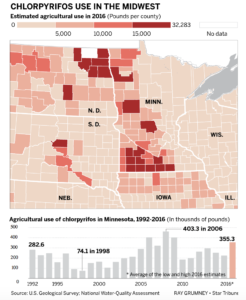
“Minnesota farmers watch a pesticide battle play out in courts,” by Adam Belz. Minneapolis Star Tribune (November 17, 2018).

The Star Tribune article noted that, “In the last two years of the Obama administration, it appeared the EPA was on course to ban the chemical, but in 2017, then-EPA Administrator Scott Pruitt denied the petition. His order said that chlorpyrifos needs further study and said the agency would need ‘greater certainty as to whether the potential exists for adverse neurodevelopmental effects to occur from current human exposure to chlorpyrifos.’

“The Ninth Circuit stepped in this past August, ruling that ‘there was no justification for the EPA’s decision in its 2017 order to maintain a tolerance for chlorpyrifos in the face of scientific evidence that its residue on food causes neurodevelopmental damage to children.’

“The EPA is now asking the court to rehear the case, and the appellate court has not decided whether to do so.”


Posted in Agriculture Law | Comments closed

New Madrid County (Missouri) Man and Farm Indicted on Illegally Applying Dicamba on Crops

A New Madrid County man accused of using the weedkiller dicamba on his cotton and soybean crops outside of Environmental Protection Agency guidelines likely caused significant damage to neighboring crops, the U.S. Department of Justice announced Tuesday.

“Bobby David Lowrey, 51, of Parma, is also accused of providing false documentation and making false statements about his use of dicamba on Lowrey Farms when the Missouri Department of Agriculture investigated crop damage reported by several neighboring farmers in June 2016.

“The federal indictment against Lowrey alleges 49 instances of misapplication of a pesticide, a false statement and three acts of obstruction of justice.”

The Post-Dispatch article noted that, “Lowrey is accused of disregarding guidelines that dicamba cannot be used in post-planting of cotton crops. He also allegedly violated the EPA’s guidelines regarding the limited application of dicamba on soybean crops. The Department of Justice reports that Lowrey’s crops, which span 6,700 acres, were genetically modified to be resistant to dicamba.

“If found guilty, Lowrey faces up to 20 years in prison and a fine up to $250,000.”

Posted in Agriculture Law | Comments closed

Tax Treatment of Equipment Trade-ins Gets Complicated

DTN Special Correspondent Elizabeth Williams reported today that, “Tax treatment of equipment trade-ins got a tune-up in 2017’s tax reform legislation. Experts say provisions restricting like-kind exchanges for machinery are offset by more generous rules on depreciation, resulting in little change to federal tax returns.

“The complication: many states didn’t follow suit, especially on like-kind exchanges, which are also known as 1031 exchanges and allow taxpayers to trade equivalent properties without a taxable event taking place.

“‘In my state, Minnesota, if the legislature does not fix the 1031 issue we may have farmers owing more to the state than to the IRS,’ said Rod Mauszycki, principal with CliftonLarsonAllen in Minneapolis, and DTN/The Progressive Farmer’s tax columnist. ‘Although I’m confident that a fix will be adopted, it might not be quick enough. As a result, we may have to delay filing the 2018 tax returns.'”

The DTN item noted that, “Without 1031 exchanges, the tax treatment of trade-ins becomes more complicated. It’s just one way changes to the tax code are forcing farmers to change their mindset.”

Ms. Williams pointed out that, “The amount of equipment and software that can be depreciated in a given year has been increased from $500,000 in 2017 to $1 million in 2018. The phase out for the $1-million availability begins after equipment purchases exceed $2.5 million in a given year. However, beginning Sept. 28, 2017, until the end of 2022, 100% bonus depreciation applies to almost all purchases of farm property, including used property. The bonus depreciation phases out beginning in 2023.

“Additionally, new farm equipment can now be depreciated over five years rather than the seven years previously allowed. However, used farm equipment depreciation continues with a seven-year life.

“Because Congress eliminated like-kind exchanges for equipment — it kept the provision for real estate transactions — equipment trades will now be considered as two transactions for tax purposes.”

Posted in Agriculture Law | Comments closed

Big Tech vs. Flyover Country

An update last week at the Real Time Economics Blog (The Wall Street Journal), stated that, “Amazon.com and Google’s decisions to add tens of thousands of jobs to New York and the Washington area reflect a growing divide in the U.S. A few big cities, particularly on the coasts, are soaking up high-tech talent and are also becoming wealthier, more liberal and more ethnically diverse—shifting the economic, political and cultural landscape of the nation, Shayndi Raice and Janet Adamy write.

“Smaller cities are also pulling in educated workers, but are having trouble competing for the nation’s most prized jobs and biggest projects, while rural areas are falling behind.”

The Journal indicated that, “As global competition dried up manufacturing jobs in small towns, the U.S. became more dependent on the growth of knowledge and service jobs that tend to proliferate in dense places. Five cities—New York, Chicago, Dallas, Houston, San Francisco—accounted for a third of all Fortune 500 headquarters and half of Fortune 500 firms’ profits last year, according to the University of Toronto’s Richard Florida. The Washington area, which had just four corporate headquarters in 1975, was home to 17 last year. New York had 70, more than any other U.S. city.

“In the past 10 years, employment in U.S. cities has grown 7% and the number of businesses has grown 11%, while employment has contracted in nonmetro areas and the number of businesses there has barely changed.”

In its annual Rural America at a Glance publication, the USDA’s Economic Research Service (ERS) pointed out that, “Since peaking at 10.3 percent in 2010, the rural unemployment rate steadily declined to 4.4 percent in 2017; urban areas followed suit, with unemployment dropping from 9.9 to 4.1 percent.”

However, ERS also pointed out that, “Although urban (metro) and rural (nonmetro) unemployment rates have declined at a similar pace since their peak in 2010, and both are now below their pre-recession levels, growth in employment has been slower in rural areas. Urban employment has grown steadily at about 1.6 percent per year since the fourth quarter of 2009 and had risen 8.2 percent above its pre-recession level by the second quarter of 2018. Rural employment has grown at about 0.5 percent per year, with periods of stagnation (2012-13 and 2016). Estimated rural employment in the second quarter of 2018 was still 1.8 percent below its pre-recession level. Rural America includes 14 percent of the Nation’s population but has accounted for only 4 percent of employment growth since 2013.”

Posted in Start-up Company Law | Comments closed

Real-Estate Use of So-Called 1031 Exchanges, Survived the GOP Tax Overhaul

Robyn A. Friedman indicated this week at The Wall Street Journal Online that, “The tax overhaul enacted last year made a lot of changes, but one provision cherished by real-estate investors survived: so-called 1031 exchanges.

“It’s the name for a tax break that lets you defer capital-gains taxes on the sale of a property used for business or investment if you reinvest the proceeds in another business or investment property. It’s often used by large real-estate investment companies, but individual investors—even those who own a single rental-income property—can take advantage of it as well. The ‘1031’ name refers to section 1031 of the U.S. tax code.

“‘You don’t have to be a professional investor to use this tax break to your advantage,’ says Andy Weiser, a real-estate agent with Better Homes and Gardens Florida 1st Real Estate in Fort Lauderdale, Fla. ‘You just have to be a smart investor.'”

The Journal item noted that, “The provision only applies to properties held for business or investment; a personal residence is not eligible for the tax break. You also must complete certain steps at set times. You have 45 days from the date of the sale of the old property to identify potential replacement properties. And you must acquire the new property no later than 180 days after the sale.”

Friedman added that, “Before the tax code overhaul this year, a variety of transactions—not just real estate—qualified for 1031 exchange treatment. These transactions, also called ‘like-kind exchanges,’ were allowed for any type of property used for business or held as an investment, including exchanges of personal or intangible property such as artwork or other collectibles. The new rules now limit exchanges to real estate only.

“But many types of real estate qualify. An investor can exchange a single-family home held for investment in New York for a farm in Colorado or a small strip shopping center in Las Vegas, as long as all those properties are used for business or investment purposes.”

Posted in Real Estate Law | Comments closed

Caution for Financially Distressed Farmers: Don’t Let Bad Circumstances Become Worse

A recent update from Iowa State University (ISU) Extension by Kristine A. Tidgren indicated that, “As tough times continue in the farm sector, more farmers are calling it quits. In particular, many operators who do not own ground and are dependent upon renting the land of others are struggling to hold on. Many are selling farm assets and securing full-time off-farm employment to make ends meet. It’s a quiet exodus, but it comes with hidden danger.

“Liquidating assets without a careful plan can generate tax consequences that will impair any hope for a fresh start down the road. As farmers weigh these tough decisions, it is imperative that they seek good counsel regarding their options. Although cash flow is tight, good advice is worth the investment.”

The ISU update explained that, “It is important to remember that depreciated assets, when sold, generate ordinary income tax liability. Depreciation is intended to allow farmers to write off the cost of a business asset over its useful life.”

Ms. Tidgren stated that, “If the owner sells the asset while it still has value, IRC § 1245 steps in to ‘recapture‘ ordinary income tax on the difference between the current basis of the asset and the sales price. The current basis is equal to the original cost, less any depreciation or expensing taken. In many cases, the basis may be zero. In other words, the sale of $100,000 of fully depreciated machinery will result in $100,000 of ordinary income, which is subject to income tax, but not self-employment tax.”

The ISU article also pointed out that, “A farmer enrolled in an [Affordable Care Act] insurance policy, relying on advanced premium tax credits to pay an affordable monthly premium, must realize that if year-end income exceeds 400 percent of the federal poverty limit, he or she may face a hefty tax bill. If the farmer enrolled in insurance expecting taxable income of $45,000, but ends the year with $49,000 in income, the advanced premium tax credit that must be repaid can climb into the thousands. Many who receive the advance premium tax credit do not understand the associated risks.”

Ms. Tidgren added: “These are just several of many traps for the unwary when navigating financial distress. The word of caution for financially distressed farmers is don’t let bad circumstances become worse. Consult with an attorney or tax advisor experienced in these matters before engaging in self-help measures, such as selling farm assets. The advice will be worth the cost.”

Posted in Agriculture Law | Comments closed

Tech Funding- Asking For More Money

Paula Sambo indicated recently at Bloomberg Online that, “Michelle Scarborough, who runs one of the world’s largest venture capital funds dedicated to female-led startups, sees one big difference between men and women in the space: men demand more money.

“Coaching women to make more forceful pitches is one of the things Scarborough does as managing director of the C$200 million ($152 million) fund she runs for the Business Development Bank of Canada.

“A man might explain how he’ll meet his sales target and ask for C$5 million to get him there, said Scarborough. A woman will tell her story and ask for help — not necessarily money.”

The Bloomberg item pointed out that, “After more than 20 years as an entrepreneur and investor, including at Toronto-based private equity firm Kensington Capital Partners, Scarborough said asking for what is necessary is serious business. She herself went back to BDC, a government-owned corporation, to ask the fund be increased from C$70 million in an effort to move the needle on gender dynamics in Canada’s tech industry.”

Ms. Sambo added, “Only 5 percent of Canadian tech companies have a solo female founder while 13 percent have a female co-founder, according to a study by #movethedial, a group dedicated to increasing women in tech.”

Posted in Start-up Company Law | Comments closed

EPA Region 7 Administrator Talks About Working With Agribusiness on Air and Water Laws

DTN Ag Policy Editor Chris Clayton reported yesterday that, “A year into his second stint as EPA’s Region 7 administrator, Jim Gulliford said he remains committed to compliance over enforcement in working with agriculture and other industries in the four-state region, which includes Iowa, Kansas, Missouri and Nebraska.

“Gulliford visited with DTN last week at EPA’s regional office in Lenexa, just after EPA Acting Administrator Andrew Wheeler had signed a proposed rule in the office seeking to amend the Emergency Planning and Community Right to Know Act to exempt animal livestock emissions from reporting requirements.

“Gulliford summed up the rationale for the proposal: ‘It just confuses them when they are getting reports of emissions,’ he said. ‘Generally when they receive reports of emissions, it’s a key or an indicator they need to respond to something — that there has been an accident, there’s been a release, just generally some kind of concern from human health impacts and the environment. That’s just not the case with these livestock operations.”

The DTN article stated that, “The National Pork Producers Council praised the proposal, citing the rule fits with legislation passed earlier this year by Congress, the Fair Agricultural Reporting Method, or FARM Act. The law exempts livestock farmers from emission requirements under the Comprehensive Environmental Response, Compensation and Liability Act, or CERCLA, which also is commonly referred to as the ‘Superfund Law.’

“The pork industry wants regulations that are practical and effective, but applying CERCLA and EPCRA to livestock farms would be neither, said Jim Heimerl, president of NPPC and an Ohio farmer. ‘Pork producers are very strong stewards of the environment and have taken many actions over the years to protect it,’ he said.

“Still, the proposal drew criticism from environmental groups over the impact on the health of rural Americans. Food and Water Watch and the Center for Biological Diversity were among groups critical of the rule.”

Mr. Clayton added: “Agriculture is the largest economic function in Region 7, by far, which puts the farmers in contact with water resources and air quality, Gulliford said. Still, if there are compliance problems with regulations, EPA’s goal is to get the industry, including agriculture, in compliance as quickly as possible.”

Posted in Agriculture Law | Comments closed

Omaha Startup Finds Success on the “Silicon Prairie”

Omaha World-Herald columnist Matthew Hansen indicated recently that, “You don’t need to be a genius to understand how Flywheel is changing Omaha. You don’t even need to fully grasp what the Omaha tech startup actually does.”

“Omaha startup has grown sales by more than 1,445 percent in 3 years. What’s its secret?” by Mathew Hansen. Omaha World-Herald (November 11, 2018- print edition).

Mr. Hansen explained that, “Five short years ago, this company that sells products and services to web designers had three employees: [37-year-old CEO, Dusty Davidson] and co-founders Tony Noecker and Rick Knudtson.

“Now, fueled by millions of dollars in outside investment, the number of Flywheel employees is nearing 200. Most are millennials who on a recent workday made sales calls, did product design and offered online tech support between guzzles of free sparkling water and games of fetch with [the office dog] Sharky.”

The World-Herald column stated that, “Flywheel’s aggression is interesting because it’s so un-Nebraskan in some ways. Davidson and his co-founders are seemingly succeeding at building a tech business from scratch, turbocharging its growth and then planning to sell it — likely for a whole boatload of money — within a decade.

“That’s a common move in Silicon Valley, but still uncommon on the so-called ‘Silicon Prairie.'”

Mr. Hansen added, “And, in the coming years or months, it seems likely that Davidson and his co-owners will sell to a larger company, completing the circle that happens weekly in Silicon Valley but not so often here.”

“[Davidson] said Flywheel’s owners will wait for the right price but also for a buyer who values what Flywheel values, including its Omaha location. The company’s founders would likely work at the newly acquired company for some period of time, he said.”

Posted in Start-up Company Law | Comments closed

States Struggle to Interpret New Dicamba Rules

DTN writer Emily Unglesbee reported yesterday that, “Just how complex will dicamba use be in 2019?

“So complex that the three new dicamba labels released by EPA last week are each around 40 pages long and accompanied by nearly 200 pages of documents detailing the herbicides’ registration requirements and their potential impacts on the general population, farmers and endangered species.

“States are working overtime to interpret the new XtendiMax, Engenia and FeXapan labels and struggling to take the proper first steps to prepare for 2019.”

The DTN article stated that, “Indiana’s pesticide regulators decided to drop all state-mandated dicamba training for its applicators in an effort to cut down on the state dollars and resources devoted to dicamba. Illinois agencies are knocking on EPA’s door, asking for clarification on the new applicator requirements, which could mean up to 5,000 applicators in the state are not qualified to apply these herbicides in 2019. And the Arkansas State Plant Board has voted to consider allowing dicamba use in 2019 with a June 15 cut-off.

“All are driven by a ticking clock — states have only a few short months to prepare thousands of applicators and farmers for the 2019 spray season — and the promise of a heavy workload ahead.”

Ms. Unglesbee added that, “For more information on the new dicamba labels and registration, see the EPA website here: https://www.epa.gov/ingredients-used-pesticide-products/registration-dicamba-use-dicamba-tolerant-crops

Posted in Agriculture Law | Comments closed