
Housing Pressure: Many Nonbank Lenders are Shutting Down

Wall Street Journal writer Christina Rexrode reported recently that, “Small and midsize U.S. mortgage firms are trimming staff, putting themselves up for sale and closing up shop at a clip not seen in years, a sign of the mounting pressure on the housing market as interest rates rise and a long economic expansion matures.

The number of nonbank mortgage lenders was down by about 3.5% at midyear from the end of 2017, according to the Conference of State Bank Supervisors. Mortgage-loan-originators at those firms dropped by more than 11,000 workers, or 7%, according to the group, which operates the system that processes mortgage licenses and registrations.

The declines follow years of significant growth for nonbank lenders, which have taken mortgage-market share from traditional banks by being nimble and sometimes knowing local markets better. Led by larger firms such as Quicken Loans Inc., Freedom Mortgage and loanDepot, nonbanks made more than 52% of $1.26 trillion in originations in the first nine months of 2018, according to industry research group Inside Mortgage Finance.”
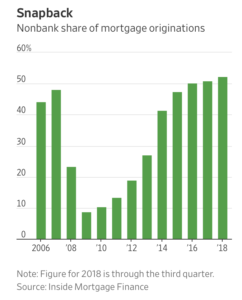
“Retreat of Smaller Lenders Adds to Pressure on Housing,” by Christina Rexrode. The Wall Street Journal (November 22, 2018).

The Journal article explained that, “Bankers and other industry watchers expect the ranks of smaller nonbank mortgage lenders to keep shrinking in coming months, as rising rates dry up the once-lucrative mortgage-refinancing business and make home purchases costlier. The nonbanks’ retreat adds to the concerns swirling about the health of the economy, particularly in the housing sector, which has slowed this year. Housing and lending are both major employers and widely followed leading indicators of future economic activity.”

The article added that, “‘Rising rates are headwinds to us,’ said Dan Gilbert, chairman of Quicken, the largest nonbank lender and one of the largest mortgage providers in the U.S., according to industry rankings. ‘When rates go low, those are tailwinds. But either way the plane has to fly,’ he said.

The shakeout also reflects the straitened economics of the housing industry, where sales are slowing amid concerns about declining affordability, and rising costs for materials and labor are helping to narrow the pipeline of future construction projects.”


Posted in Real Estate Law | Comments closed

Scientists in Helsinki Have Created an Edible Vaccine for Bees

Bloomberg writer Kati Pohjanpalo reported today that, “A growing number of honey bees die each year due to pesticides, vanishing habitats, poor nutrition and climate change, with potentially disastrous consequences for agriculture and natural diversity.

Now, scientists at the University of Helsinki have developed the first edible vaccine against microbial infections, hoping to save at least some of the pollinators.

“‘We might be right now at a tipping point, without even realizing it,’ Dalial Freitak, the lead scientist on the project, said in an interview on Wednesday. ‘We’ve been taking the pollination services for granted for so long. These insects are not there, they are disappearing.'”

The Bloomberg article noted that, “The vaccine is administered via an edible sugar patty that’s suspended in the hive for the queen to consume over seven to 10 days. After she ingests the pathogens, she is able to spark an immune response in her offspring, eventually generating an inoculated hive.

The vaccine still needs a lot of work before it can become commercially available. Scientists must ensure it’s safe for the environment, the bees themselves and humans who consume the honey. Regulatory hurdles will take years to clear. It’s also too early to estimate how much beekeepers will have to shell out to buy inoculated hives, Freitak said.”

Posted in Agriculture Law | Comments closed

Federal Affidavit Details Alleged Scheme to Defraud Minnesota Cooperative

DTN writer Todd Neely reported today that, “The man accused of stealing millions of dollars from the Ashby Farmers Cooperative in Ashby, Minnesota, has surrendered himself to federal authorities and now faces one count of mail fraud.

“Jerome Hennessey, 56, of Dalton, Minnesota, made his initial court appearance in the U.S. District Court for the District of Minnesota in Minneapolis on Tuesday, according to the U.S. Department of Justice.

“The former manager of the Ashby cooperative allegedly stole at least $2 million from the elevator from 2003 to 2018, before disappearing in September 2018.”

The DTN article stated that, “According to the affidavit, Hennessey allegedly caused the cooperative to make more than $1.1 million in payments to himself and more than $1.1 million in payments to a personal Cabela’s Visa card in Hennessey’s name. In addition, co-op funds allegedly were spent by Hennessey on hundreds of thousands of dollars in payments for ‘various expensive hunting trips and taxidermy services,’ the affidavit said.”

Mr. Neeley noted that, “Erik Ahlgren, an attorney hired by the cooperative, told DTN the cooperative is doing all it can to recover the money from Hennessey. In October the co-op filed a civil suit against him. Ahlgren said the co-op is considering additional lawsuits.

“‘We expect to obtain assets on behalf of the creditors but we do not expect to obtain sufficient assets to make the creditors whole,’ he said. ‘We are hopeful that Mr. Hennessey will cooperate in obtaining assets to repay the creditors but we do not expect Mr. Hennessey’s return to have a significant impact on whether we obtain a judgment against him and we will do the best we can, with or without his cooperation, to recover assets on behalf of the creditors.'”

Posted in Agriculture Law | Comments closed

Caution Advised for Grain Elevators in Year Ahead

Sara Schafer reported today at AgWeb Online that, “‘Cautious.’ That’s the word Will Secor, a grain and farm supply economist with CoBank, would use to describe the year ahead for grain elevators.

“‘There are some bright spots based on the fundamentals for corn and wheat,’ he says. ‘But there’s extreme caution when we think about the overall picture, as we incorporate what is going on in the soybean market.’

“Even with the recent news of President Donald Trump and Chinese President Xi Jingping agreeing to a trade truce, uncertainty remains. Combine that with farmers in challenging financial positions, likely interest rate hikes and other macroeconomic forces, and the outlook for grain elevators in 2019 looks volatile.”

Ms. Schafer noted that, “‘The big issue is the large crops,’ he says. ‘For an elevator, it’s not just the size of the crop, but it’s where the crop is; we have some surpluses in localized areas, but generally, there is tight supply of storage and capacity.’

Illinois and Nebraska will have the largest grain storage shortages, Secor says. Iowa, Kansas, Indiana, South Dakota and Ohio will also come up short.

“‘We’re hearing of a lot of producers using ag bags and opening up bins they haven’t used in years,’ he says. ‘It’ll be really interesting to see how it plays out.'”

Posted in Agriculture Law | Comments closed

Proposed Regulations Would Allow for More Home Sales Without Human Appraisals

Wall Street Journal writers Ryan Dezember and Cezary Podkul reported last week that, “The battle between man and bot has a new front: your mortgage.

“Federal regulators have proposed loosening real-estate appraisal requirements to enable a majority of U.S. homes to be bought and sold without being evaluated by a licensed human appraiser. That potentially opens the door for cheaper, faster, but largely untested property valuations based on computer algorithms.

“The proposal was made earlier this month by the Office of the Comptroller of the Currency, the Federal Deposit Insurance Corp. and the Federal Reserve. It would increase to $400,000, from $250,000, the value of homes that can be bought and sold without a tape-measure-toting appraiser visiting a property.”

The Journal writers explained that, “More than two-thirds of U.S. homes sell for $400,000 or less, according to U.S. Census data and the National Association of Realtors. If the regulators’ proposal had been in force last year, about 214,000 additional home sales, or some $68 billion worth, could have been made without an appraisal, regulators said in their 69-page proposal.

“Some worry, though, that dropping appraisal requirements would introduce new risks into the $10.7 trillion market for home loans.”

Last week’s article added that, “Scrapping the appraisal requirement would open a swath of new turf for upstart property valuation companies, like HouseCanary Inc., which use artificial intelligence, algorithms and sometimes even drones to value homes. Jeremy Sicklick, the company’s chief executive, said that replacing appraisers with computers will speed up home sales by weeks, reduce costs for buyers and eliminate human bias and error from the process of valuing mortgage collateral.”

Posted in Real Estate Law | Comments closed

Minnesota Task Force Looks at Ways to Protect the State’s Bees

Josephine Marcotty reported recently at the Minneapolis Star Tribune Online that, “After two years of sometimes fractious discussion, a task force charged with finding ways to protect the state’s bees and butterflies is proposing dozens of ideas to make Minnesota’s landscape more hospitable to pollinators.

“Chief among them: programs to add more clover and other flowers to lawns and farm fields, and tightening up on the wide use of the insecticide that carries much of the blame for their declining numbers.

“The task force, appointed by Gov. Mark Dayton, will present its findings to the state Environmental Quality Board, which is made up of the heads of key state agencies. The report is likely to result in proposals at the 2019 Legislature to create and fund some of the suggested programs.”

The article noted that, “The detailed, 60-page report also revealed a clear dividing line between the committee members who represented agriculture and those who represented environmental and conservation groups on the issues of insecticide use and regulation. While there was broad support for more education and improved habitat for pollinators, committee members were unable to reach consensus on ways to reduce insects’ exposure to neonicotinoids, the widely used class of insecticides that has proved to be one of the culprits in the pollinators’ decline. Instead, the report tallied the votes on each proposal and noted how each committee member voted.”

The Star Tribune article added that, “Dayton appointed the 15-member committee in 2016 in an effort to find common ground among disparate interests on how to protect bees and rapidly declining populations of wild pollinators.

“It included representatives from Syngenta, one of the leading manufacturers of neonicotinoid products; farmers from the state’s largest commodity groups; the Xerces Society for Invertebrate Conservation, a nonprofit; two U scientists; a beekeeper; educators; and a representative from the Pesticide Action Network, an environmental advocacy group.”

Posted in Agriculture Law | Comments closed

DTN: New Dicamba Registration Complicates Lawsuit in the Ninth Circuit Court of Appeals

DTN writer Emily Unglesbee reported this week that, “EPA’s decision to continue the registration of three dicamba herbicides has reverberated far beyond D.C. — through Midwest soybean fields, Southern cotton fields and all the way to Seattle, Washington, where the U.S. Ninth Circuit Court of Appeals is mulling a lawsuit over these very herbicides.

“Monsanto and EPA are now arguing that this lawsuit, which claims the original dicamba registrations are illegal and should be vacated, is ‘moot’ and should be dismissed entirely.

The court’s decision could have repercussions for U.S. farmers, who — operating under the expectation that dicamba applications will remain legal — plan to plant 60 million acres of dicamba-tolerant soybeans and cotton in 2019.”

The DTN article stated that, “The lawsuit was first filed against EPA in 2017 by four farm and environmental groups: National Family Farm Coalition, Center for Food Safety, Center for Biological Diversity and Pesticide Action Network North America. The groups argue that the federal agency broke the law when it first registered three dicamba herbicides (XtendiMax, FeXapan and Engenia) in 2016 for over-the-top use on Xtend soybean and cotton crops, by ignoring key requirements of the Endangered Species Act and the Federal Insecticide, Fungicide and Rodenticide Act (FIFRA).

“In August, three judges from the Ninth Circuit Court of Appeals heard arguments from both sides (see the video here: https://www.youtube.com/…) and then retired to consider their ruling.

“Then just two days after EPA’s dicamba registration decision landed late on Halloween night 2018, lawyers for Monsanto (now part of Bayer) filed a motion to dismiss the lawsuit entirely.

“‘As a result of EPA’s issuance of the new, superseding 2018 Registration, the 2016 Registration that Petitioners challenge is no longer in force, and a court order vacating that registration would have no legal or practical effect,’ the lawyers wrote in their motion, available via the court’s electronic case filing system. ‘The petition for review of the 2016 Registration is therefore moot, and this Court accordingly should dismiss the petition for lack of jurisdiction.'”

Ms. Unglesbee noted that, “Now all eyes rest on the judges of the Ninth Circuit, who will issue a decision on Monsanto’s motion in the coming weeks or months.”

Posted in Agriculture Law | Comments closed

Recent Index Shows Slow Growth in Home-Prices

Bloomberg writer Sho Chandra reported yesterday that, “Home-price gains in 20 U.S. cities grew in September at the slowest pace in almost two years, adding to signs that buyer interest is waning amid higher mortgage rates and elevated property values.

“The 20-city index of property values increased 5.1 percent from a year earlier, the least since November 2016, after rising 5.5 percent in the prior month, according to S&P CoreLogic Case-Shiller data released Tuesday. The median estimate in a Bloomberg survey of economists called for a gain of 5.2 percent. Nationally, home prices were up 5.5 percent from September 2017.”

“Home Prices in 20 U.S. Cities Rise Least in Almost Two Years,” by Sho Chandra. Bloomberg News (November 27, 2018).

The Bloomberg article added, “The report marks the sixth straight deceleration in price gains. It’s the latest in a spate of reports indicating housing is in a broad slowdown, with sales and home-building also showing signs of weakness.”

Posted in Real Estate Law | Comments closed

Tax Reform Lessens Burdens to Converting Your C-Corporation

Elizabeth Williams reported recently at DTN that, “There was a time when C-corporations made a lot of sense for farmers, but as tax laws changed and the benefits eroded, farmers found changing their business structure could be cumbersome and expensive. Tax advisers say 2017’s Tax Cuts and Jobs Act makes it easier than ever to make the switch.

“‘If you’ve been sitting on the sidelines waiting for a better time to get out of your C-corp, today is a good time,’ said Doug Claussen, certified public accountant with KCoe Isom in Goodland, Kansas.

“Many farm corporations were formed in the 1970s because of lower corporate tax rates, ease of farm succession and deductible fringe benefits.”

The DTN article noted that, “‘C-corporations were the best thing for many years until the 1986 tax law,’ Claussen said. But for many, the tax consequences of converting were too steep to justify a change.

The new law lessens the penalties for converting from a C-corporation to an S-corporation, and tax experts say it’s especially beneficial for farmers with an heir or heirs that aren’t involved in business operations. C-corporations also aren’t eligible for the new Section 199A deduction.”

Ms. Williams added that, “C-Corporations are not eligible for the new Section 199A deduction, which is reserved for individuals and pass through-entities like S-corporations.

“The new tax law cut the top corporate tax rate from 35% to 21%, while pass-through entities only saw their top rate decrease from 39.6% to 37%. The new Section 199a deduction of 20% for sole proprietors and pass-throughs was seen as a way to level the playing field with the new tax cut for C corporations.”

Posted in Agriculture Law | Comments closed

Wind Developers Take Down Turbines After Losing Iowa Legal Battle

Des Moines Register writer Donnelle Eller reported last week that, “Developers who invested $11 million to install three wind turbines in eastern Iowa are tearing them down, after losing a legal battle waged by nearby residents.

“It’s only the second time nationally a judge has ordered wind turbines to be torn down and a first in Iowa.

“‘It’s great. We love it,’ said Cheyney Hershey, whose young family lives near the turbines. ‘You can’t sit outside on the deck and have a conversation without the constant thumping of the blades going round.'”

Ms. Eller indicated that, “Opponents to the 450-foot turbines believe the legal battle will empower other rural landowners and small towns to take on wind.

“Residents in Palo Alto, Black Hawk and other counties are challenging wind projects as well.”

The Register article explained that, “In 2015, the Fayette County Zoning Board provided permits that allowed the wind developers to build the turbines.

“Nearby landowners challenged the permits in district court, where a judge agreed with them, saying the permits were ‘illegal and void.'”

“Developers appealed the decision, and decided to move ahead with construction.

But the Iowa Court of Appeals this year ruled in the city and residents’ favor. And the Iowa Supreme Court declined to consider the case, forcing the developers to tear down the turbines.”

Last week’s article added, “Wind energy supporters say the order could hurt new investment, jeopardizing jobs, landowner payments and tax revenue that come with the projects.”

Posted in Agriculture Law | Comments closed