Home Mortgage Rates: Credit Score an Important Variable

Michael Burge indicated in yesterday’s Los Angeles Times that, “Without a high credit score, you won’t qualify for the best mortgage rates available, which could mean you’ll end up paying more money over the term of your mortgage. Even with rates at historic lows right now, the difference between 3.5% and 3.75% can add up, especially if you’re applying for a 30-year fixed-rate mortgage.

“Along with a low debt-to-income ratio and a strong financial history, a high credit score gets you a low mortgage rate. But why?”

Mr. Burge noted that, “Lenders want to loan to people who have a record of on-time payments to creditors.

“‘If somebody has a high credit score, what that shows us is that they’ve been good on meeting their obligations, whether it be credit cards, car loans or other home loans in the past,’ says Brian Hoovler, a loan production partner with Peoples Home Equity in San Francisco. ‘It means we’re more likely to want to give you a loan because we know you’re going to pay us back.'”

The L.A. Times article explained that, “David Lin, a former director of risk management for consumer credit at Barclays and Citibank, said a score of 700 or higher will result in ‘a pretty good interest rate.’ He says that although you still can qualify for certain loans if your score is under 680, the 700s are where you want to aim to pay the lowest rates…[T]he lending industry carves up the credit score scale into 20-point increments and adjusts the rates it offers borrowers each time a credit score moves up or down by about 20 points. In the industry, this is called ‘loan-level pricing,’ and every time you go down a level, there’s an increase in costs, Hoovler says.”

Posted in Real Estate Law | Comments closed

Start-Ups in India See Opportunity in Online Delivery Market Through Local Grocery Stores

Simon Mundy reported yesterday at The Financial Times Online that, “Manish Supermarket appears typical of the kirana neighbourhood stores that have been at the heart of Indian communities for decades, its every available space crammed with goods from soap to biscuits.

“Yet amid the household essentials are two distinctly modern, smartphone-wielding young interlopers sent by Grofers, a technology start-up seeking a slice of an Indian ecommerce market that Morgan Stanley analysts predict will be worth $119bn by 2020.”

The FT article explained that, “A dizzying number of tech companies have emerged to offer Indian online shopping ventures in recent years. The number of web users increased by roughly 50 per cent to pass 300m between 2014 and 2015, according to the Internet and Mobile Association of India, and is expected to reach 462m this year. In a country where western-style hypermarket chains never took off, this has fuelled predictions that consumers will leapfrog directly from local family-run stores to ecommerce.

“But Grofers has taken a more nuanced approach, developing an ecommerce service that piggybacks on the age-old kirana network, enabling customers to order from their local store with a few taps on a smartphone.”

Mundy noted that, “To entice consumers to the platform, Grofers decided to ‘give them a look into the inventory’ of their local stores through a smartphone app, which customers would use to order products instead of calling the shop.”

Yesterday’s article added that, “There is an intimidating new competitor on the scene in the form of Amazon’s Indian subsidiary, which this year began testing its own grocery delivery service, which also relies on kirana stores and other local retailers.

“Still, some investors are sceptical about the notion of trying to integrate kirana stores, with long-established ways of operating, into ecommerce.

“‘If you take too much [commission] from the kirana shop, they’re going to say: why the hell am I bothering with you? You’re just giving him the customer that’s already coming to him,’ says Sandeep Murthy, a partner at the Mumbai venture capital firm Lightbox Ventures.”

Posted in Start-up Company Law | Comments closed

Food Service– An Increasingly Important Channel for Natural Food Startups

Beth Kowitt reported this week at Fortune Online that, “For decades there has been a tried and true path for natural food companies looking to grow: Start in your hometown’s natural food store. Next, try to get your products into your region’s Whole Foods and then build out with the natural food chain region by region. After that, see if you can get your goods placed on the shelves of conventional grocers like Kroger and Safeway, followed by mass retailers such as CVS and Target, and then finally club stores like Costco.

“Only at this point, when you’re a $150 million to $200 million brand by sales, would you consider selling your product via food service, the decidedly unsexy and low-profile food companies that provide meals in venues ranging from school cafeterias to corporate campuses to hospitals.

“‘There’s a lot of skepticism about going down the food service path—that it’s low margin and doesn’t translate into building a brand,’ says Alejandro Velez, co-founder of Back to the Roots.”

The article noted that, “But that’s exactly what he and his fellow founder, Nikhil Arora, decided to do with their burgeoning startup. Last month Sodexo, one of the world’s largest food service companies, started carrying Back to the Roots’ cereal with its school customers. This month the startup’s breakfast offerings will launch in the rest of Sodexo’s accounts. Velez says that his brand is displacing cereals that have higher sugar content.”

The Fortune article explained that, “Food service has become an increasingly important channel for natural food startups, which Velez says companies like Sodexo view ‘as the future.’ Sodexo in 2014 said it would purchase $1 billion in products and services over three years from small- and medium-sized enterprises; its other small partners include Paleo baked goods company Base Culture, Village Tea Company, and Gavina Coffee Company. Sodexo competitor Compass Group carried Hampton Creek’s vegan mayo early in the startup’s tenure and was the first to carry its dressings.

“Teaming up with small brands is a chance for food service companies to tap into consumers’ growing interest in natural foods and desire for transparency—an area where startups have led the rest of the industry.”

Posted in Agriculture Law, Start-up Company Law | Comments closed

If You Want to Run a Successful Tech Company, You Don’t have to Follow the Path of “Silicon Valley”

Farhad Manjoo reported in today’s New York Times that, “The typical start-up fairy tale goes something like this: You begin with young entrepreneurs from Stanford or Harvard who have come up with some novel idea for disrupting restaurants or dog walking or whatever else.

“After creating a prototype, the guys (they are almost always men) enter start-up boot camps like Y Combinator, recruit a group of early investors, and perhaps launch a Kickstarter with a slick video. If the initial plan succeeds, the founders go into heedless expansion mode, which usually means selling off huge chunks of their company in exchange for gobs of money from venture capitalists. Then, after a few years, if all goes according to plan, they hit the big time — an initial public offering and a chance to be the next face of the future.”

The Times article noted that, “Well, sometimes. What’s often left out of the start-up dream story is any mention that there’s another way.

“In fact, it’s possible to create a huge tech company without taking venture capital, and without spending far beyond your means. It’s possible, in other words, to start a tech company that runs more like a normal business than a debt-fueled rocket ship careening out of control. Believe it or not, start-ups don’t even have to be headquartered in San Francisco or Silicon Valley.”

Mr. Manjoo explained that, “There is perhaps no better example of this other way than MailChimp, a 16-year-old Atlanta-based company that makes marketing software for small businesses. If you’ve heard of MailChimp, it’s either because you are one of its 12 million customers or because you were hooked on ‘Serial,’ the blockbuster true-crime podcast that MailChimp sponsored.

“Under the radar, slowly and steadily, and without ever taking a dime in outside funding or spending more than it earned, MailChimp has been building a behemoth. According to Ben Chestnut, MailChimp’s co-founder and chief executive, the company recorded $280 million in revenue in 2015 and is on track to top $400 million in 2016. MailChimp has always been profitable, Mr. Chestnut said, though he declined to divulge exact margins. The company — which has repeatedly turned down overtures from venture capitalists and is wholly owned by Mr. Chestnut and his co-founder, Dan Kurzius — now employs about 550 people, and by next year it will be close to 700.”

Today’s article pointed out that, “As a private company, MailChimp has long kept its business metrics secret, but Mr. Chestnut wants to publicize its numbers now to show the road less traveled: If you want to run a successful tech company, you don’t have to follow the path of ‘Silicon Valley.’ You can simply start a business, run it to serve your customers, and forget about outside investors and growth at any cost.”

Mr. Manjoo pointed out that, “But if companies are forced to generate revenue from the beginning, ‘what you get really good at is making money,’ [Jason Fried, the co-founder of the software company Basecamp] said. ‘And that’s a much better habit for a business to work on early on, to survive on their own rather than be dependent on money people.'”

The Times article added that, ‘”Every time we sat down with potential investors, they never seemed to understand small business,’ Mr. Chestnut said. Venture capitalists always wanted MailChimp to serve ‘enterprise companies,’ large businesses with thousands of employees and, potentially, thousands to spend.

“‘Everybody we talked to said, ‘You’re sitting on a gold mine, and if you pivot to enterprise, you could be huge,’’ Mr. Chestnut said. ‘But something in our gut always said that didn’t feel right.'”

Posted in Start-up Company Law | Comments closed

Bipartisan Bill Would Help Startups and Small Businesses Invest in Research

A news release last week from Sen. Christopher Coons (D., Del.) stated that, “[Sen. Coons] and Pat Roberts (R., Kan.) introduced the Support Small Business R&D Act, legislation that will help startups and small businesses take advantage of the newly available research and development (R&D) tax credit.

“Specifically, the bill would require the Small Business Administration and Internal Revenue Service to partner to develop educational and training materials for entrepreneurs who invest in research and could be eligible to use the R&D credit to offset their expenses. These materials would be provided to SBA programs around the country and business development entities that partner with SBA programs, such as universities, business accelerators, and business incubators.

“At the end of 2015, Congress passed legislation that not only made the R&D credit permanent but also expanded the credit to allow more startups and small businesses to access it. The inspiration to expand the credit was drawn from a proposal by Senators Coons and Roberts known as the Innovators Job Creation Act. However, despite these changes to the credit, many small businesses do not have the information necessary to take advantage of this opportunity to offset their research costs. The Support Small Business R&D Act is designed to address that knowledge gap.”

The release added that, “‘We welcomed legislation passed by Congress in 2015 that expanded the R&D credit to provide access to startups and small businesses,’ said Stephen S. Tang, Ph.D, MBA, President, University City Science Center. ‘The challenge now is to raise awareness in the startup community. We believe the Support Small Business R&D Act is an important step towards encouraging the SBA and IRS, in partnership with business incubators like the Science Center, to help educate the startup community about the R&D credit. This critical legislation introduced by Senators Coons and Roberts will help us explain the benefits of the R&D credit to the startups that are driving economic activity in the Philadelphia and Delaware region.'”

Posted in Start-up Company Law | Comments closed

Another Year of Farm Losses is Beginning to Worry Grain Belt Farm Lenders

DTN Executive Editor Marcia Zarley Taylor reported recently at the Minding Ag’s Business blog that, “Another consecutive year of farm losses is beginning to worry Grain Belt farm lenders. Many thought liquid reserves accumulated during years of peak prices would help crop producers absorb multi-year losses now, but they may have underestimated the length and depth of this downturn.

“No one has a precise handle on the scale of the difficulties, but by mid-year, about 22% of the borrowers in the Kansas City Federal Reserve district were experiencing repayment problems, although only 7% of those were severe.

“A key issue is that much of the liquid wealth that farmers acquired during corn’s boom years will be gone by year-end, some economists now predict. Without a strong financial buffer, some farm operators will need to make serious course corrections to qualify for financing in 2017. That could set the stage for more cost cutting, farmland sales and downsizings in the year ahead.”

The DTN update noted that, “If USDA estimates of a $3.15 per bu. season average cash price for corn materializes, the [Farm Credit Administration] economists believe about 88% of corn farms can cover their operating costs, but a mere 17% are able to cover total costs this season, including land.

“The first item lenders monitor is how much working capital growers hold, in case they need to fund cash shortfalls from operations. Based on Illinois farm business records, University of Illinois economist Gary Schnitkey estimates in a recent farmdoc daily post that most of the extra working capital reserves his state’s farmers built during high-income years from 2007 to 2013 will be depleted by year-end. That would make working capital levels comparable to the low income years of 1996 to 2006.

“That’s not a disaster, but it does make finances fragile for below-average operators. Earlier farmdoc posts show, ‘In 2015 and 2016, [Illinois] working capital reserves were used to fund cash shortfalls coming from operations,’ Schnitkey reports. ‘If prices remain low through 2017, means other than reducing working capital likely will be needed to address cash shortfalls.'”

Ms. Taylor added that, “Evan Hahn, a senior agricultural analyst who covers large farm and agribusiness accounts for Farm Credit Mid-America in southwest Ohio, encourages borrowers to reach out to lenders early.”

Posted in Agriculture Law | Comments closed

GOP Lawmakers: Startups Can Benefit from Stock Options Tax Delay

House Majority Leader Kevin McCarthy (R., Calif.) and Rep. Erik Paulsen (R., Minn.) recently penned an opinion item at The Mercury News (Silicon Valley, Calif.) Online where the lawmakers indicated that, “As anyone who has tried to start a business or turn an idea into a reality knows, the most difficult period to stay afloat is at the beginning. In the startup world, it is particularly hard to find and retain employees in the earliest stages.

“Startups don’t have the resources to compete with well-established companies, and they can’t offer potential employees the same salary and benefits as employers that have already become household names. However, startups can offer employees something potentially worth much more than a decent paycheck: partial ownership of the company.

“At many startups across the country, stock options make up a significant portion of employees’ compensation while offering employees a greater stake in a project they truly believe in. It remains the case, though, that more and more startup employees aren’t exercising these stock options because if they do, they are required to immediately pay taxes on the income associated with the stock, even though they may not have the available cash to do so.”

The GOP lawmakers noted that, “The solution to this problem is simple. We need to defer the tax either until employees have a reasonable amount of time to pay it or until their stock becomes tradable on an established market and they can sell stocks to pay the bill.

“That is the purpose of Rep. Erik Paulsen’s Empowering Employees Through Stock Ownership Act, part of the House’s Innovation Initiative, which recently passed the House with bipartisan support and now goes to the Senate.

“This legislation allows employees who own less than 1 percent of the stock of a privately held company that offers stock options to at least 80 percent of its employees to defer tax payments for seven years or until they are actually able to sell their stock, whichever comes first.”

The opinion item added that, “The innovation economy is the key to America’s economic future, and a growing economy is the foundation of a stronger and more confident America for everybody. Giving startups room to grow at their inception and attract creative talent will keep America at the forefront of innovation, ensuring continued American leadership in the 21st century.”

Posted in Start-up Company Law | Comments closed

Some Home Buyers Opting for Startups Instead of Real Estate Agents

Carren Jao reported recently at the Los Angeles Times Online that, “Real estate agents used to be privy to a lot of information that home buyers couldn’t obtain on their own.

“But now property listings, photo galleries, historic sales prices, school ratings and neighborhood crime rates are freely accessible to anyone with just a few clicks. For some assertive buyers, that’s an invitation to bypass an agent and, in the process, cut out the pesky 5% to 6% commission that is traditionally split between the buyer’s agent and the seller’s agent.

“To help buyers go it alone, or close to it, several real estate start-ups have emerged that promise an easier solution to a notoriously stressful and expensive purchase. By eliminating or limiting an agent’s role, customers save money and streamline the process.”

The article stated that, “It’s also leading to tensions with the hundreds of thousands of real estate agents around the country, who say the companies are shortsighted and overlook the skills that a professional agent can offer.”

The L.A. times item noted that, “[One couple] turned to Open Listings, a Y Combinator-backed start-up that replaces most of what agents do with an online platform. The Los Angeles company helps customers find a home on their own by creating a personalized feed of available properties that meet their requirements, and sending them emails of open houses.

“It’s free for customers to use the service. Once a home has been purchased, Open Listings refunds customers half of the commission it receives from a successful transaction.”

Ms. Jao explained that, “Real estate start-up founders say the industry is ripe for change.

“According to the National Assn. of Realtors, 92% of buyers use the Internet during their home search and 68% of first-time home buyers are millennials, used to the conveniences of Airbnb and Uber to simplify routine transactions. The same demographic is similarly moving away from actively managed investments to lower-cost, automated financial advisors that provide a list of suggested portfolios and investment options.”

The article also pointed out that, “Sellers, too, are turning to real estate start-ups to help them save money.

“Dallas-based Door launched last year. Instead of carving out a roughly 6% chunk of the sale price for commissions, it charges sellers a flat fee of $5,000 plus 2% to 3% of the purchase price for the buyer’s agent. Denver-based Trelora has a similar model, although it charges sellers $2,500.

“SideDoor, meanwhile, earns its money from tangential real estate businesses like lenders, real estate lawyers and title companies that use SideDoor to find clients.”

Posted in Real Estate Law, Start-up Company Law | Comments closed

When Comparing Input Price Changes During Multiple Year Declines, Rent is an Outlier

Agricultural economists Carl Zulauf and Gary Schnitkey indicated recently at the farmdoc daily blog (“Comparing Input Price Changes during Multiple Year Declines: Rent as an Outlier in the Current Decline“) that, “Three multiple year declines in crop revenue and price have occurred since 1970 [See Figure 1]. The index of prices received by US farms for all crops peaked in calendar years 1981, 1996, and 2012 before declining for multiple years. The index bottomed in 1986 and 2000.”

Figure 1

The farmdoc update explained that, “Price behavior of the 6 individual input categories differs across the decline periods (see Figure 2). Price of fuels varies the most.”  In addition, “The ag services and rent price index is up 20% in the current period compared with a 5% increase from 1979-81 to 1986 and a 1% decline from 1994-96 to 2000. A price index for rent alone is available since 1990. It declined by 6% from 1994-96 to 2000, but has increased 24% since 2010-12.”

Figure 2

With respect to how input prices changed in periods of stable crop prices, the authors stated that, “Compared with the 1984-2005 period, the only input whose price is increasing faster during the current period is ag services and rent (see Figure 3).”

Figure 3

Among the summary observations included in the farmdoc update, the authors pointed out that:

“- Rental rates have increased notably more during the current period than during the earlier periods.

“- This finding lifts up the need to understand why rental rates have behaved differently in the current period of crop revenue and price declines. For example, have farmers used the relatively large savings from lower fuel and fertilizer prices to maintain land rental rates?

“- This finding nevertheless underscores the need to focus on rental rates in future cost adjustments.

“- A managerial lesson from the current period of crop price declines is the need to create and adopt crop leases that are more responsive to market conditions and thus share farm gains and losses more appropriately between farmers and farm land owners.”

Posted in Agriculture Law | Comments closed

Federal Crop Insurance for Specialty Crops: A Growing Focus

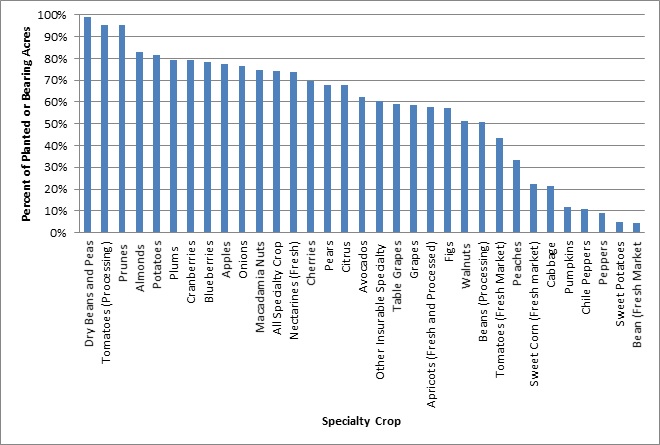
Mechel S. Paggi indicated recently at Choices Magazine Online that, “The federal crop insurance program has been the focus of increased attention following its enhanced role in the farm safety net resulting from the 2014 Farm Bill (Zuluf and Orden, 2014). Most often that attention has been directed at coverage for crops associated with traditional federal farm support programs, such as corn, wheat and soybeans (Babcock, 2016). However, as some researchers have pointed out, crop insurance is also a risk management tool for U.S. specialty crop producers, such as, fruit, vegetables, tree nuts (Coble, 2016). According to the most recent U.S. Department of Agriculture, Risk Management Agency (USDA-RMA) report around 73% of the acres devoted to specialty crop production have been covered by federal crop insurance programs (Figure 1) (FCIC, 2015).”

Figure 1, Choices Magazine

The Choices article stated that, “Efforts by USDA-RMA to develop risk management programs for specialty crops were encouraged by the Federal Crop Insurance Reform and Department of Agriculture Reorganization Act of 1994. During the period 1995 to 2003 USDA-RMA had policies in place that covered 32 specialty crops with active pilot programs for an additional 30 crops (USDA- RMA, 2004). In their latest Specialty Crop Report to Congress, the USDA provides a list of 38 specialty crops that are currently covered by federal crop insurance plans (FCIC 2015).

“The 2014 Farm Bill continued the move toward enhancement of specialty crop insurance coverage. One example was the call for the development of a whole farm revenue protection policy tailored to specialty crop producers.”

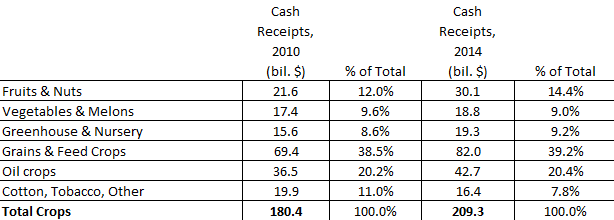
Dr. Paggi noted that, “The value of U.S. farm cash receipts from the sale of fruits, tree nuts, vegetables, melons, greenhouse, and nursery was $68.2 billion in 2014 up from $54.6 billion in 2010 (Table 1). The value of specialty crops accounts for over 30% of the cash receipts for crop sales in the United States.”

Table 1, Choices Magazine

After additional analysis, the Choices article added that, “Crop insurance plays a valuable role for specialty crop producers in managing risk. There is increasing focus on improving U.S. consumers’ dietary habits by promoting increased consumption of fruits, vegetables, and tree nuts. Providing the producers who supply U.S. specialty crops with a risk management safety net will likely continue to be a farm policy priority. There have been substantial improvements in the coverage levels and products available in recent years. Additional progress will likely depend on the decisions of policy makers in the future as they struggle to allocate increasingly scarce budgetary resources.”

Posted in Agriculture Law | Comments closed