An Update on the Next Farm Bill

A recent update at the American Farm Bureau Federation (AFBF) Online included a very helpful eight-minute video from AFBF’s Mary Kay Thatcher that provided a brief overview of the budget issues for the upcoming Farm Bill debate.

Furthermore, the AFBF page includes information being developed by a Farm Bill Working Group and the page will be updated as additional analysis is published.

Recall that earlier this week, Renée Jean a journalist with the Williston Herald (N.D.), pointed out that, “While the Farm Bill doesn’t expire until Sept. 30, 2018, some are calling for a new farm bill as early as possible. Republican Senator Chuck Grassley (R-IA), for example, on Wednesday said he cannot see why the bill couldn’t get done a year in advance, to better help farmers with prices this year, which have been even lower than 2015.”

Despite the chatter about an early Farm Bill, recall that last month, the Chairman of both the House and Senate Ag Committees expressed reluctance about the concept of an early Farm Bill while speaking at a public forum at the Kansas State Fair.

And Steve White reported yesterday at Nebraska TV Online (NTV- Kearney, Neb.) that, “Rep. Adrian Smith (R., Neb.) said he’s keeping a close eye on the ag economy.

“He told NTV, ‘Whether it’s row crops, whether it’s livestock — we’ve got some concerns. As we head into the debate for the next farm bill, I think it’s important to stay in tune with the realities that are around the ag world.’

“Many farmers were frustrated with the last farm bill, and Smith said he is hopeful the process will go better with the next one.”

The NTV update added that, “‘If we can just get it done on time, that’ll be a step in the right direction. The last debate was very discouraging. It was delayed — it didn’t need to be delayed, and we didn’t even get anything for that delay,’ [Rep. Smith] said.

“He said a goal of his is to reduce bureaucracy.”

With this background on mind, an update yesterday at FarmWeekNow Online stated that, “The current farm bill might not officially expire for a couple of years, but the discussion for the next one has already started. You’ll have three opportunities next month to offer ideas on what is important to you in the next federal farm bill.

“Illinois Beef Association, Illinois Corn Growers Association, Illinois Farm Bureau, Illinois Pork Producers Association and Illinois Soybean Growers are working together to host listening sessions throughout Illinois in November. Make plans now to attend.”

Specific dates, times and locations can be found here.

Posted in Agriculture Law | Comments closed

Lower Corn Prices Helpful to Cattle Producers, But Only Partially Stem the Red Ink

Purdue University agricultural economist Michael Langemeier indicated yesterday at the farmdoc daily blog (“Impact of Lower Corn Prices on Feeding Cost of Gain and Cattle Finishing Net Returns“) that, “Both fed cattle and corn prices have dropped significantly during the last year. Specifically, since September 2015 fed cattle prices in Kansas have declined approximately 23 percent (from $137.35 to $106.07 per cwt), and corn prices have declined approximately 16 percent (from $3.88 to $3.25 per bushel). Using these prices, the fed cattle to corn price ratio has declined from 35.4 in September 2015 to 32.6 in September 2016. Lower corn prices along with a lower fed cattle to corn price ratio naturally lead to questions pertaining to the impact of corn price on feeding cost of gain and cattle finishing net returns, the topic of this article.”

After a detailed analysis, Dr. Langemeier pointed out that, “Cattle finishing net returns are sensitive to changes in feeding cost of gain and the feeder to fed cattle price ratio. Regression analysis was used to examine the relationship between these variables. Results are as follows: each $1 increase in feeding cost of gain results in a decrease in cattle finishing net returns of $1.99 per head, and each 1 percent increase in the feeder to fed cattle price ratio results in a decrease of $7.62 per head in cattle finishing net returns. Using relationships between corn prices, feeding cost of gain, and cattle finishing net returns; the $0.60 decline in corn prices during the last year, holding all else constant, resulted in an increase in cattle finishing net returns of approximately $12 per head.

“This article examined the impact of lower corn prices on feeding cost of gain and cattle finishing net returns. Each $0.10 decrease in corn price results in a decrease in feeding cost of gain of approximately $1. In turn, each $1 decrease in feeding cost of gain results in a $2 per head increase in cattle finishing net returns. Using these values, holding all else constant, the $0.60 drop in corn prices since last August has resulted in a $6 per cwt. decline in feeding cost of gain and a $12 per head increase in cattle finishing net returns. The impact of lower corn prices on cattle finishing net returns may seem small to some industry observers. It is important note that the impact of lower corn prices on cattle finishing net returns is dampened by the fact that lower corn prices typically increase feeder prices. These relatively higher feeder prices adversely impact cattle finishing net returns. In summary, lower corn prices are helpful, but, unfortunately, they are only going to partially stem the red ink anticipated in the next few months.”

Posted in Agriculture Law | Comments closed

Wheat Production- Record Output is Exacting a Toll on Farmer Finances

DTN Ag Policy Editor Chris Clayton reported today that, “Farmers in the Plains are harvesting a corn crop that is paying roughly the same cash price as the winter wheat crop they are planting.

“Neither crop is expected to generate profitability, but wheat production is busting records and sharply taxing Wheat Belt growers’ financial reserves.”

Mr. Clayton pointed out that, “By Ohio State University calculations, inflation-adjusted 2016 wheat prices are the worst in 50 years, currently running 9% below 1998-2005 averages. (By the same token, corn’s 2016 inflation-adjusted price is expected to be up 19% compared to that depressed 1998-2005 era).”

“Before fall planting began, Kansas State University released an outlook that showed farmers would need winter wheat to yield 60 bushels per acre to break even. USDA estimated this year’s national average yield for winter wheat was 55.3 bpa. A lot of operations in Kansas are coming off a strong harvest year — the state average was 57.0 bpa for 2016, according to USDA’s latest estimates — so farmers are leery about the prospect of reproducing such a yield next harvest,” the DTN article said.

Mr. Clayton added that, “In terms of belt-tightening, [Marvin Anliker, market president of American State Bank & Trust Co., in Garden City, Kansas] said more farmers are forgoing chemicals, especially with weed management. Producers who learned to rely on chemicals to fallow ground and convert to no-till farming to conserve moisture now are breaking out the old iron to till for weed management as a cost-saving strategy…[S]till, Anliker said most farmers he works with are sitting in a pretty strong equity position, even though they may have burned through their working capital and cash reserves in the past two years. For farmers who are more highly leveraged, Anliker said his bank has been able to do some restructuring, as much as can be done, and gone to Farm Service Agency loan guarantees to stretch out the payments over longer periods. That reduces the cash-flow requirements needed on the farm.”

Today’s article also indicated that, “Farm Credit Services of America also has been very active with those who are stressed customers who have depleted or wiped out their working capital, said Bill Davis, chief credit officer for FCS America. Davis spoke at a financial and ag-law conference last month in Manhattan.

“Davis said farmers need to look at underperforming assets, such as marginal ground, and decide whether those assets would be better served converting to working capital. That could mean selling a tract that is a little farther away from the rest of the operation, for instance.”

Posted in Agriculture Law | Comments closed

Latest Government Reports Show Record Corn, Soybean Production

Jesse Newman reported yesterday at The Wall Street Journal Online that, “Government forecasters again boosted their outlook for a record U.S. soybean harvest but stopped short of the crop projections that have unnerved investors over the past several months.

“Corn production is also set for a record year and with plentiful domestic supplies of other crops such as wheat and rice, the U.S. has become more reliant on export markets to absorb the bumper harvests.”

Ms. Newman indicated that, “U.S. farmers are expected to harvest a record 4.269 billion bushels of soybeans, just shy of analysts’ expectations. The bump-up yield of 51.4 bushels an acre following August rains was in line with trade guesses, with some concerned yields could top 52 bushels…[T]he [USDA] expects [corn] production to reach a record 15.057 billion bushels on yields of 173.4 bushels an acre this fall.”

Graph From USDA

Reuters writer Timothy Ahmann reported yesterday that, “Expectations for bumper harvests have weighed on corn and soybean prices for months. Soybean futures have sagged 21 percent from their 2016 peak hit during mid-June while corn has fallen 22 percent during the same time period.”

In a separate report (World Agricultural Supply and Demand Estimates- WASDE) yesterday from the World Outlook Board indicated that, “The projected range for the season-average corn price received by producers is raised 5 cents on both ends to $2.95 to $3.55 per bushel.”

The WASDE report added that, “The soybean price is projected at $8.30 to $9.80 per bushel, unchanged from last month.”

University of Illinois agricultural economist Darrel Good discussed the government reports in more detail yesterday in an interview with Todd Gleason, a replay of that conversation is available here.

Meanwhile, Iowa State University ag economist Chad Hart indicated yesterday that, “With production approaching 4.3 billion bushels, the soybean market has never had more beans to work with. So again, it’s a story of record supplies and demand, but demand growth lags behind supply growth.”

Posted in Agriculture Law | Comments closed

Report on Big Data for Agriculture Released

A recent news release from the Council on Food, Agriculture & Resource Economics (C-FARE) indicated that, “[C-FARE], the national non-profit organization that channels information from the agricultural economics profession to policy-makers and the public, has released a report on Big Ag. Data. The report, entitled Advancing U.S. Agricultural Competitiveness with Big Data and Agricultural Economic Market Information, Analysis, and Research, was authored by a multidisciplinary team of economic and engineering scientists. Authors Keith Coble (Mississippi State University, Department of Agricultural Economics) and Terry Griffin (Kansas State University, Department of Agricultural Economics) released the document at the USDA National Institute of Food and Agriculture (NIFA) Data Science in Agriculture Summit.

“Coble, Griffin and co-authors, including Mary Ahearn (retired USDA-ERS), Shannon Ferrell (Oklahoma State University, Department of Agricultural Economics), Jonathan McFadden (USDA-ERS), Steve Sonka (University of Illinois, Department of Agricultural and Consumer Economics), and John Fulton (Ohio State University, Department of Food Agricultural and Biological Engineering), examine Big Ag. Data’s potential, challenges and opportunities, as well as future research questions and approaches for extension and outreach.

“The paper adds context to the growth trajectory of Big Ag. Data technologies, identifies policy and science questions, and reviews the limitations of, and opportunities for, greater use of Big Ag. Data and Big Ag. Data analytics.”

An executive summary of the report is available here, while the complete report can be found here.

Posted in Agriculture Law | Comments closed

Wind: The Newest Cash Crop for Some Farmers

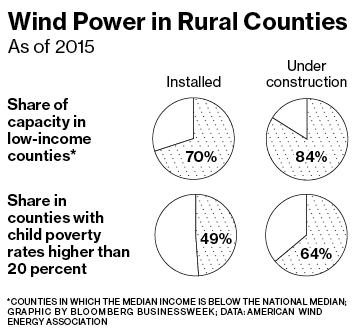
Bloomberg writer Jennifer Oldham reported recently that, “Wind energy, the fastest-growing source of electricity in the U.S., is transforming low-income rural areas in ways not seen since the federal government gave land to homesteaders 150 years ago. As commodity prices threaten to reach decade lows and farmers struggle to meet debt payments, wind has become the newest cash crop, saving family farms across a wide swath of the heartland.

“The money Richard Wilson earns from leasing his land for about 35 turbines run by the Golden West Wind Energy Center outside Colorado Springs has kept him from having to sell off pieces of the 6,000-acre cattle and wheat ranch his family has owned since 1948. ‘We weren’t making enough money to sustain ourselves,’ he says. ‘Now we’re in a position where we can operate our farm for another generation at least.’

“For others, turbines spin off six-figure incomes that have allowed them to retire from farming altogether.”

Graph From Bloomberg News

The Bloomberg article noted that, “The more than $100 billion that companies have invested in wind power in low-income counties—where about 70 percent of wind farms are located—has helped double assessed land values in some of the poorest parts of rural America. That’s provided a much-needed infusion of local tax revenue that’s being used to rebuild schools and pay down debt.

“A five-year extension of a federal tax credit on wind production, passed at the end of last year, should accelerate the construction of turbines.”

Ms. Oldham added that, “In Iowa, which got 31 percent of its power from wind in 2015, more than any other state, money from turbines has protected farmers from falling corn prices. Annual lease payments of about $17 million helped some avoid foreclosure as they prepared for a record corn harvest that could drive receipts to a 10-year low. Tim Hemphill, a corn and soybean farmer outside Milford, gets about $20,000 a year for leasing land for turbines. ‘A few years ago corn was $7 a bushel,’ he says. ‘Now my cost to raise it is $4.20 and [the price] could fall to $2.70. It’s going to break a lot of people.’

“Wind is also keeping power prices low across much of rural America. In the 11 states that produce more than 7 percent of their power from wind, electricity prices fell 0.37 percent from 2008 to 2013; nationwide, power prices were up 7.7 percent during that period.”

Posted in Agriculture Law | Comments closed

Dairy: Farmers on Track to Produce the Most Milk Ever this Year- Pouring out Tens of Millions of Gallons of Excess

Kelsey Gee reported yesterday at The Wall Street Journal Online that, “U.S. agricultural officials stepped in to help dairy farmers for the second time in less than three months, pledging to buy another $20 million worth of cheddar cheese as prices remain the lowest in years.

“Dairy farmers are on track to produce the most milk ever this year. In August, they urged the U.S. Department of Agriculture to support the market by buying as much as $150 million worth of products for food pantries and other government programs. The USDA initially said it would buy $20 million worth of cheese, or around 11 million pounds, two months ago.

“‘USDA is making use of every tool that we have to help them,’ Agriculture Secretary Tom Vilsack said after regulators met dairy producers on Tuesday in La Crosse, Wis.”

Ms. Gee explained that, “U.S. farmers are reckoning with a glut in commodities from corn and soybeans to pork and poultry, thanks to favorable weather at home and skyrocketing output globally.

“The oversupply is expected to prompt the third straight year of falling farm incomes. U.S. dairy farmers in August were making $17.10 per hundred pounds of milk, down 30% since prices hit records two years ago.”

Meanwhile, in an article posted today at The Wall Street Journal Online (“America’s Dairy Farmers Dump 43 Million Gallons of Excess Milk“), Ms. Gee reported that, “Farmers in the U.S. are pouring out tens of millions of gallons of excess milk, amid a massive glut that has slashed prices and has filled warehouses with cheese.

“More than 43 million gallons’ worth of milk have ended up in fields, manure lagoons or animal feed, or have been lost on truck routes or discarded at plants, according to data from the U.S. Department of Agriculture. That is enough milk to fill 66 Olympic swimming pools, and the most wasted in at least 16 years’ worth of data requested by The Wall Street Journal.”

Ms. Gee indicated that, “Desperate producers are working to find new uses for the excess, like getting more milk into school lunches, and in revamped tacos and Egg McMuffins. But many can’t even afford to transport raw milk to market at current prices, which have plunged 36% on average since prices hit records in 2014.”

Today’s article added that, “Dairy and meat producers in the U.S. and abroad expanded their operations two years ago in response to a shortage, setting the stage for the current global glut.

“American farmers are in the process of harvesting record-large corn and soybean crops, and meatpackers are now producing the most ever meat and poultry. As a result, food prices in the U.S. have plummeted and farm incomes this year are headed for their third consecutive drop.”

Posted in Agriculture Law | Comments closed

Analyst Sees Improved Prospects for Farm-Machinery Manufacturers Ahead

Bloomberg writers Lydia Mulvany and Arie Shapira reported yesterday that, “Deere & Co., the world’s largest farm-machinery manufacturer, was upgraded by a Wells Fargo & Co. analyst who said the industry’s demand cycle will reach a bottom in the next year to 18 months.”

Yesterday’s article explained that, “Moline, Illinois-based Deere may already be seeing improved demand in Brazil, parts of Europe, Ukraine, Russia and India, [Wells Fargo analyst Andrew Casey] said. The company will also see better returns than competitors over the next 10 years due to reductions in structural costs, and its initiatives in agricultural technology.

“‘Demand appears to be flattening as dealer pricing drops’ in the U.S. and Canada, Casey wrote.

“Such a recovery would bring much-needed relief to Deere, which has cut production amid a recession in the agricultural economy. When the company reports earnings next month, it’s expected to post a third consecutive year of falling revenue and net income.”

The Bloomberg article added that, “The main culprit for lower farmer spending is the glut of grain and soybeans, which has driven down crop prices. In such an environment, growers haven’t been as willing to purchase new Deere tractors, which can cost hundreds of thousands of dollars. Instead, they have continued to rely on existing equipment, or turned to cheaper used tractors and combines.”

Posted in Agriculture Law | Comments closed

Egg Industry Battled Against Vegan Mayo Start-Up

Geoffrey Mohan reported on the front page of today’s Los Angeles Times that, “With its egg-free recipe, Just Mayo had become a darling of vegans, a hot investment for Silicon Valley venture capitalists and an avatar for alternatives to industrial agriculture.

“But to the nation’s $7-billion egg industry, Just Mayo posed an existential crisis so serious that a federally supervised trade group launched a secret two-year campaign to thwart the San Francisco start-up that makes it.

“The campaign against Beyond Eggs, the original name of company behind Just Mayo, included flirting with an offer from a consultant who bragged he could rid the product from Whole Foods’ shelves ‘with one phone call,’ and jokes among American Egg Board members and affiliates about ‘pooling our money to put a hit’ on the company’s founder, emails show.”

From the Front Page of today’s Los Angeles Times

Today’s article noted that, ” The investigation, sparked by documents obtained through the Freedom of Information Act by a Massachusetts Institute of Technology researcher and his Washington attorney, reveals the lengths the American Egg Board appeared willing to go to crush Just Mayo, its manufacturer, now called Hampton Creek, and the firm’s founder, Josh Tetrick.

“Federal investigators did not find the campaign amusing, slamming the American Egg Board for overstepping its congressional mandate and chiding its overseers at the U.S. Department of Agriculture in a lengthy investigation that was quietly released on the agency’s Freedom of Information library page late Thursday.

“The American Egg Board, an industry-funded promotion group overseen by the U.S. Department of Agriculture’s marketing branch, spent at least $59,500 to counter the product’s publicity advances.”

Mr. Mohan added that, “Investigators found that the board’s monitoring of a specific company and product and its attempt to undermine them were inappropriate and exceeded the 1976 bylaws that govern the 18-member board, which is appointed by the secretary of Agriculture and uses the $20 million in annual fees it collects from large-scale producers to support research and promote the egg industry.”

The L.A. Times article also noted that, “Beyond Eggs won customers and attention by taking aim at the industrialized food chain, its chemically enhanced production practices and its treatment of animals.

“But that public image soon tarnished. More critical looks at company practices revealed that Hampton Creek hired contractors to buy back its products from grocery shelves, which could create false sales figures. Tetrick said the moves were part of quality control testing. The revelation, published by Bloomberg, nonetheless sparked an investigation by the Securities and Exchange Commission and Justice Department.

“Hampton also jousted with the Food and Drug Administration, which monitors claims and labeling of food products, and was concerned whether ‘Just Mayo’ described a true mayonnaise, which has egg in its recipe.”

Posted in Agriculture Law, Start-up Company Law | Comments closed

A Closer Look at the Farm Safety Net

Purdue University agricultural economist Michael Langemeier indicated recently at the farmdoc daily blog (“An Update on the Farm Safety Net“) that, “In an earlier article (farmdoc daily, April 28, 2016), we projected earnings for a case farm in west central Indiana, and examined the sensitivity of earnings and farm program payments to changes in price and yield. Using base corn and soybean prices of $3.75 and $8.73, projected earnings for a corn/soybean rotation in our earlier article was a loss of $126 per acre. This article updates projected earnings and reexamines the sensitivity of farm program payments to possible prices and yields for this fall’s crops.”

The update noted that, “When the crop insurance and farm programs were initiated, it was anticipated that they would provide an effective safety net for farmers who might encounter significant price and/or yield reductions due to changing market conditions or weather/disease events. But crop insurance indemnities adjust to market conditions over time. If prices systematically decline, the potential indemnity also declines. Farm program payments under the ARC-CO program are capped, and they decline as market prices increase. So in contrast to the most recent direct payment program that resulted in a pre-specified amount of income and cash irrespective of market prices, under the current program higher prices may result in more income from the market and less from the government in many circumstances (a ‘dead zone’). Also, it is important to note that cash payments from the ARC-CO program are not received until approximately a year after the crop is harvested, so they are not available to meet cash flow requirements in the year of actual production.”

The farmdoc update stated that, “Average projected gross revenue and earnings for the 2014 to 2018 period are presented in table 1 for an Indiana case farm in west central Indiana (White County). Actual county yields were used for 2014 and 2015. Crop prices for the 2014/15, 2015/16, and 2016/17 crop years were estimated using the September 2016 WASDE report (USDA, 2016). Yields for 2016 were assumed to be 10 percent above trend yields. Base prices (medium price scenario in table 1) for corn and soybeans in 2016 were $3.20 and $9.05 per bushel, respectively. Trend yields were used to estimate 2017 and 2018 crop yields. The medium price forecasts for the 2017 and 2018 crop years were obtained from FAPRI; these prices are $3.57 and $3.80 for corn, and $9.44 and $9.64 for soybeans, respectively. The low price scenario and the high price scenario assumed that corn (soybean) price was $0.25 ($0.60) lower and higher, respectively, from 2016/17 to 2018/19, than the medium price forecasts. Purdue crop budgets for average productivity soil (Dobbins et al., 2016) and cash rent estimates reported in the latest Purdue cash rent and land value survey (Dobbins and Cook, 2016) were used to estimate production costs for 2014, 2015, and 2016. With the exception of cash rents, the other production costs were assumed to remain constant in 2017 and 2018. Cash rent per acre was assumed to decline 5 percent in 2017 and an additional 5 percent in 2018.”

Table 1

After more detailed analysis regarding the sensitivity of ARC-CO program payments to prices and yields and the sensitivity of the farm safety net (including crop insurance) to prices and yields, Dr. Langemeier concluded the farmdoc update by pointing out that, “This article examined earnings per acre projections for a case farm in west central Indiana. Under the price and yield combinations or scenarios examined in this paper, annual projected earnings per acre were negative from 2014 to 2018 for the case farm. The results also illustrated the gaping holes in the farm safety net. The safety net for 2016 was of particular interest in this article. The strong expected yields this fall have improved the outlook for earnings in 2016 from previous estimates. However, expected earnings are still relatively low. Even with ARC-CO payments and crop insurance indemnity payments, 44 percent of the 2016 price/yield combinations examined had negative earnings that exceeded $100 per acre. Using base corn and soybean prices of $3.20 and $9.05 per bushel, projected earnings for a corn/soybean rotation was a loss of $96 per acre, which is $30 higher than our April projection.

“In summary, there are three issues related to the farm safety net we are currently facing. First, the ARC-CO payment caps limit mitigation of downside risk. Second, as crop prices increase, the ARC-CO payments often decline, resulting in a less effective safety net. Third, the decline in the crop insurance revenue guarantee since 2012 has contributed to the large decline in the case farm’s ability to mitigate downside risk. Further adjustment of the ARC-CO payments and crop insurance indemnities to expected future continued weak market conditions suggest that the farm safety net will likely be lowered further in 2017 and 2018.”

Posted in Agriculture Law | Comments closed