Summer Tax School Centers on Farm Taxes

An update this week from the University of Missouri Extension Service stated that, “University of Missouri Extension will sponsor a Summer Tax School July 6 at Stoney Creek Hotel & Conference Center, Columbia, Mo.

“MU Extension agricultural business specialist Mary Sobba says the program centers on farm tax issues.

“Speakers include a tax law professor, a retired Internal Revenue Service agent and a Missouri Department of Revenue employee.”

The release indicated that, “Early-bird registrations are due June 22. Register at extension.missouri.edu/agtax.”

Posted in Agriculture Law | Comments closed

Second Lady Karen Pence, Ag Secretary Sonny Perdue Install Beehive at Vice President’s Residence

A news release yesterday from USDA indicated that, “Second Lady Karen Pence and Agriculture Secretary Sonny Perdue today unveiled a newly-installed beehive on the grounds of the Vice President’s residence, drawing attention to the plight of pollinators whose numbers are in decline. Together, the two urged Americans to do their own part to help reverse the population trend among the creatures, which are essential to producing much of the nation’s food.

“‘All types of pollinators, such as bees, butterflies, birds and bats, are critical to providing our nation’s food, fiber, fuel and medicine,’ Mrs. Pence said. ‘However, our beekeepers have been losing colonies for many years. This presents a serious challenge to our ability to produce many of the agricultural products that we enjoy today. The bees at the Vice President’s Residence will provide an added bonus to the vegetable and flower gardens by making them well pollinated and taste even better at harvest.’

“Perdue released a proclamation he has signed declaring June 19-25, 2017 as ‘National Pollinator Week.’ Perdue noted that the U.S. Department of Agriculture (USDA) and the Environmental Protection Agency led efforts to create a National Pollinator Health Strategy. The two agencies are working with a number of other federal departments to implement that strategy, which includes significant USDA research.”

The USDA update noted that, “Honeybees are the nation’s primary pollinators, adding at least $15 billion a year in value to about 90 crops by increasing yields and helping to ensure superior-quality harvests. Those crops include nuts, fruits, berries and vegetables, which add color, taste and texture to our diet.”

Posted in Agriculture Law | Comments closed

New York Company, Square Roots, Joins Expanding Industry of High-Tech Indoor Farming

Thomas MacMillan reported yesterday at The Wall Street Journal Online that, “In a factory parking lot in Brooklyn, a crowd of about 100 people gasped and murmured as Tobias Peggs cracked open the heavy metal doors of a white shipping container, allowing pink light to spill out from within.

“The interior of the container looked like a dance club, or a space station: Strips of dangling LED lights glowed red and blue, illuminating white plastic panels. Leafy green vegetables grew from the walls.

“Mr. Peggs, 45 years old, chief executive of a new company called Square Roots, recently was leading a farm tour of his new urban agriculture operation in the Bedford-Stuyvesant neighborhood of Brooklyn. The shipping container was a vertical farm, one of the company’s 10 located in the parking lot, each capable of growing the equivalent of 2 acres of crops in a carefully controlled indoor environment, he said.”

The Journal article stated that, “Square Roots, which uses hydroponic technology to raise a variety of herbs and greens, is one of the latest companies to join the expanding industry of high-tech indoor farming. Proponents of vertical farming say it is designed to meet the increasing demand for locally grown food—fueled by distrust of large-scale industrial agriculture—at a time when more people are moving into cities.

“Square Roots, co-founded by Kimbal Musk, brother of famed inventor and businessman Elon Musk, isn’t only growing vegetables. The company is trying to cultivate a network of food entrepreneurs by operating a kind of apprenticeship program. Each of its 10 shipping-container farms is run by a different entrepreneur selected from hundreds of applicants.”

Mr. MacMillan also pointed out that, “Messrs. Musk and Peggs have a grand vision: A network of Square Roots farms in urban centers across the U.S., each supplying locally grown produce to city-dwellers, while transforming mostly young people into urban farmers and food entrepreneurs. While there is no age limit, the farmers in the first group range from 22 to 30 years old, Mr. Peggs said.”

Posted in Agriculture Law | Comments closed

Ag Groups Concerned About GOP Proposal on Interest Deductions

Naomi Jagoda reported yesterday at The Hill Online that, “More than 30 agriculture groups are expressing concerns about House Republicans’ proposal to eliminate the deduction for interest expenses as part of corporate tax reform.

“‘As Congress works to enact comprehensive tax legislation, the positive reforms made should not be undermined by negative, unintended consequences as a result of eliminating the business interest deduction for agricultural entities,’ the groups wrote in a letter earlier this month to House Ways and Means Committee Chairman Kevin Brady (R-Texas) and ranking member Richard Neal (D-Mass.).

“The tax reform blueprint that House Republicans released last year proposed eliminating the interest deduction because it would instead allow businesses to immediately write off the full costs of their capital investments. The elimination of the interest deduction has been estimated to raise more than $1 trillion in revenue that can be used to offset cutting tax rates.”

The Hill article noted that, “But some businesses and policymakers have been pushing to keep the deduction for businesses’ interest costs. Treasury Secretary Steven Mnuchin has said that the administration’s preference is to keep the deduction because of its importance for small- and medium-sized businesses.

“The agriculture groups said in their letter that most family-owned farms rely heavily on credit, and that agricultural producers use debt financing to purchase land and equipment.

“‘Eliminating the interest deduction will place further financial stress on an already debt-burdened industry, and prevent producers from staying profitable in challenging economic times,’ they said.”

Posted in Agriculture Law | Comments closed

“Pink Slime” Defamation Trial Against ABC News Set to Begin

Jacob Gershman and Lukas I. Alpert reported yesterday at The Wall Street Journal Online that, “Opening statements in what could be the largest defamation case in U.S. history are set to begin Monday in a South Dakota courtroom.

“In suing ABC News for its coverage of a widely used processed-meat product that the news organization and others have branded ‘pink slime,’ Beef Products Inc. claims it was a victim of a journalistic hit job. The family-owned South Dakota meat processor claims the reporting reduced its revenues.

“Raising the stakes is a state food-disparagement law that allows prevailing plaintiffs to triple actual damages. Beef Products has alleged $1.9 billion in damages. That means, in theory, ABC could be hit with a nearly $6 billion judgment, not including any potential punitive damages awarded if it were to lose.”

The Journal article noted that, “ABC, a unit of Walt Disney Co. , says it never reported anything about the beef that it knew to be a lie and contends Beef Products is trying to punish it for making reasonable editorial judgments.

“The case will go before a 12-person jury at a time when opinion polls have shown declining trust in the media. In court documents, Beef Products has referred to ABC’s coverage as ‘fake news,’ a term, widely used to describe scurrilous internet reporting, that has broadened in use since the 2016 presidential election.”

Gershman and Alpert added that, “To prevail, Beef Products will have to show that ABC acted with actual malice, meaning it must prove that the news organization either knew the information was false or recklessly disregarded the truth.”

Posted in Agriculture Law | Comments closed

Farmer Lawsuit Against Syngenta Over China Trade Goes to Trial Today

Associated Press writer Jim Suhr reported today that, “The first of tens of thousands of U.S. lawsuits will go to trial on Monday in Kansas against Swiss agribusiness giant Syngenta over its decision to introduce a genetically engineered corn seed variety to the U.S. market before China approved it for imports.

“The lawsuits allege Syngenta’s move wrecked an increasingly important export market for U.S. corn and resulted in price drops that hurt all producers. Court filings show Syngenta aggressively marketed the seeds even when it knew Chinese approval was going to be a problem.

“Plaintiffs’ experts estimate the economic damage at about $5 billion, though Syngenta denies its actions caused any losses for farmers.”

Mr. Suhr explained that, “Monday’s trial in Kansas City, Kansas, involves four Kansas farmers representing roughly 7,300 farmers from that state, according to William Chaney, an attorney for the plaintiffs. It will mark the first test case. The second, involving about 60,000 cases, goes to trial July 10 in a state court in Minnesota, where Syngenta’s North American seed business is based in suburban Minneapolis. The two cases are meant to provide guidance for how the complex web of litigation in state and federal courts could be resolved.”

Posted in Agriculture Law | Comments closed

A 5% Increase in Revenue, While Decreasing Costs 5%, Can Have Big Impact on Farm Business Bottom Line

An update yesterday from University of Minnesota Extension stated that, “A single 5% improvement may be easy to overlook, but you should not take this small improvement for granted. Increasing revenue 5% while also decreasing costs 5% can have a big impact on your bottom line.

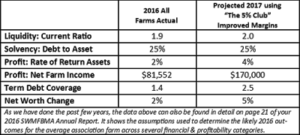
“The table below compares actual outcomes for the average Southwest Minnesota Farm Business Management Association farm in 2016, to the projected 2017 results for the average association farm if it joins ‘The 5% Club.’ Our analysis of ‘The 5% Club’ compares farm performance if the average association farm improves gross revenues by 5% and lowers operating costs by 5% over 2016 for 2017.

“It is impressive how just these small changes result in Net Farm Income of an average farm more than doubling to $170,000 and Term Debt Repayment Capacity improves from 1.4 in 2016 to 2.4 in 2017. In 2016, the same 5% changes would have almost tripled Net Farm Income for the average farm. Therefore, small changes have a BIG impact on your bottom line. Attention to the correct details can make a real difference.”

Projected Impact of Improved Margin Management; 5% Increase in Revenue & 5% decrease in Costs on the average SWMFBMA Farm (University of Minnesota Extension).

The update added that, “Is it possible to achieve a 5% improvement in gross revenue? Probably. Do a little better than average on selling prices, yields or a little of both. Be willing to sell portions of your production when profitable pricing opportunities are available.”

“Is it possible to lower costs by 5%? Probably. Being more effective with expenditures on inputs is one of the real keys. Getting the most revenue possible for each dollar spent on herbicides, pesticides, seed, fertilizer, and feed is very important,” yesterday’s extension item said.

Posted in Agriculture Law | Comments closed

Corn Seed Treatment and Potential Risks to Honey Bees

A recent news release from Purdue University indicated that, “Nearly every foraging honey bee in the state of Indiana will encounter neonicotinoids during corn planting season, and the common seed treatments produced no improvement in crop yield, according to a Purdue University study. (Click http://purdue.ag/perilstopollinators for a video abstract).

“Neonicotinoids, including clothianidin and thiamethoxam, are a class of insecticide commonly applied as a coating to corn and soybean seeds to protect them from early-season pests. Since the coatings are sticky, a talc or graphite powder is added to vacuum systems in planters to keep the seeds from clumping. Powder exhausted from the planter contains neonicotinoids.

“The United States is losing about one-third of its honeybee hives each year, a significant problem since the bees pollinate many crops used to feed people and livestock. Neonicotinoids, which are highly toxic to honeybees, are being scrutinized as a possible contributor to the losses.”

The news update noted that, “Christian Krupke, a professor of entomology, showed in 2012 that exhausted insecticides collected on flowers that border agricultural fields and were present in hives near those fields. Bees in those hives showed physical signs of insecticide poisoning, and dead bees tested positive for the neonicotinoids used as seed treatments of corn and soybeans.

“Now, Krupke, along with collaborators Jeff Holland at Purdue, Elizabeth Long at Ohio State University, and Brian Eitzer with the Connecticut Agricultural Experiment Station, have measured the drift of those neonicotinoids from fields and found that the insecticides can settle on flowers up to 100 meters from the edge of the planted fields, the farthest distance examined in the study. Their findings are published in the Journal of Applied Ecology.”

The Purdue update added that, “Mapping Indiana’s corn acreage, as well as the areas that may receive drift, the authors say that 42 percent of the state is exposed to neonicotinoids during crop planting. Looking at public data on the location of apiaries and projecting the range that honey bees forage, they found that 94 percent of bees could fly through areas that contain lethal doses of the insecticides during the period when corn is planted.”

Posted in Agriculture Law | Comments closed

Opendoor, a Model For a New Kind of Tech Upstart: The Fat Start-Up

In 2003, Keith Rabois, a longtime Silicon Valley investor and executive, had an ambitious idea: He wanted to start a website that would instantly offer a fair price for your home. If you accepted the offer, the site would agree to buy your house immediately, closing the deal in a matter of days.

“To Mr. Rabois, the plan seemed obvious: Homes are the most expensive possession many of us own, and yet they are also the most difficult to trade on — to sell in a hurry if you need to relocate or are otherwise looking for quick cash. But tech could solve that. By analyzing lots of sales data, a company could come up with an accurate price for most homes; then the start-up could buy houses quickly, charge people a convenience fee and sell the homes over a longer period of time.

“There was just one problem: Back then, Silicon Valley was in the middle of a post-dot-com bust and nobody would fund such an expensive plan. So Mr. Rabois sat on the idea for more than a decade. Then in 2014, amid flusher times, he and several partners opened the home-buying company, called Opendoor. Opendoor has since raised more than $300 million in equity and has also taken out more than $500 million in debt. It plans to be in 10 markets by year’s end.”

The article pointed out that, “In the process, Opendoor also has become a model for a new kind of tech upstart: Call it the fat start-up.”

Mr. Manjoo explained that, “For much of the past decade, tech investors have been enamored of software companies that could grow very quickly for little money — like Instagram, which raised less than $60 million before it was bought by Facebook for $1 billion. Even Uber, which has raised billions of dollars for expansion, has attracted investors on the promise of eventual low operational costs, as it neither owns nor actually employs its drivers. (They are considered independent contractors.)

“But modern capital markets have since unlocked far grander opportunities for tech entrepreneurs. They are blessed with essentially unlimited access to money, and ideas that once seemed too expensive, too risky or just too crazy are now getting off the ground. These start-ups are fat — with capital, with industry-altering ambition and, to their critics, often more than a little hubris.

“Consider how Elon Musk, the chief executive of Tesla and SpaceX, is building electric cars, a gigantic automated factory, solar roofs, rockets and, as a hobby, a tunneling company. There are start-ups trying to create superspeedy Hyperloop transportation and others working on flying vehicles.”

The New York Times article added that, “Opendoor fits that mold. Its plan is precarious: It faces rising competition, high operating costs and — because we are talking about the market that caused the global financial crisis — the possibility of an unforeseen blowup. But if it works, Opendoor could be transformative; by making buying and selling houses as easy as buying and selling cars, it might thoroughly alter the American economy and change how we think of homeownership.”

Posted in Real Estate Law, Start-up Company Law | Comments closed

Tips to Consider When Working Toward a Down Payment on a Home

Associated Press writer Alex Veiga reported yesterday that, “Saving up for a down payment is the biggest hurdle for many would-be homebuyers, particularly those looking to make the leap from renting to owning.

“More than two-thirds of renters consider setting aside money for a down payment the No. 1 obstacle to buying a home, according to a recent survey by real estate data provider Zillow. That edged out other concerns, including job security and a thin supply of homes on the market.”

In his AP article, Mr. Veiga explained that, “Here are some tips to consider when working toward that down payment on a home:

* Start Soon– Begin saving now.  Renters may want to calculate what their extra monthly costs would be as a homeowner and then set aside that amount, minus rent and utilities. This accomplishes two goals: Saving money for a down payment and getting you accustomed to the financial constraints of living with the costs of homeownership.

* Weigh Loan Options–  Buyers may not need to save for a down payment at all if they are U.S. military veterans, servicemembers or residents of certain rural areas. The Department of Veterans Affairs and the U.S. Department of Agriculture have zero-down payment loan programs for qualified borrowers.

* Explore Other Options– Borrowers with low or moderate income, and teachers, firefighters or other public service job holders may also qualify for down payment assistance through thousands of federal, state or local programs aimed at helping homebuyers.

* Consider Using Home Equity– A newer approach to coming up with a down payment involves letting investors put up some of the money in exchange for a slice of the potential value in the home.

Posted in Real Estate Law | Comments closed