Legal Challenges Abound For Farmers

Deana Stroisch indicated this week at the Illinois Farm Bureau homepage that, “From dicamba to trade, America’s farmers could be affected by legal, policy and regulatory proposals pending across the country.

“Speaking at Illinois Farm Bureau’s Governmental Affairs Conference last week, Harrison Pittman, executive director of the National Agricultural Law Center, outlined a number of emerging legal issues farmers need to watch. They include:

“Flooding. A federal judge last week found the U.S. Army Corps of Engineers responsible for persistent flooding to farms in Iowa, Nebraska, Kansas and Missouri. In the case of Ideker Farms, Inc. et al. v. United States of America, damages could exceed $300 million, he said.

“‘The central piece is the (Corps’) liable and has to pay under the Fifth Amendment of the Constitution for what amounts to the taking of their property,’ Pittman said. ‘This is a landmark decision and it has implications in states like Illinois and beyond.'”

“Syngenta settlement. A $1.5 billion settlement agreement was reached last week in the class action lawsuit regarding the company’s modified Viptera and Duracade corn seed strains. It’s believed to be the single largest ag litigation settlement in history, he said.

“The products were put into the U.S. market before being approved for import by China. ‘The theory goes that they turned away shipments, and that depressed the price on the market, and U.S. farmers lost a lot of money on the deal,’ he said.”

Other issues noted in the update included:

  • Chlorpyrifos
  • 2018 Farm Bill
  • International Ag Trade
Posted in Agriculture Law | Comments closed

Start-ups Seek Increased Diversity From Venture Capitalist Firms

Pui-Wing Tam reported earlier this week at The New York Times Online that, “When Trevor McFedries set out last year to raise money for Brud, his robotics and artificial intelligence start-up, he found himself in many meetings with ‘a ton of white guy’ venture capitalists.

“So Mr. McFedries, who is black, and his co-founder, Sara DeCou, a Latino woman, added a condition for investors: The pair would accept money only from venture firms that had a woman or a person of color in a position to write them a check.

“‘It was counterintuitive for us to raise money from a bunch of white guys who want to extract all the value from the world,’ said Mr. McFedries, who eventually collected several million dollars from firms that met the condition. ‘We’re interested in reshaping the way that tech looks.'”

The Times article stated that, “Mr. McFedries is one of more than 400 tech entrepreneurs and chief executives who have now banded together, in a loose coalition known as Founders for Change, to pressure the venture capital industry to diversify its ranks. The group includes Dropbox’s chief executive, Drew Houston; Logan Green and John Zimmer of Lyft; Airbnb’s chief executive, Brian Chesky; and founders of public companies such as Katrina Lake of Stitch Fix.”

The Times article also pointed out that, “In 2016, 11 percent of venture capital firms’ investment partners were women, according to a survey by the National Venture Capital Association and Deloitte. The survey found no black investment partners at venture firms, while 2 percent of investment partners were Latino.

“Venture capital firms have made some attempts to diversify their own ranks, as well as in the companies they invest in. Several high-profile Silicon Valley partnerships have recently hired female investment partners. Others have pledged to take more meetings with female entrepreneurs. To cut down on harassment, more than 40 venture firms also made their codes of conduct public this month.”

Posted in Start-up Company Law | Comments closed

Congress to Weigh Bill Doubling USDA Organic Oversight

Peter Whoriskey reported earlier this month at The Washington Post Online that, “Amid growing tumult over whether the ‘USDA Organic’ label really guarantees that a product is grown as advertised, Congress is weighing legislation that would roughly double the budget for the USDA’s oversight of the organic industry.

“The bill, introduced by Rep. John J. Faso (R-NY), has 33 House cosponsors, and its backers hope that its bipartisan support will enable its passage next year.

“The USDA’s National Organic Program is supposed to protect consumers from food that is advertised as organic but that does not meet organic standards. This year The Post has published several stories casting doubt on the authenticity of the products from some of the largest ‘organic’ producers of milk, eggs and imported grains.”

The Post article stated that, “The legislation roughly doubles the budget for the USDA’s organic program to $24 million over the next five years. It also, among other things, calls for the modernization of the USDA system that tracks imports of purportedly ‘organic’ foods, allows organic inspectors to share investigative information across a supply chain, and requires officials to file an annual report to Congress detailing its organic investigations.

“‘I definitely support it,’ said Sen. Patrick Leahy, (D-VT), who sponsored the 1990 legislation creating the USDA’s organic program. Since then, he said, the rapid growth in sales has outpaced enforcement. ‘We’ve built a tremendous, $47 billion industry. I’m not going to let it disappear.'”

Posted in Agriculture Law | Comments closed

Deal Reached to Fix “Grain Glitch” in New Tax Measure

Richard Rubin reported yesterday at The Wall Street Journal Online that, “U.S. lawmakers reached a last-minute deal to reverse an error in December’s tax law that was helping farm cooperatives and hurting their corporate competitors.

“The agreement to alter the so-called grain glitch is attached to a must-pass spending bill slated to become law later this week, and the details were released late Wednesday.

“Democrats, who had been wary of helping Republicans change the tax law without extracting a concession, won an expansion of the low-income housing tax credit in exchange.”

The Journal article noted that, “Under the tax law passed in December, farmers who sell grain and other products to cooperatives get a much larger deduction than if they sell to a private or investor-owned company, because they could deduct 20% of gross sales instead of 20% of net income. In some cases, farmers could wipe out their entire taxable income.

“The provision’s authors, including Sens. John Hoeven (R., N.D.) and John Thune (R., S.D.), were trying to make sure that cooperatives and their patrons benefited from the 20% deduction available to other pass-through businesses.

“They said the significant advantage given to cooperatives was inadvertent, and lawmakers have been working on a potential change since January. Without a change, independent grain elevators were worried about business drying up, and companies were considering creating their own cooperatives.”

Mr. Rubin added that, “If the fix is passed as part of the spending bill, ‘it’ll be a huge relief,’ said Todd Lafferty, co-chief executive of Wheeler Brothers Grain Co. Time has been running short for the Oklahoma-based grain company, which buys wheat from farmers at locations around the state. About 90% of the millions of bushels of grain the company buys and trades each year is winter wheat, and with that crop’s harvest approaching at the beginning of June, farmers soon will begin to sell it, Mr. Lafferty said. If the new U.S. tax law continues to provide big benefits for farmers who sell their crops to cooperatives, Wheeler Brothers stands to lose out on a significant part of its annual business, Mr. Lafferty said.

“The proposal would cap farmers’ deduction at 20% of net income, excluding capital gains. Farmers could also get an additional benefit from deductions at cooperatives where they are members. The provision is generally retroactive to the beginning of 2018.”

Posted in Agriculture Law | Comments closed

Urban Farm in Des Moines Runs Into Roadblock of County Regulations

Lee Rood reported last week at The Des Moines Register Online that, “Spring planting is underway inside the greenhouse at Dogpatch Urban Gardens, marking what should be the most hopeful time of year for owners of Des Moines’ only urban farm.

“But when Eric and Jenny Quiner talk about all the changes they have to make this year on their acre lot on Meredith Drive to stay in business, the strain is palpable.

“‘The stress has almost been the biggest hardship in all of this,’ Eric Quiner said, his voice quivering.”

The Register article explained, “A March meeting may tip the scale on whether the couple’s two-year-old business ultimately succeeds or fails. That’s when Polk County’s Board of Adjustment will weigh in after planning and development staffers determined the Quiners’ new building amounts to a commercial storefront, not just a farm stand.

“With that change comes a mix of building, landscaping, health and safety requirements for the Quiners that they say have necessitated spending about $75,000 more than expected.”

Last week’s article noted, “As bootstrap urban farm businesses and nonprofits have sprouted up around the country in urban centers, some have run afoul of local requirements guiding everything from food sales to water runoff to building codes.

“Some cities and counties in recent years have enacted urban farming ordinances or zoning codes because the operations don’t neatly fit into regulations for residential, commercial or agricultural land.

“Boise, Idaho, Denver and Kansas City, Mo., have made urban farming a permitted land use. As yet, Des Moines and Polk County have not.”

The Register article also stated that, “The unplanned costs and changes forced the Quiners to take out a second mortgage and appeal for help from supporters with a Kickstarter campaign.

“Thus far, supporters have invested more than $21,000 to help them succeed.

“Still, Eric and Jenny say the stress of having their infrastructure costs double has weighed heavily on them. It’s even strained their marriage.”

Posted in Agriculture Law | Comments closed

Boozman, Leahy Introduce Legislation to Extend Assistance for Farmers, Veterans

A news release on Tuesday from Sen. John Boozman (R., Ark.) stated that, “U.S. Senators John Boozman (R-AR) and Patrick Leahy (D-VT), members of the Senate Committee on Agriculture, Nutrition and Forestry, introduced the Veteran and Beginning Farmers Technical Assistance Act. This bipartisan legislation would reauthorize the Appropriate Technology Transfer for Rural Areas (ATTRA) program to continue educating farmers and ranchers on farming practices and assist veterans in becoming successful producers.

“‘Arkansas farmers and ranchers feed the world. Providing access and connecting producers to information helps them make smart business decisions, which is important to our economy and our food supply,’ Boozman said. ‘Developing veterans’ agriculture skills equips them to become the next generation of producers. I’m pleased to work with Sen. Leahy to advance this legislation and preserve this critical program.'”

The release added that, “ATTRA’s Armed to Farm program assists veterans in the transition to civilian life by training them for a career in farming. More than 20 participants in Arkansas have been trained through the program.

“‘ATTRA has served our nation’s farmers for thirty years through training and technical assistance. In addition, we have been honored to assist military veterans as they enter farming careers through our ATTRA-supported Armed to Farm. We have seen veterans start and expand farming operations, enter new markets, and contribute to their local economies. We look forward to continuing this work for Arkansas farmers, and all the farmers and veterans across the country,’ said Margo Hale, Southeast Regional Director of the National Center for Appropriate Technology.”

Posted in Agriculture Law | Comments closed

Venture Capitalists Focus on Car Batteries

Financial Times writer Henry Sanderson reported this week that, “Venture capital investment into batteries has hit a record $1bn this year as companies race to develop better technology to power electric cars and store renewable energy from the wind and the sun.

“The amount raised by energy storage companies year-to-date is already double that of 2017, due to a large $790m fundraising in February by China’s Farasis.

“The number of investments in battery companies is set to go from 37 last year to 60 this year, according to forecasts from Cleantech Group, a marketing intelligence company. It said there have been 15 investments so far this year.”

The FT article pointed out that, “The funding highlights the surge of interest in battery technology as carmakers race to develop the next generation of electric vehicles that can compete with their petrol counterparts.”

Posted in Start-up Company Law | Comments closed

Fewer New Houses are Being Built in America

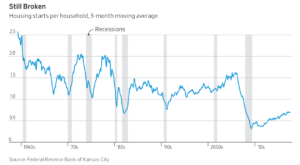
Laura Kusisto reported earlier this week at The Wall Street Journal Online that, “America is facing a new housing crisis. A decade after an epic construction binge, fewer homes are being built per household than at almost any time in U.S. history.

“Home construction per household a decade after the bust remains near the lowest level in 60 years of record-keeping, according to the Federal Reserve Bank of Kansas City.

“What makes the slump puzzling is that by most other measures, the American economy is booming. Jobs are plentiful, wages are on the rise and the stock market is near record highs. Millennials, the largest generation since the baby boomers, are aging into home ownership.”

“The Next Housing Crisis: A Historic Shortage of New Homes,” by Laura Kusisto. The Wall Street Journal Online (March 18, 2018).

The Journal article stated, “A combination of tightened housing regulations, a lack of construction labor and a land shortage in highly prized areas is driving the crisis, according to industry experts.”

Ms. Kusisto also explained, “The National Association of Home Builders estimates builders will start fewer than 900,000 new homes in 2018, less than the roughly 1.3 million homes needed to keep up with population growth. The overall inventory of new and existing homes for sale hit its lowest level on record in the fourth quarter of 2017, at 1.48 million, according to the National Association of Realtors.

“That, in turn, is pushing up prices at what economists say is an unsustainable pace. The S&P CoreLogic Case-Shiller National Home Price Index rose 6.3% in 2017. That was roughly twice the rate of income growth and three times the rate of inflation.”

Posted in Real Estate Law | Comments closed

Democrats May Not Help GOP Lawmakers Fix “Grain Glitch” in New Tax Law

Erica Werner reported on Friday at The Washington Post Online that, “Republicans aiming to use an upcoming spending bill to fix a glaring problem with their recently passed tax overhaul are running into a wall with Democrats, who were shut out of the tax law process and now don’t want to cooperate unless they get something in return.

“Shortly after the rushed passage of last year’s $1.5 trillion tax law, agricultural companies warned that their livelihoods were imperiled after language in the legislation gave a major advantage to their competitors — farming cooperatives — in the heart of America’s agriculture economy. Republicans professed surprise and promised to fix the problem as soon as possible.

“‘It has to get fixed,’ said Rep. K. Michael Conaway (R-Tex.), chairman of the House Agriculture Committee. ‘I mean, it’s essential.'”

Ms. Werner noted that, “But Democrats aren’t willing to go along so easily. They say they warned Republicans that pushing through the law in a matter of weeks — without public hearings — would result in problems and unintended consequences. And now that such issues are emerging, some Democrats resent being asked to lend their votes to a solution.”

The Post article added that, “Democratic votes are needed on the government-wide spending bill that must pass by March 23 at midnight to stave off a third federal shutdown this year. In exchange for including a fix to the grain glitch in the omnibus spending bill, Senate Democrats are pushing for inclusion of a tax provision of their own, an affordable-housing tax measure championed by Sen. Maria Cantwell (D-Wash.).”

Posted in Agriculture Law | Comments closed

Report: Shopping at Farmers’ Markets and Roadside Stands Increases Fruit and Vegetable Demand

A recent update from USDA’s Economic Research Service (ERS) by  Hayden Stewart (“Shopping at Farmers’ Markets and Roadside Stands Increases Fruit and Vegetable Demand“) stated that, “Direct-to-consumer (DTC) outlets, such as farmers’ markets and roadside stands, have grown in number over the past few decades. According to USDA’s Agricultural Marketing Service, 8,687 farmers’ markets operated in 2017, up from 2,746 in 1998. This expansion reflects primarily consumer interest in fresh, locally grown foods, especially fruits and vegetables. Consumers buying directly from farmers at markets, stands, and other types of DTC outlets may see a greater variety of produce items, interact with growers, and be exposed to nutrition information, cooking instructions, and recipe ideas. This interaction and exposure can further increase consumer demand for fruits and vegetables.

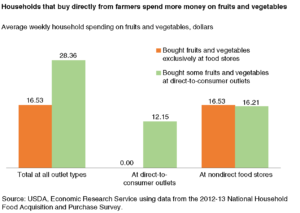
“ERS researchers used data from USDA’s National Household Food Acquisition and Purchase Survey (FoodAPS) to investigate the relationship between patronizing DTC outlets and spending for fruits and vegetables by U.S. households. Among 4,826 households that reported their food acquisitions over a 1-week period between April 2012 and January 2013, 231 bought food from a DTC outlet. Fruits and vegetables were the most frequently purchased type of food at such places; 170 of the 231 households bought fruits and vegetables.

“Total fruit and vegetable spending—at DTC outlets and nondirect retailers (food stores)—was higher among those 170 households than among another 3,388 FoodAPS households that also bought fruits and vegetables but patronized exclusively food stores. Households that bought fruits and vegetables at both DTC outlets and food stores spent a total of $28.36 on fresh and processed products that week—$16.21 at stores and $12.15 at DTC outlets—versus the $16.53 spent on fruits and vegetables by households that bought only from stores. Average weekly fruit and vegetable spending across all FoodAPS households, including those that did and did not make purchases, was $12.60.”

“Shopping at Farmers’ Markets and Roadside Stands Increases Fruit and Vegetable Demand,” by Hayden Stewart. USDA- Economic Research Service. Amber Waves (March 5, 2018).

Dr. Stewart added that, “Households that patronize DTC outlets may already have a greater demand for fruits and vegetables, owing in part to a heightened interest in and knowledge of nutrition. For this reason, ERS researchers used a statistical model to control for other factors that might affect fruit and vegetable demand, such as income, demographics, and attitudes toward food, shopping, and nutrition. Of key interest to the researchers was how a household’s fruit and vegetable spending varied with its inclination to buy these foods at DTC outlets. They found that the average weekly fruit and vegetable spending of $12.60 increased by 60 cents—about 5 percent—if a household’s likelihood to visit a DTC outlet in a given week increased by 2 percentage points.”

Posted in Agriculture Law | Comments closed