
Glyphosate Detected in Honey- French Beekeepers File Legal Complaint Against Bayer

A recent AFP news article reported that, “A beekeeping cooperative in northern France has filed a legal complaint against German chemicals giant Bayer after traces of the controversial weedkiller glyphosate were detected in batches of honey, officials said Friday.

“The head of the cooperative in the Aisne region, which represents some 200 beekeepers, said Famille Michaud, one of the country’s largest honey marketers, found the chemical in three batches supplied by one of its members.

“‘They systematically analyse the honey shipments they receive, and they found glyphosate,’ Jean-Marie Camus said.”

The article stated that, “Emmanuel Ludot, a lawyer for the cooperative, said the tainted honey came from a producer whose hives are near extensive fields of sunflowers, beets and rapeseed.

“‘But you also can’t forget the weekend gardeners who often tend to use Roundup,’ he said.

“The complaint was filed Thursday to coincide with the closing of Monsanto’s merger with Bayer, creating an agrichemical behemoth which many environmental activists denounce for its promotion of chemical herbicides as well as genetically modified seeds.”

The AFP article added that, “Ludot hopes the complaint will prompt an inquiry to determine the percentage of glyphosate in the batches and any health consequences it might have for humans.

“‘It’s also a matter of knowing how widespread this might be. Famille Michaud tells me this isn’t an isolated case,’ he said.”

Posted in Agriculture Law | Comments closed

The New Tax Law Changed How We Look at Farm Losses

DTN Tax Columnist Rod Mauszycki reported on Friday that, “The ag economy isn’t great and many producers are struggling to break even. In the past, farmers accepted losses and even looked at them as opportunities. Having good and bad years is just part of the rollercoaster called farming. However, the new tax law changed how we look at farm losses.

“Under the old tax law and the 2014 Farm Bill, taxpayers who received a Commodity Credit Corporation (CCC) loan were restricted in the deductibility of a farm loss (this rule didn’t apply to C corporations). The disallowed portion of the loss was carried to the following year, tested again for limitation purposes and claimed on Schedule F (Form 1040).

“Under the new tax law, the old excess farm loss rule does not apply; losses are now subject to ‘excess business loss’ limitations. Excess business losses are carried forward as part of the taxpayer’s net operating loss (NOL) instead of claiming the loss on Schedule F.”

The DTN update noted, “So why does this matter? Under the old rules, excess farm losses offset farm income without limitation. Because it went on Schedule F, it also offset income subject to self-employment tax. That was a win-win!

“Under the new tax law, an excess business loss is NOT deducted on the Schedule F and does NOT offset self-employment income. Also, post-2017 NOLs can only offset 80% of pre-NOL taxable income. That is, even if you have a substantial loss in 2018 followed by a substantial profit in 2019, you could offset no more than 80% of the 2019 taxable income. Farmers are allowed to carry back farm NOLs two years, giving some flexibility. However, due to the dynamics of the excess business loss rules, the farm NOL will be limited to $250,000 ($500,000 for married filing joint).”

Posted in Agriculture Law | Comments closed

Landowner Prevails in North Dakota Eminent Domain Pipeline Lawsuit

Associated Press writer Blake Nicholson reported yesterday that, “A judge has dismissed Montana-Dakota Utilities’ eminent domain lawsuit over a proposed half-mile natural gas pipeline in northern North Dakota, a decision hailed by landowner attorneys as a rare victory.

“North Central District Judge Gary Lee ruled May 29 that harm to private landowner Lavern Behm outweighed any public benefits from the pipeline. Pipelines have become a contentious issue in North Dakota since the prolonged and sometimes violent protests against the $3.8 billion, four-state Dakota Access oil pipeline in 2016 and 2017.

“MDU sought an easement across Behm’s property in Ward County to build a 3,000-foot-long (915-meter-long) pipeline to service a BNSF Railway facility west of Minot. The railroad maintains and operates a switch heated in the winter with propane tanks near the private property to keep it free of snow and ice. MDU proposed replacing the tanks with the underground pipeline, according to court records.”

The AP article explained that, “Bismarck attorney Derrick Braaten has represented landowners in dozens of eminent domain cases. He said most landowner victories amount to increased compensation for the use of their land, and that it’s rare for a judge to entirely bar the taking of private property.

“Braaten said the Ward County case, though involving a small pipeline, touches on a larger issue.

“‘The big ones that are a question right now are these interstate pipelines,’ he said. ‘I think there is kind of a looming question out there, is that a public purpose?‘”

Posted in Agriculture Law | Comments closed

Shared Equity: New Home Buyers Seeking Outside Investors For Down Payment Assistance

Tara Siegel Bernard reported earlier this month at The New York Times Online that, “For aspiring homeowners, coming up with a healthy down payment has long been the biggest obstacle to owning a home.

“With property values soaring in many areas — median prices in San Jose, Calif., and Denver are 60 percent above their prerecession peaks — the barrier is rising. That has some firms promoting unconventional ways to scrape together a down payment, including crowdfunding and using Airbnb rental income.

“Now, a small but growing number of home buyers are trying something different: asking an outside investor to put down money alongside them.”

The Times article explained, “It is called shared equity, and Unison, a company based in San Francisco, is the largest of a handful of firms putting it to work. Unison will provide at least half of a consumer’s down payment in exchange for a piece of any appreciation in the home’s value when it is sold. If the home sells at a loss, the company absorbs a share of that, too.”

This month’s article added, “Until the home sells, Unison is mostly a silent partner. The homeowner pays taxes, insurance and all other necessary costs.

“The idea behind the program is to provide home buyers with more options. It can help those who are short on down payment funds increase their buying power, though it may also work for people who simply do not want to sink every last dime into their homes. But whether it is right for any individual buyer — upfront cash now versus less proceeds later — is a difficult and highly personal calculation.

“Most first-time home buyers put down only about 7.4 percent, on average, according to Inside Mortgage Finance. Although there are plenty of programs that permit small down payments, they can substantially increase monthly housing costs.

“Unison and its competitors help increase a down payment to 20 percent of a home’s purchase price — the magic number needed to qualify for the best interest rates and to avoid the added cost of private mortgage insurance.”

Posted in Real Estate Law | Comments closed

Increased U.S. Organic Corn Production in 2016

An update on Monday by Catherine Greene and Dennis Vilorio of the USDA’s Economic Research Service (ERS) stated that, “The small, longstanding market for organically grown food continues to expand. In 2016, the Nutrition Business Journal estimated U.S. organic food purchases at over $40 billion (about 5 percent of total U.S. at-home food expenditures). Annual sales have shown double-digit growth during most years since 2000, when USDA set national organic standards.

“Converting from conventional to organic production systems requires the use of approved materials and practices in every phase of crop production. For example, most of the synthetic pesticides and fertilizers used for pest and nutrient management in conventional crop production are prohibited in organic production. In addition, farmers cannot be certified organic and receive organic price premiums for their crops and livestock until 3 years after they have adopted organic practices. These organic requirements may decrease crop yields, increase labor requirements, and slow the adoption of certified organic farming systems in some commodity sectors.

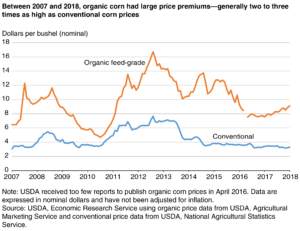
“Organic price premiums help offset the cost of organic production. For example, organic corn prices are generally two to three times higher than conventional corn prices. As a result, organic corn operations are often more profitable than conventional operations once the 3-year transition period is past.”

“Lower Conventional Corn Prices and Strong Demand for Organic Livestock Feed Spurred Increased U.S. Organic Corn Production in 2016,” by Catherine Greene and Dennis Vilorio. USDA- Economic Research Service, Amber Waves (June 4, 2018).

The ERS update also noted that, “Lower prices for conventionally produced corn—and strong U.S. demand for organic livestock feed—spurred increased U.S. organic corn production starting in 2016. Total U.S. corn acres increased 2 percent between 2011 and 2016, while U.S. certified organic corn acres were up 55 percent during this period and increased 29 percent between 2015 and 2016. However, U.S. organic corn acres are growing from a small base. In addition, demand for organic corn has outpaced its domestic supply for the last decade, and U.S. organic imports have increased as the U.S. organic dairy and poultry sectors expanded. The United States produced organic corn worth $170 million in 2016 and imported organic corn worth $160 million.”

Posted in Agriculture Law | Comments closed

USDA Resumes Continuous Conservation Reserve Program Enrollment

A news release Friday from the U.S. Department of Agriculture (USDA) stated that, “As part of a 33-year effort to protect sensitive lands and improve water quality and wildlife habitat on private lands, the [USDA] will resume accepting applications for the voluntary Conservation Reserve Program (CRP). Eligible farmers, ranchers, and private landowners can sign up at their local Farm Service Agency (FSA) office between June 4 and Aug. 17, 2018.

“‘The Conservation Reserve Program is an important component of the suite of voluntary conservation programs USDA makes available to agricultural producers, benefiting both the land and wildlife. On the road, I often hear firsthand how popular CRP is for our recreational sector; hunters, fishermen, conservationists and bird watchers,’ U.S. Secretary of Agriculture Sonny Perdue said. ‘CRP also is a powerful tool to encourage agricultural producers to set aside unproductive, marginal lands that should not be farmed to reduce soil erosion, improve water quality, provide habitat for wildlife and boost soil health.’

“FSA stopped accepting applications last fall for the CRP continuous signup (excluding applications for the Conservation Reserve Enhancement Program (CREP) and CRP grasslands). This pause allowed USDA to review available acres and avoid exceeding the 24 million-acre CRP cap set by the 2014 Farm Bill. New limited practice availability and short sign up period helps ensure that landowners with the most sensitive acreage will enroll in the program and avoid unintended competition with new and beginning farmers seeking leases. CRP enrollment currently is about 22.7 million acres.”

The USDA update added, “For this year’s signup, limited priority practices are available for continuous enrollment. They include grassed waterways, filter strips, riparian buffers, wetland restoration and others. To view a full list of practices, please visit the CRP Continuous Enrollment Period page.”

Posted in Agriculture Law | Comments closed

Purdue Ag-celerator Invests $100,000 in Two Plant Science Startups

A recent news release from Purdue University stated that, “The Purdue Ag-celerator Fund has invested a total of $100,000 in two plant science startups for the spring round of investments. The recipients are JUA Technologies International LLC, a startup building multipurpose crop dehydrators, and ZeaVaxx LLC, a startup developing a plant-derived nanoparticle that can improve animal vaccines.

“‘The Ag-celerator is moving into the third year in its goal to help Purdue agricultural entrepreneurs commercialize their innovations,’ said Karen Plaut, the Glenn W. Sample Dean of the College of Agriculture. ‘With this funding through Ag-celerator, these startups have the opportunity to continue to advance their technologies to the public.’

“Both startups presented their technology to the Ag-celerator Selection Committee, which includes entrepreneurial and industry professionals from Purdue and beyond, alongside other finalists earlier this month. JUA Technologies International and ZeaVaxx each received $50,000 in funding.”

The update added that, “The Purdue Ag-celerator was founded jointly by Purdue Ventures, Purdue Foundry and Purdue College of Agriculture in 2015. A research advancement initiative, Purdue Moves, supports Ag-celerator with a $2 million fund.

“‘Purdue’s plant sciences startups are advancing quickly throughout the industry, and the Ag-celerator is contributing to this success,’ said John Hanak, Purdue Ventures’ managing director. ‘The selection committee was, as always very impressed by presentations’ high quality, and they deliberated very carefully before choosing ZeaVaxx and JUA Technologies as the recipients for this round of awards.'”

Posted in Agriculture Law, Start-up Company Law | Comments closed

USDA Partners with Texas A&M to Help Veterans Seeking Agriculture Loans and Careers

A news release yesterday from USDA stated that, “U.S. Secretary of Agriculture Sonny Perdue today announced a partnership between the [USDA] and Texas A&M’s AgriLife Extension Service to help military veterans obtain loans and pursue careers as farmers and ranchers. Secretary Perdue joined local dignitaries, members of the Armed Forces, veterans, and community leaders at the Dallas Farmers Market to unveil the new pilot program.

“USDA’s Farm Service Agency (FSA) is collaborating with AgriLife Extension Service on the pilot, which is part of the Texas A&M Battleground to Breaking Ground project. The program makes it easier for veterans to meet federal requirements to get FSA direct farm ownership loans, which can help provide access to land and capital.

“‘Veterans retiring from active duty face many challenges, and this effort provides them with hands-on training and financial planning to help them succeed as new farmers and ranchers,’ said Secretary Perdue, who is a veteran of the U.S. Air Force. ‘Through this pilot, veterans will learn how to build an agricultural business and how USDA can help them at every step of the way. We are committed to supporting veterans, whether they are starting or growing their farming or ranching operations. This is an important step in our efforts to strengthen the American economy and support our American heroes.'”

The USDA news release also indicated that, “The pilot program, which will include 15 to 18 veterans, will roll out in three phases: an introductory workshop, a business planning curriculum, and a production curriculum over a period of 12 to 18 months.

“Typically, loan applicants must participate in the business operations of a farm for at least three years during a 10-year period. However, as part of this pilot program, participants can combine the certificate they receive with their military leadership or management experience to satisfy this requirement. According to the U.S. Department of Labor, approximately 45 percent of armed service members are from rural America.

“Pilot program applications will be accepted from interested veterans between June 15 and July 20, 2018, until 11 p.m. central standard time. For more information about USDA programs, visit newfarmers.usda.gov/veterans or www.farmers.gov.”

Posted in Agriculture Law | Comments closed

USDA Reopens Application Period for Producers Recovering from Cattle Loss, Other Disasters

A news update yesterday from USDA’s Farm Service Agency (FSA) stated that, “The [USDA] will begin accepting disaster assistance program applications on June 4 from agricultural producers who suffered livestock, honeybees, farm-raised fish and other losses due to natural disasters.

“USDA’s [FSA] is reopening the application period for two disaster assistance programs in response to statutory changes made by Congress earlier this year.

“‘When disasters hit, help is as close as your USDA service center,’ said Bill Northey, Under Secretary for Farm Production and Conservation. ‘After any catastrophic event, an eligible producer can walk into any one of our local offices and apply for help.'”

The FSA update added that, “Beginning June 4, FSA will accept new applications for losses for calendar year 2017 or 2018 filed under the Livestock Indemnity Program (LIP) or Emergency Assistance for Livestock, Honey Bees, and Farm-raised Fish Program (ELAP). Producers who already submitted applications and received decisions on their applications for these years do not need to file again, but they can reapply if they have additional losses or their application was disapproved because it was filed late.”

Posted in Agriculture Law | Comments closed

Jumia, Africa’s Aspiring Alibaba

Wall Street Journal writer Matina Stevis-Gridneff reported last week that, “On safari for the rare African tech unicorn, Goldman Sachs Group Inc. and other big-name investors think they have spotted a winner in Jumia, the continent’s aspiring Alibaba.

“The online retailer, which launched in 2012 in Nigeria with the backing of German startup fund Rocket Internet SE, is Africa’s biggest e-commerce platform selling goods and services to millions of customers. It has raised more than $700 million from investors, including global telecom operators and was valued at $1.2 billion—qualifying as a so-called unicorn—during its last fundraising round in 2016.

“Jumia has expanded from four to 14 countries. Gross sales last year reached €507 million ($597 million), up 42% from the year before. Its vendor network, from Cape Town, South Africa, to Casablanca, Morocco, includes up to 70,000 businesses offering their goods and services online.”

The Journal article noted that, “Jumia’s growth story outlines the scale of the challenge for African online retail. Faced with poor internet connections and tight bank lending for vendors and consumers, the startup has had to build from scratch much of the economic infrastructure within which to operate.

“‘Nowhere else in the world is it more difficult to shop than in Africa,’ said Sacha Poignonnec, Jumia’s co-founder and chief executive.”

Last week’s article stated that, “Just 0.5% of all retail on the continent takes place online, according to Boston Consulting Group research, compared with about 15% in China—home to Alibaba Group Holding Ltd. —and 5% in India. But companies like Jumia are changing the economic landscape for many African entrepreneurs.”

The Journal article added, “Analysts say they expect e-commerce in Africa to boom eventually.”

Posted in Start-up Company Law | Comments closed