Biodiesel Industry: A Record Number of Acquisitions in 2018

DTN writer Todd Neeley reported this week that, “As difficult as 2018 was for the ethanol industry in the United States, the biodiesel sector turned in one of its best years as companies improved their balance sheets despite operating without the biodiesel blenders credit, according to a new analysis by biofuels mergers and acquisitions specialist Ocean Park in Los Angeles.

“Not only were profit margins good, but the biodiesel industry saw a record number of acquisitions in 2018, the analysis said.

There were 11 biodiesel plants acquired, totaling 425 million gallons in capacity. That far exceeds the second-biggest year on record, 2016, when there were seven acquisitions totaling 265 million gallons.”

Mr. Neeley explained that, “Overall biofuels merger and acquisition activity not only picked up in intensity in 2018, but the ‘deals grew considerably in size.’

“Ocean Park said a total of 12 biofuels merger and acquisition transactions closed in the United States in 2018.”

This week’s DTN article pointed out that, “‘In ethanol and biodiesel, nine deals took place worth an estimated $752 million, involving 15 facilities with 770 million gallons per year of capacity,’ the analysis said. ‘In advanced biofuels, three transactions occurred involving two cellulosic ethanol facilities and one demonstration facility.’

“The ethanol industry, in particular, has seen significant margin pressure since the middle of 2018.”

Posted in Agriculture Law | Comments closed

Home Sales Tumbled in December

Wall Street Journal writers Laura Kusisto and Sarah Chaney reported earlier this week that, “Home sales tumbled in December to their weakest level since 2015, ending a difficult year at a new low and offering fresh evidence that the housing market could be in for a bumpy ride in 2019.

“Some of the same forces that pounded global financial markets in the fourth quarter caused home buyers to pull back at the end of the year. Home sales were weighed down by a surge in stock-market volatility, uncertainty as the government shutdown began and rising interest rates, which pushed up mortgage rates in November to their highest level in seven years.

Housing also suffered from high home prices and a dearth of starter homes in major markets, a nagging problem for much of last year that shows little sign of abating. A growing U.S. economy and low unemployment haven’t kept home sales from sputtering.”

The Journal writers noted that, “December capped the weakest year for home sales in three years. Existing-home sales fell 6.4% in December from the previous month to a seasonally adjusted annual rate of 4.99 million, the National Association of Realtors said Tuesday. Compared with a year earlier, sales in December declined 10.3%.”

Kusisto and Sarah Chaney also pointed out that, “Meanwhile, home-price growth has also slowed significantly, a sign that many owners struggling to sell their homes are starting to cut prices or ask for a more conservative number. The median sale price for an existing home in December grew 2.9% from a year earlier—the smallest increase since March 2012, when the market was still depressed from the housing crash.

“That slump could be good news for buyers, many of whom can’t afford higher prices or worry about another housing bubble, and it could inject some positive momentum into the market.”

Posted in Real Estate Law | Comments closed

USDA to Reopen FSA Offices for Additional Services During Government Shutdown

A news release yesterday from USDA stated that, “U.S. Secretary of Agriculture Sonny Perdue today announced that all Farm Service Agency (FSA) offices nationwide will soon reopen to provide additional administrative services to farmers and ranchers during the lapse in federal funding.  Certain FSA offices have been providing limited services for existing loans and tax documents since January 17, and will continue to do so through January 23.  Beginning January 24, however, all FSA offices will open and offer a longer list of transactions they will accommodate.

“Additionally, Secretary Perdue announced that the deadline to apply for the Market Facilitation Program, which aids farmers harmed by unjustified retaliatory tariffs, has been extended to February 14.  The original deadline had been January 15.  Other program deadlines may be modified and will be announced as they are addressed.

“‘At President Trump’s direction, we have been working to alleviate the effects of the lapse in federal funding as best we can, and we are happy to announce the reopening of FSA offices for certain services,’ Perdue said.  ‘The FSA provides vital support for farmers and ranchers and they count on those services being available.  We want to offer as much assistance as possible until the partial government shutdown is resolved.'”

Yesterday’s release noted that, “The U.S. Department of Agriculture has temporarily recalled all of the more than 9,700 FSA employees to keep offices open from 8 am to 4:30 pm weekdays beginning January 24. President Trump has already signed legislation that guarantees employees will receive all backpay missed during the lapse in funding.

“For the first two full weeks under this operating plan (January 28 through February 1 and February 4 through February 8), FSA offices will be open Mondays through Fridays. In subsequent weeks, offices will be open three days a week, on Tuesdays, Wednesdays, and Thursdays if needed to provide the additional administrative services.

“Agricultural producers who have business with the agency can contact their FSA service center to make an appointment.”

For more details on what transactions FSA staff will work on during this time frame, click here.

Posted in Agriculture Law | Comments closed

After Iowa’s ag-gag Law Ruled Unconstitutional, Animal Rights Group Advertising for an Investigator

Des Moines Register writer Donnelle Eller reported recently that, “About a week after Iowa’s ag-gag law was struck down over free speech violations, a national animal rights group is advertising for an investigator to work undercover in Iowa livestock and meat processing facilities.

“Mercy For Animals, a Los Angeles animal welfare group, is advertising online for an Iowa-based undercover investigator to work at ‘factory farms, hatcheries, livestock markets and slaughterhouses’ to catch possible animal abuse.

“The California group said it routinely advertises for undercover investigators, and didn’t target Iowa because of the federal court ruling last week.”

The Register article noted that, “Iowa leads the nation in pork and egg production. It ranks seventh for beef and 12th for milk production.”

Last week’s article stated that, “Eldon McAfee, a Des Moines attorney who often represents Iowa livestock producers, said many animal welfare groups ‘are opposed to consuming animals for food.’

“‘Their real motive is to shut down modern animal agriculture production,’ he said.”

Posted in Agriculture Law | Comments closed

Rural Bankers Increasingly Concerned About Farm Loan Defaults, Survey Says

The Associated Press reported yesterday that, “A monthly survey of rural bankers in parts of 10 Plains and Western states suggests banks are growing increasingly concerned about farm loan defaults in 2019.

“More than 4 of every 10 bankers questioned for the Rural Mainstreet survey for January said they expect farm loan defaults to be the year’s biggest challenge.

“Creighton University economist Ernie Goss, who oversees the survey, says their outlook is being negatively influenced by tariffs, trade tensions, weak commodity prices and the partial federal government shutdown.”

The AP article explained that, “The survey’s overall index dropped to 51.5 from December’s 54.2. Any score above 50 suggests a growing economy in the months ahead, while a score below 50 indicates a shrinking economy.

“Bankers from Colorado, Illinois, Iowa, Kansas, Minnesota, Missouri, Nebraska, North Dakota, South Dakota and Wyoming were surveyed.”

Posted in Agriculture Law | Comments closed

Some Start-Ups Probing Alternatives to the Traditional VC Funding Model

Last week, New York Times writer Erin Griffith reported that, “On a sunny Saturday morning in New York a few months ago, a group of 50 start-up founders gathered in the dank basement of a Lower East Side bar. They scribbled notes at long tables, sipping coffee and LaCroix while a stack of pizza boxes emanated the odor of hot garlic. One by one, they gave testimonials taking aim at something nearly sacred in the technology industry: venture capital.

“Josh Haas, the co-founder of Bubble, a software-writing start-up, told the group that he and venture capitalists ‘were pretty much totally on different wavelengths‘ about the trajectory of his business.

“Seph Skerritt, the founder of Proper Cloth, a clothing company, said that the hype around raising money was a trap. ‘They try to make you feel inferior if you’re not playing that game,’ he said.”

The Times article stated that, “The event had been organized by Frank Denbow, 33, a fixture of New York’s tech scene and the founder of T-shirt start-up Inka.io, to bring together start-up founders who have begun to question the investment framework that has supercharged their field. By encouraging companies to expand too quickly, Mr. Denbow said, venture capital can make them ‘accelerate straight into the ground.'”

After briefly describing the V.C. business model, the article noted that, “But for every unicorn, there are countless other start-ups that grew too fast, burned through investors’ money and died — possibly unnecessarily. Start-up business plans are designed for the rosiest possible outcome, and the money intensifies both successes and failures. Social media is littered with tales of companies that withered under the pressure of hypergrowth, were crushed by so-called ‘toxic V.C.s’ or were forced to raise too much venture capital — something known as the ‘foie gras effect.’

“Now a counter movement, led by entrepreneurs who are jaded by the traditional playbook, is rejecting that model. While still a small part of the start-up community, these founders have become more vocal in the last year as they connect venture capitalists’ insatiable appetite for growth to the tech industry’s myriad crises.”

Last weeks article also pointed out that, “In September, Tyler Tringas, a 33-year-old entrepreneur based in Rio, announced plans to offer a different kind of start-up financing, in the form of equity investments that companies can repay as a percent of their profits. Mr. Tringas said his firm, Earnest Capital, will have $6 million to invest in 10 to 12 companies per year.

“Hundreds of emails have poured in since the announcement, Mr. Tringas said in an interview. ‘They’re almost entirely from people who assumed there was no form of capital that matched any version of their expectations,’ he said.”

Nonetheless, the Times article added that, “Still, the new growth models represent a tiny percentage of the broader start-up funding market. And venture capitalists continue to aggressively pitch their wares — even to companies that aren’t interested.”

Posted in Start-up Company Law | Comments closed

Provisions of the New Farm Bill Could Speed Adoption of the Uniform Partition of Heirs Property Act

DTN Special Correspondent Elizabeth Williams reported today that, “Dying without a will or without properly structured farmland ownership can make life messy for heirs.

“In many of those situations, the next generation owns the land as tenants-in-common, and if the owners can’t agree on how to split the property, they can go to court for a judgment allowing partition by sale, the preferred settlement method in 39 states. This forced sale obligates the family members who want to keep the farm to have the winning bid at a public auction on land they partially own.

Eleven states have created an alternative to this process by passing the Uniform Partition of Heirs Property Act (UPHPA), which allows the tenants-in-common to cash out an owner who wants to sell at an appraised value without having to put the entire property up for sale. It establishes a clear preference for a physical division of heirs property, as opposed to partition by sale, and allows the court to consider factors such as heritage, historical or culture value of the property in deciding how to partition the land.”

The DTN article noted that, “The new farm bill gives states with UPHPA an additional boost. Frequently, land inherited this way lacks a clear title because not all the fractional interest owners have been identified or legally established, said Thomas Mitchell, a professor at Texas A&M University School of Law that drafted the UPHPA law.

The new farm bill now allows the owners of ‘heirs property’ as defined under the UPHPA to qualify for a Farm Services Agency farm number and to be eligible for many different USDA programs, including lending and disaster relief programs.

The definition of ‘heirs property’ includes property that passes with or without a will. The main criteria is it must be family-owned and the ownership must be as tenants in common, not joint tenancy. Family-owned is defined as 20% of the ownership interest owned by family or 20% of the co-tenants are family.”

Ms. Williams also explained that, “The farm bill also gives farmers and ranchers who own heirs property in these 11 states priority consideration for legal assistance to help them restructure their legal ownership for greater stability and obtain clear title to their property.

Iowa is the only Midwest state with this law, which passed in 2018. Other states that have passed the UPHPA are Alabama, Arkansas, Connecticut, Georgia, Hawaii, Montana, Nevada, New Mexico, Texas and South Carolina.”

Today’s DTN article added: “State legislatures in Indiana, Virginia and West Virginia have already introduced UPHPA bills so far this year.

“In Illinois, ‘It is something that we are looking into,’ said Zach Schmidt, assistant director of state legislation with the Illinois Farm Bureau.”

Posted in Agriculture Law | Comments closed

Mortgage Rates Fall, Offering Potential Boost to Housing Market

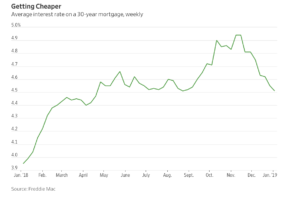
Wall Street Journal writers Ben Eisen and Laura Kusisto reported last week that, “Mortgage rates have fallen to around their lowest levels in eight months, offering a potential boost to the housing market after a rough patch in recent months.

“The average rate for a 30-year fixed mortgage fell to 4.51%, matching the lowest level since last spring, according to data released Thursday by mortgage-finance giant Freddie Mac. That rate is still higher than its level of 3.95% from a year ago but has fallen from a more-than-seven-year high of nearly 5% last fall.

“The decline stands to give consumers another shot at obtaining low rates on loans to purchase or refinance their homes, if they can stomach volatile financial markets and still lofty home values.”

“Falling Mortgage Rates Raise Hopes for Battered Housing Market,” by Ben Eisen and Laura Kusisto. The Wall Street Journal (January 7, 2019).

The Journal writers pointed out that, “Stock-market swings, high home prices and a traditionally slow time of year for home buying have largely kept a lid on housing-market activity in recent months. Mortgage applications slid 9.8% in the week ended Dec. 28 from two weeks earlier, according to a survey released Thursday by the Mortgage Bankers Association. The shutdown of the federal government also factored into the drop, according the group.

“Yet as rates have steadily fallen, some agents said they have seen buyers start to creep back into the market.”

Posted in Real Estate Law | Comments closed

Partial Government Shutdown Impacting Some Craft Breweries

New York Times writer Nick Corasaniti reported last week that, “The locked doors of federal agencies in Washington are leading to locked taps and empty vats at craft breweries around the country.

“One such scene unfolds in an 11,000-square-foot warehouse in northern New Jersey, where the usual low hum and screeching hiss of an active brewhouse and the musty stench of fermentation wafting outside are absent. Instead, there is just the echo of passing conversation and stale cold air.

The partial government shutdown has idled a division of the Treasury Department that regulates manufacturers of craft beer, dealing a blow to a booming industry and disappointing discerning drinkers.

At Alementary Brewing in Hackensack, the owners cannot get federal approval to begin brewing in their warehouse space — they operate a smaller brewhouse across the street — since their application for the new location is sitting on empty desks. They nervously wait each day as the bills and overhead from their $1 million investment to ramp up their production and distribution begin to pile up.”

The Times article noted that, “But a distillation of the shutdown’s far-reaching consequences can be seen in the surging $76 billion craft beer industry, which is driven by many smaller operations. The industry is regulated by the Alcohol and Tobacco Tax and Trade Bureau, which controls craft breweries mainly in two ways: approving any new brewery equipment and approving labels on new lines of beer.”

Mr. Corasaniti added that, “With the alcohol bureau shut down, breweries across the country are facing similar problems as Alementary is, throwing their business plans and survival into question.”

Posted in Start-up Company Law | Comments closed

Government Shutdown Freezes IPO Market

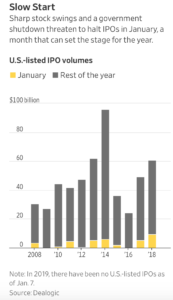
Wall Street Journal writers Corrie Driebusch, Maureen Farrell and Dave Michaels reported earlier this week that, “The government shutdown is threatening to spoil what was poised to be a banner year for IPOs.

“The partial closure of the Securities and Exchange Commission is forcing companies that were seeking to list shares in January to push back their plans, according to bankers and lawyers. They include biotechnology firms Gossamer Bio Inc., Alector Inc. and Blackstone Group LP’s Alight Solutions LLC.

It now looks likely that no major company will tap the U.S. IPO market this month. Since 1995, there have been just three years that had a new-issue drought in January, according to Dealogic data. That happened as a result of choppy markets in 2003, 2009 and 2016, which went on to be some of the weakest years for initial public offerings on record, the data show.”

“U.S. Government Shutdown Freezes IPO Market, Imperiling Expectations for 2019,” by Corrie Driebusch, Maureen Farrell and Dave Michaels. The Wall Street Journal (January 9, 2018).

The Journal writers pointed out that, “As part of the shutdown, currently the second-longest on record, the SEC has furloughed thousands of employees and stopped reviewing and approving all new and pending corporate registration statements, including proposed IPO filings, according to the agency’s shutdown plan and other notices on its website. Dozens of SEC accountants and lawyers who review IPO paperwork are prohibited from reading email or calling deal lawyers seeking to discuss complex disclosure questions.

By contrast, past shutdowns hardly affected the SEC; in 1995, 1996 and 2013, the agency was able to draw on surplus cash to remain open while other government offices closed. The SEC this year didn’t have enough funds available to ride out the entire shutdown.”

This week’s Journal article also explained that, “The halt in the work at the SEC is threatening a resurgence in the IPO business in the past couple of years as more private companies warm up to the possibility of public ownership. With some of the largest startups, including Uber Technologies Inc., Lyft Inc. and Pinterest Inc., planning share sales, bankers and lawyers have said 2019 could set a record for IPOs in terms of dollars raised.”

Posted in Start-up Company Law | Comments closed