General Mills Inc. Accelerates Regenerative Agricultural Practices

Wall Street Journal writer Kimberly Chin reported yesterday that, “General Mills Inc. said Monday that it will accelerate the adoption of regenerative agricultural practices on one million acres of farmland by 2030.

“The move brings the company closer to its goal of curbing greenhouse emissions by 28% across its supply chain by 2025. General Mills said it has already reduced its footprint by 13% in 2018 from 2010.

Regenerative agriculture focuses on pulling carbon from the air and storing it in the soil, helping protect the health of soil and enhancing the resiliency of natural resources.”

The Journal article added that, “The company said that it would implement on-farm training and education for oat growers in North America, who produce the oats for its Cheerios, Annie’s Cascadian Farm, Nature Valley and Blue Buffalo brands.”

Posted in Agriculture Law | Comments closed

Farmers Sue to Stop Measure Giving Lake Erie Legal Rights

The Associated Press reported last week that, “An unusual ballot measure approved by voters in Ohio’s fourth-largest city to give legal rights to Lake Erie is being challenged by farmers in a federal lawsuit that was filed Wednesday.

“The lawsuit names the city of Toledo, where voters overwhelming approved the Lake Erie Bill of Rights during a special election on Tuesday. The measure seeks to add new protections for Lake Erie by allowing people to file lawsuits on its behalf.

The plaintiffs, members of a fifth-generation farm family in Wood County, call the measure an assault on the fundamental rights of farmers in the Lake Erie region.”

The AP article indicated that, “Farmers are concerned the measure opens the door for lawsuits that would force them to make costly changes to the way they farm. The lawsuit claims it violates farmers’ constitutional rights and is unenforceable because it is too vague. It also seeks to immediately stop the new law from being enforced.

“Legal experts have raised doubts about whether the law can survive a court challenge.

“Case Western Reserve University law professor Jonathan Adler told cleveland.com the law oversteps the city’s jurisdiction because Lake Erie extends far beyond Toledo.”

Posted in Agriculture Law | Comments closed

Bayer Faces 11,2000 Plaintiffs over Roundup

Wall Street Journal writer Ruth Bender reported earlier this week that, “Bayer AG said the number of plaintiffs suing over its weedkillers had risen by a further 1,900 over the past three months, adding to the legal pressure on the German pharmaceuticals and chemicals company as it navigates a broad restructuring of its businesses.

“The company, which makes aspirin, chemicals and seeds, also posted a net loss of €3.92 billion ($4.46 billion) for the fourth quarter compared with a profit of €148 million a year earlier, most of which resulted from write-offs for consumer-health brands it is selling, a pharmaceuticals plant it is closing and costs linked to acquiring U.S. agriculture giant Monsanto Co. last year.

“Still, shares closed up 4.2% on Wednesday, after Bayer reported better-than-expected sales. That offered investors a break from a monthslong share rout, driven to a large extent by the company’s growing legal jeopardy over the world’s most widely used herbicide.”

The Journal article stated that, “Another test case for Bayer opened up this week, this time in federal court in California. Six other trials are scheduled to begin in 2019.

Bayer said Wednesday that as of late January it faced a total of 11,200 plaintiffs over its glyphosate products, compared with 9,300 at the end of October. Bayer has rejected the allegations, arguing that there are numerous studies that demonstrate the safety of glyphosate and its products.

“‘We have the science on our side and will continue to vigorously defend this important and safe herbicide for modern and sustainable farming,’ Chief Executive Werner Baumann said. He warned though that it would take some time to get more clarity over the outcome as the first trials were only starting.”

Posted in Agriculture Law | Comments closed

Crowdsourced Delivery Company Roadie Raised $37 Million in New Funding

Wall Street Journal writer Erica E. Phillips reported this week that, “Crowdsourced delivery company Roadie Inc. has raised $37 million in new funding that includes investment from Home Depot Inc., boosting dollars available for marketing efforts with big retailers and for building out its technology.

The Atlanta-based startup has been providing same-day delivery services through its ‘on-the-way’ model, which uses an app to tap into drivers already on the road. Roadie delivers orders for retailers such as Home Depot and Walmart Inc., shuttles delayed luggage to Delta Air Lines Inc. travelers and handles personal deliveries for everyday users of its app.

“Home Depot joined Warren Stephens of Stephens Inc. and Eric Schmidt’s TomorrowVentures in the Series C funding round, which brings Roadie’s total raised to $62 million, the company said in a statement. The round values the company at less than $500 million, according to a person familiar with the matter.”

Ms. Philips noted that, “Roadie Chief Executive Marc Gorlin said the startup’s use of passenger vehicles that are already on the road is the company’s ‘secret sauce,’ allowing it to provide same-day delivery service for big retailers, even to customers in rural areas. ‘People are going everywhere all the time,’ Mr. Gorlin said. ‘So we can say, ‘Hey, do you want to make $20 for going somewhere you were already going?’’

“Roadie, which launched in 2014, said it has more than 120,000 drivers across all 50 U.S. states using its app, and it can deliver same day to 89% of U.S. households.”

Posted in Start-up Company Law | Comments closed

Ag Startup Helps Provide Insight, Establish Market Price for Land

Bloomberg writer Alexandra Semenova reported today that, “Renting a farm can now be as easy as finding a vacation home.

Tillable, a website that connects landowners and growers, aims to bring transparency to the $32 billion U.S. farmland rental market. The startup, which offers digital leases to streamline rentals, is being backed by investors including The Production Board, an agtech investment company, and venture firm First Round Capital, with about $8 million in Series A funding.

“The online marketplace gathers data from property tax records to find landowners. Tillable then contacts them for additional information to be provided to prospective farmers. There are currently 5,000 landowners and growers on the site, which launched in mid-2018, and the company has plans to triple that number over the next few years.”

The Bloomberg article explained that, “‘It’s very similar to what Zillow does,’ Tillable chief executive officer Corbett Kull said in a phone interview, referring to the housing search website.

“About 40 percent of all American farmland is rented, according to data from the U.S. Department of Agriculture. Lack of available data leads to under-priced rent, according to Kull. At the same time, some fields sit unused because families that own plots move away from farming but don’t want to give up the land.

Kull likened the potential for the unused farmland to the condos and vacation homes listed by property owners on Airbnb. Price is determined by grower offers, and each potential renter has a profile that includes details about their experience and equipment.”

Posted in Start-up Company Law | Comments closed

China’s Tech Firms See Opportunity in African Swine Fever

New York Times writers Sui-Lee Wee and Elsie Chen reported this week that, “A database of every pig’s face. Voice scans that detect hogs with a cough. Robots that dispense just the right amount of feed.

This could be China’s pig farm of the future.

Chinese companies are pushing facial and voice recognition and other advanced technologies as ways to protect the country’s pigs. In this Year of the Pig, many Chinese hogs are dying from a deadly swine disease, threatening the country’s supply of pork, a staple of Chinese dinner tables.”

The Times writers explained that, “Broadly, the Chinese government in recent years has endorsed technology on the farm. Its most recent five-year plan, a major economic planning document, calls for increased use of robotics and network technology. In October, the State Council, or China’s cabinet, said it wanted to promote ‘intelligent farming’ and the application of information technology in agriculture. In August, Beijing city agricultural officials praised ‘raising pigs in a smart way’ using the A-B-C-Ds: artificial intelligence, blockchain, cloud computing and data technology.

So when African swine fever swept through China’s farms, the country’s technology companies saw an opportunity. The disease has no known vaccine or cure. It can spread through contact between animals or through infected pig products, meaning it can lurk for months in sausages or ham. It doesn’t affect humans, but they can carry it. China has culled nearly a million pigs, set up roadblocks and built fences, to no avail.”

This week’s article added that, “There’s a lot at stake. China is the world’s largest pig breeder, with a current population of about 400 million, and its largest pork consumer. The meat is so important that the country has its own strategic pork reserve in the event of a shortage.

The disease could also ripple across borders. It has been found in sausages transported by Chinese tourists in Australia, Taiwan, Japan and Thailand, stoking fears that it could end up in the United States. A prolonged outbreak could cause prices to rise globally.”

Posted in Agriculture Law | Comments closed

Another Roundup Trial Begins

An update this morning from The Economist Espresso daily Email stated that:

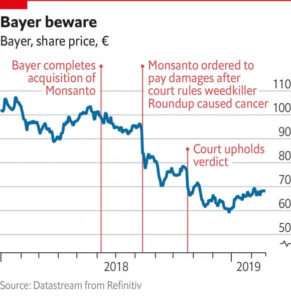
“When the German chemicals firm [Bayer] bought Monsanto, an American rival, for $63bn, it thought it had got a good deal. But Monsanto may have left Bayer with billions of dollars in liabilities given claims that Roundup, a weedkiller it makes, causes cancer. In August a California jury ruled in favour of a school groundskeeper who alleged that Roundup caused his non-Hodgkin’s lymphoma; it ordered the company to pay $289m in damages. Bayer, which denies that the weedkiller causes cancer, said the ruling would be overturned. But in October a judge at a state appeals court upheld the original verdict (while reducing the damages). Today another trial over Roundup, the first to take place in a federal court, begins in San Francisco. Around 8,700 similar cases targeting Monsanto are going through America’s legal system. It may not have been such a good deal after all.”

“Bayer’s remorse: Monsanto and Roundup,” The Economist Espresso Daily Email (February 25, 2019).

Also recall that Bloomberg News reported earlier this month that Monsanto also “faces a claim that it deceived home gardeners about Roundup’s impact on their gut bacteria and their health.”

Posted in Agriculture Law | Comments closed

Business Entities- Update from Iowa State University Extension

A recent update by Kelvin Leibold (“Business Entities“), a farm management specialist at Iowa State University (ISU) Extension, explained that, “The state of Iowa allows for several different forms of business. The choice of a business entity affects liability, taxation, capitalization, decision making, agricultural government payments, gifting or transfer options. Such a decision requires much thought and advice from professionals such as attorneys and accountants when deciding on which business structure is appropriate. This publication is not intended to provide legal advice but to familiarize you with some of the terms and concepts.

“The business structures allowed in Iowa include:

  • Sole Proprietorship
  • General Partnership (Iowa Code chapter 486A)
  • Limited Partnership [Domestic or Foreign] (Iowa Code chapter 488)
  • Limited Liability Partnership [Domestic or Foreign] (Iowa Code chapter 486A)
  • For Profit Corporation [Domestic or Foreign] (Iowa Code chapter 490)
  • Nonprofit Corporation [Domestic or Foreign] (Iowa Code chapter 504)
  • Professional Corporation [Domestic or Foreign] (Iowa Code chapter 496C)
  • Limited Liability Company [Domestic or Foreign]”

The ISU update highlighted several factors to consider when choosing a business entity, and noted in part that:

Liability

“Individual liability for debts and torts varies based on the business structure. Often preference will be given to a business structure that limits the individual’s financial liability to the equity contributed and shields the other personal assets from possible business exposure.”

Decision Making

“The business structure can also impact the amount of decision making and control that other investors have. Certain classes of shareholders may or may not have voting rights. Some may have buy-sell agreements or other restrictions on transfer of shares or units. The structure also impacts the complexity of the organization, record keeping, tax reporting, and related costs.”

Ag Program Payments

“In the past, USDA farm program payments have been a substantial part of farm profits. Eligibility and payment limits can be impacted by the type of business structure. The USDA rules have changed over time and continue to be a moving target. Currently the programs look at payments at the business level and at the individual level.”

Also in his ISU Extension update, Mr. Leibold indicated that, “The type of business structure may impact USDA Farm Service Agency programs as well as other government programs. Rules change over time, to find out the current implications, visit the local FSA office to understand liability issues beyond what the entity may provide and reasons that you may still have liability issues.

“When putting together a business structure think about how the business will deal with gifts, transfers, sales, buy-sell agreements, financial stress, death, termination, or transfer to the next generation.

“There are other business arrangements such as labor sharing agreements, machinery sharing agreements, livestock production contracts, and strategic alliances that may be useful.”

Posted in Agriculture Law | Comments closed

Stamp Farms Co-Defendants Sentenced

DTN writer Todd Neeley reported earlier this week that, “Two of three men indicted on 14 counts of conspiracy to commit bank fraud and making false statements to attain loans and crop insurance for Decatur, Michigan-based Stamp Farms LLC, have been sentenced to prison time. They have been ordered to pay hundreds of thousands of dollars in restitution as a result of reaching plea agreements.

“According to court documents filed in the U.S. District Court for the District of Western Michigan, James Leonard Becraft, Jr. pleaded guilty to conspiracy to make false statements on crop insurance forms. On Feb. 12, he was sentenced to a year in prison, a two-year supervised release and ordered to pay $648,188 in restitution to the Risk Management Agency in Kansas City, Missouri.

“Douglas Edward Diekman pleaded guilty to conspiracy to make false statements on crop insurance forms. On Dec. 20, 2018, Diekman was sentenced to 13 months in prison, a two-year supervised release and ordered to pay $488,432 in restitution — $409,403 to RMA and $79,029 to the Farm Service Agency in Kansas City.”

The DTN article stated that, “On Dec. 13, 2017, a grand jury handed down an indictment of Becraft, Diekman and Michael Stamp in connection with the Stamp Farms Chapter 11 bankruptcy filed in November 2012. The bank found Stamp Farms in noncompliance on loan agreements, including working capital and other ratios. Michael Stamp is the former owner of the farm. Stamp’s case has yet to be resolved, as a hearing was scheduled for Tuesday in Michigan.

“Stamp and Becraft originally pleaded not guilty in January 2018, according to court records, after being arrested by Internal Revenue Service agents on Jan. 18, 2018. According to the indictment, the losses alleged in the fraud total about $60.5 million.

“Becraft agreed to cooperate with federal authorities on the investigation into Stamp Farms, as part of the plea agreement.”

Mr. Neeley added that, “The Stamp Farms bankruptcy case left southwestern Michigan landowners and creditors jolted by what legal experts believe was, at the time, the largest grain farm bankruptcy in U.S. history.”

Posted in Agriculture Law | Comments closed

Supreme Court Agrees to Hear Clean Water Act Case

Timothy Cama reported yesterday at The Hill Online that, “The Supreme Court agreed Tuesday to hear a major dispute with potentially far-reaching implications for how the federal government protects waterways from pollution.

“The case, County of Maui v. Hawaii Wildlife Fund, challenges an appeals court’s ruling that pollution discharged into groundwater that later flows into a navigable waterway can constitute a violation of the Clean Water Act.

“Congress traditionally leaves regulation of navigable waterways up to the federal government, while groundwater is regulated only by states. But the 9th U.S. Circuit Court of Appeals last year upheld the Environmental Protection Agency’s (EPA) finding that pollution discharged from Maui County municipal wastewater wells into groundwater, which later went into the Pacific Ocean, violated the federal law.”

The Hill article explained that, “Kevin Minoli, a former general counsel for the EPA and now an attorney at Alston & Bird’s environmental practice, said the Maui appeals court case and a similar one — Kinder Morgan Energy Partners LP v. Upstate Forever — were landmark rulings for water regulation.

“‘These two cases significantly expand EPA’s decades-long understanding that a Clean Water Act permit is only required when a discharge is into groundwater that has a direct hydrologic connection to a surface water,’ he said in a Tuesday statement.

“‘By holding that permits are required whenever any amount of the discharge reaches the surface water in any way and at any point in time, the two decisions have unearthed incredible uncertainty for those who are trying to understand and comply with the law.'”

Mr. Cama added that, “The controversy is separate from the ongoing debate over the EPA’s Waters of the United States rule, which determines the waterways that are subject to federal regulation. The Trump administration is currently working to greatly restrict which waterways, like wetlands and tributaries, are within federal jurisdiction.

“In asking the high court to hear the case last year, attorneys for Maui County called the 9th Circuit ruling a ‘radical expansion‘ of the Clean Water Act.”

Posted in Agriculture Law | Comments closed