
Animal Confinement Livestock Production Issues Persist in Iowa

Donnelle Eller reported in today’s Des Moines Register that, “Iowa should strengthen rules that guide where large animal feeding operations can be built, a move that would give local communities more control over where facilities are located, a petition filed Tuesday with the state says.

“Iowa Citizens for Community Improvement and Food & Water Watch filed a petition with the Iowa Department of Natural Resources, seeking changes to the state’s animal feeding operation rules.”
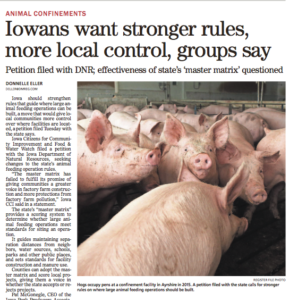
Front Page of the Business section in Wednesday’s Des Moines Register (July 19, 2017).

The Register article noted that, “‘The master matrix has failed to fulfill its promise of giving communities a greater voice in factory farm construction and more protections from factory farm pollution,’ Iowa CCI said in a statement.

“The state’s ‘master matrix‘ provides a scoring system to determine whether large animal feeding operations meet standards for siting an operation.

“It guides maintaining separation distances from neighbors, water sources, schools, parks and other public places, and sets standards for facility construction and manure use.”

Today’s article stated that, “Counties can adopt the master matrix and score local projects, giving them a voice in whether the state accepts or rejects projects.

“Pat McGonegle, CEO of the Iowa Iowa Pork Producers Association, said the state’s master matrix is working.

“‘Iowa already has some of the toughest ag regulatory laws in the country and the pork industry is one of the most heavily regulated,’ he said in a statement. ‘The master matrix is a good system and it will continue to be without changes.'”


Posted in Agriculture Law | Comments closed

Dicamba Disputes “Turning Neighbor Against Neighbor”

Associated Press writer Andrew Demillo reported yesterday that, “A longtime Arkansas soybean farmer, Mike Wallace thought of his neighbors as a community and always was willing to lend a hand if they faced any hardships with their crops.

“‘Mike would do anything for any farmer,’ his wife, Karen, said. ‘If there was a farmer who got sick in harvest time or planting time or whatever, he would say, ‘What can I do to help? Here’s my equipment. Here’s my guys. Let’s go do it.”

“But across much of farm country, a dispute over a common weed killer is turning neighbor against neighbor. The furor surrounding the herbicide known as dicamba has quickly become the biggest controversy of its kind in U.S. agriculture, and it is even suspected as a factor in Wallace’s death in October, when he was allegedly shot by a worker from a nearby farm where the chemical had been sprayed.”

The AP article noted that, “Concern about the herbicide drifting onto unprotected crops, especially soybeans, has spawned lawsuits and prompted Arkansas and Missouri to impose temporary bans on dicamba. Losses blamed on accidental chemical damage could climb into the tens of millions of dollars, if not higher, and may have a ripple effect on other products that rely on soybeans, including chicken.”

Mr. Demillo explained that, “Dicamba has been around for decades, but problems arose over the past couple of years as farmers began to use it on soybean and cotton fields where they planted new seeds engineered to be resistant to the herbicide. Because it can easily evaporate after being applied, the chemical sometimes settles onto neighboring fields. Some farmers illegally sprayed dicamba before federal regulators approved versions that were designed to be less volatile.

“The chemical ‘has made good neighbors look like bad neighbors,’ said Reed Storey, an Arkansas farmer who says about half of his soybean crop has shown damage from drifting dicamba.

“As the herbicide was put into broader use, complaints began pouring in from farmers in Arkansas and other states. Crops near many dicamba-treated soybean fields turned up with leaves that were cupped and crinkled. The Plant Board has received more than 630 complaints about dicamba so far this year, many more than the 250 or so total complaints normally received in a full year. Complaints have also been registered in Missouri, Mississippi and Tennessee.”

Yesterday’s article added that, “The drifting herbicide has been particularly damaging for soybeans. A group of farmers in Arkansas filed a class-action lawsuit in federal court against BASF and Monsanto, which make dicamba.”

Posted in Agriculture Law | Comments closed

Board Members Resign at Healthy Food Start-Up, Hampton Creek

Nick Wingfield reported yesterday at The New York Times Online that, “Nearly the entire board of Hampton Creek, a high-profile food start-up responsible for the Just Mayo condiment, resigned last month, leaving the company’s founder and chief executive, Josh Tetrick, as its only member.

“The resignation of the four board members was the latest sign of turmoil at Hampton Creek, a San Francisco-based company that has said it is using high-tech methods to create healthier, environmentally friendly foods.

“While Hampton Creek did not say why the board members resigned, their departures followed an effort by several Hampton Creek managers last month to change the company’s corporate bylaws in a way that could have given more control to investors, Hampton Creek has said.”

The Times article indicated that, “Still, the reason for the mass resignation of the board members was not clear. When Bloomberg reported new details of the departures on Monday, it said the board members had left because of friction with Mr. Tetrick.

“The four board members who resigned last month were Samir Kaul, a partner at Khosla Ventures; Kathleen Sebelius, the former secretary of the Health and Human Services Department; Fedele Bauccio, chief executive of Bon Appétit Management Company; and Mustafa Suleyman, a founder of DeepMind, an artificial intelligence start-up acquired by Google.”

Posted in Start-up Company Law | Comments closed

2018 Cash Rents, Tight Crop Margins a Concern

Mike Walsten indicated last week at AgWeb Online that, “Summer might seem a little early to be thinking about 2018 cash rents, but it might prove useful to keep operator budgets in mind as landowners and tenants visit during summer inspection tours.

“Obviously, prospective margins are extremely tight, reports the University of Illinois’ Gary Schnitkey. Using records of more than 5,500 farm operators handled by local Farm Business Farm Management (FBFM) Associations across Illinois, Schnitkey developed the following projections for this year’s budgets. He used a projected sales price of $3.70 per bushel for corn, which is based on current projections for this year’s total harvest, potential use and old-crop carryover of 2.295 billion bushels. USDA currently projects carryover from the 2017 crop will total 2.11 billion bushels. Much can still happen between now and when those bushels are in the bin.”

“Using records of more than 5,500 farm operators handled by local Farm Business Farm Management (FBFM) Associations across Illinois, Gary Schnitkey developed the following projections for this year’s budgets.” (“Expect More Pressure on Cash Rents in 2018,” AgWeb Online.  July 12, 2017).

The update noted that, “The projected margins leave little room for farmers to pay cash rent. The state average cash rent is $221 an acre, according to USDA. This means only those operators farming high-productivity farmland in central Illinois will have a positive margin of $9 an acre to go toward family living expenses.”

“But, tight margins are real,” the AgWeb update noted; while adding that, “And based on USDA projections for 2018, the likelihood of another year of tight crop margins is quite high. So be prepared for tough conversations about the need to trim costs when you discuss cash rents for 2018.”

Posted in Agriculture Law | Comments closed

First-Time Home Buyers Display Growing Interest in Purchases

Laura Kusisto reported on Friday at The Wall Street Journal Online that, “Prospective first-time home buyers are showing more interest in making purchases, despite rising prices and growing anxiety over affordability.

“Google searches related to buying a first home jumped 11 percentage points to 44% of all home buying-related search activity in 2017 compared with a year earlier, according to a study of Google search data conducted by Chase Home Lending.

“In all, first-time buyers accounted for 33% of all home sales in May, up from 30% a year earlier, according to the most recent data from the National Association of Realtors.”

The Journal article noted that, “First-time buyers are critical to the market because they bring new demand, allowing homeowners to trade up and stimulating demand for builders to construct new homes.

“Demand from millennials has been soft because of stagnant wage growth, student loans debt and wariness about the benefits of homeownership.

“But so far this year, new purchasers accounted for 42% of all buying this year through April, up from 40% in 2016 and 31% during the lowest point during the recent housing cycle in 2011, according to the most recent data from Fannie Mae, which defines first-time buyers as anyone who hasn’t owned a home in the last three years.”

Posted in Real Estate Law | Comments closed

Microsoft- An Ambitious Plan to Improve Broadband Services in Rural America

Jane Wakefield reported this week at the BBC Online that, “Microsoft has laid out an ambitious plan to improve broadband services in rural America, using TV white space.

“The US Federal Communications Commission says 34 million Americans – 23.4 million of whom are in rural areas – lack a broadband net connection.

“Microsoft pledged to ‘eliminate’ the problem in five years’ time, using spectrum freed up by the move to digital TV.”

The article noted that, “Experts said the plan could be costly and may cause interference.

“White space technology refers to the unused broadcasting frequencies in the wireless spectrum.

“TV networks leave gaps between channels, and the spectrum – which is similar to that used for 4G – can be used to deliver broadband access.”

Posted in General Interest | Comments closed

Missouri Updates Rules on Dicamba Products

DTN writer Pam Smith reported yesterday that, “Missouri Director of Agriculture Chris Chinn on Thursday issued a notice of release from the statewide stop sale, use or removal order for Engenia, XtendiMax with VaporGrip Technology and FeXapan Herbicide Plus VaporGrip Technology.

“New rules put additional rules and regulations on who can spray the products and the hours of day they can be sprayed. The move follows similar rules announced for use of dicamba products in Tennessee. Arkansas has instituted a ban on in-crop agricultural uses of dicamba products for the remainder of the growing season.

“The new rules come on the heels of reports of injury in sensitive crops and plants and formal complaints that have been filed with state pesticide regulatory agencies.”

The DTN article stated that, “‘From the moment the stop sale and use order went into effect, we’ve been working to get these weed control products back into the hands of our farmers,’ said Chinn. ‘BASF, Monsanto and DuPont came to the table and agreed to additional safeguards for product use in response to issues we’ve faced this growing season.’

“In an effort to reduce off-target crop injury, the department has approved a ‘special local need’ label for each herbicide, which includes special provisions and safeguards for the use of this technology in Missouri.”

Posted in Agriculture Law | Comments closed

Dicamba Drift and Crop Insurance

DTN Ag Policy Editor Chris Clayton reported last week that, “After a few conversations with our crops technology editor about dicamba drift, getting a few emails and checking out the Twitter scroll on the topic, it appears at least a few farmers in the Midwest aren’t as clear on the crop insurance situation regarding dicamba drift as their mid-South brethren.

“Federal crop insurance won’t come to your rescue if your yield is hammered because of heavy pesticide drift. As the Risk Management Agency responded to me, the Federal Crop Insurance Act only covers losses for drought, flood or other natural disasters. Chemical drift is not an insurable loss. This is essentially a third-party tort issue.

“Just to clarify that point, RMA shared a link to the 419-pageLoss Adjustment Manual Standards Handbook. https://www.rma.usda.gov/… “

The DTN article added that, “Getting back [to] insurance, there have been a lot of questions about what happens to Actual Production History when there is dicamba damage. Here, RMA is making some changes. Starting in the 2018 crop year, farmers can elect to exclude yields from their APH due to uninsurable losses, such as third-party damage. So if a farmer has a significant yield collapse because of dicamba drift, then the farmer can elect to exclude that APH. Once again, RMA graced us with more summer reading with the recent release of the 2018 Crop Insurance Handbook that addresses the issue on page 189, section 1305 G of the handbook, https://www.rma.usda.gov/handbooks/18000/2018/18_18010.pdf “

Posted in Agriculture Law | Comments closed

Tennessee Announces Additional Measures on Dicamba

DTN writer Pam Smith reported yesterday that, “The Tennessee Department of Agriculture (TDA) on Wednesday joined other Southern states by announcing additional measures to mitigate the risk of herbicides containing dicamba.

“The new rules filed with the Tennessee Secretary of State extend through Oct. 1, 2017, and require anyone spraying dicamba to be certified as a private or licensed applicator and keep records of the applications. Available hours to spray dicamba are now restricted to a period of 9 a.m. to 4 p.m. to avoid temperature inversions. No older formulations of dicamba products can be sprayed in agricultural settings for the remainder of the agricultural growing season. Applications over the top of cotton after first bloom are also prohibited.

“Dicamba herbicide is the suspected cause of widespread crop injury across several states.”

The DTN article noted that, “The Missouri Department of Agriculture said it may lift the temporary ban on the sale and use of in-crop use of the herbicide this week if a new label is developed with additional safeguards. The state has received over 130 official complaints related to dicamba since June 13, 2017.

“Both Monsanto and BASF, companies that manufacture dicamba herbicides designed to work with new Xtend-traited soybeans and cotton, confirmed to DTN that they have been actively working with state rule makers. ‘We are hopeful we will be able to reach resolution on this matter in very short order,’ said Monsanto spokesman Kyel Richard.”

Ms. Smith added that, “Tennessee has been working closely with producers, industry representatives, manufacturers and the University of Tennessee to address complaints of potential off-target movement of dicamba. Most of those complaints are from farmers, a release said. As of July 11, state officials told DTN they were investigating 69 complaints of possible dicamba drift.

“In Arkansas, official complaints continue to pile up with 633 recorded as of July 11. An official ban of dicamba sales and spraying in row crops began at 12:01 a.m. on July 11.”

Posted in Agriculture Law | Comments closed

USDA Approves Another Request to Assist Drought-Stricken Livestock Producers

A news release this week from Sen. John Thune (R., S.D.) stated that, “[Sen. Thune], a longtime member of the Senate Agriculture Committee, today issued the following statement after the U.S. Department of Agriculture (USDA) granted a request to allow emergency haying and grazing on Conservation Reserve Program (CRP) acres beginning July 16, which is more than two weeks ahead of schedule. These CRP-enrolled acres are typically not available to haying and grazing until August 1. Today’s authorization includes any county with any part of its border that is located within 150 miles of a county that has been approved for emergency CRP haying. USDA’s announcement also means that no CRP rental payment will be assessed for CRP emergency haying or grazing.

“‘Two weeks might not sound like a long time, but when faced with conditions as severe as they currently are, every single day matters,’ said Thune.”

The update added that, “On June 29, USDA approved Thune’s common-sense recommendation to reverse an earlier decision that would have forced ranchers to destroy useable hay on CRP-enrolled acres that are subject to CRP mid-contract management. As a result of USDA’s decision, that hay can now be used as feed for livestock in areas that are suffering from drought conditions.

“USDA also granted Thune’s request to allow immediate access to emergency grazing on CRP-enrolled acres for any county in which any part of its border lies within 150 miles of a county that has been approved for emergency grazing of CRP. That means all of South Dakota and North Dakota, two-thirds of Montana, half of Wyoming and Nebraska, and portions of Iowa and Minnesota are now available for emergency grazing on certain CRP land.”

Additional information on this issue is also available at this USDA radio update, “Emergency Haying Soon Available On Drought Plagued CRP Lands.”

Posted in Agriculture Law | Comments closed